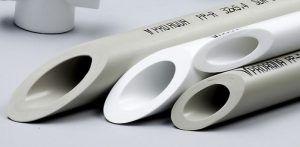
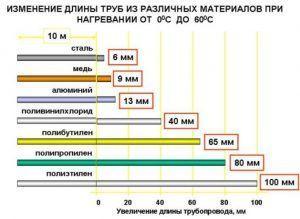
 Polypropylene rolled pipes expand more than their steel counterparts when the medium temperature increases. Moreover, the coefficient of linear expansion of polypropylene pipes is more pronounced along their length.
These properties must be taken into account during installation. Otherwise, deformation and loss of integrity of the pipeline will occur.
IMPORTANT! There are no significant temperature changes in the cold water supply system, so the thermal expansion coefficient of polypropylene pipes is not relevant in this situation. This is important for heating and hot water supply networks, especially for long main lines.
- How does temperature affect these materials?
- Thermal expansion coefficient value
- Linear increase in reinforced products
- Reinforcement with aluminum and fiberglass
- Why you need to know about the coefficient of thermal expansion
- The nuances of laying pipelines
- Some features of choice
- Expansion joints for polypropylene pipes
- Types of compensators
- Coefficient calculations
- Approximate calculation
How does temperature affect these materials?
Despite the fact that PP products can withstand temperatures up to +170 degrees, they soften at +140 degrees.
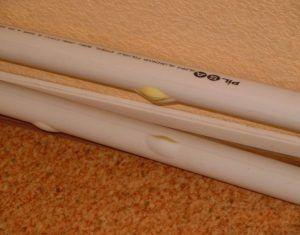
Severe deformation of these rolled pipe products is taken into account during installation.
Installing such pipes into a wall can, over time, compromise its integrity. This doesn't happen with reinforced materials, but they do have another drawback: they can burst.
Thermal expansion coefficient value
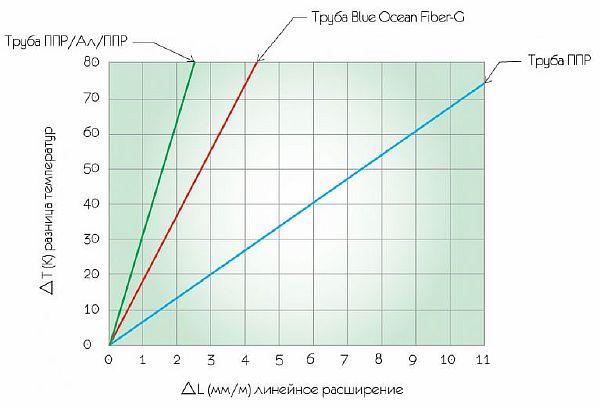
It's important to note that non-reinforced products have a higher coefficient of thermal expansion compared to reinforced types. This should also be taken into account.
If the thermal expansion coefficient of polypropylene pipes is not taken into account, then under the influence of temperature, the fastening clips may be torn out, and sinusoidal deformation will appear on the straight section of the pipeline.
Air accumulates in this area, reducing the flow capacity. This causes the radiator temperature in the heating network to drop, causing connections to break.
Non-reinforced products have a coefficient of thermal expansion of 0.1500 mm/mK, while fiberglass reinforced polypropylene pipes are From 0.03 to 0.05 mm/mK. Clearly, this difference is quite significant, and it's important to keep this in mind when working.
In practice, it was verified that a 5-meter long PP pipe expands from 11 to 17 mm when exposed to heat.
Linear increase in reinforced products
Polypropylene is a material with a relatively high coefficient of thermal expansion. If it is exposed to high pressure and hot water for a long time, it will deform, significantly affecting the appearance of the room.
In order to reduce linear expansion and increase strength, these pipe-rolled materials are reinforced with fiberglass or aluminum.
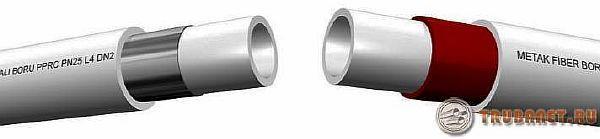
There are several types of reinforcement. Aluminum reinforcement is performed in three different ways: the outer wall of the blank is bonded to a solid aluminum sheet; the internal wall is reinforced with an aluminum sheet; and the final method is reinforcement with perforated aluminum.
Each of these methods involves bonding PP pipes with aluminum foil. However, this method is not always effective because the material delaminates, significantly affecting the quality of the work.
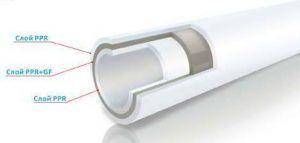
Reinforcing pipes with fiberglass is a more reliable method. The top and inside of the pipe are lined with polypropylene, while the center is filled with fiberglass. This reinforcement is typically done in three layers. This prevents the pipe from deforming.
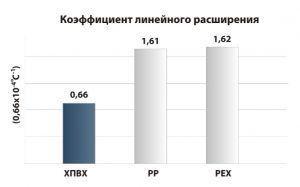
This is what the coefficient indicator looks like before and after reinforcement:
- Unreinforced products – 0.15 mm/mK. This is approximately 10 mm per meter for a temperature increase of 70 degrees.
- Aluminum reinforcement increases this value by 0.03 mm/mK, and the linear increase is approximately 3 mm per meter.
- The coefficient of thermal linear expansion of fiberglass-reinforced polypropylene products is 0.035 mm/mK.
 Reinforced polypropylene rolled pipes are one of the building material options available on the modern market.
These pipes are lighter than their metal counterparts, flexible, and highly resistant to corrosion. They easily withstand exposure to chemicals and are environmentally friendly.
Linear expansion fiberglass-reinforced polypropylene pipes, deserves special attention. The point is that polypropylene is a plastic with a high coefficient of thermal expansion.
Combined with excess pressure and hot liquid, this leads to deformation changes in the material.
To reduce the amount of linear expansion and increase strength, polypropylene rolled pipes are reinforced with aluminum foil or fiberglass.
Reinforcement with aluminum and fiberglass
This is done with solid or perforated foil, thickness 0.01 – 0.005 cmIt is placed on the outer or inner edge between layers of polypropylene. The layers are joined with a special adhesive.
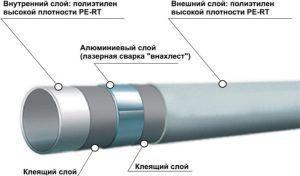
A continuous foil layer prevents oxygen from reaching the heat carrier. Excessive oxygen levels lead to corrosion on heating devices.
The linear expansion of these pipes is 0.03 mm/mK, approximately 0.3 cm per meter.
Glass fiber reinforced PP pipes are a three-layer compositeIn it, a middle layer of fiberglass is welded with polypropylene particles from adjacent layers.
Video
When comparing this type of polypropylene with similar materials, fiberglass has the advantage. Its monolithic nature prevents delamination of polypropylene pipes, which is not the case with aluminum.
Also Products made from fiberglass reinforced polypropylene are distinguished a large indicator elasticity, this makes them very flexible.
The latter characteristic is largely simplifies installation and reduces its time, just like before welding no need to clean the aluminum layer.
Why you need to know about the coefficient of thermal expansion
Linear increase must always be taken into account, otherwise the pipeline network may be destroyed by temperature changes, the transported medium. This is especially important for heating and hot water supply systems.
This applies to a slightly lesser extent to underfloor heating systems. When laying polypropylene pipe, keep this detail in mind. Each meter of the pipe will subsequently experience a linear expansion of almost 1.5 mm.
Fiberglass-reinforced products reduce this figure by almost six times. This is crucial because deformation changes due to thermal expansion will lead to increased noise during fluid passage. This also negatively impacts the stability of the system as a whole.
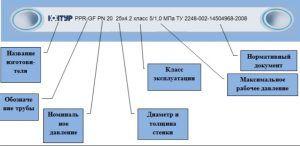
Based on the above, the first rule for installation actions is formulated: “For a pipe rolling system that is subject to high temperatures, it is recommended to select a product range with a minimum thermal change indicator.
The nuances of laying pipelines
Glass fiber has only recently come into use. Glass fiber is characterized by a very low coefficient of linear change, which is 0.009 mm/mK.
It should also be noted that this additive is characterized by excellent strength under various loads.
Watch the video
[sociallocker]
Compared to steel, it's three times larger. This means fiberglass-reinforced tubular products combine elasticity and strength, resulting in a lower coefficient of expansion.
It seems plausible that this additive to polypropylene is simply ideal. However, fiberglass has one significant drawback: brittleness.
This drawback was mitigated by creating three-layer blanks, where the materials are bonded together at the molecular level. This number of layers was chosen for a reason. The logic is as follows:
- Neither the inner nor the outer layers may have fiber additions.
- For the inner layer, this is not permissible for hygiene reasons, so that the fibers do not end up in the supplied water.
The primary goal in mass production of this rolled pipe product was to maintain a stable expansion coefficient. The notion that the linear expansion of this rolled pipe product depends solely on the fiber content is incorrect.
Video
When performing practical calculations for the installation of these pipes and number of compensators for them, it is recommended to take into account the figures – 0.05 mm/mK.
Some features of choice
The widespread popularity of reinforced products has led some manufacturers to use low-quality raw materials to reduce production costs.
Watch the video
[sociallocker]
It's difficult to distinguish such a product by appearance. Fiberglass can come in a variety of shades, so it's not recommended to rely on color alone. Ask the seller for a certificate, and it shouldn't prevent the buyer from inspecting the product in detail.
Only high-quality products are joined into strong joints and are characterized by the required anti-corrosion properties.
When installing a heating main, the modern consumer gives preference to fiber-reinforced polypropyleneThe high technical performance of these types makes it possible to create a network of any complexity.
The most important thing is that the pipes are chosen correctly and are suitable for the given situation. If you have any doubts about this, it's best to seek professional help. Otherwise, the work will yield disastrous results.
The solution to this problem should be approached thoughtfully, and then the designed network will function for a very long period and will not be frustrated by regular breakdowns.
Video
However, to fully utilize their best qualities, it's essential to follow the manufacturers' recommendations. And don't forget to prevent liquid contact with the reinforcing core layer; for this purpose, use a special trimmer during installation.
Expansion joints for polypropylene pipes
A significant drawback of PP products, deformation due to elevated temperatures, leads to elongation and sagging of the components over time. For this reason, flexible expansion joints are used on pipelines exceeding 10 meters in length.
The expansion compensator for polypropylene pipes is a simple connecting piece, which has a flexible shape and resembles a wrapped loop.
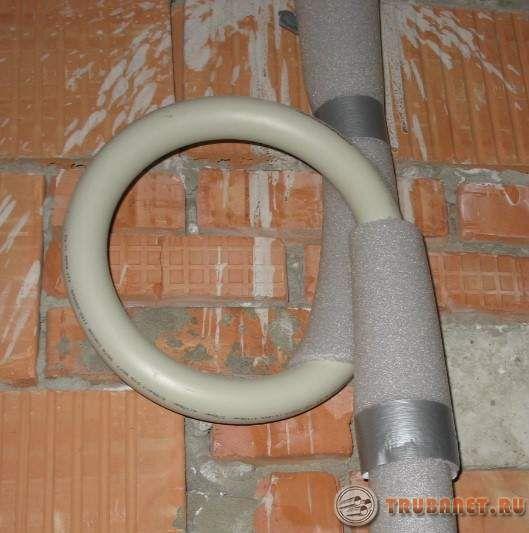
This device plays a very important role. It compensates for thermal expansion during temperature fluctuations within the line. It also acts similarly during pressure increases.
The compensator is inexpensive and easy to install in the pipeline. Its use increases the network's reliability and uptime.
Types of compensators
The following types of devices are available for installation in a water supply network:
- Axial. These expansion joints are equipped with mounting guide assemblies and serve as a fixed support, making them very easy to install.
- Shear. These devices can move in both directions. They are equipped with a single- or double-bellows conduit, made of stainless steel, and are secured together with a fitting.
- Rotary. These devices help eliminate linear expansion at the point where a pipeline turns and secure the angle of the turn. These devices are used where the pipeline's direction needs to be changed to a right angle.
- Universal. These devices are equipped with three types of operating stroke: angular, transverse, and axial. This mechanism is most often used for assembling small pipelines or in conditions where the installation of bellows expansion joints is limited.
- Flanged. These are rubber bellows devices used to dampen shock waves generated by a sudden increase in internal operating pressure. These mechanisms can also be used to compensate for axial imperfections in the pipeline.
These compensators are fastened in two ways: welded or flanged.
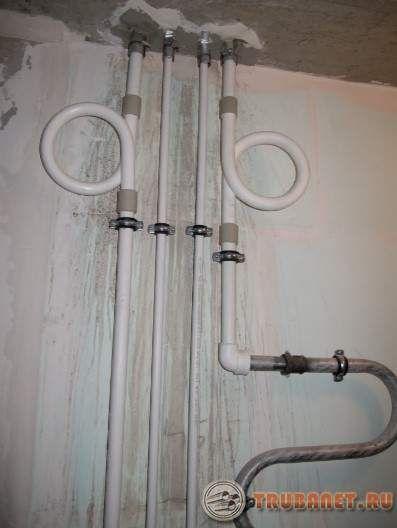
Benefits of using compensators:
- Elimination of vortex flow and equalization of operating pressure in the middle of polypropylene rolled pipe products.
- Ensuring the necessary tightness.
- Extension of the service life of the pipeline.
Coefficient calculations
The expansion of polypropylene heating pipes depends on their type, as described above. To avoid many of the inconveniences associated with this characteristic of PP materials, you can use a formula for calculations.
Video — Kozlov Compensator
[sociallocker]
To determine the possible deformation changes of a pipe in centimeters, it is necessary to know its exact expansion coefficient and the length of the blank used. The operating temperature is then set to room temperature.
First, the difference in temperature readings is found, then it is multiplied by the length of the pipeline, and the resulting value is multiplied by the expansion coefficient.
Approximate calculation
If the calculated linear expansion coefficient is 20 mm, this means that during operation of the heating main, the linear expansion of fiberglass-reinforced polypropylene pipes will be 2 cm. This must be taken into account when installing such a main.
These extra centimeters can be compensated for in the following ways:
- Lay the tiles at right angles. It's recommended to leave some space at the back of one side, as the structure will tilt during deformation, creating sharper angles.
- Several loop-like elements are also added to compensate for the missing space.
- U-shaped pipe installation. This method combines both fixed and sliding supports, thus reducing linear expansion.
Knowing these three methods, you can correctly calculate the space and choose the most optimal method for a given situation.
If you have any doubts about the correct choice, or whether the thermal expansion of polypropylene pipes has been calculated correctly, you can seek help from specialists and receive expert advice.
Video
Before purchasing, it's a good idea to consult with a plumber. They can provide recommendations on product selection and installation. And while in the store, carefully inspect the products for damage and cracks. Pay particular attention to the type of product you choose.
I'm certainly no expert, but everything was explained to me in great detail. I've been interested in this issue for a long time.