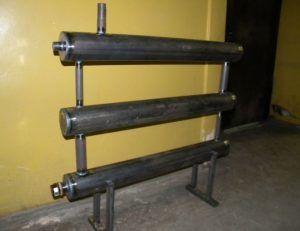
 Heating registers made of steel pipes are a common type of heating device. They are welded or assembled from horizontally positioned pipes. They are connected by crosspieces to allow the passage of the heat transfer fluid.
The number of radiators in use is vast, but registers remain relevant to this day. These devices are manufactured using a variety of materials, each with its own advantages and disadvantages.
For example, copper options are used for copper pipe distribution systems. Copper has high heat transfer rates, four times higher than steel. Therefore, the length and volume of copper pipe materials are more modest than those of steel options for a similar pipeline.
Also, copper products give off a lot of heat if they are not hidden in the wallThey are also flexible, allowing them to be bent without much effort.
The extensive range of advantages in this case offsets the significant drawbacks of copper's high price and instability under operating conditions. Cast iron heating systems are often used.
These devices are bulky. Their heavy weight requires the installation of heavy stands. It's worth noting that cast iron is a brittle material.
Therefore, cast iron heating systems must be installed with protective casings. Moreover, the installation itself is quite a labor-intensive process. As you can see, both options presented are quite complex, so the optimal solution in this situation is steel heating systems. For obvious reasons, they have become the most popular type.
The low heat output of steel heating devices is offset by their low cost, ease of processing, and wide selection available for purchase.
It's very rare to find stainless steel registers, but to achieve decent power output, a lot of material is required, and such stainless steel products are quite expensive.
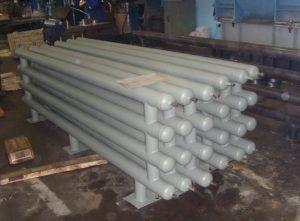
Heating registers are divided into the following types:
- Smooth-pipe structures. These structures, in turn, can have serpentine or register shapes. Their connections can be either "thread" or "column" types.
- Square tube heaters. These options offer higher heat output because they expand the area of contact between the metal and air. While they may not look particularly attractive, these heaters provide excellent heating for a room.
Advantages and disadvantages of steel heating registers
Steel heating has a number of advantages:
- During work, any individual design can be implemented.
- Not only water, but also heated steam can serve as a heat carrier.
- Easy to connect to the system.
- High heat output makes it an excellent choice for installation in a large building.
- Low cost.
- Low heat transfer rates.
- Fear of corrosion.
- Unpresentable appearance.
- Such products require regular painting.
The algorithm used in creation
- First, pipes of the required volume are prepared and cut into blanks of the required length.
- Afterwards, the internal cleaning of the rolled tubular products is performed. This reduces the resistance to the movement of the coolant.
- End caps are welded onto the ends. Some of them are equipped with holes.
- After this, the pipes that will be located horizontally are fastened to the vertical pipes, which have a smaller diameter.
- Now it's time to install the valves. They will be needed to release any air accumulated in the pipeline.
- At the final stage, all seams are cleaned and the surfaces are painted.
Steel registers with ribs
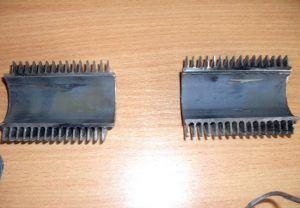 Before installing finned steel pipe registers, it is recommended to pay particular attention to the pipe volume. For a private home, experts recommend installations with a volume of by 3 or 4 centimeters.
Larger diameter pipes can be used, but they should not exceed 8 centimeters. The main reason lies in the heating boiler. A device like the one used in homes cannot generate sufficient heat energy to warm large areas.
When making calculations, it's important to consider the length of one register fin and its heat output per square meter. As an example, a meter-long pipe with an internal cross-section of 60 mm will heat approximately one square meter.
After calculating the required number of registers, rounding is performed upward. However, there are certain conditions under which the resulting figures are increased by 20, or even 50 percent. These include:
- The presence of a large number of openings for windows and doors in the room.
- Small wall thickness.
- Poor quality insulation of the premises, or its complete absence.
A simple heating register has a lower heat output than finned units. Finned units not only increase heat output but also transform the register into a design element—a radiator—that can play a significant role in the aesthetics of an interior.
Combination instruments
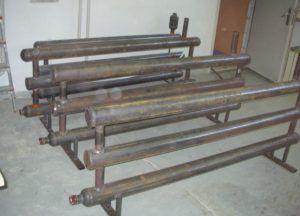 Any device can be equipped with a heating element, creating a combined heating device. It can be independent of the system and used independently.
If the register is insulated and heated solely by the heating element, an expansion tank must be installed in its upper section. Its capacity must be no less than 10% of the heating element's capacity. For steel registers, closed-type tanks should be installed.
Such steel structures are a great help during very cold weather, when the heating capacity of the boiler is insufficient. This option is also very practical during the off-season, when it's not practical to use the heating system at full capacity. After all, the room only needs a slight warming during this time.
Heat dissipation of registers
Heat transfer from steel pipe registers is the transfer of thermal energy between the radiator and the surrounding environment. Heating devices made from smooth pipes are less cost-effective.
The heat output of one meter of these structures is approximately 550 W, for diameters ranging from 3.2 to 21.9 cm. Welding during installation is recommended to be carried out in a manner that prevents mutual heating of the elements.
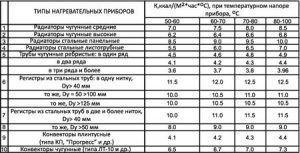
Under these conditions, the heat transfer rate increases. If the register is assembled correctly, it becomes a reliable and durable steel heating device. Optimizing the heat transfer of a steel pipeline is decided at the design stage. The following methods are used for this purpose.
- Changing the infrared radiation in the direction of increase. This can be accomplished using paint.
- Ribs are installed, which also improves the required performance of the structure.
However, there are cases where these figures need to be reduced. Such measures are required for pipeline sections that run outside residential areas. In these situations, thermal insulation of the main line is carried out..
The calculations are performed as follows: Q = K*F*dT. In this formula, Q denotes the heat transfer coefficient, K is the thermal conductivity of steel materials, and F indicates the length of the pipe used for the calculations. dT in this formula is the sum of the initial and residual temperatures, taking into account the room temperature.
If the steel heating pipe is insulated, the resulting figure should be multiplied by the insulation material's efficiency. This indicates the percentage of the heating system's thermal energy released by the coolant flow.
If you want to design a system intelligently, choosing steel tubing by eye is not a good idea. Proper calculations in this case not only reduce construction costs but also ensure a heating system that will operate efficiently for a long time.
Installation of steel registers
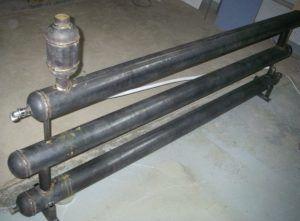 There are two methods for installing steel pipe registers. The first is threaded connections, and the second is welding. The choice of solution is based on the overall weight of the structure, its dimensions, and its characteristics.
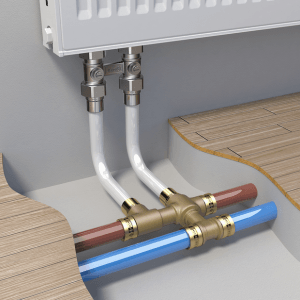
The process itself is similar to connecting radiators. The only difference is the geometric dimensions of the structure. If the heating unit is connected to gravity networks, the required slope standards must be observed.
The register must slope in the direction of the coolant flow. For a natural circulation main, the described standards are not mandatory.
The rules used for the correct connection of steel pipe structures are as follows:
- A minimum distance of 20 cm from windows and walls must be maintained. These clearances are necessary for ease of maintenance.
- When using threaded connections to connect the device, it is recommended to use only gaskets made of paronite or flax, which is used in plumbing work.
- Every steel appliance must be painted after installation. Otherwise, rust can quickly form on its surface. This slightly reduces its thermal conductivity, but extends its service life without maintenance.
- Don't schedule all installation work during the heating season. After a trial run and comparison of the appliance's estimated output, prompt design modifications may be necessary.
A combined method of fastening the structure has become increasingly popular. This involves first preparing the posts and then attaching them to the walls.
This method is suitable even for very heavy heating units and guarantees a high level of safety. Don't forget about air vents, which are included with every heating unit. The air vent releases accumulated air from the line.
Dismantling registers
Both installation and removal of steel pipe registers require specific skills and abilities. Proficiency in welding equipment, metal cutting tools, and machine operation are required.
If you don't have this knowledge, there's no point in acquiring it during the installation of your heating system. The best solution is to seek professional help.
Dismantling and installing damaged heating systems is best done outside the heating season. When performing any work, drain the system and turn off the boiler.
If the heating system is connected by welding, the unit will need to be cut with a grinder. If the connection is threaded, removal can be done with a wrench. In any case, such work should not be attempted without some experience.
Heating registers made from steel pipes have created serious competition for traditional heating radiators. These heating systems offer significant savings.
The main advantage in this situation is the heating appliance's ability to operate even in aggressive environments. However, such steel structures are not very common in private homes, as there are a wide variety of other options.
The price range in this case is also quite broad. Smooth and ribbed pipe options are more often installed in production, utility, and warehouse spaces, garages, greenhouses, and the like—in other words, in places where visual appeal is less important.
Good afternoon. Could you please advise? The Temple has registers welded from steel pipes and painted white. I read an article that said painting them a dark color would change the radiation and improve the efficiency of the heating system. Is this true? What color should I paint them? Do I need to remove the old paint? And is it worth the effort? Best regards.
Hello. This question is covered in detail in this article - Is it possible to paint hot radiators?