A heat pump is a device for transferring thermal energy from a source to a consumer.
Heat is spontaneously transferred from a hot body to a cold one. The pump transfers heat in the opposite direction.
The design consists of a compressor, a thermal expansion valve, an evaporator, and a condenser. A typical example of a heat pump is an air conditioner.
To determine which type of pump to choose for home use, it's recommended to study the features of each model and their operating principles. Each type also has limitations that are important to be aware of.
The operating principle of heat pumps
Heat pumps are just beginning to be widely used in private homes. One of the main advantages of this heating method is is low power consumption, but high heat generationClassification is based on the heat source.
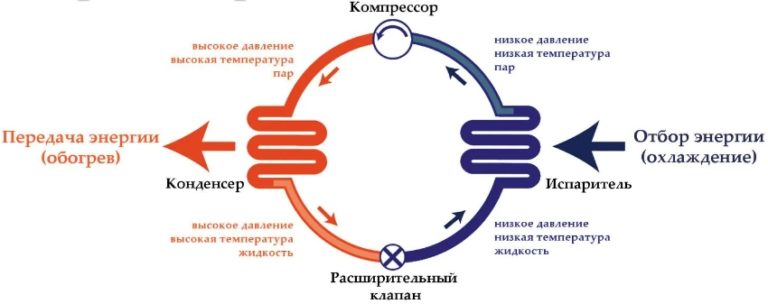
A home heating device operates on the principle that a substance (the refrigerant) can release or absorb heat energy during a change in state. This principle underlies the operation of a refrigerator (which is why the back of the appliance is hot).
The heating heat pump functions as follows:
- The incoming agent is cooled by 5 degrees in the evaporation section based on the energy from the heat carrier.
- The cooled agent enters the compressor, which compresses and heats it as a result of its operation.
- The already hot gas enters the heat exchange compartment, where it gives off its own heat to the heating system.
- The condensed refrigerant returns to the start of the cycle.
There are also some models that can operate in reverse mode. This means they can be used even in the summer to cool the building. The heat is sent to storage and then used for heating during the colder months.
Device
A heat pump for heating a home consists of several basic circuit elements:
- a circuit with a coolant that moves energy from the heat source;
- a circuit with freon, which periodically evaporates, taking thermal energy from the first circuit, and again settles as condensate, transferring heat to the third;
- a circuit in which a liquid circulates, which acts as a heat carrier for heating.
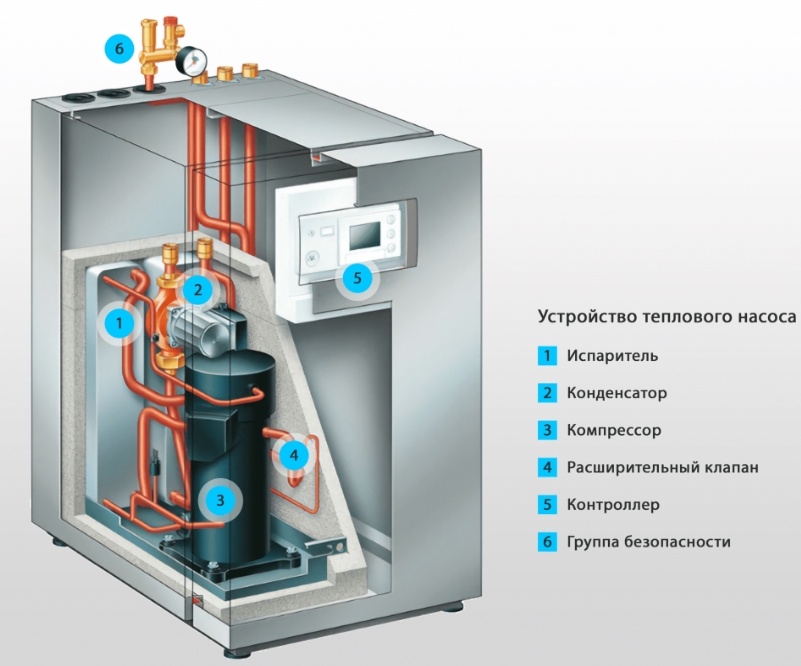
Using a heat pump to heat a home is cost-effective. This is because the device doesn't require much power (and therefore consumes no more electricity than a standard household appliance), yet it produces four times more heat than the electricity consumed.
There is also no need to create a separate wiring line to connect the pump.
Pros and cons
Before deciding whether to use a heat pump or not, you should familiarize yourself with the advantages and disadvantages of its operation. Let's take a closer look at the pros and cons of using a heat pump..
- Low electricity consumption for heating the house;
- There is no need for regular inspection and maintenance, which makes the operating costs of a heat pump for heating minimal;
- Installation is possible in any location. The pump can operate with heat sources such as air, soil, and water. This makes it possible to install it virtually anywhere a house is planned. And in areas far from a gas line, the device is the most suitable heating method. Even without electricity, the compressor can be powered by a gasoline or diesel engine.
- The house is heated automatically. There's no need to add fuel or perform any other maintenance, as is the case with boiler equipment.
- No pollution of the environment with harmful gases and substances. All refrigerants used are completely safe and environmentally friendly;
- Fire safety. Residents will never be at risk of explosion or damage due to overheating of the heat pump;
- Possibility of operation even in cold winter conditions (down to -15 degrees);
- A high-quality home heating heat pump can last up to 50 years. The compressor only needs to be replaced every 20 years.
- If the ambient temperature drops below 15 degrees Celsius, the pump will not operate. In this case, a second heat source will need to be installed. At very low temperatures, a boiler, generator, or electric heater is activated;
- The equipment is expensive. It will cost approximately 350,000-700,000 rubles, plus another 350,000 rubles for the geothermal station and installation. Only air-source heat pumps require no additional installation work;
- It's best to install a heat pump in combination with underfloor heating or fan-assisted convectors. However, in older buildings, this will require remodeling and possibly even major renovations, which will entail additional time and expense. If a private home is being built from scratch, this problem is eliminated.
- When a heat pump operates, the temperature of the soil surrounding the coolant pipeline drops. This kills some microorganisms involved in environmental health. While some environmental damage still occurs, it is significantly less than that caused by gas or oil production.
Use of thermal power plants in the world
The practice of using such heating units in the world has been for more than 50 yearsThe main driving forces behind this phenomenon were the rising cost of traditional energy resources and the widespread support of governments in many countries for the use of alternative energy sources.
Therefore, the number of heat pumps is constantly growing at a high rate – up to 10–30% per year, despite the high installation costs. The number of such devices currently stands at over 270.
Thermal systems are most widely used in the United States and Canada, accounting for up to half of the installations used worldwide.
Despite favorable conditions for the use of heat pumps, Russia lags behind global trends in their use. This is likely due to our belief in our complete availability of natural resources.
However, not all populated areas in the country have gas pipelines. Global experience with heat pumps indicates positive trends in their use.
Heat pump calculation
As we mentioned above, low-potential heat sources for such pumps are most often the following media:
- Air from the outside space with an average temperature of -15 to +25 degrees.
- The air comes from a heated room, its temperature is +15 - +25 degrees.
- Air from the subsoil probe heated to plus 4 - 10 degrees.
- Air from geothermal formations, the temperature of which can be 10 degrees or more.
- Air from bottom probes of non-freezing water bodies with a temperature of 0–10 degrees, including that obtained in probes installed in industrial wastewater channels of enterprises.
Calculation method
Any thermal calculation is a complex process, capable only of being performed by qualified specialists. However, a simplified methodology can be proposed that is sufficient to obtain a result that determines the choice of a particular unit model.
The calculation comes down to performing a number of steps:
- Determining the amount of heat loss through the enclosing elements of a building – walls, ceilings, attics, windows, doors, etc. This can be achieved using the following relationship:
Qок = S x (tвн – t нар) x (1 + ?b) xn : Rт, Where
S – total area of all building enclosure elements, m2;
t вн – outside temperature, degrees C;
t nar – air temperature in the outside space, degrees C;
n is a coefficient that takes into account the building structure; for open buildings it is equal to 1; for buildings with attic spaces it is applied at a value of 0.9; for premises located in the basement it is taken as equal to 0.75;
b – coefficient of additional heat loss, depending on the type of building and its location in the climatic zones of Russia, its value can fluctuate within the range of 0.05 – 0.27;
Rт is the thermal resistance, which must be additionally calculated using the formula:
Rт = 1( , m2xC/W, where
- calculated values of thermal conductivity of enclosing structure materials;
- coefficient of heat dissipation from internal surfaces;
- the same for external surfaces.
After carrying out preliminary calculations, we determine the total heat losses from various factors:
Qт.пот = Qок+Qи-Qбл, Where
Qbl – total heat transfer from the operation of household appliances and human activity;
Qи – energy costs for compensating heat losses due to leaks in the enclosing structures.
- Based on the results obtained, we can calculate the annual electricity demand. To do this, we use the following ratio:
Qyear = 24x0.63 x Qt.pot x ((dx (tin-toutdoor) : (tin-tout)) (kW/hour) per year, Where:
- tvn - the desired temperature value in the interior of the house;
- t nar – actual outdoor temperature;
- tнар.ср – average annual temperature in the region;
- d – duration of the heating period, days.
- To gain a more accurate understanding of a heat pump, you need to calculate the amount of heat output required to heat the water in your home's heating system. This can be done using the following calculation formula:
Qhor.v = V x 17 kW/ per year, Where:
V – volume of daily consumption of water heated to 50O WITH.
As a result, the energy costs for meeting the need for heat and hot water will amount to:
Q = Qyear + Qgv, (kW/hour per year).
It is recommended to increase the obtained result by 10%, taking into account the more intensive operation of the system during peak loads. A preliminary calculation of the heat pump capacity for home heating allows for an accurate selection of the installation.
To perform the calculation, you can use a special calculator, they are available in abundance on the Internet.
Types of heat pumps
There are several types of devices depending on the heat source used. The operating principle of a home heating pump assumes that heat is drawn from sources that are best able to accumulate solar energy throughout the season.
The following types of devices are available for sale:
- ground (earth - water);
- air (air - air);
- air - water;
- water (water - water).
Let's look at them in more detail below.
Air - water
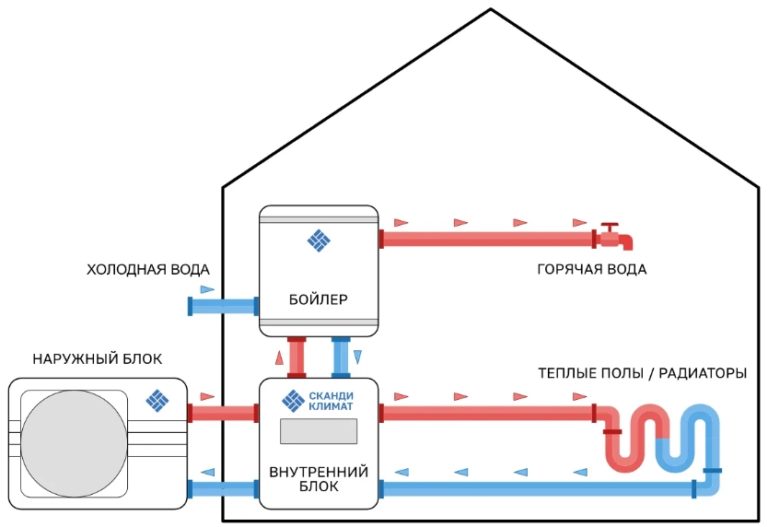
How the pump works AIR-WATER The process involves heating the coolant in a heat pump system with warm air. A fan forces warm air from the surrounding environment into the system.
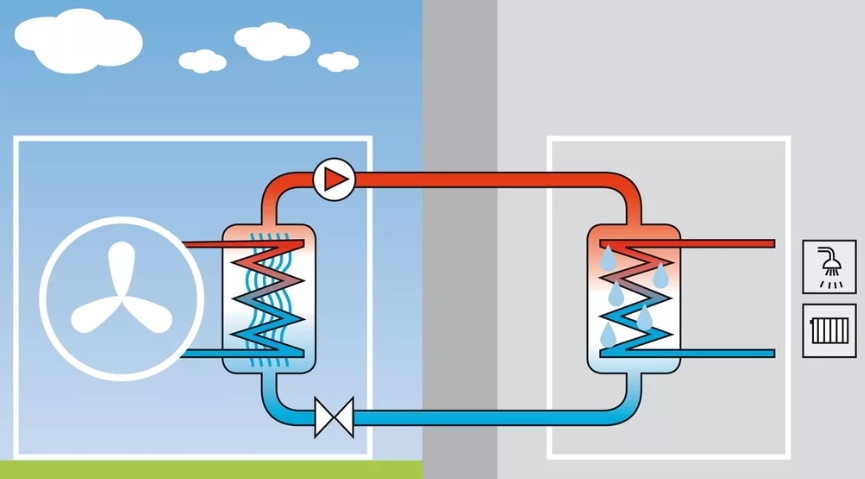
There, it interacts with the refrigerant, which heats up as a result of this interaction, transforming into a gas. The gas then enters the compressor, where it is forced under pressure into the internal condenser, transferring its heat to the water.
Earth - water
Soil is the most stable and therefore popular heat source. At a depth of 4 to 8 meters, the temperature is constant at 5 to 8 degrees above zero, and at a depth of 10 meters, it rises to 10 degrees. There are two main methods of collecting thermal energy:
- using a horizontal collector;
- by means of a vertical geothermal probe.
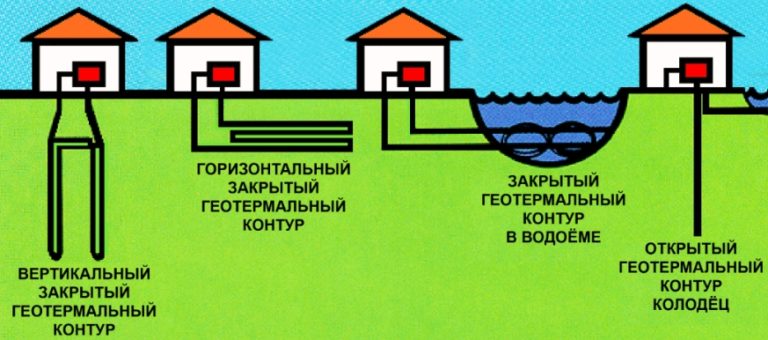
The first type consists of a set of pipes laid horizontally to carry the coolant. The installation depth must be calculated individually for each case, based on the terrain, climate, and other factors.
In some situations, it is advisable to place the pipeline at the depth of soil freezing (1.4 - 1.8 m), 2.5 - 3.5 meters (if it is necessary to reduce the temperature difference and achieve greater constancy) or 1 - 1.3 meters (At this depth, the soil warms up faster in the spring.) Sometimes, a special collector consisting of two layers is even installed.
This type of collector uses pipes with a cross-section of 25, 32, or 40 mm. They can be laid in various patterns: spiral, lightning bolt, serpentine, loop, etc. If a serpentine pattern is used, the pipes should be spaced 0.6 to 1 meter apart (most commonly, 80 centimeters).
To calculate the heat transfer rate of a pipeline, the soil type must be taken into account. For dry sand or clay, the heat transfer rate is 10 and 20 W per linear meter, respectively; for wet clay, the heat transfer rate is 25 W; and for clay with a high moisture content, the heat transfer rate is 35 W.
The disadvantage of this type of collector is the need for a large system. If the area of the house being heated is 100 square meters, and the soil consists of wet clay, then the collector system will require 400 square meters of land, or about 500 square meters.
Considering that buildings and other objects cannot be located on the surface (only a lawn with 1-year-old plants can be placed), not all owners will be able to allocate enough free space.
In this case, a vertical probe is a more suitable solution. It consists of a heat exchanger in which pipes are buried in the ground to a depth of up to 200 m. The number of probes installed depends on the required heating power.
Shallow boreholes should be spaced approximately 5-8 meters apart. Drilling a single pipe 100-200 meters deep is not cost-effective, and permits from the relevant authorities are also required. To avoid this, it is advisable to install multiple pipes.
Thus, the only drawback of vertical structures is the high cost of drilling deep wells.
However, despite this, the probe is a more popular solution, as it provides sufficient efficiency without any requirements for the area of the site or other limiting factors.
Water is water
Another popular heat source for home heating is water. There are three types of such systems, depending on the source of the liquid:
- a collector placed on the bottom of an open body of water (it should not freeze) – seas, rivers, lakes;
- a collector located in the sewer;
- using water from wells or groundwater.
The first option involves placing the antifreeze pipes underwater. To prevent them from rising to the surface, they are secured with additional weights. Due to the elevated temperature of the coolant, this method is considered effective yet cost-effective.
The downside is that such a structure can only be built if the pond is located no further than 50 meters from the property. Otherwise, installation and operation will be uneconomical. However, for coastal residents, a water source heat pump is an optimal home heating solution.
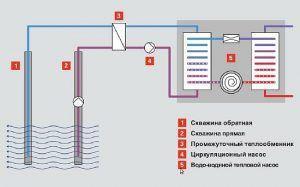
Using treated wastewater and wastewater discharged from process plants, a collector can heat multi-story buildings and industrial facilities and provide hot water. This system is rarely used for heating private homes, as they are often located far from the central sewer system.
A collector that collects water from wells or groundwater is used less frequently than other types. This is largely due to the need to construct two pits. The first collects the liquid, which then transfers its thermal energy to the refrigerant, while the second receives the cooled water.
In some cases, a percolation well is constructed instead of a borehole. The discharge well should be located downstream of the groundwater level and 20 meters away from the original well.
This system is quite difficult to install and maintainRegular monitoring of pump components for corrosion and contamination is essential. It's also important to monitor the quality of the incoming water and filter it promptly.
Air - air
Air-source heat pumps offer a distinct advantage over other types of units. A heat pump uses only air as a heat source, eliminating the need for drilling ground wells or installing water collectors. Consequently, air-source heat pumps are significantly less expensive.
This type has the simplest structure and operating principle. Air enters the evaporator, where it transfers heat to the refrigerant. This heat is then transferred from the evaporator to the heat carrier directly in the house. This type of heating can be represented, for example, by ventilation convectors (fan coils) or an underfloor heating system.
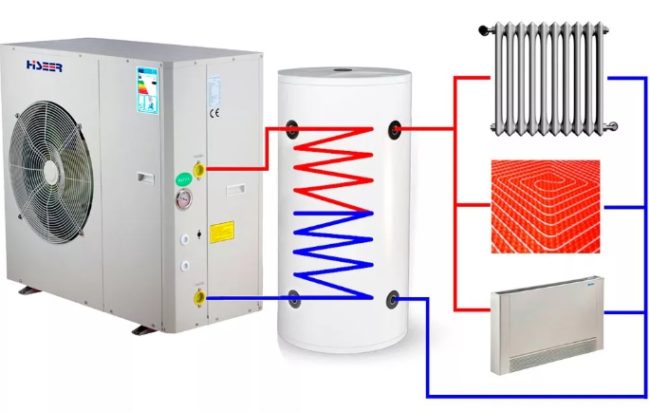
The installation cost of this device is relatively low compared to water or ground-based systems, and its efficiency depends primarily on the air temperature. If you live in an area with warm winters (at least 0°C), this method is considered the most cost-effective.
If the temperature drops below -15 degrees, then the pump will not be able to provide sufficient heating of the room, therefore, it will be more appropriate to use electric or boiler heating of the room.
If it is important to operate an air pump in regions with cold winters, then an additional backup heat source is installed, which will be connected during severe frosts.
It is also possible in some cases to install an air system if the climate is dry and the temperature does not drop below -15 degrees.
In humid and frosty conditions, a layer of ice will form on the device's body, which will interfere with the device's operation and may cause it to quickly fail.
Prices and manufacturers
The approximate average market value of the equipment and its installation is:
Horizontal collector:
- Pump – $4500;
- installation — $2500;
- operating cost - $350 per year.
Geothermal probe:
- Pump – $4500;
- installation — $4,500;
- operating cost - $320 per year.
Air - for home:
- Pump – $6500;
- installation — $400;
- operating cost - $480 per year.
Water-to-water pump for the home:
- Heat pump – $4500;
- installation — $3,500;
- operating cost - $280 per year.
The prices listed are not final. The final cost will depend on the country and manufacturer of the device, the type of terrain, climate, drilling costs, construction conditions, etc.
For example, the price of an air pump from a Russian manufacturer will be about $7,000, while from a foreign one it will be $13,000.
Don't forget about the cost of electricity either. Even though the equipment doesn't consume much power, these expenses should definitely be factored into your overall estimate and budget.
Which pump to choose?
To decide which device to choose, you should consider the following factors:
- Estimated budget – how much money the owner is willing to spend on installing and connecting the complete system;
- what is the existing or planned heating system inside the house - underfloor heating, radiator, etc.;
- How many square meters is the owner willing to allocate on the site for the creation of a collector;
- Is it possible to drill deep?
- the need for a geological survey (if a geothermal probe is planned) to determine how deep the collector should be located;
- Is it necessary to condition the air flow in summer?
- Will air heating devices be installed?
When choosing a heat pump, it's recommended to pay attention to the "heat transformation coefficient" (denoted as ϕ). It determines the efficiency of the device. If ϕ=4 is specified during purchase, then with an electricity consumption of 1 kW, the heat pump will produce 4 kW of thermal energy.
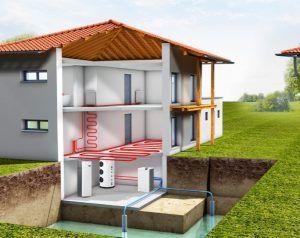
When planning your budget, it's important to consider not only the pump's purchase cost but also future operating costs. These factors often differ.
For example, installing an air-to-water system will have low installation costs, but will require significant operating costs due to its low efficiency. If you need to minimize operating costs, then a vertical ground source heat pump is the way to go.
The cost of a ground- or water-based system and its installation is quite high, requiring a significant initial investment. However, a heat pump used for heating will pay for itself within 5-10 years. Therefore, the decision to purchase this device should be based on financial capabilities and the building's construction conditions (location, climate, etc.).
If, for example, deep drilling is not possible on a site, its area does not allow for the placement of a horizontal collector, and there are no bodies of water nearby, the only solution is to install an air source heat pump to heat the house.
DIY installation
If the homeowner is well versed in the operating principles and circuit design of the equipment, they can assemble the pump themselves. However, preliminary calculations are required; for this, use ready-made software for optimizing cooling systems.
The least complicated installation is a DIY air-to-water heating system. It will consist of two ducts (one for air supply and one for exhaust), a fan, and a compressor.
You don't have to buy a new compressor; you can use a working unit from a refrigerator or other equipment. A scroll compressor is recommended.
Stages of work:
- Make a coil out of copper pipe. Place the pipe carrying the refrigerant on top.
- Mount the coil into a plastic container divided in half. This will act as the evaporator.
- Connect the thermostatic valve and insulate it.
- Assemble all the elements into a block and check its functionality.
It's important to note that this procedure is quite complex for the average person. A non-professional will not be able to properly assemble all the parts and connect the thermostatic valve.
It's best to entrust the work to professionals, as errors in the procedure will cause equipment malfunction or inefficient power consumption.
Thus, a heat pump is an effective way to heat a private home. While this type of equipment is not widely used in Russia and the CIS, it is widely used for heating in Europe and the US.
It is recommended to select the appropriate heat pump based not only on the cost of installation and operation, but also on the region of use, construction conditions, site area, and other factors.
Everything is clearly and thoroughly covered, covering all points. I was especially interested in the information on thermal calculations. Thanks for the material!