A compensator is a part or device (fitting) used to balance or compensate for deviations in dimensions (changes in position, influence of temperature, pressure and other factors) of parts during the assembly and operation of machines, mechanisms, devices, etc.
These days, virtually any utility system is easy to build yourself. All necessary components are assembled very easily (like a construction set). Such components include expansion joints for polypropylene pipes.
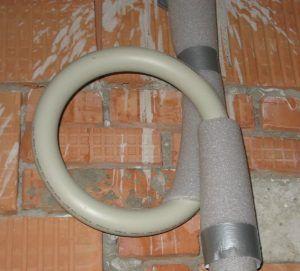 Expansion joints for polypropylene pipes are an integral part of any modern utility system. They're easy to purchase at a specialist store and install on the pipeline yourself. Expansion joints are a simple, flexible structure.
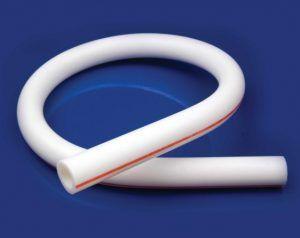
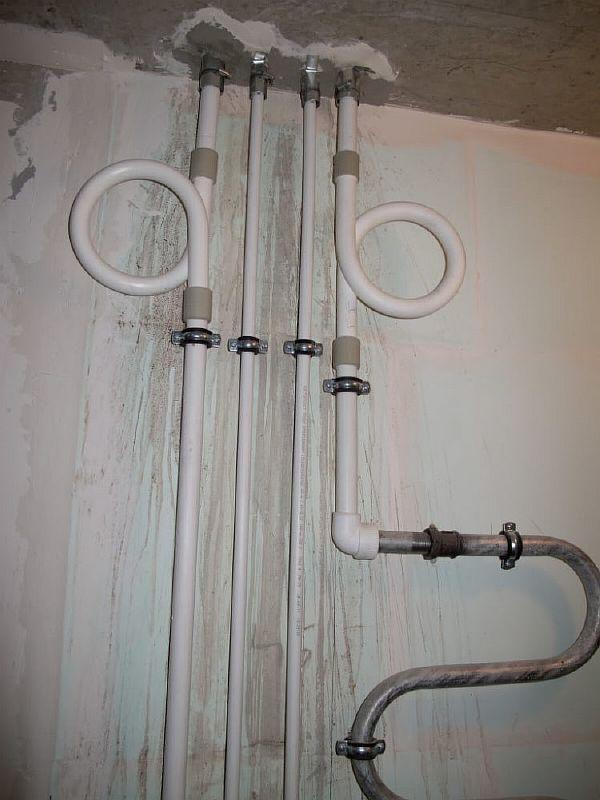
Externally, they resemble a loop. These seemingly simple details serve a very important function. This is what we will discuss further.
- What are compensators?
- How great is the need for these devices?
- How to choose the right device
- Varieties
- Which option is better to install on polypropylene?
- Mounting features
- How the calculation is performed
- How to calculate the right size
- U-shaped elements
- Kozlov mechanism
- Installation on risers
- How are such structures installed?
- Tables used for compensating devices
- Their purpose
- Areas of use
What are compensators?
Polypropylene pipes are most often used for heating and plumbing installations. They have proven themselves to be excellent due to their impressive range of positive characteristics.
But, despite such a number of quality indicators, they have a significant drawback: when exposed to heat, they expand and sag.
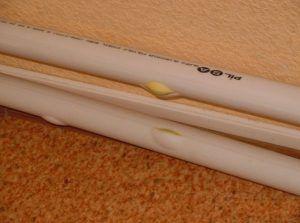
For these reasons, when constructing a network longer than 10 meters, flexible compensators are installed.
These are simple, flexible connecting structures that visually resemble a hinge. However, they play a very important role.
Expansion joints for laying polypropylene heating networks compensate for pipeline expansion during sudden increases in temperature and pressure.
They are typically inexpensive, and their simple design allows for easy installation within the pipeline. This increases network reliability and extends its service life.
How great is the need for these devices?
Consider the question: "Do polypropylene pipes need an expansion joint?" It follows from such an angle that experts recommend placing them without fail.
And they motivate this with the following reasons:
- Normalized working pressure in the line throughout the entire period of use.
- Maintaining straightness throughout the entire length of the network.
- Comfortable design and installation of pipelines.
- Small dimensions.
IMPORTANT! Experts unanimously agree that these adapters are essential. Otherwise, the heating pipe laid using PP blanks will not last long. Thermal deformation will damage it.
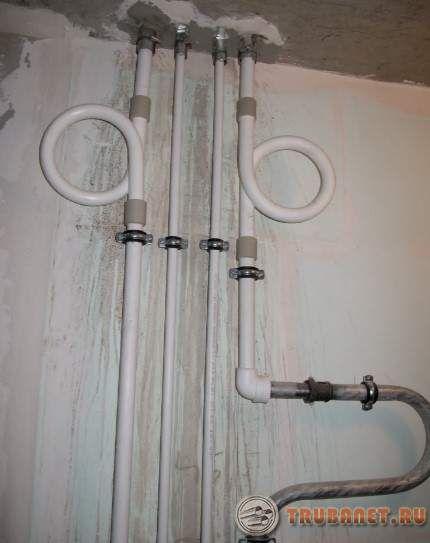
How to choose the right device
To determine which compensating element is best to install on polypropylene, it is necessary to thoroughly understand the design of these devices.
Polypropylene (PP) piping is very commonly installed. It is used to supply hot water, where the temperature rises. almost one hundred degreesPolypropylene has demonstrated a number of properties during use, making it ideal for plumbing and heating systems. It is resistant to aggressive chemical environments, lightweight, and quite durable.
But despite all its advantages, polypropylene also has a significant drawback. As temperature increases, polypropylene's ability to expand significantly. The system then begins to sag.
For this reason, flexible expansion joints are recommended for sections longer than ten meters. They help reduce thermal expansion.
To select and install it correctly, you need to consider its diameter. It must match the diameter of the pipeline itself. Most often, the diameter of an expansion joint ranges from 20 to 40 mm. For a house or apartment, a 20 mm device is sufficient.
When it comes to manufacturers, it's best to choose well-known global brands. They offer high-quality polypropylene netting products that are successfully used in many industries.
Varieties
In practice, the following varieties have proven themselves to be the best:
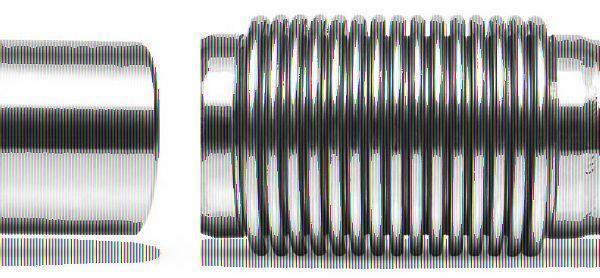
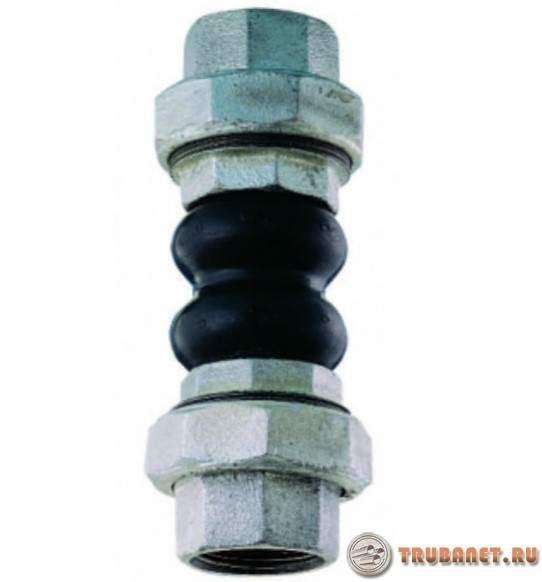
- Bellows Expansion joints for polypropylene (PPR). They are used in the installation of heating and water supply networks made of PPR materials. The nominal diameter of bellows types ranges from 1.5 to 5 cm. The bellows type is connected by a coupling, and the casing is made of aluminum. The inner screen is made of stainless steel. The working medium temperature is up to 115 degrees Celsius, and the pressure is up to 16 bar. The working medium for the bellows type is potable water, air, and steam.
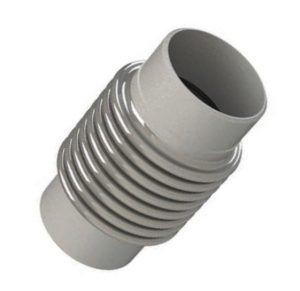
- ShearThey are designed to accommodate movement in both directions. The design features in this situation are one or two bellows-type conduits. They are made of stainless steel and secured with fittings.

- RotaryThey are used to compensate for linear expansion in the area of a pipeline turn and serve to stabilize the turn. They are most often used to change the system's direction by ninety degrees.
- UniversalThey have three operating stroke options. They are installed where a short network needs to be laid, or in areas where space is limited for a bellows-type installation.
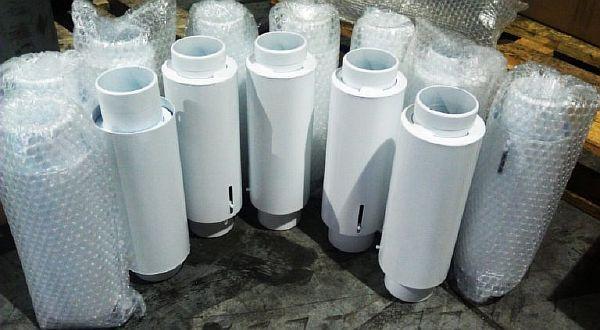
- FlangedThese rubber parts are installed where it is necessary to dampen the shock wave from a sudden increase in average operating pressure. They also smooth out axial imperfections in the pipeline.
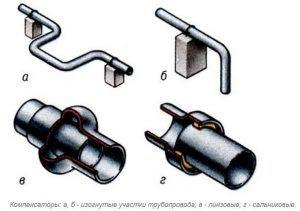
- Loop-shaped device.

- Coils
- Axial bellows mechanisms

- Flanged devices, made of soft material
- Bellows

- Universal, which are effective for displacement in the axial, angular, and lateral directions. They are recommended for installation on a small line with branches.
Manufacturers offer a variety of devices that boast excellent quality. However, a DIY expansion loop in a heating system can also perform its intended functions perfectly.
It's not difficult to build such a device yourself. An expansion joint can be made in a short period of time. This important component, when properly installed, guarantees flawless operation of the heating or hot water supply.
A simple, do-it-yourself installation of a compensating loop will extend the service life of communication networks by up to half a century.
Which option is better to install on polypropylene?
When tested in practice, all of the listed devices produce the expected results. T-shaped devices, bellows-type devices, and others demonstrate high efficiency. This is evident in all water supply and heating systems.
Technical analysis confirms that expansion joints on polypropylene heating risers operate reliably, but they are recommended for use with flexible polypropylene structures.
Before installing an expansion joint on a polypropylene pipe, the following calculations must be made. The load and pressure must be calculated, and the diagrams for each pipe and the heating risers must be compared.
This will help determine where additional components—compensating devices—need to be installed. When calculating expansion joints for a PP main, it's necessary to consider many factors, including the pipe cross-section, internal and external diameters, types of bends, heating risers, and the type of mechanisms being installed or already in place.
Mounting features
The main fastening methods in this case are:
- welded;
- flanged.
In order to properly install a compensation device, it is necessary to know that most types of these devices require rigid fixation using welding.
Before installing an expansion joint for polypropylene heating pipes, it's necessary to check that the diameter of the pipe matches the diameter of the element being installed. This is the only way to create a highly leak-proof heating system.
It's best to leave the installation of a flange joint to a professional. This type of joint requires the installation of a counter flange. This allows for a detachable joint, which is very convenient when repairing heating or water supply pipes.
The bellows mechanism is installed on a short linear section of the main line and works well for rooms where the coolant temperature frequently fluctuates.
Important! Before beginning installation, we recommend inspecting the component being installed for damage. If any is found, do not install the device.
How the calculation is performed
Calculating expansion joints for polypropylene pipes is not difficult, but in such a situation, an understanding of their operating principle and knowledge of their varieties will be required.
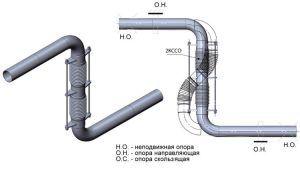
There are specific standards for calculating sliding and fixed fastenings. At least one such mechanism (at a minimum) must be inserted between fixed supports in any section.
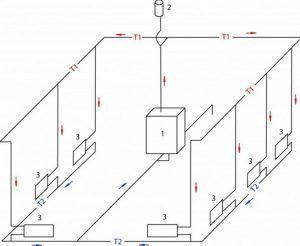
To determine the exact quantity, it is recommended to draw a precise plan of the pipeline and mark all fixed connections. This makes it easy to calculate the required quantity for each section of the pipeline.

The following formula is used for calculations: Q = L/ΔLk. The first indicator is the required number of compensating elements, L is the length of the section, and ΔLk is the magnitude of the compensating capacity, expressed in millimeters.
Detailed information for calculation can be obtained from the manufacturers of the rolled pipe range.
How to calculate the right size
The dimensions of the expansion joint for polypropylene pipes can be calculated using an example. The example uses a 90 mm pipe.
It will expand by 4.2 cm and contract by 2.1 cm. The calculation is made for the largest increase, ΔL/2 = 21 mm.
Draw a horizontal line from the vertical section to the intersection with the 9 cm gradient line of the workpiece. Then, drop a perpendicular from the intersection to the horizontal scale.
The resulting value will indicate the free movement of the knee for the hinge mechanism. Based on this, a compensator 12 cm long and 6 cm wide will allow for free movement with an amplitude of 2.1 cm. Consequently, the product will be able to compress and expand freely.
It is recommended to calculate the distance between expansion joints with a reserve when laying polypropylene pipes.
In this case, it is necessary to calculate that this distance should be selected based on the fact that a reinforced product expands by 1 mm for each linear meter, and not a reinforced one by 3 mm.
The exact elongation values for each product depend on temperature fluctuations, volume, brand, and manufacturer. These values should be verified on the manufacturers' websites.
U-shaped elements
High-parameter steam pipelines are designed in such a way that temperature deformation is leveled out due to the natural configuration of the pipeline.
In places where this cannot be achieved, U-shaped elements are installed. They are three options, which are distinguished from each other by the ratio of the shoulder length and straight inserts.
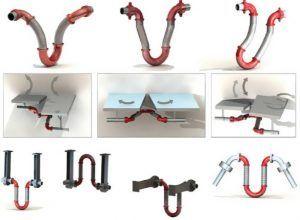
A U-shaped compensator for polypropylene pipes, just like other types of similar pipes, requires calculation of the dimensions required to compensate for thermal changes in the main line.
For precise calculations, you can use the provided online forms. They make all calculations very convenient.
The calculation of the U-shaped compensator for polypropylene pipes is carried out taking into account the following recommendations:
- I recommend taking the highest level of stress in the backrests in the range from 80 to 110 MPa.
- The optimal ratio of the element's extension to the external volume of the workpiece should be H/DN = (10-40). With this calculation, an element extension of 10 DN corresponds to a DN 350 pipeline. A 40 DN extension corresponds to a DN 15 pipeline.
- The optimal ratio of the width of the U-shaped connection to its projection is recommended to be within the range of L/H = (1-1.5).
- If a very large version is required for installation, it can be replaced with two smaller structures.
- When calculating the thermal increase of the main line, the temperature of the heat carrier is taken into account as the highest, and the temperature of the environment as the lowest.
When performing U-shaped calculations, it is necessary to take into account the following parameters:
- The pipe is filled with a liquid or vaporous substance.
- What material is the pipe made of (metal, plastic).
- The highest ambient temperature is no more than 200 degrees Celsius.
- The network pressure must not exceed 16 bar.
- The structure stands on a horizontal highway.
- The joint is symmetrical and its arms are of equal size.
- The fixed supports must be very rigid.
- The highway is not exposed to wind or other load-bearing influences.
- The resistance of the force friction of movable supports during deformation is not taken into account.
- The bends are smooth.
It is recommended to install U-shaped mechanisms in straight, extended areas.
The absence of U-shaped devices on a rigidly reinforced pipeline with different ambient temperatures leads to the occurrence of stresses that lead to deformation and destruction of the pipeline.
Kozlov mechanism
Kozlov compensator for polypropylene pipes is an excellent option for heating and water supply networks.
This mechanism is designed to level out the thermal expansion of reinforced and non-reinforced PP pipe materials in hot water supply and heating systems.
Kozlov's design works exactly like other similar devices. However, it has some design differences.
The Kozlov connection takes up little space and has a presentable appearance. It fits harmoniously into the system.
Some technical characteristics of this mechanism:
- The compression compensation capacity of a polypropylene product is 2 cm for a volume of 2.5 cm and 2.5 cm for a volume of 3.2.
- Working pressure level – 16 atm.
- The highest operating temperature level is 100 degrees.
Installation on risers
Before installing these components on plastic risers and straight sections of the main line, the technical components should be treated with asbestos cloth. This will protect the structure from metal splashes.
Only one technical unit is allowed to be installed between two fixed fastening elements.
When installing this device on a riser or straight section, it's important to check the alignment of the fastened elements. The threaded version of the device on polypropylene systems doesn't guarantee high strength, so welding is recommended.
Also in great demand is a device called the "American"This detachable fitting has a metal thread on one end and a polypropylene base on the other.
How are such structures installed?
- Before welding, the technicians wrap the components in asbestos cloth. This is done to prevent metal spatter.
- Installation is permitted only in the direct zone of the network.
- Only one technical unit is allowed to be present between two fixed fasteners.
- Before carrying out work, it is necessary to check whether the technical parameters of the element match the data of the pipeline network.
- And most importantly: this connection must be inspected for defects and damage before installation. If any defects are found, the product must not be used.
Installation will depend on the type of product you choose. The cutting method for polypropylene products does not provide the required high strength.
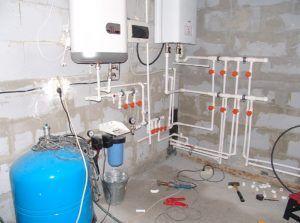
To achieve this strength, welding is used. It is considered the most effective and reliable fastening method. A welding machine is used for this purpose.
IMPORTANT! A very popular installation method is the "American" fitting. This method uses a detachable fitting. It has a metal thread at one end and a PPR base at the other end.
If installation is carried out using a combined method, the joint is made using welding on one side, and a threaded joint on the other.
Installing expansion joints on polypropylene pipes has several unique features. Professional plumbers will recognize several different types of fastening.
- Welded.
- Flanged.
During welding, the structure is firmly secured. The end of the workpiece is welded with a compensator during assembly. To ensure a high level of tightness, the welds must be perfectly aligned during operation.
With a flanged fastener, the part is secured not to the pipe, but to a counter flange. This creates a detachable joint, allowing for easy replacement of the required technical component in the event of a leak.
This type of installation can only be performed by highly qualified specialists, because it is quite complex to perform.
Tables used for compensating devices
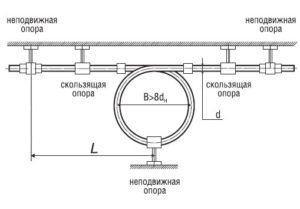
The installation table for compensating mechanisms on polypropylene pipes varies for each type of device. For example, for a loop-shaped device, it's as follows:
And below you can see a table that is used for bellows devices.
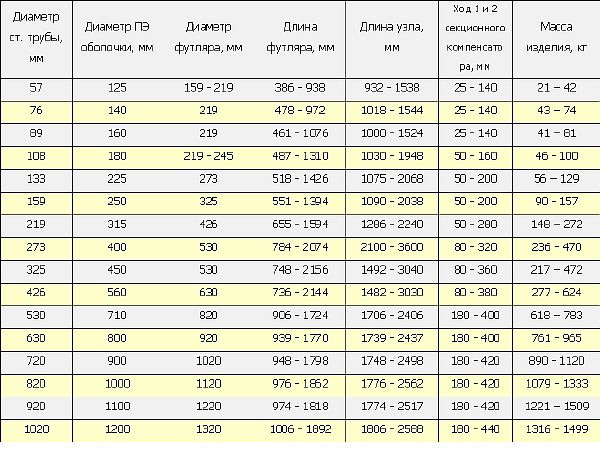
The calculated compensation length is the distance where there are no hangers or supports that would impede compensatory movement. The spacing between supports is determined based on the ambient temperature and the pipe diameter.
If difficulties arise during the calculation, and these are likely to arise with an inexperienced technician, it's best to seek professional assistance. An experienced technician can not only help you choose the right device for your specific situation but can also quickly install it. The money spent on their services will guarantee the reliable operation of your home's heating system.
Their purpose
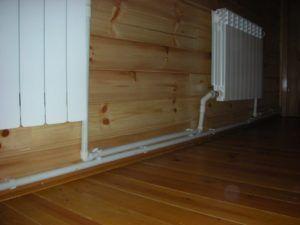 The role of expansion joints in polypropylene heating pipes is crucial. Many people mistakenly believe that this detail is unimportant. However, this is fundamentally incorrect. If the main pipe is constantly contracting or expanding freely, this creates additional stress in its walls.
Consequently, thermal expansion poses a serious threat to the integrity of the entire structure. As a result, the service life of polypropylene (PP) piping is significantly reduced. If no measures are taken to mitigate this linear change, the pipeline will quickly fail. This is something a thrifty homeowner will never allow.
Methods for combating temperature-induced changes include self-compensation and compensation using an elastic element. Additional countermeasures include installing the required number of supports to eliminate sagging.
Polypropylene's flexibility allows for protective compensation. The most effective compensation option is considered to be one in which the lines are bent perpendicular to the route. This leaves a free extension of the compensation line in this direction, preventing additional stress and pressure buildup.
The importance of deformation damping deserves special mention. This method relies on the shock-absorbing properties of the material itself, including all types of polypropylene: PP, PPRC and othersSmoothing out deformations using compensating parts has become widespread due to its low cost.
These components absorb the mechanical load, thereby relieving the pipeline section and fastening devices. Once the influencing factors cease to act, the network returns to its original state due to the elasticity of the compensating mechanism.
To summarize, it can be concluded that each person will have to make their own decision regarding which option to choose: a simple loop-shaped device, a Kozlov device, or a bellows device. But one thing is certain: this device is indispensable.
Any budget-conscious homeowner who cares about the comfort of their home will choose these mechanisms. This simple and inexpensive device will save significant money in the future, which would otherwise be spent on replacing a faulty main line.
Areas of use
Expansion compensators for polypropylene pipes are used not only in water supply systems, but also in heating and sewerage systems.
They are successfully used in any residential building and in industrial buildings.
These mechanisms have gained great popularity due to the fact that they are very simple to design and install.
Installing these connections requires no special equipment or tools. They can be installed not only on horizontal sections of the pipeline, but also on vertical ones.
Expansion joints for polypropylene heating and hot water pipes are mandatory. They are indispensable. They can be installed on any pipeline, extending its lifespan.
These connections are only permitted on level surfaces between pairs of fixed supports. However, it should be noted that there are special components that can mitigate the increase in angle.