Historical reenactments aren't just entertainment, they're a true journey through time. Participants at these festivals often spend several days at the site, living in stylized camps and participating in battles, master classes, and craft fairs. However, behind all this romance lies serious organizational work, and one of its most important elements is providing food. This is where renting a field kitchen—a mobile solution that allows you to prepare food on-site, in conditions reminiscent of the field—becomes especially valuable.
Why is renting a field kitchen convenient?
Most reenactment festivals take place far from cities: on riverbanks, in forests, near old forts or abandoned fortresses. This lends the event the right atmosphere, but also creates challenges. Organizers must find a compromise between stylization and practical needs—after all, the costumes may be from the 15th century, but the participants want to eat hot food three times a day.
Renting a field kitchen from companies like Military Catering solves several problems at once:
- Cooking on site - no need to transport prepared food that spoils quickly;
- The ability to serve many people at once — one field kitchen can feed up to a hundred people at one meal;
- Autonomy — no connection to the power grid, water supply or sewerage system required;
- Preserving the atmosphere — externally, such kitchens do not stand out from the surrounding environment, especially if older wood-burning models are used.
What cuisines are suitable for festivals?
There are various models of field kitchens, varying in capacity, fuel type, and autonomy. The following options are suitable for large-scale reenactment events:
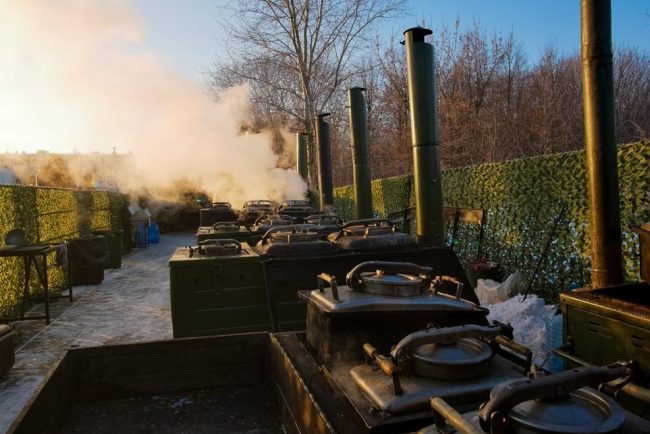
- KP-130 or its analogues — classic army kitchens on a trailer, with multiple pots. Can be used for both first and second courses, as well as for boiling water.
- Field modules based on gas burners — less atmospheric, but convenient and mobile, especially if the event lasts only 1–2 days.
- Kitchens with a serving section — especially relevant if you plan to eat with food ration cards or at certain times.
When choosing equipment, it's important to consider not only the festival's scale but also the catering format. If it's a closed camp with a pass system, a single large kitchen may be sufficient. However, if the camp is divided into several independent stations (for example, Vikings, Rus', Crusaders), it makes more sense to install a kitchen for each block.
Logistics: Delivery, Accommodation, and Maintenance
A field kitchen isn't just equipment, it's a complete process. Even if you rent it turnkey, there are some nuances:
- Delivery to the siteIt's important to check in advance whether the equipment can navigate unpaved roads, especially in rainy weather. Trailer kitchens are often delivered using SUVs.
- Accommodation on the siteIt is important to choose a safe location: away from tents, with smoke venting, and near a water source, if available.
- StaffIt's advisable for the landlord to provide a cook or instruction manual. Otherwise, the organizers should find a responsible person with experience.
- SanitationEven with full immersion in the historical atmosphere, sanitary regulations remain in place. Containers for storing food, water for washing dishes and hands, and disinfectants are needed.
Diet: How to Feed Reenactors Deliciously and Easily
Cooking at reenactment festivals is an art unto itself. Some camps prefer to eat exclusively from historical recipes, while others take a more pragmatic approach. Ideally, the diet should be:
- Nutritious — especially if the participants are actively training, fighting, or carrying heavy objects;
- Diverse — porridge and stewed meat quickly become boring;
- Safe — products must be stored properly, especially in summer;
- Subject to restrictions — in any camp there will be vegetarians or allergy sufferers.
- Here's an example of a simple but atmospheric menu for the day:
- Breakfast: porridge (millet or oatmeal), tea with honey, bread;
- Dinner: cabbage soup or bean soup, stewed meat with cereals, compote;
- Dinner: baked vegetables, stew with meat or mushrooms, porridge, herbal tea.
If possible, you can arrange evening treats around the fire: baked apples, fresh bread, flatbreads on stones.
Maintaining the atmosphere and safety
Even the most thoughtful food can ruin the magic of a reenactment if it's served on plastic plates with disposable utensils. Many organizers solve this problem this way:
- They purchase wooden or clay utensils for the participants;
- They create zones where entry in modern clothing is prohibited;
- They decorate the field kitchen with fabric and awnings so that it is not conspicuous;
- They hold tastings of “food of the era” for festival guests.
Safety remains a priority. A first aid kit, fire extinguishers, and clear instructions on what to do in case of a burn or smoke exposure are essential. The use of gas or open flames is always a matter of particular concern.
Conclusion
Catering at historical reenactment festivals is a delicate balance between atmosphere and reality. On the one hand, we want to recreate the past down to the last detail, while on the other, we want to provide comfort, warmth, and hearty food. Modern solutions, such as renting a field kitchen, make this possible without compromising authenticity. A thoughtful approach to logistics, diet, and the aesthetics of the food makes the event not only spectacular but also truly welcoming.
If you're planning your next festival, consider incorporating a field kitchen into it. It's not just a piece of equipment, but an element of the overall atmosphere that warms and unites.