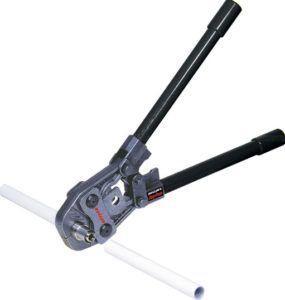
Press pliers are a tool for joining metal-plastic pipes by crimping them. They are used in the construction of heating systems, boiler systems, underfloor heating systems, and more.
The operation is carried out by compressing a metal sleeve located on the pipe in the area where it meets the fitting, which creates a strong and durable connection.
- Types of crimping pliers, their advantages and disadvantages, technical parameters
- Purpose
- How to choose a tool: professional or for home use
- What fitting is used for the connection?
- Preparing metal-plastic pipes for connection
- Pipes and fittings
- Union
- We perform pressure testing
- Safety precautions during installation
- Related videos
Types of crimping pliers, their advantages and disadvantages, technical parameters
Press pliers used for crimping metal-plastic pipes are available for both household and professional use:
- Household tools are designed for home use. They have a simple design and are inexpensive.
Note! In addition to manual press pliers for metal-plastic pipes, a set often includes a crimping head and interchangeable nozzles of different diameters.
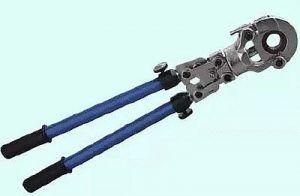
- Professional tools are used by construction companies that undertake large-scale installations of metal-plastic products. They are driven by electric or hydraulic motors. Using these tools increases the speed and volume of work. They are more expensive than household tools, making them uneconomical to purchase for home use.
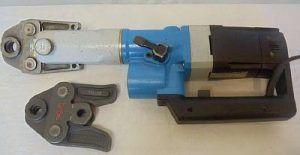
In addition, there are manual, hydraulic and electric types of pressing tongs.
| View | Characteristic | Pros | Cons |
| Manual | The simplest model. It operates using mechanical force. It features two handles connected to the crimping head via a gear. When they are squeezed, the force is transferred to the head, applying pressure to the fitting sleeve. This device allows the handles to be adjusted in length. This model is often equipped with a universal head with a set of liners of various diameters. | Compact, easy to use, lightweight (2.5 g) and low cost. | They can only be used for metal-plastic products with a cross-section of up to 26 mm.
Muscle strength is required. |
| Hydraulic | They have a hydraulic press connected to the head. When operated, the piston enters the cylinder, creating force that is transferred to the head. Recommended for metal-plastic pipes 50-100 mm. | There is no need to use physical force, it is replaced by hydraulic force.
Labor productivity increases. | The cost is high and constant maintenance is required. |
| Electric | Power is supplied by the mains or a battery. There are also universal ones. | A reliable device for joining metal-plastic products measuring 110 mm and above. Electric crimping tongs distribute the load evenly across the entire joint surface, improving quality and ensuring a smooth process. Allows for the installation of large-scale utility lines. | High price and large dimensions, making them suitable only for large areas. |
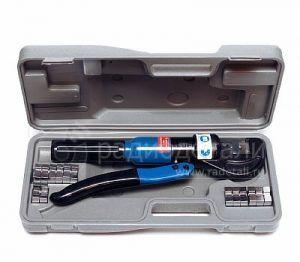
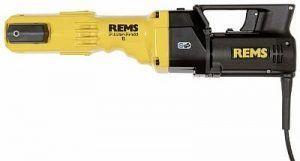
In addition, there are press pliers for crimping metal-plastic pipe materials. in the form of a press pistolIt looks like a drill with a pistol grip. The device is easy to use.
It is used for metal-plastic pipes with diameters from 12 to 108 mm. It is suitable for use in areas with high humidity. Using this tool for crimping metal-plastic pipes and fittings makes the crimping process quick and easy in difficult areas.
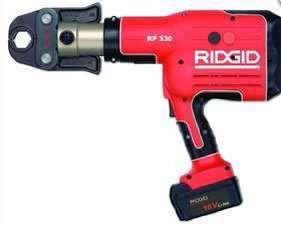
Some crimping tongs are equipped with a crimping control function. This function automatically releases the tool at the end of the operation.
Purpose
Press tongs are recommended for installing metal-plastic structures of any complexity. They have a wide range of applications:
- serial connection of water and heating units;
- a collector-type system, when each node can be connected and disconnected separately, which makes it possible to disconnect even one room;
- installation of "warm floors";
- combined connection method.
Tightness is especially important in the last three options, where the structure is fully embedded in the wall or flooring after installation. Here, the use of press-fitting pliers is indispensable.
How to choose a tool: professional or for home use
Before purchasing crimping pliers for metal-plastic pipes, determine the scope and complexity of the planned repair. Additionally, consider the diameter of the pipe; this information can be found in the tool's specifications.
If the installation of metal-plastic pipe materials with a diameter of 26 or 32 mm is to be carried out, it is better for the tool handles to be extended.
For home use, a household pipe crimping tool is suitable and quite affordable. Hand-held models are ideal for working with indoor systems, which typically have a pipe diameter of no more than 20 mm.
The main types of ticks sold in the Russian Federation are:
- REMS - with inserts from 16, 20, 26;
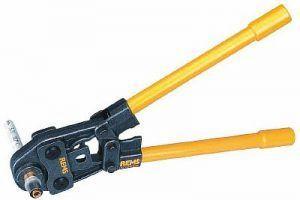
- VALTEC — 16, 20, 26, 32;
- FORApress — 16, 20, 26, 32;
- STC 500 — 16, 20, 26.
Hydraulic or electric press tongs are expensive, and purchasing them for a one-time assembly job at home isn't justified. Professionals who perform large volumes of press tongs are recommended to choose these.
The availability of options such as optimization and control over work is of great importance:
- OPS is a design with stepped clamps, which leads to optimization and increased pressure;
- APS is an improved model, in which the load is evenly distributed on the sleeve;
- APC is a special feature of these pliers; the crimping process will not stop until the crimping is completely completed.
This equipment is manufactured by Belgian and German companies and is expensive. However, according to user reviews, it's possible to buy equally high-quality and affordable equipment from Turkish or Italian manufacturers.
There are general recommendations for anyone planning to purchase an instrument:
- the purchase must be made in a store that specializes in this product or from a dealer;
- For large-scale crimping with fittings, it is recommended to rent the device, so you can understand the feasibility of purchasing it in more detail;
- When choosing a press, it is worth paying attention to European manufacturers.
What fitting is used for the connection?
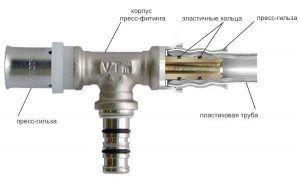
When constructing pipelines, fittings are used as connecting parts. These fasteners include crosses, tees, and plugs. They come in both compression and press types.
Compression fittings are installed using a wrench, but the second type requires press tongs to install.
They are:
- Transitional - installed in areas where polymer and steel pipes are connected.
- Collet chucks are designed for crimping materials in the shape of a cylinder.
- Press fittings are a reliable (withstand high pressure) and practical model; when used, they produce a high-quality construction, recommended for assembling metal-plastic pipes.
Advantages of fittings during crimping:
- possibility of hidden installation;
- the connecting unit does not require constant monitoring and maintenance;
- serve for 50 years or more.
Today, most residential buildings are equipped with plastic pipes, both for water and heating. Their advantages include durability and excellent hygienic and operational characteristics.
And if you use a crimping tool for press fittings on these pipes, you can easily create a layout in the most complex communications.
However, it is worth noting that the prices for these parts are quite expensive, but they will ensure that your system is leak-proof.
Preparing metal-plastic pipes for connection
To carry out this work, it is necessary to prepare a flat and well-lit surface.
In addition to the press tongs, the following is required for assembly:
- metal-plastic scissors;
- nozzles;
- scan.
Before proceeding with the assembly of a structure using pressing tongs, regardless of their type, preparatory measures are required.
Pipes and fittings
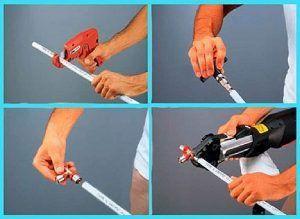
- It is necessary to measure the required size of the tubular product using a tape measure.
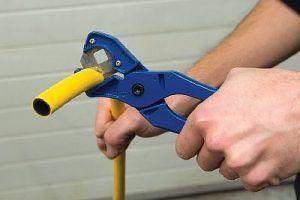
- Using plastic scissors, cut the pipe section along the mark you made. The cut edge should be straight and at a right angle to the main axis.
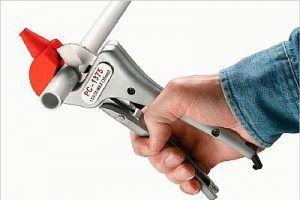
- The guillotine press should be used so that its lower part is positioned parallel to the pipe, and with a little pressure, press the cutting element into the material.
- The cut edges should be calibrated with a calibrator, as the pipe becomes oval after cutting. To do this, insert the tool into the pipe and rotate it, creating a rounded end edge. It's best to chamfer the ends; this will simplify the process later.
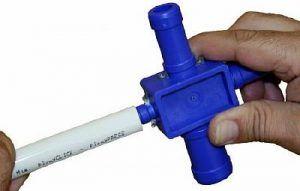
- Place the coupling on the cut end of the pipe.
Union
The fitting is a component used during assembly and is the main component of the connecting unit. Before use, it should be checked for a number of parameters:
- The tubular rings are positioned in specially designed grooves. Otherwise, the sleeve is removed with a screwdriver, the rings are installed in the grooves, and the sleeve is reinstalled.
- Place the nozzle inside the cut.
- Connect the parts end-to-end, and insulate and seal the joint with a dielectric gasket. This will create a tight seal and protect against corrosion.
- You can make sure that the pipe is positioned correctly in the sleeve by looking at the cutout on its extreme side.
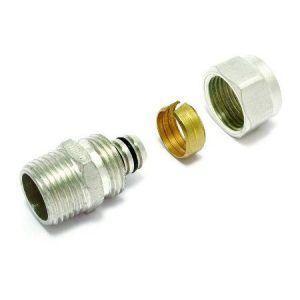 After checking the fitting, you can begin connecting the structure.
We perform pressure testing
Once the preparatory work is complete, you can begin crimping with pliers. Crimping can be done with various types of tools (manual, electric, or hydraulic) using the same technique. It's simple, but requires attention and precision, as the slightest shift must be avoided.
Let's break down the installation step by step:
- Place the pipe, fitting and crimping pliers on the surface, with the handles of the pliers spread apart by 180 degrees to allow the special jaws to bend back.
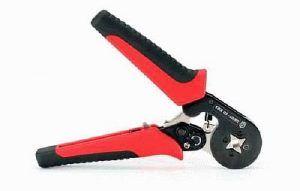
- Remove the top of the clamp from the tool and insert the top of the press insert into it. It should match the pipe size. Place the bottom part into the clamp located below, then snap the device into place.
- Assemble the pipe and fitting into a joint and insert it into the pressing jaws. Carefully inspect the fitting sleeve; it should fit inside the press insert. The flange stop must touch the press insert's recess.
- After this, bring the handles of the pliers together to crimp the pipes. During crimping, there should be a right angle between the crimping jaws and the sleeve. To remove the crimper, simply move the handles apart.
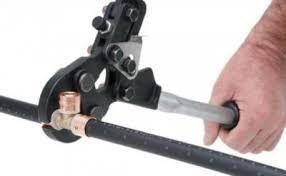
Once completed, two identical curved bends and two clear ring-shaped lines will be visible on the metal. The result is a high-quality fitting.
A poorly made connection will be indicated by a loose or loose nut, as well as a gap of more than 1 mm between it and the pipe.
Manual pliers for metal-plastic pipes are used for crimping operations where the volumes are small and power is unavailable. Cordless tools can also be used.
Please note: The electrical device should be used for 2 minutes of work, followed by an 8-minute rest period.
Using any crimping pliers, crimping pipes is a one-time process, and if assembly is improper, the joint cannot be disassembled. All components must be replaced and the process repeated.
Safety precautions during installation
There is nothing complicated about using this device, the main thing is to strictly follow the instructions below:
- It is prohibited to use pressing pliers in rooms with high humidity, as moisture has a negative effect;
- When carrying out repairs, clothing should be comfortable and hands should be covered with construction gloves made of thick fabric;
- To avoid injury, do not allow clothing to become caught in the device.
Additionally, to ensure long-lasting, high-quality service, the device requires proper maintenance. After use, clean the metal head with a special solution, then lubricate the screw and crimping elements. Store the press in a dry location, and keep it in a case.
Electric and hydraulic tools require careful professional maintenance. Equipment instructions are included in the equipment manual.
By following these simple rules, you can independently perform crimping repairs on metal-plastic pipes using this device without causing harm to yourself or the tool.