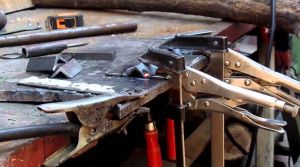
 Experienced welders and DIYers know that the preparatory stage takes no more time than the actual welding process.
A significant amount of time is spent on assembling the welding structure and installing all the elements in the required location.
Knowing the importance of welding equipment for profile pipes and knowing how to use it correctly allows a welder to complete the tasks assigned to him quickly and efficiently.
A wide variety of pipe welding mechanisms and devices are used in everyday life. These auxiliary devices are most often hand-held and versatile.
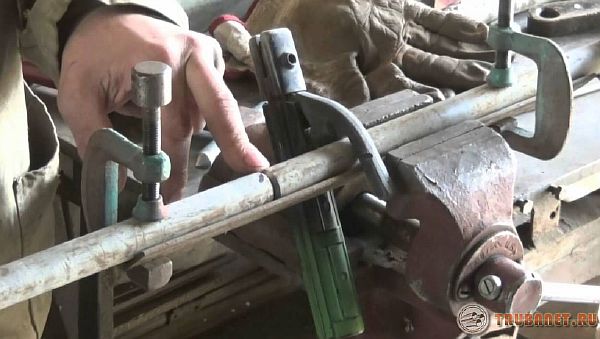
They help to quickly assemble a structure with securely fastened parts, and also allow work to be carried out with virtually no deformation.
Assembly and welding devices for profile pipes and their types
They are divided into the following types:
- Fasteners.
- Installation.
Mechanisms for installation
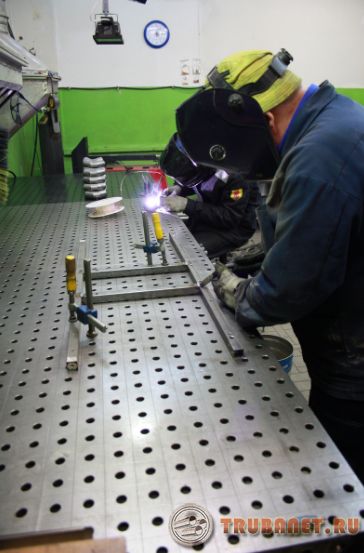 These devices allow you to install profile pipes in the required position.
Exactly how they will be arranged in the end. Based on their functional and structural design, they are divided into:
- Stops.
- Squares.
- Templates.
- Prisms.
PersistentThey secure workpieces to the main surface and can be used permanently, removed, or even retractable (used for retraction and rotation).
Permanent fixtures are plates that are welded to the base.
Removable devices are used in situations where a permanently installed device cannot be used.
CornerThey are used to install profile pipes at a given angle.
PrismsThey secure cylindrical profile blanks in the required position. Very simple constructions welded from angle irons are used as this device.
This mechanism helps to install profile pipes in the required position in relation to the already existing parts of the future structure.
Fasteners
These fixtures for installing profile pipes for welding allow for secure fixation of the part and prevent it from accidentally shifting after cooling. These include:
- Clamps.
- Clamps.
- Clamping.
- Ties.
- Spacers.
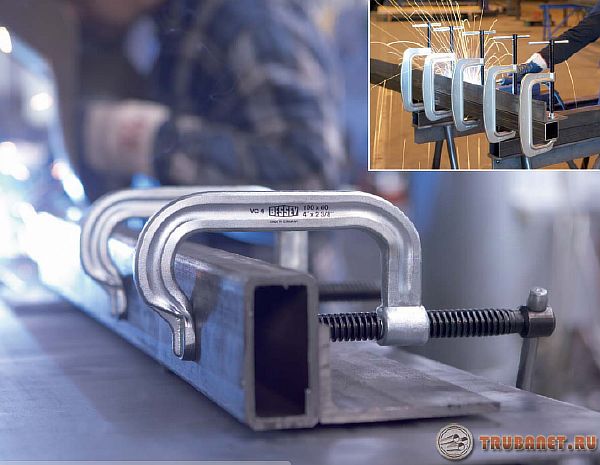
ClampIt is a universal tool that can be used for all types of work with metal products.
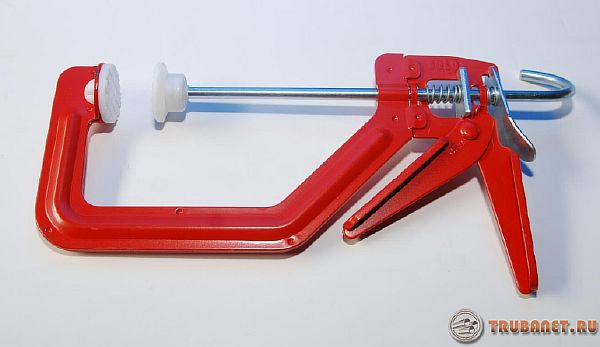
Experts call them the most important and say that it is almost impossible to do without them.
Clamps come in a variety of shapes and sizes. The jaw opening can be fixed or adjustable.
Quick-clamping devices, in which the clamping function is performed by a cam mechanism, are particularly convenient.
ADVICE! Professional welders recommend purchasing a set of various clamps. For welding projects, you may need several different sizes.
Clamps. Compared to clamps, these mechanisms are more convenient and better suited to this type of work. The required jaw size is set using a screw in the clamp handle and by moving a pin.
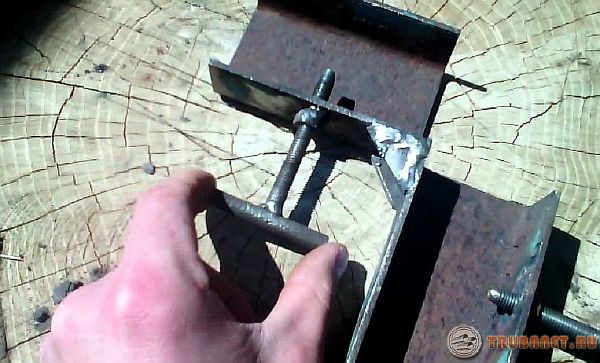
Clamps. This is the most common. They come in the following types: wedge, screw, spring, and lever.
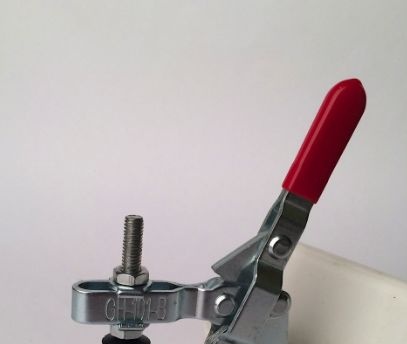
The simplest form of such a device is a simple bolt and nut that holds two plates together to clamp the workpiece.
Ties. They are used to bring elements of similar dimensions closer together. The length and method of construction of such a structure depend on the tasks it must perform.
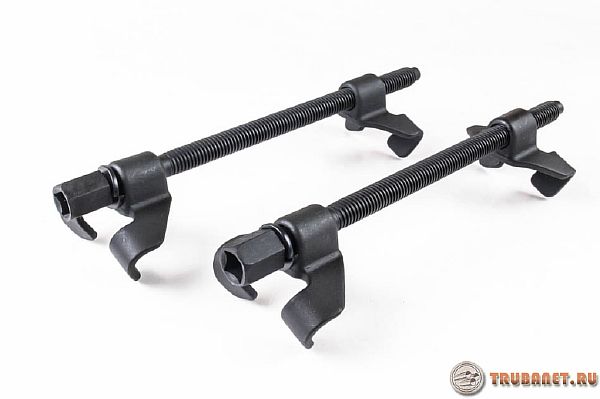
SpacerThis mechanism allows you to align the edges of assembled workpieces, give them the desired shape, and correct minor defects.
Installation and fastening devices
The most user-friendly designs perform multiple functions. Simply insert the parts and tighten the eccentrics and screws. All parts snap into place without any additional effort.
Most of us have to do welding profile pipes very often. Therefore, a large number of different devices have been developed for this process.
Centralizers. They maintain the alignment of the welded parts and align the edges at the ends. They are divided into internal and external.
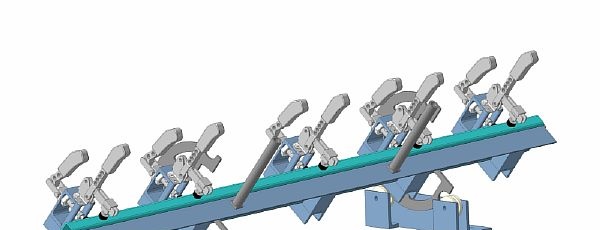
External mechanisms are used much more frequently. This mechanism consists of several links connected by hinges. Together, they form a closed circuit.
In addition, the alignment of the workpieces is well ensured by homemade structures made from a corner and clamps welded to it.
Mechanisms with magnets
Squares on magnets. These welding fixtures are widely used and come in a variety of shapes. They connect sheet metal parts, frame structures, and so on in the desired position.
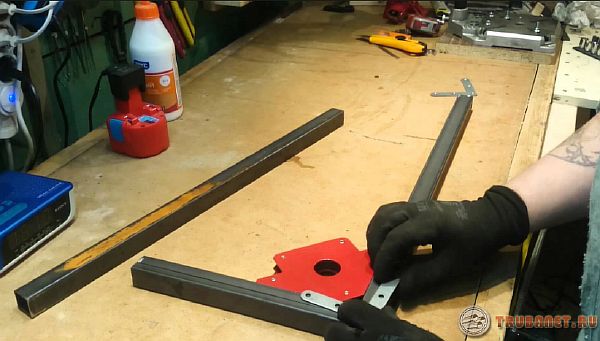
These fixtures are used not only in the form of a square, but also in other types. The magnetic force in them allows for a secure installation of a profile structure in the required position, and the parts remain stationary during the welding process.
DIY welding tools: clamp
Welding fixtures are easy to make yourself. Many craftsmen prefer homemade devices for their work, as store-bought options are not reliable enough.
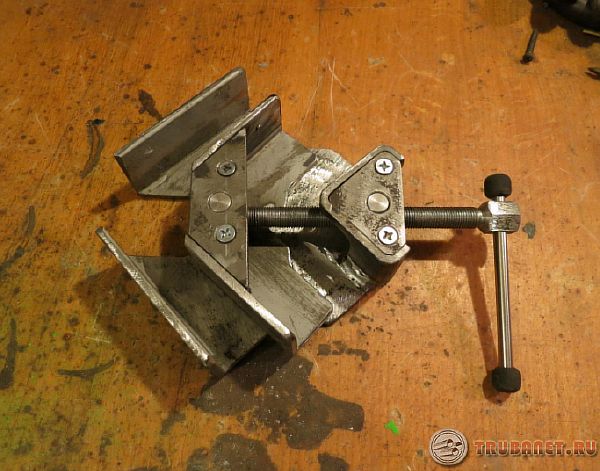
You need to prepare:
- Steel sheet with thickness from 9 to 11 mm.
- Three nuts.
- A washer. It needs to be of a larger diameter.
- A rolled pipe blank with an external thread corresponding to the thread on the nut.
The DIY process
Three strips 4 cm wide, 50 cm, 25 cm, and 10 cm long are cut from a steel sheet. Then two more rectangular plates are prepared to fasten the movable element and to provide support for the static part of the device.
Video: DIY Movie 1
After this, a supporting piece is welded to the base of the clamp. Together, this creates an L-shape. A second rectangular sheet is welded to the smaller side of the structure. The washers are also welded together.
The nuts are placed “on the edge” to the moving part, in such a way that the unscrewed rod is parallel to the base of the clamp.
Video: DIY Movie 2
[sociallocker]
Welding is performed along the outer side of the first rectangular sheet. A sliding device is attached to its inner edges. Finally, washers are welded to the end of the rod, positioned flat.
The resulting structure allows for the support of large-sized structures made from rolled pipe products without causing any shifts.
Video: DIY Movie 3
Homemade magnetic device
You need to prepare:
- A square sheet metal plate with a side size of 25 cm.
- A square pipe.
- Three bolts and three small nuts.
- Steel cylinder with a diameter of 4.5 mm.
- Welding machine, drill, drill.
Two pipes measuring 15 and 20 cm are welded to opposite sides of a metal sheet plate. Then two auxiliary parts are made.
Video: DIY Movie 4
The first is a U-shaped piece (made from 10 cm pieces). The second is an isosceles trapezoid. The base is 11.5 cm and 5.4 cm, and the sides are 10 cm.
When assembling fixtures with permanent magnets, follow the strict sequence of attaching the components. These fixtures perform their intended functions perfectly.
Welding fixtures for profile pipes are indispensable for welding work. They significantly facilitate the entire welding process.