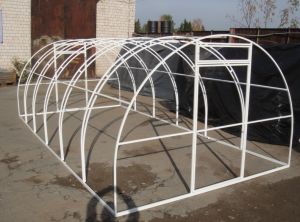
 If you're the proud owner of a summer cottage, it's simply a sin to waste money on store-bought vegetables and herbs. To speed up the harvest time and A home greenhouse will allow you to significantly extend their lifespan.
Building a greenhouse frame from a profile pipe yourself will require a certain amount of time, money, and physical effort, but ultimately, all the effort will pay off handsomely during the operation of this unique structure.
Why a profile pipe?
When choosing a material for construction, a profile pipe will be the most optimal solution.
Naturally, you can also use wooden slats, but you will have to take maximum protective measures for them, since this material is subject to rotting, shrinkage and deformation.
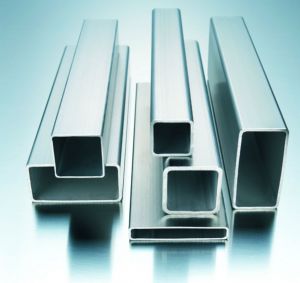 A steel profile pipe is a cost-effective solution because it's easier to attach any covering to it, including polycarbonate. This type of frame allows for easier joining of the covering elements than a round pipe.
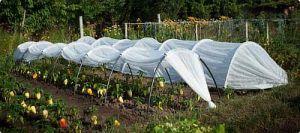
However, if you use polyethylene film for covering, keep in mind that it will have to be changed annually, as it deteriorates under the influence of sunlight, wind and frost.
It is worth considering the fact that protection includes priming and coating with high-quality paint.
But even after treatment, it's important to constantly monitor the frame, react to even the slightest defects, and correct them promptly to maximize the building's lifespan.
Where to start?
Before building the frame yourself, you need to decide on the appearance of your future greenhouse. The most common designs are "arch" or "house."
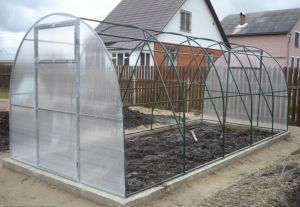
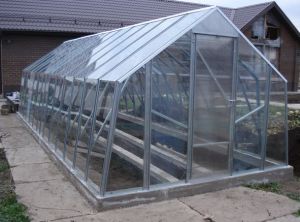
The latter type does not have any particular advantage; it is simply still used most often today out of habit, since previously glass was used to cover a greenhouse, which would have been difficult to cover an arched structure with.
And the innovative and elastic material – polycarbonate – makes it possible to cover any type of greenhouse.
For the main frames of the future greenhouse, it is recommended to use a 4x2 cm pipe. For horizontal connecting elements, a 2x2 cm profile can be used.
If you want to build a high-quality frame for a structure like a greenhouse made from profile tubing yourself, drawings are essential. This will allow you to select the correct dimensions and thereby avoid significant metal loss during cutting.
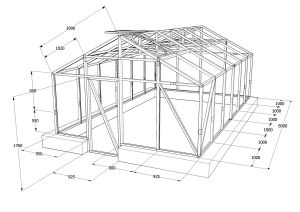
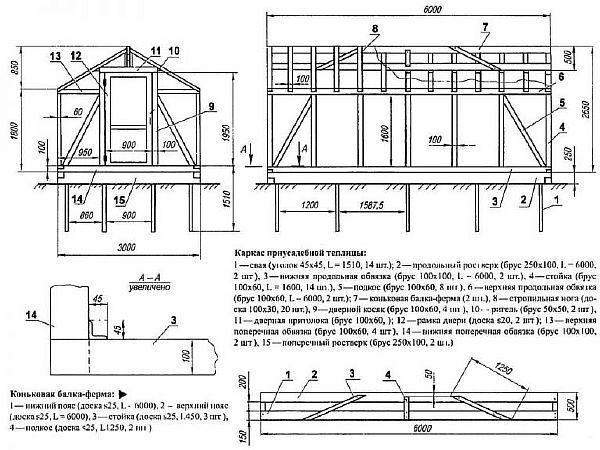
Making a metal profile frame yourself isn't the cheapest option, so it's recommended to calculate the cost so that no more than one standard 6.05m pipe is used to make the frame.
The optimal size for a gable-roofed structure is calculated as follows. If the height is 1.7 m, then two frames will require 3.4 m of pipe, leaving an additional 2.65 m of profile.
Video
Taking into account the roof slope, the width of one frame should be 2.25 m. It is important to ensure that after the frame is covered, there is 10 cm of material left on each side for the side overhangs.
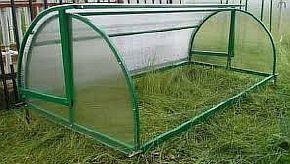
If desired, you can begin building your greenhouse using semicircular frames. This will result in a larger structure than a gable roof, increasing the overall usable interior area.
Video
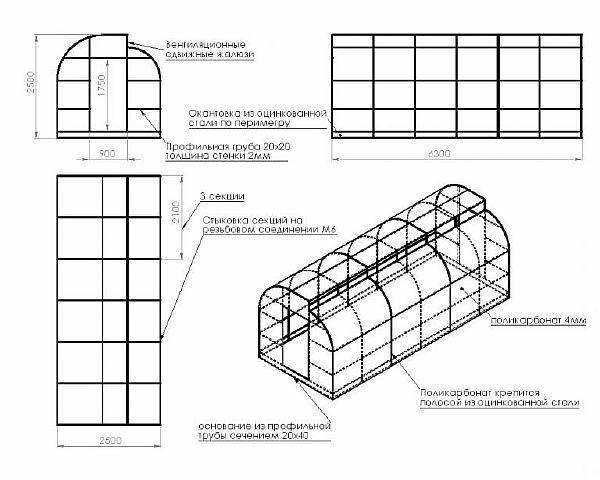
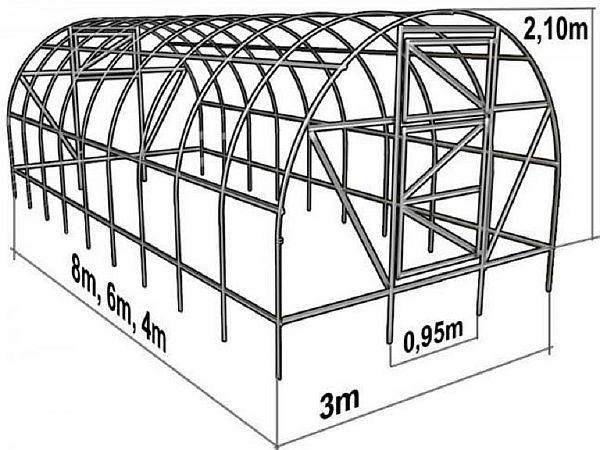
It's worth considering, as the pricing for such a device is very high, and making a pipe bender using improvised means is not within everyone's capabilities.
There are several ways to bend a profile without using special equipment, but these methods will not produce an ideal bend and can lead to deformation of the expensive material.
Video
Therefore, to avoid such difficulties, it is advisable to opt for a gable roof type of home greenhouse.
Selecting and laying the foundation
Here you can choose from several foundation options, from wooden sleepers to a grillage made of screw piles.
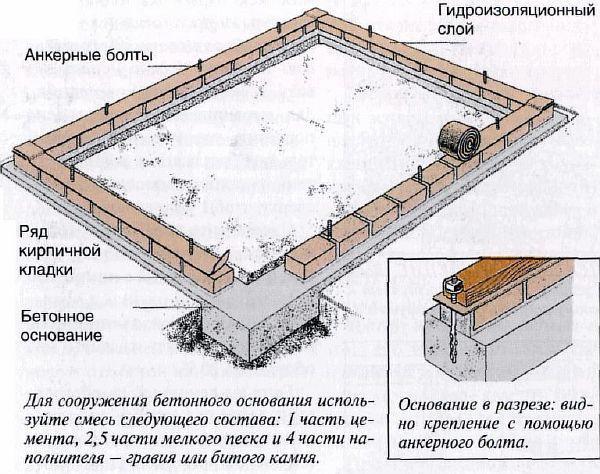
The best option is to choose a shallow monolithic foundation, which is laid with your own hands, not deep enough to cover the depth of one shovel blade.
Before constructing the foundation, anchors are installed on all sides to secure the profile components. Once the concrete mixture has set, 4x2 cm profiles can be welded to the anchors, providing a secure foundation for the future greenhouse frame.
A regular strip foundation can also be used for a building; it will increase the reliability and durability of the structure.
Video: Foundation Installation
Laying a foundation yourself requires a significant amount of physical labor, time, and precision in every step.
Therefore, before starting construction, it is recommended to prepare a drawing of the future structure, indicating all dimensions that should not be deviated from, in order to avoid unpleasant consequences during subsequent operation.
A greenhouse house-like structure doesn't require a pipe bender when building it yourself. To avoid any potential unevenness, it's best to assemble everything on a flat, paved surface.
If such a section exists, it is recommended to outline the outline of the structure being created on it, taking into account all dimensions, and cut the profile according to this template.
Installing the frame yourself
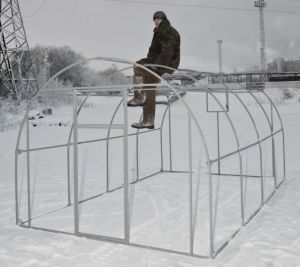 To make installation easier, professionals recommend not cutting the profile pipe into individual elements, but making several cuts in specific locations to easily bend them to the desired angle and create frames of the desired shape without using a welding machine.
The main thing is to correctly calculate the cutting angle so that after bending, the cuts join evenly and only then should they be carefully welded.
The most critical elements of the greenhouse frame are the outer frames, which will accommodate the window and door. It's advisable to weld hinges for these hanging parts during the assembly stage.
To create doors, take a profile measuring 4x2 cm, and to create a window, a pipe with a smaller cross-section of 2x2 cm will be enough.
The 2-meter polycarbonate sheets dictate the dimensions of the future frame, so the distance between the greenhouse arches must be adjusted to this size, so that the joints of the sheets fall precisely on the profile.
Because the chosen pipe section is rigid, the optimal frame spacing is considered to be one meter. This homemade greenhouse involves connecting all the frames together using small pieces of 2x2 cm square profile.
Video
The frame is assembled from the outermost frame, which contains the doorway. To prevent the structure from tilting laterally, it is additionally secured with two angle braces welded to the foundation base.
Horizontal fasteners are installed at an offset from the frame bending points. This ensures the covering is securely and evenly attached to the entire building surface.
Covering a greenhouse with polycarbonate sheets
Once the frame is connected and installed, we begin covering the structure. The polycarbonate is secured to the profile using screws or special fasteners designed specifically for this material.
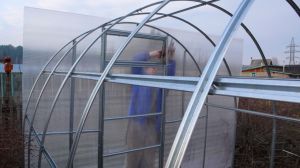
Greenhouses made of polycarbonate and profile pipes should be covered only end to end, and it is important to carefully ensure that the front side of the material faces the outside of the structure.
The ends of polycarbonate sheets must be sealed with a silicone-based sealant to protect them. The seal should extend 10 cm beyond the profile height to create a slope.
At the top joint of the roof of a metal greenhouse made of a profile pipe, they are covered with a profile, which is fastened with self-tapping screws along the longitudinal ties.
Polycarbonate installation on doors and windows follows the same principle; the main thing is to ensure that its size does not interfere with the operation of these elements.
Video
Having delved into the topic and the nuances of the process of constructing structures from profile pipes, it becomes clear that high-quality drawings, the manufacture of each element, and the technology of covering the frame are of equal importance.
When constructing a greenhouse frame from a profile pipe yourself, you need to have a minimum knowledge of architecture and working with metal elements.
One wrong step or miscalculation can ruin all your hard work, but a correct decision will lead to an excellent final result.