Outside the city, a shed is an essential building that's simply indispensable. At the dacha, it can also become an indispensable tool for many. It's easy to build using metal, provided you have at least some welding skills.
The cost of such a structure is much lower than that of brick buildings, but is not inferior to wooden ones, so building a shed from a profile pipe yourself is economically advantageous.
- Building an iron shed with your own hands – technology
- Metal frame and wooden floor
- We are building a shed using metal profiles
- Instructions on how to build a shed yourself
- Building on – the next steps
- What other steps are needed to build a shed from a profile pipe?
- What's in the final stages?
- About some features of construction
Building an iron shed with your own hands – technology
The structure can be either prefabricated or permanent. There's a separate solution for those who choose the permanent option.
Work begins with a concrete floor. It is poured onto the subfloor, which has been prepared in advance. However, a wooden floor covering can also be installed.
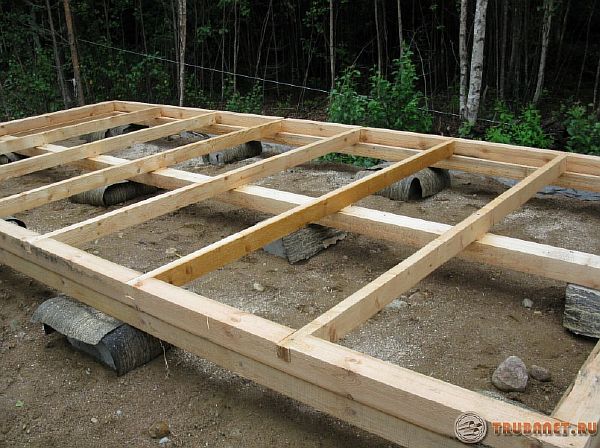
Wooden flooring requires a special approach.
- You need to take a profile pipe with thick walls, with a cross-section of 60 by 40 or 60 by 60 mm.
- You will also need a corner with a wall thickness of up to 4-5 millimeters.
The parts can be either metal or wood. They'll be needed when we begin building the shed frame ourselves from profile pipe.
It's possible to create a floor without joists if the structure is small. The frame consists of 4-6 mm thick angles with sides of at least 10 cm. The boards will then rest on the angle bracket.
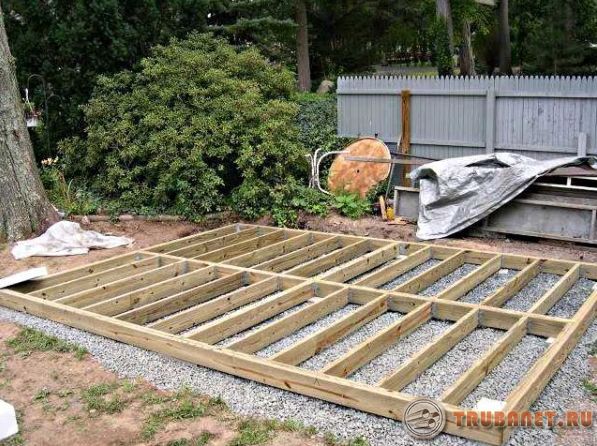
The main thing is that the thickness of the board is at least 4 cmAdditional support is needed if the span is large enough. To do this, simply use a profile pipe with a diameter that matches the specifications.
Metal frame and wooden floor
A prefabricated metal structure, like a knock-down one, is made from wall frames. They are welded separately and bolted together.
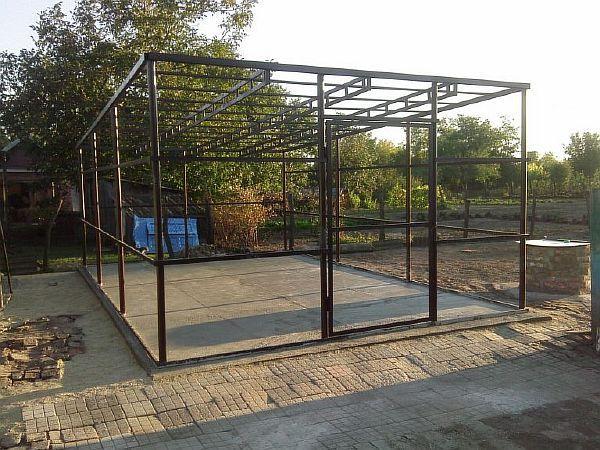
Corrugated sheeting is used for the sheathing. It's quick and easy to install yourself. It's also recommended to use corrugated sheeting for the roof.
Such structures are not only easy to construct but also easy to dismantle if necessary. They are installed for one season at dachas that are not subject to any additional security.
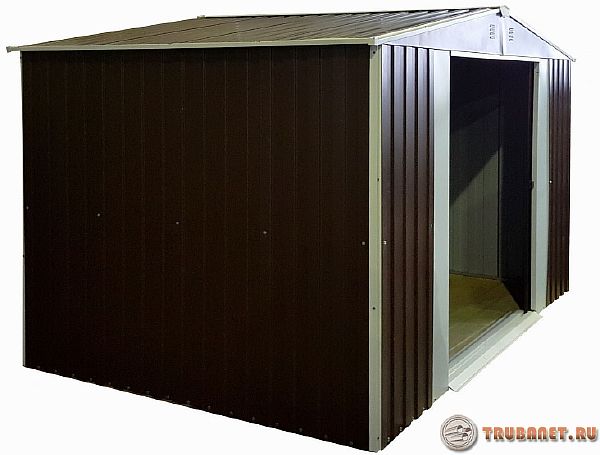
Furthermore, the industry produces prefabricated metal structures that can be assembled on-site, like a construction kit. These are produced by both domestic and international manufacturers, including Chinese ones.
We are building a shed using metal profiles
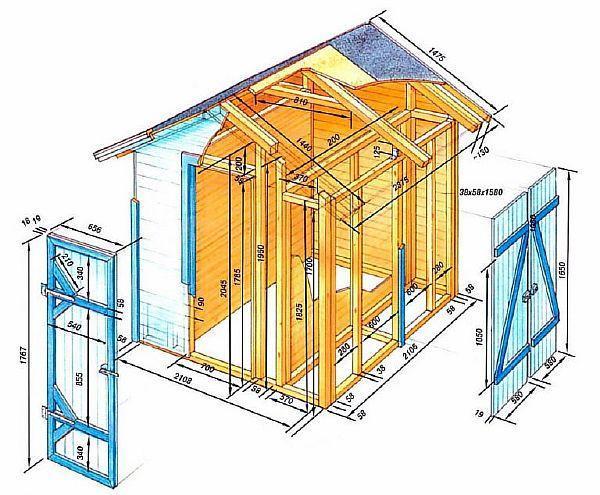
For example, let's build a structure with our own hands, measuring six and a half by four meters. The front wall is 2.5 meters high. The back wall is slightly smaller – 2.15 meters.
It's best to make the floor concrete. This is especially true if you're storing nothing inside except tools. Next, build the shed out of profile pipe.
We use round steel pipe posts with a diameter of 6 cm. These pipes are easy to find in private homes, but other diameters are also available. A rectangular profile pipe is used to create the post with intermediate ties.
Its diameter is 40 by 20 millimeters or 40 by 60. The walls should be of the same thickness, up to 2 millimeters.
The following consumables will be used:
| Name of material | Consumption (meters) |
| Round pipes with a diameter | 32 |
| Large diameter profile | 21 |
| Smallest diameter | 156 |
| Corrugated sheet for profile | 4 sheets of 3.5 meters in length, another 4 sheets of 4 meters each. |
| Galvanized fence profile C8 | For the walls you will need: 4 sheets of 2.15 meters each, 16 sheets of 2.5 meters each |
These materials are needed only to erect the frame. Don't forget about fasteners for concrete pouring and other consumables.
- For the sheathing, you'll need a set of wooden slats. Six pieces are needed, each 6 meters long. The diameter should be between 5 x 2.5 centimeters.
- Welding cannot be done without electrodes and rivets; self-tapping screws will also be needed.
- 1 roll of materials with waterproofing properties is required.
- Gravel in the amount of 7 tons.
- Cement, in 16 bags.
This is part of the answer to the question of how to build a shed from a profile pipe.
Instructions on how to build a shed yourself
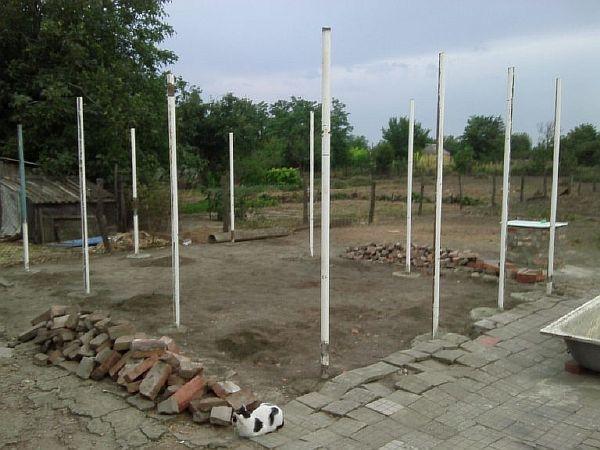
Work begins with marking out the area. Pegs need to be driven into the corners, and then the diagonal alignment needs to be checked. The twine can then be tightened only if everything is even.
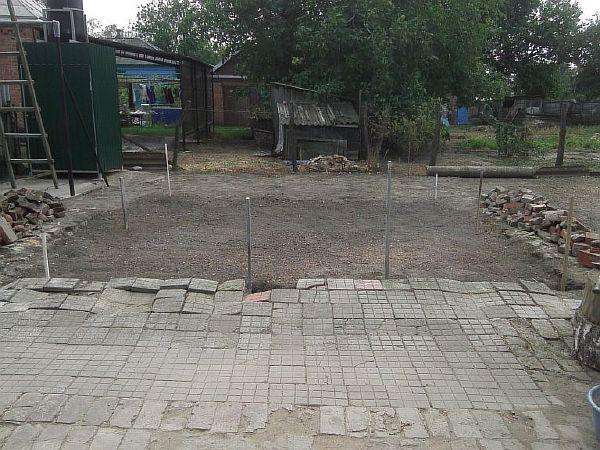
This detail is important for marking the locations where the posts will be installed. Shafts up to 60 centimeters deep are drilled at the locations marked with a drill.
They put metal pipes in them. We take concrete solution grade at least M200, fill everything.
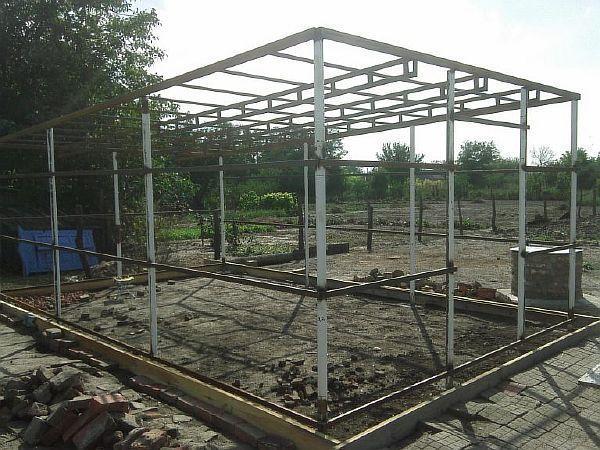
Next, the metal frame is welded. A 60 x 40 mm pipe is welded to the top of the structure. Its wall thickness is 2 mm. The floor level should be marked on the corner pipes.
We use a water level to transfer the marks to other parts of the structure. Based on these marks, we tie the twine. Then, everything is transferred to the other posts.
A 40 x 20 mm pipe is tied around the perimeter, ensuring it matches the markings. The crossbars in the middle are welded in place using the same method. You'll need exactly two pipes. At this point, the metal frame for the shed is complete.
Building on – the next steps
Then, the roof guides are assembled by hand. First, the metal structure is welded on the ground and then attached to the beams, which are positioned opposite each other.
Next, they weld on transversely arranged tubular sections measuring 40 by 20 millimeters in diameter. Ten of these pieces are needed. After this, the metal frame is completely ready.
After this, you will need a primer, it will help the shed not rust.
The concrete floor is prepared separately. It all begins with installing the formwork. It is placed outside the frame, 10 cm away. The boards are secured with pegs and supported with bricks. This will prevent the concrete from pressing on the structure and causing it to move apart.
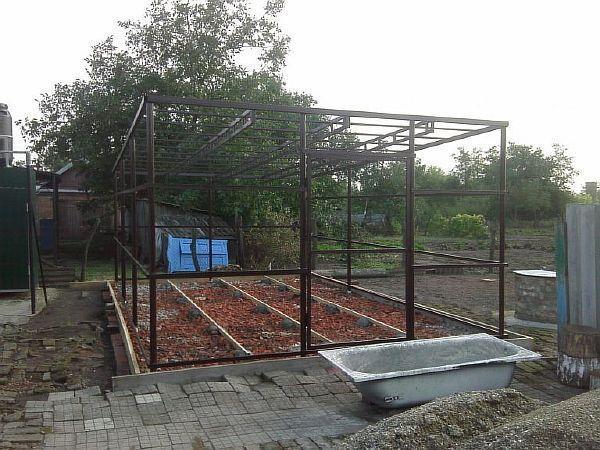
Let's build further – prepare the foundations.
- Broken bricks or crushed stone are driven into the prepared area.
- An ordinary mallet is also suitable for this.
- We place broken bricks on the surface of the soil and drive them into the ground.
- The result is a more rigid foundation. Furthermore, this improves the adhesion between the level ground and the subsoil.
The beacons are placed in the mortar while it's still thick. These are even planks, 25 x 50 mm in diameter, and aligned with a special line.
We mark several points at the ends of the frame at the bottom, located on opposite sides. A string is stretched between them. The beacon panels are aligned along this line after the horizontal alignment is checked.
What other steps are needed to build a shed from a profile pipe?
Wait a bit until the mortar on the surface of the beacons dries. Then, everything is filled with M-250 concrete.
- They're moving on to installing the corrugated sheet sheathing themselves. It's best to start with the main part of the roof. Laying a waterproofing membrane is the first step; this will ensure water doesn't get on your head.
- First, one panel is laid, and then the next one is laid on top of it. The step is 10 cm. Double-sided tape is used for gluing.
- The waterproofing is laid gradually, starting from the bottom and ending at the top.
- The next step is installing the corrugated sheet itself. The key is to position the first sheet correctly, as is true for any sheet material. This will ensure the rest of the work goes smoothly and easily. Squares, rulers, and other tools are used for measurements.
- The sheet is screwed in place with self-tapping screws after it has been installed.
- Roughly the same principle is followed when it comes to side paneling.
It may take up to 20 screws to secure one sheet.
What's in the final stages?
A frame for the door is welded from a 40 x 20 mm profile pipe (Learn how to weld profile pipes correctly – video instructions). Hinges also cannot be attached to the structure without welding. The door can be sheathed separately from the other components and then hung in its finished form.
The shed is lined around the edges with metal angle iron. The sheet itself is riveted in place. This is not only for decorative purposes but also to seal any potential cracks.
The resulting space measures 26 square meters. That's a more than impressive amount of space. As you can see, building it yourself isn't all that difficult.
About some features of construction
Metal profiles are most often used for shed cladding instead of planks. The material is easier to install than its counterparts, more durable, and more affordable.
But sometimes, plank sheathing provides more rigidity. It would be a good idea to reinforce the frame with braces if the metal spans in the sheds are quite large.
To secure the metal profile, you'll need special washers—galvanized ones with additional spacers. However, standard washers can also be used if the above-mentioned parts are unavailable.
When joining metal to metal profiles, use standard self-tapping screws with drill-shaped heads. These drills should be used to drill through both parts.
The key is to use a good screwdriver with sufficient power. Sometimes, a hole is drilled first and then the sheet is secured with a screw.
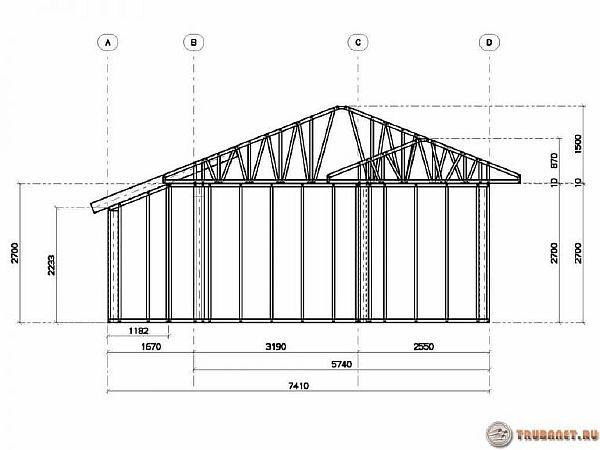
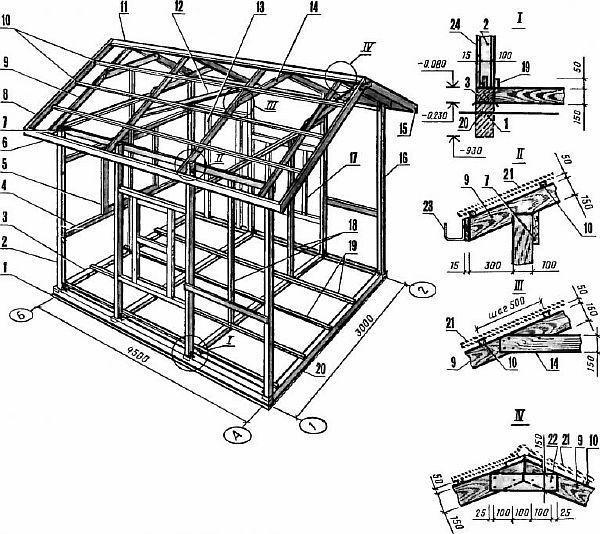
A DIY shed made from profile pipes will be ready quickly. Watch the videos we've provided, and building it yourself won't be difficult. See the plans below.