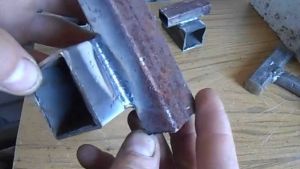
 The welding process itself for rolled profile products takes much less time than the preparatory work required for it.
A significant part of the preparatory process is taken up by the assembly of structures and the preparation of devices that fix the workpieces in the required position.
How to weld a profile pipe – you'll find video tutorials and photo guides in this article.
There are many different devices that are designed for welding activities.In industrial enterprises where serial and mass production takes place, special mechanical and automatic equipment is used.
These are transport devices and mechanisms for installation and tilting. At home, homemade devices are used. Typically, these are versatile structures that can be quickly assembled and securely fastened to the components.
Watch the step-by-step video instructions on how to do it yourself weld a gate from a profile pipe.
Welding a profile pipe yourself is quite a complex process, but the video clearly demonstrates all the intricacies of the process. Even an experienced craftsman will find this task challenging.
Achieving a strong connection that meets the required dimensions is not easy. Achieving a high-quality result requires extensive preparation.
Features of the process
It should be noted right away that profile pipes are very convenient for welding:
- They are made in standard sizes, so they can be easily combined.
- The variety of sections makes it possible to select a part for any structure.
- Uniformity of metal thickness.
- Welding profile pipelines with your own hands produces a straight edge and a smooth surface.
Difficulties that arise
- When heated, the workpieces change configuration.
- When connecting the ends, high stress areas appear in the corners.
- The clearance of the rolled pipe product may be partially blocked by metal that has solidified after heating.
If you carefully study all the complexities of the technology, then you can weld the profile yourself without any difficulty.
Welding technology + video instructions
The quality of the result depends largely on the degree of preparation. This stage includes:
- Selecting parts of the required size and cross-section. Cutting to the required dimensions is done with a metal saw. After welding, the edge is not straight, making it difficult to work with.
- Next, all the pipes need to be aligned. They may warp in curved areas.
- The joints need to be cleaned of any rust. Use a wire brush to polish them until they shine. This can also be done with a sanding machine.
- The edges need to be aligned so that there are no large gaps when joining. If this is done carefully, welding will require little effort.
- After this, the parts should be laid out in the position they will occupy in the finished structure. For welding, it is advisable to additionally secure the assembled parts in a special fixture. The fasteners can be removed after the weld has cooled.
Once all the details are prepared, you can get down to business. Two methods are used here:
- Gas welding.
- Electric welding.
How to choose electrodes
The table below will help you select electrodes for welding profile tubes:
| Wall thickness of rolled tubular products (mm) | Electrode diameters (mm) | Current setting on the device (A) |
| 2 | 1.5 | up to 50 |
| 2 or 3 | 2 | from 40 to 80 |
| 2 or 3 | 2.5 | from 60 to 100 |
| 3 or 4 | 3 | from 80 to 100 |
| From 4 to 6 | 4 | from 120 to 200 |
| From 6 to 8 | 5 | from 175 to 250 |
| From 10 to 24 | 5 or 6 | From 220 to 300 |
| From 24 to 50 | 8 | from 300 to 400 |
Please note that these values are advisory!
Before starting work, it's a good idea to conduct a test weld on a separate section of the pipe to check the quality of the weld. This will help you decide which electrodes are suitable for welding.
How connections are made
- The part is fixed manually on an auxiliary device.
- First, spot welding is performed, and the pipes are tacked together. Typically, this is done in a maximum of four spots.
- After tack welding, the position of the parts is checked. If necessary, the position is adjusted with hammer blows.
- After this, the joints of the parts being joined are welded. A bead of heated metal is formed into a weld seam.
- The arc is carried out in such a way that the edge has time to melt, and the metal should not sag.
Watch the video tutorials to get a visual idea of the process.
Inverter
Welding profile pipelines with an inverter is recognized as the most reliable method. Welding inverters are the most advanced power source for the welding arc.
The advantages of these devices are their small dimensions and light weight, which is significantly less than that of previously manufactured devices.
This technology for welding profile pipelines allows for faster work processes and improved quality of finished structures.
Gas welding
Connecting profile pipes yourself using gas welding is very different from electric welding. The preparatory work is similar. Only all surfaces to be joined are coated with flux powder. Then, the filler wire is prepared.
Connection. It is performed in two ways:
- Thin-walled products are connected from right to left.
- If the walls are thicker than 5 mm – from left to right.
During work, the position of the parts must be constantly monitored. Once the pipes have cooled, the weld is cleaned with an abrasive and an anti-corrosion coating is applied.
Connecting pipes without welding
Small-sized frame structures are assembled without welding. In this case, the profile pipe is joined without welding using a special fixture.
Crab systems
These devices are a special crab-shaped clamp that is placed in a specific location and connects a specific section of the profile. These devices consist of two parts, which are connected with nuts and bolts.
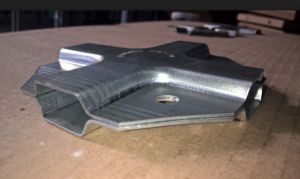 When assembled, this device forms a rectangular or square shape, its dimensions allowing it to tightly grip the rolled pipe product from all sides.
The most popular clamps are 95x95 mm. They allow for reliable connections and guarantee high-quality, durable fastening of structures.
These devices are made from galvanized or powder-coated metal.
Benefits of using a crab system
They allow the structure to be assembled or disassembled quickly. All pipelines with such connections are detachable.
Crab-type joints for fastening profile pipes without welding are very popular. These connections allow for quick relocation of structures and the possibility of constructing new structures.
In terms of strength, these crab clamps are not inferior to the welded version of the joint, but after welding, the fastening cannot be disassembled.
Another advantage of these fasteners is that the building can be erected with little financial investment.
As a disadvantage, one can highlight the fact that it can only be used to fasten small-sized pipes.
Clamps
Used for a profile for a fence structure. The device is rectangular and consists of two parts. One is screwed into the wall and the pipe is inserted into it. The second part secures the pipe (with a clamp and bolts).
Fitting
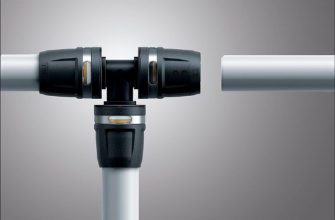
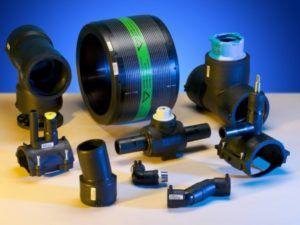
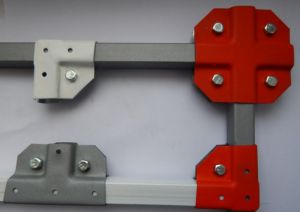 Another way to connect profile pipes without welding, are fittings. They are used in situations where branches and bends need to be made. They serve as fixed fasteners for joints and ends. These fasteners can be of the following types:
- Tees and crosses. They are used for branching and connecting items of different and similar sizes.
- Elbows. They are used when it is necessary to change the direction of a pipeline.
- Couplings. They are installed at the joint.
Now you know how to weld a profile pipe, and the video tutorials will help give you a visual representation. We've also covered the various joining methods available. Using this information, you'll complete the job quickly and easily.