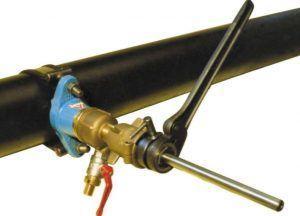
 To learn how to join metal pipes without welding, you need to thoroughly study the joining methods for these pipe materials. The point is that pipelines are complex structures consisting of a series of pipe products, measuring equipment, valves and other parts, which are provided for in the project.
Splicing can be accomplished using various methods. The optimal solution is determined by the intended purpose of the pipeline and its operating conditions. The diameter of the rolled pipe is also taken into account.
When laying a pipeline, connection methods can vary. Some may be permanent, but dismantling and subsequent reassembly of the structure is still possible.
There are also monolithic joints that cannot be disassembled without destroying the structure. Welding has become the most popular monolithic joint. However, it is far from the only method for joining pipeline sections; there are others.
Despite the widespread popularity of plastic, steel products are still used. Welded fastenings are very common, but performing such a joint is impossible without specialized knowledge and skills. Therefore, many try to use alternative methods for joining.
Installation using a threaded connection
We will discuss further how to connect iron pipes without welding, and in this article you can find out How to properly weld galvanized tubular productsTo make a docking, this method is very common.
Threaded connections can be installed in pipeline locations where conditions allow for continuous monitoring of the joint. Repairs should also be possible if necessary.
Most often, threads are rolled using special equipment, but this work can be done independently.
It is performed in the following sequence:
- A piece of the workpiece is cut off, which provides the required allowance for the threaded part.
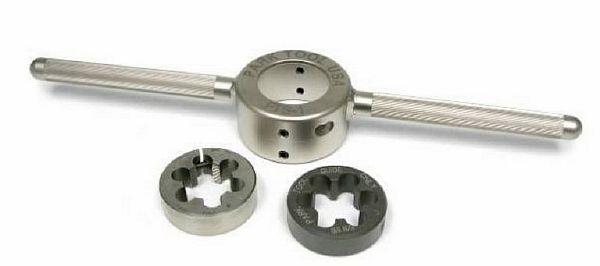
 The pipe is secured to a die holder. A piece of metal blank is clamped in a vice so that it does not rotate.
- The die must be carefully threaded onto the end of the metal pipe. It's important not to allow even the slightest distortion, otherwise the thread will be crooked and the sections will not be connected.
- For ease of use, it is recommended to lubricate the workpiece with machine oil.
- When the die stops turning, it's recommended to perform one turn in the opposite direction. This will remove the cut chips, which are what's blocking the forward movement.
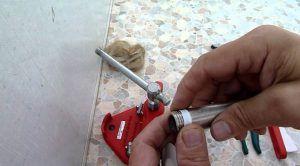
- When cutting a thread close to a wall, it's not always possible to complete a full turn. In such situations, a ratcheting die holder is recommended.
- To ensure a secure threaded connection, a seal must be used. Plumbing tape is used for this purpose.
- Before tightening a threaded joint, it's important to check the parts for burrs and debris. The tightening itself should be done with the appropriate amount of force.
How to connect without threads and welding
Next, you'll learn how to join metal pipes without welding or threading. When discussing joining metal pipes, this method is essential, as it's very popular in installation work.
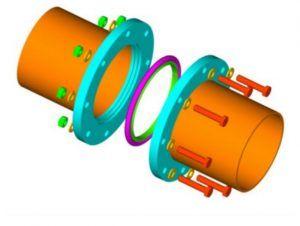
We will talk about flange connectionsTo accomplish this, special fittings called flanges are used. These parts are equipped with a rubber gasket. The joint itself is made in the following sequence:
- A cut is made in the fastening area. It is made strictly perpendicular and there should be no burrs. A chamfer is not required here.
- A flange is placed on the prepared cut.
- After this, a rubber gasket is inserted, which should extend 10 cm beyond the edges of the cut.
- A flange is placed on the gasket. It is then secured to the mating flange on the second metal pipe.
- When tightening the flanges, do not overtighten the bolts.
The next connection option is the socket connection. This method allows for a reliable, highly hermetic joint.
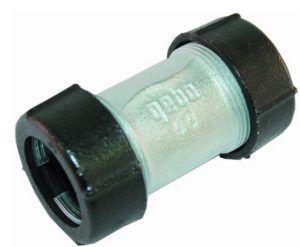
Installation works are carried out in the following sequence:
- The metal pipes prepared for fastening are cut at the ends. The cut should be made perpendicularly and ensure that it is straight.
- A coupling is applied to the connection area. The center of the coupling must be positioned exactly along the pipe joint.
- Markings are made on the pipes using a marker; these will indicate the position of the fitting.
- The end parts of the connection are coated with silicone grease.
- One pipe is inserted into the fitting according to the mark. Then, the second pipe is aligned with the first, and only then is it secured to the coupling. The mark made with a marker will serve as a guide when installing.
Watch the video
Metal gas line connection
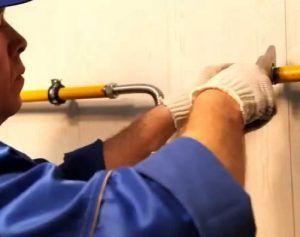 Before connecting a metal gas pipe without welding, it's important to understand all the nuances of the job. When connecting metal gas pipelines, strictly follow professional recommendations.
IMPORTANT! When performing this work, first of all, you must know basic safety precautions and check the central line components for integrity. Then, shut off the gas supply and purge any remaining gas. Only then can you begin the work itself.
The main methods of connecting such a pipeline without welding are threaded and flanged.
- Threaded. To connect a gas supply line using this method, seal the sockets with hemp fiber soaked in drying oil.
- Flanged. This option is easy to install and has become widely used. However, experts warn that its reliability is significantly lower than that of welding.
These methods are used by experienced professionals because they require the use of special equipment.
To connect such a highway with your own hands, you should have the following tools:
- Adjustable wrench.
- Grease and tow.
- Connecting pipes.
- A connector that is equipped with a double-sided thread.
Watch the video
Process of action:
- First, shut off the gas supply. After that, purge any remaining gas from the system. This must be strictly adhered to. Any spark during cutting can lead to unpredictable consequences.
- Use a grinder or hacksaw to cut away unnecessary pieces of metal gas pipes. A grinder is easier and less time-consuming. Using a hacksaw will take longer and be more difficult.
- After the cut is made, one side of it should be soldered.
- If one side needs to be connected to a hose, then a thread must be prepared on the cut piece.
- A piece of tow soaked in lubricant is screwed onto the cut threads. An adjustable wrench is required for all these steps.
- To install a new section of pipeline, you can use a special fastening adapter. These parts have pre-cut double-sided threads and a nut.
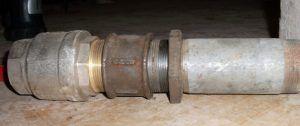
- The correctness of the connection is checked as follows: A soapy solution is applied to the joint area. When soap bubbles appear on the surface, the joint should be tightened further.
Joining muffler pipes without welding
If you're experiencing the common problem of a rotted muffler flange, it's time to consider how to connect the muffler pipes without welding. Here's the trick: There are several options in this situation.
The first option is welding. The next option is buying a new muffler. The third option is to look for alternatives. In both cases, you'll have to pay a lot of money. If the muffler isn't heavily rusted, a clamp can be used.
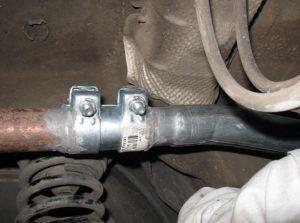
As practice has shown, such clamps have long been used by world-renowned automakers such as Volkswagen and Audi. It's worth noting that these devices have successfully replaced welding in many cases during vehicle repair.
Video
These clamps are made from steel with the addition of aluminum.This ensures the structure will last a long time and will not rust. Connecting the clamps is easy.
Products from various manufacturers are available for sale, and almost all of them are affordable and of good quality. These clamps can be purchased at any auto parts store. Experts call this an excellent alternative to expensive welding.
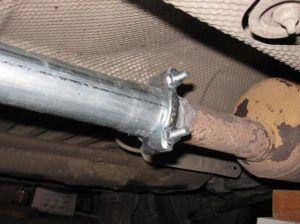 Installing a clamp is a very easy task. No professional skills are required:
- The damaged area needs to be cut off.
- The seating areas must be cleaned with a brush for metal products.
- It is also recommended to cover the mounting areas with red sealant.
- The bolts on the clamp are loosened and it is placed on the metal tube.
- Next, tighten the bolts. However, it's not recommended to overtighten them.
Joining metal pipelines for a heating system
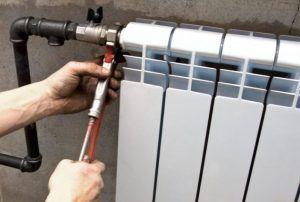 When deciding how to connect iron heating pipes without welding, it's recommended to keep in mind that experts consider welding to be the most reliable option. Only a professional can connect the main line this way.
The rest of the methods can be used independently:
- Threaded. It can be used where there is constant opportunity to inspect the joint. The process for making this type of joint is described above.
- Coupling. This method allows for the creation of airtight and reliable structures on the heating main. How to connect the coupling can be found in the description above.
- Flanged. Speaking of this method, it's worth noting that it's one of the most popular for heating systems.
Video
Flaring is another method used for copper components in heating mains. This method allows for the creation of a detachable joint without welding, which is helpful during emergency heating installations.
This process requires the use of special equipment. The sequence of actions is as follows:
- The end of the metal pipe is cleaned of burrs after cutting.
- A coupling is fixed to the pipeline.
- The pipes are then inserted into the clamping device.
- Next, tighten the screw until the end of the workpiece forms an angle of approximately 45 degrees.
- After preparing the copper pipe for the joint, the coupling is attached to it and the nuts are tightened.
In addition to these options, when installing a heating system, the pressing method is used for connection. For installation of products made of copper, the pre-prepared ends of the workpiece are “seated” in the couplingThen, fixation is achieved using a manual or hydraulic press.
Video
If the heating main is assembled from products with If the walls are very thick, you will have to use press fittings., which are equipped with special crimping sleeves.
These parts allow for the crimping of the workpiece and fitting from the inside, while the seals on the outside create a highly airtight structure.
Technological features of steel products with long and short threads
Professionals know exactly how to connect steel pipes without welding and fittings with short threads, but even a layman with little experience shouldn't have any difficulty with this job. On the straight section of the pipeline, adapter couplings, connecting nuts, plugs, and so on are installed.
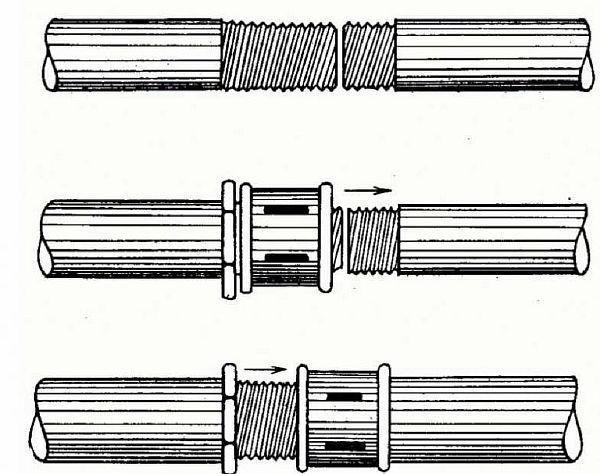
To connect pipes at an angle and for branching, other types of fittings are used: elbows, reducers, and others. The ends of the connecting parts must be clean, and the threads must be made with a high degree of precision.
To increase the strength of the joint of these products, it is wound with a strand of flax, but the threads are first covered with whitewash.
A short threaded section is characterized by the following features. In the area of the two threads at the end, known as the thread runout, the thread depth is typically shorter. This allows for a stronger joint without welding, eliminating the need for runouts and sealants.
Video
Two parts on an extended threaded section can be joined without welding using a coupling. One part has a short thread, while the other has a long thread. The short thread is designed for fastening with a coupling. The extended thread is used to attach a coupling with a locknut. The long thread allows for adjusting the length of the workpiece.
Couplings are most often used when repairing a damaged section of main pipe. The coupling element and locknut are screwed onto a larger thread.
To install the coupling, use a sealing thread. It is wound to the end of a short threaded section on the metal part.
Sometimes, when installing a coupling, a bundle of FUM tape is placed between the locknut and the coupling. It is laid in three layers. This joint is made as follows:
- A coupling and a lock nut are screwed onto the large threaded hole.
- A sealing thread is also used. It is wound around the end of the coupling, which is then tightly fitted to the lock nut.
- The tourniquet must lie in the chamfer, only then will neither liquid nor steam be able to leak out.
When discussing how to connect two metal pipes without welding, it's worth specifically mentioning the Gebo method. In pipeline sections where the connection is in a hard-to-reach area, this method proves quite effective.
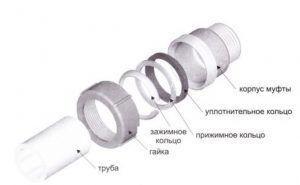 The name Gebo is given to a special fitting. It is installed for the sole purpose of connecting several pipes. The entire process can be done quickly and easily, without the need for threading.
There's a common misconception that joining a riser with such a component without welding is dangerous. However, when properly installed, this element can withstand very heavy loads. It's also worth noting that this mechanism is highly resistant to axial forces.
Video
While maintaining the temperature conditions, such a part perfectly holds not only metal products, but also plastic ones.
Using the material presented above, it's clear how to join metal pipes without welding. Almost all of the proposed methods are suitable for inexperienced craftsmen and allow you to join parts without expensive welding work that requires high qualifications and specialized equipment.
I usually do this in practice. When I don't want to bother with welding or it's not possible. I can only say that the flange connection method is effective, but more expensive. If you calculate the number of connections, welding is cheaper. By the way, I've been meaning to comment on this website for a while now. The navigation is very user-friendly, the developers are great! And the support team always responds quickly.