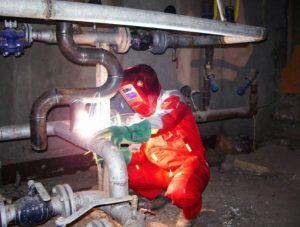
 Until recently, galvanized pipes were the primary method for constructing water supply networks in homes and industrial buildings. Welding was widely used for laying piping systems.
Even in places where, due to installation conditions, a welded connection is impossible, a threaded end is welded to the network element before installation for subsequent coupling connection.
To extend the service life of water and gas networks, pipes with a protective zinc coating are used. This does not present any difficulties during installation, but welding galvanized pipes has a number of specific features that must be considered during assembly.
To understand the essence of the process, let's consider what galvanized pipes are.
Galvanizing metal as a method of protection against corrosion
Protective coating of steel products has been used for a long time, since non-ferrous, corrosion-resistant metals are too expensive to manufacture into solid pieces. Furthermore, the strength properties of such items are quite low. Tin plating or copper plating were used to create a protective film.
Galvanizing has become popular due to zinc's increased adhesion to iron. The melting point of this metal is 900–920°C.OIn its liquid state, when applied to the surface of a steel product, it forms a durable protective film several microns thick that successfully resists corrosion.
Today, there are three main methods of applying protective coatings:
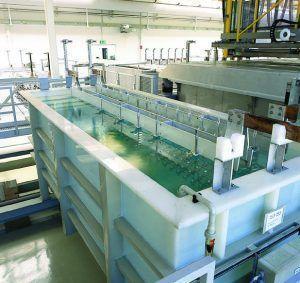
- Galvanic plating. Zinc ions are deposited on the surface of a steel component connected to the opposite electrode in a galvanic bath. They become firmly attached to the component's surface, creating a virtually indestructible protective film. The thickness of the protective layer is controlled by the processing time, allowing for the efficient use of expensive non-ferrous metals, particularly zinc.
- Spraying is a method that involves applying a sprayed metal to a surface using a special gun, which melts the sprayed substance. This substance is then jet-fed onto the surface, coating it with a protective layer.
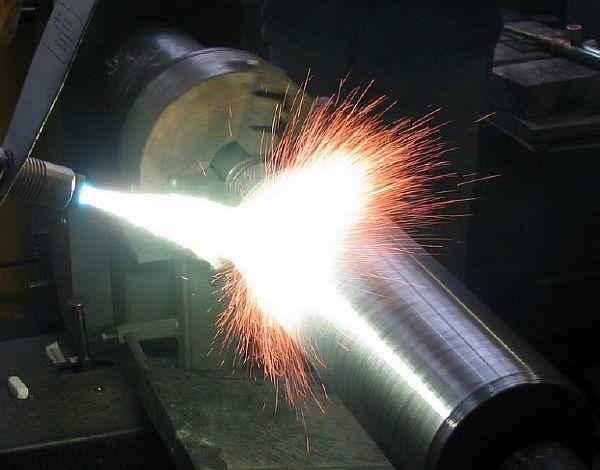
As a result, a durable protective layer of chemically passive material forms on the surface being protected. This method is convenient for field use at the installation site.
- Hot-dip galvanizing. Used on specially designed production lines, the pipe is completely immersed in a bath of molten metal. At the end of the process, centrifugation removes excess protective coating from the surface.
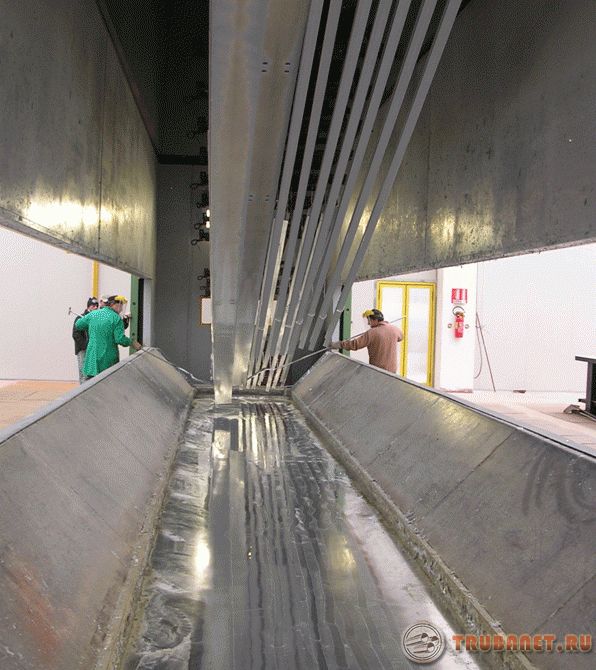
When using any of the listed methods of applying a protective coating, the surface of the products being treated is thoroughly degreased.
The layer thickness ranges from 2 to 150 microns.
Welding connection
This type of pipe connection during installation of heating, water supply and gas systems is stipulated by a number of regulatory documents, one of which is SNiP 3.05.01-85 “Internal sanitary and technical systems”.
Video
When welding galvanized pipes, the SNiP (Building Norms and Regulations) mentioned above requires compliance with a number of standards that determine the order of material application and regulate the work process. Specifically, when welding galvanized pipes, GOST 16037-80 regulates the use of certain types of welded joints, the shape and design features of the welds, and other requirements.
For gas flame welding, use self-shielding welding wire type Sv 15GSTYUTSA, which contains selenium. Wire size ranges from 0.8 to 1.2 mm.
It is also possible to weld galvanized pipes using electrodes containing calcium fluoride or rutile compounds in their coating. Their diameter is selected according to the wall thickness of the parts being welded, with a maximum diameter of 3 mm.
The construction of a pipeline network requires pre-assembly in blocks, with some of the work performed at a facility that performs a number of pre-assembly steps. The regulations also require the use of local air extractors to remove zinc coating combustion products, which pose a health hazard.
Video
The welding process for galvanized pipes also requires removing the protective coating from the surface for a distance of 30–40 mm from the end. After the weld is treated, the corrosion protection at the joint must be restored.
For this purpose, a special paint composition is used, consisting of 95% finely dispersed zinc powder and including synthetic binders in the form of epoxy resins, synthetic rubber or polystyrene.
The joining of water and gas pipes with a protective zinc coating (and without it), having a nominal bore of up to 25 mm, should be done with an overlap, for which one end is pre-expanded.
When welding, threaded pipe ends, like flange faces, need to be protected from hot metal droplets that form during the welding process.
Video
The following defects are not allowed in the weld:
- shells;
- cracks;
- undercuts;
- pores;
- unwelded craters;
- burns and metal leaks.
Ultrasonic testing of welded seams not used, their integrity is checked by pressurizing the system with a certain pressure.
A method for joining galvanized blanks by welding has been developed using fluxThis substance allows for the production of a viscous, air-impermeable layer that prevents oxidation (burnout) of the zinc cladding layer.
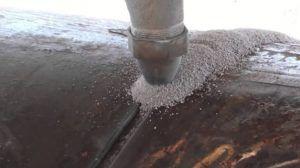 Flux for welding galvanized pipes is liquefied and applied to the joint. During the welding process, it melts, coating the weld area with a thin layer, preventing the zinc layer from peeling off and burning off.
When using flux, damage to the protective layer may occur when it was applied using the hot-dip galvanizing method.
This becomes possible with the slightest deviation from the requirements of the technological process during coating application or welding.
Flux entering the pipeline's interior is not dangerous, as it easily dissolves in water and is washed out during the pipeline pressure testing stage.
There is a method of joining galvanized pipes called welding and solderingFor this, a filler rod is used, which contains elements such as zinc, copper, silicon, and tin. The process technology is as follows:
- the butt ends are heated to the melting temperature of the filler rod, which is 900–950O;
- the filler rod is placed between the chamfers of the parts to be welded;
- a layer of flux is poured onto the seam in such a way that it covers the surface at a distance of up to 20 mm on the sides of the seam;
- The additive is heated with a torch until it melts completely, creating a reliable connection between the pipes without damaging the zinc coating.
The diameter of the filler rod is determined from the ratio:
- for wall thickness less than 10 mm D = 0.5S + 1, Where
D – diameter of the rod for additive;
S – pipe wall thickness;
- for pipes with a wall thickness of more than 10 mm, the ratio takes the form:
D = 0.5S
For beveling pipe ends in the field, specialized equipment—orbital units—is used. They can be equipped with flame cutters for cutting such elements.
For galvanized pipes, mechanical heads can be used, and cutting is performed with a cutter or milling cutter. The unit is positioned and secured directly to the pipe.
Necessary safety measures
The specifics of welding galvanized pipe require special attention to safety regulations during the work. Zinc vapors released during the joint are highly toxic, so their removal from the area is essential.
Video
For this purpose, powerful exhaust systems are used at each welding station. Other safety requirements are specified in the relevant instructions and are mandatory.
Welding galvanized pipes is the most common method for joining them, both for its reliability and durability. It's important to remember that the weld requires special corrosion protection using a zinc-based paint.