Insulation is a structural element or material that reduces heat transfer to the environment. Insulating steel pipes is the primary method for extending the service life of pipelines and also helps reduce heat loss in plumbing and heating systems.
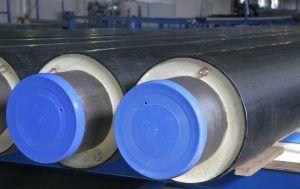 It's worth noting that insulated pipes can maintain their performance characteristics longer. This is especially important for external systems, which are most exposed to environmental factors.
Thermal insulation for steel pipes protects them from freezing and ruptures, thereby avoiding emergency problems. Therefore, purchasing protection in advance is significantly more cost-effective than undertaking emergency repairs in the winter.
All protective materials are manufactured in strict compliance with regulatory requirements and are approved for installation in the following networks:
- gas and oil;
- various engineering communications;
- with high soil moisture;
- with low temperature readings and frequent temperature changes.
Insulated steel pipe rolling materials are used in the following areas:
- Water supplyInsulation of such hot systems is done not only for cost reasons, but also for safety reasons.
- Heating systemThermal insulation protects such networks from rupture, which can occur due to a large difference between internal and external temperatures.
- ChimneysWhen insulating a chimney, it's important to use non-toxic and heat-resistant materials. Because the temperature in front of the firebox is approximately -25 degrees Celsius or more, and near the firebox itself, it rises to over 55 degrees Celsius.
The cost of insulation materials depends on the type. Prices start at 160 rubles for 5.7 cm pipes.
Polyurethane foam coating (PUF)
Steel pipe in polyurethane foam insulation is used for trenchless and above-ground heating network installations. Polyurethane foam insulation is manufactured using the latest technologies and high-quality materials.
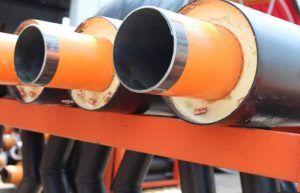
Polyurethane foam (PUF) They are created from vapors of environmentally friendly components. These are Voratek CD 100 and Izolan-345. A distinctive feature of this product is its high thermal insulation properties (97%).
Compared to mineral wool, which is widely used, polyurethane foam loses less heat. At normal humidity, the thermal conductivity of polyurethane foam is much lower than that of mineral wool.
If we consider the advantages of polyurethane foam, they are as follows:
- The temperature at which it can be used is from 85 to 135 degrees.
- Long period of use (up to thirty years).
- Thermal insulation properties up to 97 – 98%.
- Reducing the costs of heating main installation.
- Reduced costs for repairs to the water supply network.
- Possibility of use in different climatic conditions.
- Ease of identifying the emergency area.
And the most important advantage is that polyurethane foam does not have any negative impact harmful impact on the environmentThis also reduces leakage of the working fluid due to increased corrosion protection.
The thickness of the steel pipe walls and the height of the polyurethane foam surface coating at companies selling these products are adjusted in accordance with customer wishes.
Video: Pipe Insulation, Comparison of Types
Today, options using polyurethane foam insulation are recognized as the most modern and effective solution for reducing energy costs and protecting pipe materials from aggressive environmental influences.
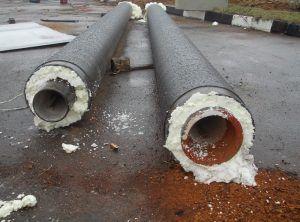 Steel pipes in polyurethane foam insulation are used in the construction of various heating mains. Manufacturing standards are defined by GOST 30732-2006.
Let's look at their technical features:
- The density index is not less than 60.
- Compressive strength not less than 0.3.
- Water absorption during boiling for one and a half hours is no more than 10.
- At a temperature of +50 degrees, thermal conductivity is no more than 0.033.
These options are suitable for the following coolant parameters:
- Working pressure within 1.5 MPa.
- The temperature of the coolant is not higher than 140 degrees.
The main advantages of products with polyurethane foam:
- Long service life, more than 30 years.
- Reducing heat loss.
- Ability to work at high temperatures.
- Reducing costs for the use of heating networks by 10 times.
Tape protection
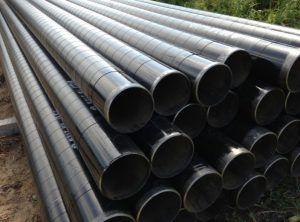
Reinforced insulation for steel pipes, according to GOST 9.602-89, is available. This polymer tape-based protection effectively performs its function on the outer surface.
This type of insulation is applied by wrapping the tape using an overlapping method. This is done after applying a bitumen-polymer primer.
There is a whole list of requirements for this type of external insulation:
- Highly reliable and permanent adhesion to steel pipes.
- High level of mechanical characteristics.
- UV resistance.
- High dielectric capacity.
- Resistance to cathodic disbondment.
Enhanced protection based on these tapes has the following advantages:
- manufacturability;
- high security.
Video: Pipeline Thermal Insulation
It is characterized by high quality and helps prevent external corrosion and mechanical damage. It also allows steel pipelines to be used in high-humidity areas and across a wide range of temperatures.
This reinforced coating has become the most common type of insulation. Currently, polyethylene adhesive tapes are often used, providing long-term protection for steel pipes.
Pipes with this type of casing are widely used in utility lines (water supply systems, storm drains). These materials can also be found in oil field pipelines.
Highly reinforced insulation (HRI)
Steel pipe with VUS insulation used for laying gas and oil pipelines and heating systems.
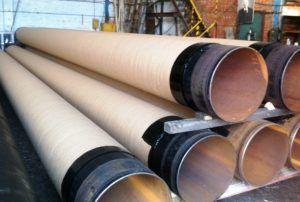
Highly reinforced insulation (HRI) is manufactured according to GOST standards and expands the scope of steel pipeline use. It increases its reliability and service life. These products retain their properties even under adverse conditions.
This protection is one of the options to protect the network from exposure to aggressive chemical environments and corrosive formations.
VUS is produced using flat-slot extrusion. Extruded polyethylene serves as a protective layer.
Video: Internal insulation (IUI) of steel pipes
- The primary layer is a primer that fills small cracks.
- The intermediate layer consists of an adhesive compound. It serves to bond the primer and create the outer coating.
- The final layer of this insulation is the application of an extruder. This allows for the even distribution of the protective layer over the surface.
Advantages of the Military Specialized Occupation:
- The service life of pipelines is becoming longer and amounts to half a century.
- Absolutely environmentally friendly.
- Reducing heat loss by up to thirty percent.
- Easy tolerance to temperature changes.
- An impressive period of operation without failures, and consequently savings on repairs.
- They can be used for underwater installation.
- Such products can be used at temperatures from -25 to +65 degrees.
- Resistance to mechanical influences.
- High water-repellent properties of rolled metal products.
Foamed polymer-mineral (PPM) protection
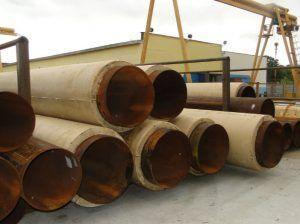 Steel pipes with PPM insulation are a monolithic structure with a variable density across their cross-section. This structure is characterized by the high quality and monomeric nature of the thermal insulation layer, which is free of voids and rust formations.
Products with foam polymer-mineral insulation are used in underground and above-ground pipelines. Steel pipes covered with this insulation are located under three layers:
- Anti-corrosion, which protects against corrosion.
- Thermal insulation. It is porous, and its thickness depends on the climatic conditions of a particular region.
- Mechanical and waterproofing. This layer provides strength to the structure and protects it from moisture.
Their advantages are obvious:
- There's no need to additionally protect the system from corrosion and moisture. These materials are 100% hermetically sealed.
- Products in PPM insulation are not susceptible to mechanical damage.
- Resistance to moisture.
- Reduces the time required for construction.
- Eliminates large-scale heat loss, even if the outer layer disintegrates.
- Vapor permeability remains unchanged, and moisture retention remains unchanged. This allows for cost savings on building maintenance.
- Long service life, over thirty years. This long service life is achieved through chemical reactions between the filler and the polyisocyanate.
Internal insulation of steel pipelines
Internal insulation of steel pipes is widely used in various pipeline systems. The impressive strength properties of internally insulated pipes overcome a drawback common to all metal products: susceptibility to corrosion.
The internal coating solves two problems simultaneously: it protects steel pipes from corrosion and reduces hydraulic resistance.
Materials used for the internal coating are characterized by a smooth surface, which reduces friction losses within the system. Epoxy is the most promising option.
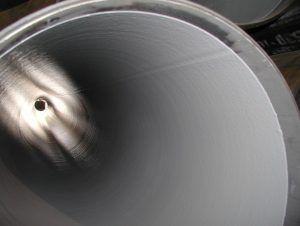
A cement-sand mixture with a low water-cement ratio is also often used. This mixture is applied to the surface using the center-sparing method. This technique ensures a uniform layer and the desired density.
The resulting layer is 0.4 to 1.6 cm thick. It effectively protects the metal from external influences. Under this protective layer, the metal is passivated by the calcium hydroxide solution created during the cement hydration process.
The CPI protection is more than just an anti-corrosion coating. The absence of rust on the pipe ensures its low roughness in the core. Furthermore, the gel layer reduces fluid friction against the steel surface and inhibits internal fouling.
Even the appearance of rust on the top does not reduce the operational characteristics of the pipeline, and they can extend their service life for several decades.
Insulating steel pipes with modern materials effectively protects pipeline systems. This minimizes heat loss and extends the service life of the pipeline system. This reduces energy costs and, consequently, lowers utility bills.