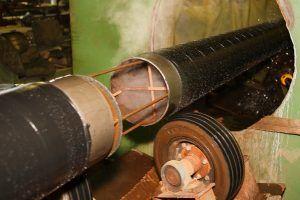
 All steel pipe manufacturers have as their top priority the effective protection of rolled pipe materials from the destructive effects of corrosion.
Currently, from an economic standpoint, the most promising and long-lasting method is the extruded polyethylene option, which has acquired the name of highly reinforced insulation of steel pipes.
This type of coating for steel pipes has proven itself so well that in a short period of time it quickly became one of the most popular building materials.
Products with this type of coating are suitable for use in the following areas:
- In an underground pipeline transporting gas at a pressure of no more than 5.5 MPa.
- They can also be installed in networks transporting oil and water.
- Transportation of sewage waste.
Product variants with a highly reinforced coating offer high-quality anti-corrosion protection and meet all modern regulatory criteria.
Highly reinforced processing of steel pipelines is an order of magnitude more reliable than other similar materials.
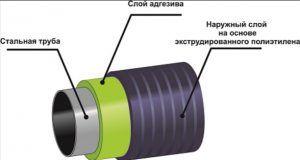
Polyethylene is applied to a solid base to improve the adhesion of the thermal insulation material to the pipe, which reduces the product's susceptibility to external mechanical damage, reduces the volume of absorbed water, and increases water resistance.
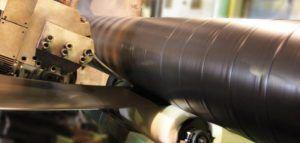
This line of products is characterized by a long service life, it has duration of 30 years or moreDuring this period, the main line does not require repairs or replacement of pipes.
The temperature range of the medium being distilled for these products ranges from -40 to +80 degrees Celsius. The operating pressure ranges from 2.5 to 5.5 MPa. These pipes can be protected from the effects of very low temperatures by insulating them.
Highly enhanced protection
Highly reinforced insulation effectively solves the problem of corrosion on pipelines, a persistent and persistent issue.
Regardless of the installation method, pipes are always exposed to water and oxygen. These are the main factors causing corrosion on metal. If the pipeline is located underground, it is also exposed to groundwater, which is often chemically aggressive.
If we consider the following methods of using VUS:
- A traditional method for strengthening steel pipeline systems is to treat them with bitumen and bitumen-rubber mastics. This treatment is then followed by a protective or reinforcing coating. A standard level of this treatment is considered to be a pair of mastic layers, each 0.3 cm thick, and a protective layer of kraft paper.
- For VUS, the mastic is applied in four layers. The second and third layers are separated by a roll of reinforcing material. Kraft paper serves as the main coating, providing protection from mechanical impact.
- The next method is an even more intensive treatment, consisting of six layers and a pair of reinforcing layers. The thickness of the protective layers in this version is 0.9 cm.
Video
VUS GOST 9.602 2005
The development of insulation materials is constantly evolving. Scientists are constantly researching and have enabled the creation of new building materials and technologies for applying insulation to them.
This significantly extends the lifespan of the products. Consequently, pipes with significantly enhanced protection have emerged.
Highly reinforced insulation according to GOST 9.602-2005 has proven itself to be highly effective in practice. This standard now guarantees a high-quality product, surpassing other similar options in its characteristics.
Modern products complying with GOST 9.602-2005 have quickly become the leading choice among other corrosion protection options for steel pipes. They are characterized by minimal moisture absorption and can provide failure-free service for over fifty years. High contact resistance provides effective cathodic protection.
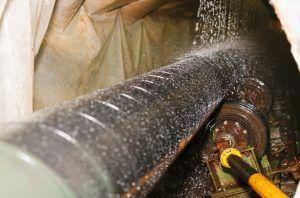 This type of material with two- and three-layer finishing is used in various pipelines, and this helps reduce the costs of repairs and work associated with excavating damaged pipelines.
In addition to insulating pipeline systems, branch reinforcement is also used. This involves applying an anti-corrosion coating to the connecting parts of the main lines. The volume of these elements should not exceed 53 cm3.
Bitumen VUS
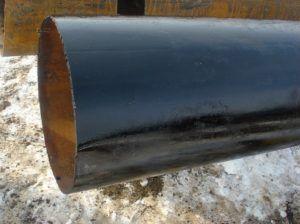 Highly reinforced bitumen insulation is used as waterproofing and a method for preventing corrosion on steel pipe mains in trenchless installations of water supply and industrial pipelines.
The main application area for existing coatings is to prevent corrosion in small-diameter pipe networks operating at normal temperatures.
The multilayer structure of bitumen-mastic treatment consists of:
- primer on the surface of the pipes;
- the first layer is reinforced fiberglass;
- the second layer consists of bitumen mastic, which is made up of hydrophobic materials;
- the next reinforcing layer consists of fiberglass;
- a pair or single layer of covering consisting of kraft paper.
Video
Highly reinforced bitumen-polymer insulation has the following advantages:
- Ease of application.
- High level of durability.
- Resistance to mechanical damage.
- Resistance to cathodic disbondment.
- Excellent adhesion properties to steel parts.
- Minimal permeability of oxygen and water.
- Resistance to corrosion formations.
- Tolerance to temperature changes.
Anti-corrosion VUS
Highly reinforced anti-corrosion insulation made of polyethylene tape deserves special attention. It meets all modern technical and sanitary requirements.
Compared to other types of protection, adhesive tape application technology offers superior coating quality. This improves:
- resistance to external mechanical influences;
- adhesion to the surface of the pipe;
- resistance to water absorption;
- duration of use.
The main advantages of these pipes are:
- Resistance to mechanical influence.
- Very low water absorption.
- Adhesion significantly exceeds standard values.
Rolled pipe assortment with such protection is installed in networks with an operating temperature of the coolant from -40 to +60 degrees. This protection maintains its technical properties for half a century.
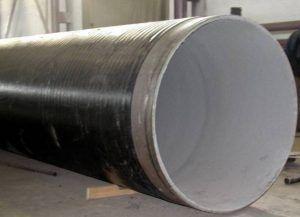
The manufacturing technology and raw materials used fully comply with all regulatory requirements. These products can be found in sewer and drainage systems.
Highly reinforced anti-corrosion insulation provides reliable protection for the system and guarantees its trouble-free operation over a long service life.
As for bitumen-polymer treatment, it has proven itself to be highly effective. For these reasons, it is used in various soil types. This type of protection allows the system to be used in soil temperatures ranging from -5 to +30 degrees Celsius.
The thickness of the reinforced type processing is equal to four to six millimeters, and the reinforced type protection is characterized by a thickness of up to nine millimeters.
Video
Application of cement-sand options:sand insulation (CPI) and cement-sand pavement (CPP) is acceptable for steel systems supplying drinking water and in utility pipelines.
This type of insulation lasts for at least 30 years, effectively extending the lifespan of the system. It also reduces repair costs. This is possible because internal deposits and fouling of the pipes are virtually eliminated.
Another advantage in this case is the good quality of the water, which does not lose its properties due to corrosion and the presence of bacteria.
Steel case with VUS
A steel casing with highly reinforced insulation is used in situations where the pipeline passes under a road for cars and under railway tracks.
In such places, pipelines are hidden in a pipe - a casing, which in terms of strength must exceed the pipelines being protected.
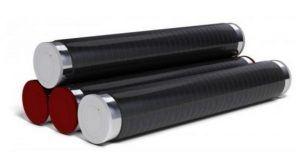
Steel casings absorb additional mechanical load and extend the life of the line. VUS enhances the protective capabilities of a steel casing, and one of the best materials for this purpose is considered extruded polyethylene.
The distinctive characteristics of this material are:
- absolute impermeability to water;
- light weight;
- resistance to the growth of mold, moss and mildew;
- maintaining performance characteristics across different temperature ranges;
- wear resistance;
- low cost.
During production of the VUS casings, they are coated with a special adhesive that strengthens the bond between the polymer and steel. Extruded polyethylene is then applied to the surface of the casing. The finished products then undergo rigorous laboratory testing.
Common sizes of cases:
- diameter from 21.9 to 102 cm;
- wall thickness from 0.5 to 1.8 cm.
According to the rules, the protective case should have a diameter of exceed the main pipe by 20 sm. All products from various manufacturers comply with international standards and can be used in any region of Russia.
Advantages
Highly reinforced pipeline insulation is applied to the rolled pipe range in the field of factory production.
This production becomes a guarantee of high-quality final products, which are characterized by uniform execution and homogeneity.
Almost always, reinforced insulation is a coating of many layers, where the surface layer is a polymer, which has the following characteristics:
- Being in the water for a long time, he does not miss it.
- It is biostable, meaning it is not destroyed by mold fungi and other organisms found in the soil.
- Resistance to temperature fluctuations. This type of thermal insulation maintains its properties even in severe frosts, when the ground completely freezes. Heating also does not change its properties. Steel pipelines under this insulation are not exposed to stray currents, which are the main cause of corrosion on steel components located underground.
- Resistance to stretching, tearing, friction and vibration.
- Durable and wear-resistant.
- The low weight of the coating does not change the overall weight of the individual parts of the structure or the system as a whole.
A pipeline with this type of protection will last for at least thirty years without maintenance. During this time, the pipeline requires no repairs, and the material's protective properties are fully maintained throughout.
When this period comes to an end, the network needs to be inspected. Areas where mechanical damage and wear have developed are easily repaired under any conditions. Special polymer materials, such as tapes, primers, and other materials, are used for this purpose.
Application of the VUS
Applying reinforced insulation to pipes requires some special considerations. Before applying the extruded polyethylene coating, all network components are treated.
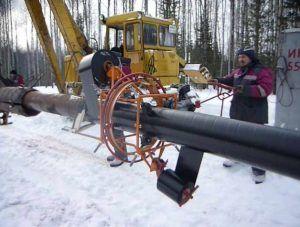
Its first stage is cleaning the steel surface from rust, dirt and paint residue.
To remove this, special shot-peening machines are used. Upon completion, the prepared parts should be carefully inspected. Only those parts that are free of defects and have the correct geometric shapes are used for further processing.
Special mixtures are applied to the prepared and tested pipe products:
- primer;
- primer;
- adhesive.
These products provide enhanced protection for extruded polyethylene against peeling processes and ensure a very long service life for products with reinforced insulation.
After coating, products first undergo laboratory testing. Test rigs are designed to closely approximate real-world conditions. Products that successfully pass these tests immediately acquire a high level of quality.
Video
This type of finish is essential for a robust steel system that operates in extremely challenging conditions. This modern type of protection reliably protects steel pipelines from external influences.
I find the information relevant. It's especially nice to see at the end of the article that it was verified by an expert in the field. The author did a great job; I like everything about it. He highlighted both the strengths and weaknesses right away.
Hello. Could you tell me which company applies VUS insulation made of extruded polyethylene to steel pipes?
Hello. What region are you in?