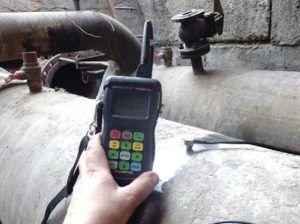
 Over long periods of use, pipelines are exposed to adverse external and internal environmental influences. As a result, the metal degrades, corrodes, cracks, chips, and other defects develop. It would seem that when designing a pipeline using modern technologies, complete protection of the main utility lines should be ensured.
Unfortunately, it's impossible to completely eliminate the possibility of damage. To prevent minor defects from developing into serious problems, various types of inspection are used.
One of them, which does not involve taking the main system out of service, is pipeline flaw detection.
This diagnostic method has become widely used. Its use allows for the detection of the following types of defects:
- loss of tightness;
- loss of control over the state of tension;
- violation of welded joints;
- depressurization of welded seams and other parameters that are responsible for the reliable operation of pipelines.
You can check this way:
- heating network;
- gas supply network;
- oil pipelines;
- water supply pipelines, etc.
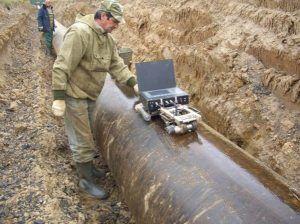
Flaw detection is 100% capable of identifying defects and preventing serious accidents. Defect detection methods are constantly being improved and equipment is being updated., and new flaw detector models are being tested. In addition, various analyses are being conducted to subsequently improve the performance of the devices.
Ultrasonic flaw detection
Ultrasonic pipeline flaw detection was first introduced by S. Ya. Sokolov in 1928. It was created based on the study of the movement of ultrasonic vibrations, 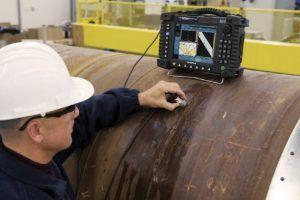 which were under the control of a flaw detector.
When describing the operating principle of these devices, it's important to note that a sound wave does not change direction in a medium with the same structure. When the medium is separated by a specific acoustic barrier, the wave is reflected.
Video: Magnetic particle inspection of welded joints
The greater the number of such obstacles, the more waves will be reflected from the boundary dividing the medium. The ability to detect small defects separately from one another is determined by the wavelength of the sound wave, which depends on the frequency of the sound vibrations.
The diverse tasks involved in ultrasonic flaw detection have led to the emergence of a wide range of possibilities for this troubleshooting method. Five main options are distinguished:
- Echo is a location.
- Shadow method.
- Mirror-shadow.
- Mirror.
- Delta is a method.
Modern ultrasonic testing devices are equipped with multiple measurement capabilities simultaneously, and these capabilities are available in various combinations.
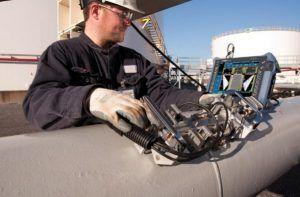
These mechanisms are characterized by very high accuracy, resulting in the residual spatial resolution and reliability of the final conclusion about the defectiveness of the pipeline or its components being as truthful as possible.
Ultrasound analysis does not cause damage the structure being studied, and makes it possible to carry out all work as quickly as possible and without harm to human health.
Ultrasonic flaw detection is a comprehensive system for inspecting joints and seams. This method is based on the high penetration of ultrasonic waves through metal.
Weld analysis
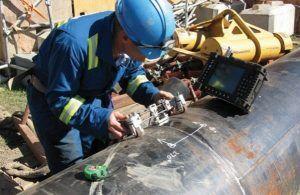 Defectoscopy of pipeline welds is a mandatory procedure before commissioning main communications, especially those running underground.
In any structure, the weld seam is a weak point, and for this reason, their quality must always be monitored. Weld seams bear an important responsibility – they determine the tightness and quality of the finished structure as a whole.
The essence of various approaches to analyzing such joints lies in assessing certain physical properties that characterize the reliability and strength of the pipeline. Defectoscopy determines not only the size of defects but also evaluates the quality of the welds. This assessment includes:
- strength index;
- ability to resist corrosive formations;
- degree of plasticity;
- the structure of the weld metal and the area around it;
- quantity and dimensions of the defect.
Ultrasonic testing is one of the main methods for detecting defects in welded seams.
Video: Magnetic Particle Inspection Flaw Detector Review
Defectoscopy of welded joints of pipelines has the following advantages.
- Quick audit.
- High research accuracy.
- Low cost.
- Absolutely harmless to humans.
- Mobility of devices used for testing.
- Possibility to perform quality checks of a functioning pipeline.
The simplest flaw detection procedure is a visual inspection. This visual and measuring method allows one to identify the presence of many defects based on the initial results obtained during a visual inspection.
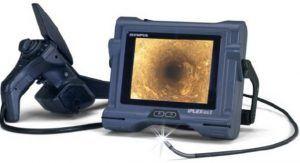 This inspection verifies the quality of finished welded joints. This type of testing is used independently of other inspection methods. It is often very informative and, what's more, the least expensive.
This method detects deviations from nominal dimensions. During this process, the pipeline surface is thoroughly cleaned of dirt, metal spatter, rust deposits, scale, oil, and other contaminants.
The welds and surrounding areas are inspected. Any defects found at this stage are corrected before other flaw detection methods are used.
For example, noticeable differences in weld seam height indicate that the arc was interrupted during welding.
During inspections, it is recommended to treat such joints with a 10% nitric acid solution. If gross geometric irregularities are visible, this indicates a defect in the weld quality.
Video: The video provides a brief overview of the TG 110-DL and Avenger EZ ultrasound devices.
The advantages of this research method are as follows:
- Most often, such an operation takes little time.
- Low cost of verification.
- The safety of this procedure for human health.
- You can check the existing pipeline.
Well, where would it be without its drawbacks:
- Possibility of destructive action.
- The need for special reagents and other consumables.
- The prototypes were not always recoverable after this process.
Defectoscopy of pipeline joints
Pipeline joint inspection is a critical process that begins only after the weld is complete. The joint must cool and be cleaned of any contaminants.
Another inspection method is dye penetrant inspection of pipelines, also known as capillary testing. This test is based on the capillary activity of the liquid. Pores and cracks create a network at the joint.
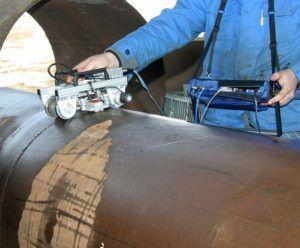
When they come into contact with liquid, they simply pass it through themselves. This method makes it possible to detect hidden problematic formations. This procedure is carried out in accordance with GOST 1844-80.
Often used for this type of verification magnetic flaw detectionIt's based on the phenomenon of electromagnetism. A mechanism creates a magnetic field near the area being inspected. Its lines pass freely through the metal, but when damage is present, the lines become uneven.
Video: In-line inspection of main pipelines
To capture the resulting image, magnetic particle inspection (MPI) or magnetic particle inspection (MPI) is used. If powder is used, it is applied dry or as a wet mass (with oil added). The powder will accumulate only in problem areas.
In-line inspection
In-line flaw detection of main pipelines is the most effective method for detecting problems, based on running special devices through the pipe system.
These are in-line flaw detectors with specialized instruments installed. These mechanisms determine the configurational features of the cross-section, identifying dents, thinnings, and corrosion formations.
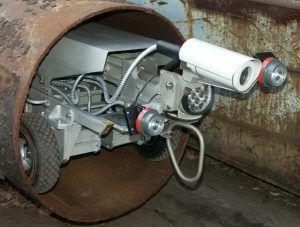
There are also in-line inspection mechanisms designed to perform specific tasks. For example, equipment equipped with video and photo cameras inspects the interior of the pipeline and determines the degree of curvature and the structure's profile. It also detects cracks.
These units move through the system in a flow and are equipped with various sensors; they accumulate and store information.
In-line flaw detection of main pipelines offers significant advantages. It does not require the installation of systematic monitoring devices.
It should be added that, using this type of diagnostics, it is possible to regularly monitor deformation changes throughout the entire section of the operating structure with a high level of productivity.
In this way, it is possible to promptly identify the section that poses an emergency threat to the entire system, and carry out repair work to eliminate the problems in a timely manner.
When discussing this method, it's important to note that there are a number of technical challenges to its implementation. The main one is its cost. Another factor is that the devices are only available for large-volume main pipelines.
Video
For these reasons, this method is most often used for relatively new gas pipeline systems. Implementing this method for other pipelines can be accomplished through reconstruction.
In addition to the technical difficulties discussed, this method is distinguished by its extremely accurate results and the processing of verification data.
When inspecting main pipelines, it's not necessary to complete all the necessary procedures to ensure there are no problems. Each section of the pipeline can be inspected using the most appropriate method.
To select the optimal inspection option, it's necessary to assess the importance of the joint's criticality. Then, based on this, select the inspection method. For example, for home production, visual inspection or other cost-effective inspection methods are often sufficient.