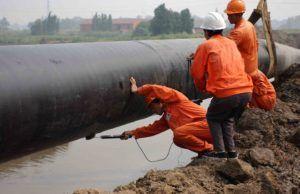
 Pipeline leak and strength testing is carried out in accordance with SNiP (Construction Norms and Regulations) requirements. Prior to testing, the pipeline undergoes a thorough external inspection.
The purpose of the inspection is to identify potential deviations from the design and to determine whether the pipeline is ready for upcoming testing. The inspection includes:
- inspection of joints;
- the correctness of the installation of the fittings is assessed;
- installation of suspensions and supports;
- finding out how easy it is to open the locking mechanisms;
- the possibilities of removing air from the line are determined;
- filling with water and draining it after testing.
The optimal temperature for such actions not below +15 degreesBefore testing external systems, they must be purged. This will clear the interior of any contaminants. Internal testing of gas pipelines is performed immediately before installation.
The method of conducting the test is immediately outlined in design documentationIf these instructions are not present, then hydraulic testing of process water supply pipelines is carried out or heating for strength and density.
Hydraulic verification method
Strength and tightness testing of utility lines is performed using pneumatic and hydraulic methods. Pressure networks running in trenches are tested twice. First times before filling and fastening the reinforcement elements. A second once after installation of hydrants and safety valves.
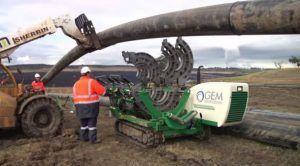
A trial check is permitted after the sinuses have been filled with earth, the water pipes and supporting devices have been filled, and the other requirements stipulated by the Safety and Industrial Safety Rules have been met.
IMPORTANT! Trial testing of steel structures can be carried out after positive results quality control of welded seams and insulation protectionWelded and flanged joints, when tested at a pressure of 0.6 MPa, must be insulated at a distance of 10 cm from the joint axis in all directions. They must also be clearly visible.
Hydraulic testing for strength and density is performed using internal pressure. Its value is specified in the working design. During this test, the valves in the network must be fully opened.
For this type of operation and for disconnecting the network section being tested, blind plugs or flanges are installed on the process pipeline. Pipelines without valves cannot be used for this purpose.
Length of tested sections and test time
Reinforced concrete and cast iron pipelines are tested over sections no longer than one kilometer. Polyethylene networks are tested over sections no longer than 500 meters. The largest network section for this type of testing is no longer than 1,000 meters.
Reinforced concrete and metal process pipelines must undergo a hydraulic test for at least 10 minutes, while polyethylene pipelines must undergo a hydraulic test for at least 30 minutes. The pressure is then reduced to the operating pressure, and the system is inspected. Water can be pumped into the system to maintain the test and operating pressure during the inspection and to detect any potential errors.
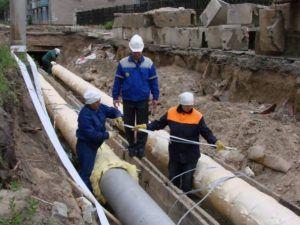
Provided that the pipes and fittings in the structure do not burst under the influence of the test pressure, and no liquid leaks appear, then it is considered that it has passed the hydraulic test.
All identified defects must be corrected, and the line must then be subjected to a second test.
Density tests
Final testing of process pipelines for strength and tightness can begin at least 24 hours after the trench is backfilled. For reinforced concrete structures, this period is extended to 72 hours.
Leaks are not intentionally detected in visible areas. The network is considered hydraulically tested when there are no breaches in its integrity and no fluid leaks appear at the operating pressure. Leaks are detected using the following formula:
q = Q/BTIn it, T is the period from the start of the test until the moment the pressure gauge needle returns to its initial position. T = T1 - T2. B is a coefficient that is taken as 1 (when the pressure decreases by no more than 20% of the test value).
If this indicator drops below the operating pressure within ten minutes, the main line is considered to have failed the test. Q is the volume of liquid required to restore pressure. If the pressure drop is insufficient, water is discharged from the network.
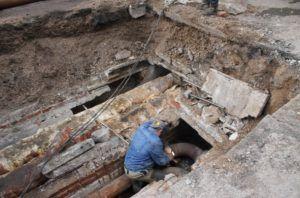 Leaks are then detected using the provided formula. Fluid is allowed to drain from the system until the specified time has elapsed. This may reveal a greater volume of fluid drained than the actual leak.
When a process pipeline is filled with liquid during the winter, the temperature difference between the pipes and the liquid is allowed to be within ten degreesThe final inspection in the winter season is carried out when the liquid temperature is not less than one degree.
Testing a full pipeline without pressure is possible with flow. This means that the pipes must be circulating liquid to heat the network. In winter, systems are tested only when absolutely necessary.
All networks are required to undergo hydraulic leak testing. Pneumatic testing is permitted if the test pressure is no more than 0.8 MPa.
SNiP standards
Main pipelines must be tested for leaks in accordance with SNiP requirements. The test pressure standard is specified in the design.
Before testing begins, it is recommended that all connecting points on the outer and inner parts be covered with a solution of sand and cement, but it should be kept for two days before application.
 All valves in the system must be fully opened during the inspection. The only exception are valves that isolate the network from branches; they can remain closed during this period. However, it's best to install dry flanges on them just in case. The use of plugs to isolate the section being inspected from operating systems is not permitted during this period.
When testing, the process pipeline should be filled with liquid from a lowered section. This will create favorable conditions for the removal of air pockets from the system. Valves used for air removal should only close at the final point of air release.
Watch the video
A pipeline is said to have passed the strength and tightness test in the following cases:
- if the seal at the connecting points has not been lost;
- if the integrity of the pipes is not damaged;
- if the reinforcement and fittings are not damaged;
- if there are no “errors” in open areas and in underground areas.
The structure is considered to have passed the test for tightness and strength when it does not leak.
Pneumatic verification
This type of testing is performed at the request of the responsible organization if there are certain difficulties with hydraulic testing for density and strength. For example, such difficulties include winter, lack of water at the testing site, etc. This type of testing is also performed in two stages:
- preliminary;
- final.
At the first stage, the pipeline is tested for strength, and at the second, for leaks. Steel systems located outside are subject to a period of air filling before testing begins.
Watch the video
This is done to equalize the temperature of the system and the ground. A 30 cm3 process pipeline is maintained for two hours, a 60 cm3 network for four hours, a 90 cm3 network for eight hours, a 120 cm3 network for sixteen hours, and a 140 cm3 network for a day.
After partially filling the pipeline with soil, a pneumatic test is performed in the following manner.
- Steel and polyethylene pipelines are tested for tightness and strength under a working pressure of 0.5 MPa, and the verified pressure is equalized to 0.6 MPa.
- Prestressed cast iron and reinforced concrete structures are tested with a test pressure of 0.15 MPa. If it is not possible to generate the required pressure for steel and polyethylene structures, preliminary testing is carried out under maximum pressure generated by a compressor. This pressure cannot be less than 0.6 MPa.
- Pneumatic testing of networks for density and strength is carried out on sections no longer than 1 kilometre.
- If any defects are found during testing, the system pressure is reduced to atmospheric pressure. The defects are then corrected and the test is repeated.
- When preparing for pneumatic testing, it's important to ensure the stops are installed correctly. Afterward, the pipeline is covered with soil (at least 25 cm). The interior of the structure is cleared of soil and other debris.
- It is only permitted to inspect the system and identify any “defective” manifestations after reducing its pressure to 0.1 MPa.
Testing of reinforcement
Pipeline fittings (with or without a manufacturer's certificate) The pipe is hydraulically tested for strength and density, and the test results are recorded in a report. The test pressure is taken as one and a half times the working pressure.
Video
Valve components with a technical data sheet but an expired warranty are installed after appropriate inspections. During this inspection, the ground O-rings on the discs and valve are inspected. The rod threads are also lubricated and the sealing rings on the glands are replaced.
Once the hydraulic testing of the pipelines for tightness and strength is complete, the system is flushed with water until scale and dirt are removed, and the pipes are tapped with a soft metal hammer. Flushing is performed with a stream of water at maximum speed until the outgoing fluid flows clean.