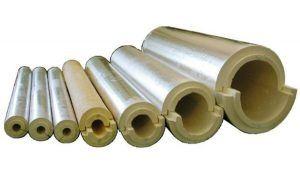
 When selecting the appropriate type of insulation material, it's important to consider not only the design features of the equipment and pipelines but also other factors. This is required by SNiP (Building Code and Regulations) for thermal insulation of equipment and pipelines.
View the current SNiP in pdf format — SP 61.13330.2012 Thermal Insulation of Equipment and Pipelines. Updated version of SNiP 41-03-2003
Let's consider the factors influencing the choice of insulating materials.
- The intended purpose of the insulating materials themselves.
- Spatial orientation.
- Possible atmospheric influences.
The requirements for thermal insulation of pipelines and equipment will be discussed below in this article.
- What function does protection perform?
- Thermal insulation of pipelines and its essence
- What are the specific requirements in this area?
- Insulation and building codes
- Procedure for making calculations
- About the thickness of pipeline and equipment insulation
- Polyurethane insulation
- PPM and APB insulation
- About the thermal conductivity coefficient
- Optimal thickness and additional recommendations
- What other rules should be followed?
What function does protection perform?
One of the purposes of thermal insulation for equipment and pipelines is to reduce heat flow within structures. Materials are coated with protective sheaths that ensure complete integrity of the layer under any operating conditions.
Thermal insulation issues are receiving significant attention in various industrial and energy sectors. Thermal insulation is becoming one of the most important components of structures and equipment in these industries.
The result is not only a reduction in heat loss during interactions with the environment, but also an expansion of the ability to maintain optimal thermal conditions.
Thermal insulation of pipelines and its essence
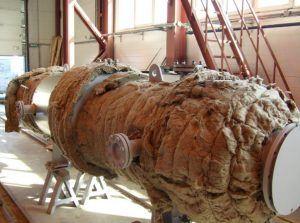 By using thermal insulation, manufacturers simplify their technological processes. This solution is widely used in many industrial sectors:
- Metallurgical.
- Food.
- Oil refining.
- Chemical.
But insulation receives more attention from energy companies. In this case, thermal insulation objects look like this:
- Smoke pipes.
- Heat exchange devices.
- Storage tanks where hot water is stored.
- Turbines with gas and steam.
Thermal insulation of pipelines is used on equipment located in both vertical and horizontal planes. This is a practical solution for insulating equipment, such as tanks that store water and heat transfer fluids. A number of stringent requirements apply to the effectiveness of insulating coatings.
What are the specific requirements in this area?
The list of necessary material requirements is based on the moisture, mechanical, temperature, and vibration loads experienced by the structures during installation. The following requirements apply to the thermal insulation coating:
- Efficiency in the thermal engineering sense.
- High safety indicators in terms of ecology and fire exposure.
- Durability combined with operational reliability.
Insulation and building codes
SNiPs are a type of regulatory document. They have become quite widespread in manufacturing. Using SNiPs, it is possible to implement thermal insulation in accordance with all density standards. The thermal conductivity coefficient for various types is also taken into account.
The calculation is performed using a special procedure for surfaces that do not have a specific temperature regime and that change their technical characteristics too quickly.
Procedure for making calculations
Without calculations, it's impossible to select the optimal material or determine the appropriate thickness. Without these calculations, it's impossible to determine the required thermal insulation density for equipment and pipelines. Factors that influence the final calculation results include:
- heat conduction.
- Ability to protect against deformation.
- Mechanical impacts.
- What is the temperature on the insulated surfaces.
- Vibration on equipment and the possibility of its occurrence.
- Temperature indicator in the environment.
- Load limit.
It's also essential to consider the loads generated by the interaction of equipment or pipelines with the surrounding soil and vehicles passing over the surface. Special formulas are used for all heat transfer systems, whether stationary or non-stationary.
We present a series of formulas for independently calculating the thickness of thermal insulation.
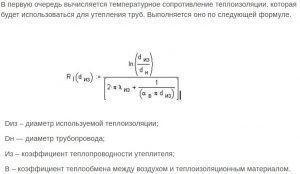
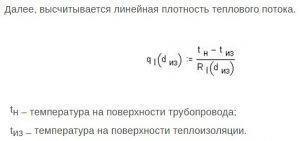
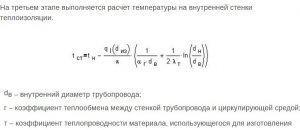
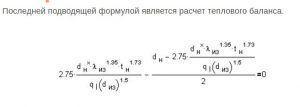

Thermal insulation calculations are artificially adapted to all operating conditions specific to a given pipeline or equipment. These conditions are determined using:
- Building materials to prepare for the changing seasons.
- Humidity, which promotes accelerated heat exchange.
Professional companies provide contractors with engineering data for future construction. Which specific requirements have the greatest impact on the selection of suitable insulating coatings?
- Thermal conductivity.
- Soundproofing.
- The ability to absorb or repel water.
- Vapor permeability level.
- Non-flammability.
- Density.
- Compressibility.
About the thickness of pipeline and equipment insulation
It's essential to refer to regulations to determine the permissible thickness for each specific piece of equipment. Manufacturers specify the density maintained during heat flow. Building codes and regulations (SNiPs) provide algorithms for solving various formulas, along with the formulas themselves.
To determine the minimum thickness of pipelines in a given case, the limit for permissible loss values in certain sections is determined.
Polyurethane insulation
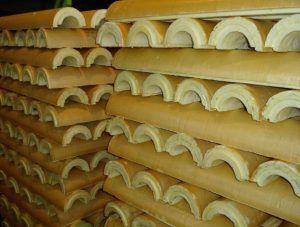
Pipelines with this type of insulation are used when the structure must be laid above ground, without trenching. During production, efforts are made to incorporate as many new technologies as possible.
Only materials of the highest quality are allowed into the process. They undergo extensive testing in advance, and according to the SP, the thermal insulation of equipment and pipelines is free of defects.
Using polyurethane foam reduces heat loss and ensures the durability of the insulation material itself. Polyurethane foam contains environmentally friendly components, such as Izolan-345 and Voratek CD-100. Compared to mineral wool, polyurethane foam's thermal insulation properties are significantly superior.
PPM and APB insulation
For over thirty years, so-called foamed polymer insulation has been used in pipelines. The primary type used in this case is polymer concrete. Its characteristics can be described as follows:
- Inclusion in group G1 during flammability tests in accordance with current GOSTs.
- Operating temperature range that allows maintaining 150 degrees.
- The presence of an integral structure that combines the functions of a waterproofing coating with a layer of thermal insulation.
Until recently, some regional manufacturers produced reinforced foam concrete insulation. This material has very low density. However, its thermal conductivity is pleasantly surprising.
APB has the following set of advantages:
- Durability.
- Waterproofing coating with high vapor permeability.
- The equipment is not subject to corrosion.
- The ability of a pipeline to withstand high temperatures.
- Fire resistance.
The advantage of these pipes is that they can be used for heating media of virtually any temperature. This applies to both water and steam networks. The type of installation is irrelevant.
Even a combination with underground trenchless and trenchless options is acceptable. However, products with polyurethane foam insulation are still considered a more technologically advanced solution.
About the thermal conductivity coefficient
While the equipment is in operation, humidification becomes possible – this is what has the greatest impact on the calculated thermal conductivity coefficient.
Special rules exist for adopting a coefficient that increases the thermal conductivity of insulating coatings. These are based on GOSTs and SNiPs, but other factors are also essential:
- soil moisture according to SP.
- The variety to which the thermal insulation material belongs.
The coefficient is equal to one for pipes with polyurethane foam insulation and a high-density polyethylene sheath. This coefficient is irrelevant to the soil moisture level where the equipment is installed. The coefficient will be different for equipment and pipes with APB insulation, which have an integral structure and allow for the possibility of the insulation layer drying out.
- 1.1 – coefficient level for structures located in soils with a large amount of water, according to SP.
- 1.05 – for soils where the amount of water is not so large.
Practical calculations use specialized engineering methods. These typically take into account resistance to external environmental influences. A two-pipe installation requires consideration of the mutual thermal influence of each element on the others.
Optimal thickness and additional recommendations
One of the determining factors when choosing the appropriate thickness is cost. These factors can be determined individually for each specific region.
There are other parameters that matter, too. Like the design coolant temperature. The ambient temperature is also important.
What other rules should be followed?
Not only Russian, but also foreign manufacturers are involved in the production of equipment and pipes, along with thermal insulation.
Some pipe-rolling production lines are capable of producing up to three kilometers of rolled pipe per day (with pipe lengths up to 12 meters). Product diameters range from 57 to 1020 millimeters. Protective wrapping is available in either polyethylene or metal.
However, certain shortcomings remain that cannot be eliminated at the production stage. These were identified by specialists through repeated practical testing.
- During transportation of metal-coated pipes, deformations may occur in the insulating coating.
- Polyurethane insulation peels off from the pipe that is being heat treated.
- The protective structure is detached from the outer or inner layers of the pipe.
The main problem is the expansion capacity of metal pipelines. Thermal heating leads to a deterioration in their quality characteristics. Therefore, protection against such impacts becomes an important factor.
The length of the pipe itself has the greatest impact on the stability and durability of a building's thermal insulation. It doesn't matter what medium it's used to transmit. The longer the length, the higher the risk of the layer simply failing.
Therefore, this parameter must be selected with the utmost care. Experts themselves have developed optimal pipe lengths and diameters that will ensure the structure remains in good condition regardless of its operating conditions.
They rely solely on SNiP, since thermal insulation of equipment and pipelines is particularly demanding in terms of compliance with the rules.