Shut-off valves are devices that divide a pipeline into separate sections and regulate the pressure within them. They regulate flow and create a certain level of tightness. They are widely used, accounting for up to 80% of all pipeline valves. Shut-off valves include: stopcocks, gate valves, butterfly valves, and cocks.
This equipment is designed to completely shut off or open the flow of various liquids in a pipeline in accordance with process requirements. Such devices include shut-off valves, gate valves, butterfly valves, and taps. Shut-off and control valves, in turn, act as flow regulators and create a tight seal within the pipeline.
Shut-off valves of all types are intended for use in the following environments:
- liquid and gas-liquid;
- water;
- vaporous.
 For the most part, such equipment is designed to operate only in two positions: “open” or “closed” and, most often, is not used in intermediate positions.
According to its purpose, reinforcement is divided into the following types:
- shut-off valve – to block the flow of the transported medium with the main condition of tightness;
- regulating – to establish a specific flow rate of the working medium by changing the nominal cross-section of the pipeline, usually controlled by an independent energy source;
- distribution – dividing the flow in the required directions, as well as for mixing different flows;
- safety - to prevent exceeding the permissible parameters of pipelines and vessels by pressure by discharging pumped products until the flow is stopped;
- Phase separation – used to separate the product into different fractions and states, these include oil separators, condensate and moisture traps.
The use of shut-off valves in sewerage systems is associated with the need to shut off individual sections for repairs.
For pipeline mains
To be effective, pumping products requires long distances at high pressure and speed. Therefore, special requirements are placed on the selection of pipes and shutoff valves—gate valves, check valves, and butterfly valves.
It is selected in accordance with technical standards, design pressure, fluid viscosity, and internal and external temperature fluctuations. The degree of pumping automation is also important.
In main water supply systems, the pumped liquid always contains a certain amount of aggressive components. Therefore, chemically resistant materials are used for valves. Cast iron, which is used to manufacture all types of pipeline shutoff valves, fully possesses these properties.
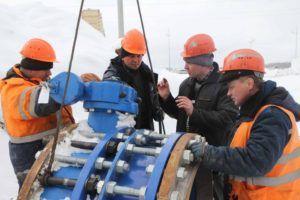 They are used in high- and low-pressure pipelines and for pumping various fluids. This material is also the most popular for the manufacture of pipeline fittings for oil pipelines.
Shut-off valves with sizes of 8–2000 millimetres are used on main pipelines.
The valves are controlled manually using flywheels, and in hard-to-reach places, using a remote electric drive.
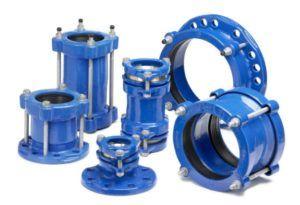
Most cast iron gate valves are designed with flange mechanisms and can be produced in various designs:
- Gate valves – with a movable or fixed stem;
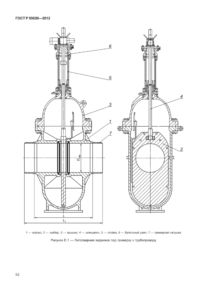 The gate valve is a cast iron body, which contains a flat gate valve with an opening corresponding to the pipe size. Two types of actuators are used for control: manual for units located in accessible locations, and remote for those installed in enclosed spaces.
The manual actuator consists of a handle, a screw pair, and a rod attached to the damper. When the handle is turned, the screw pair converts rotary motion into linear motion, which, via the rod, moves the damper in the desired direction. When the opening in the damper aligns with the opening in the pipe, fluid flow is resumed.
- Wedge valves are a highly effective type of shutoff valve for pipelines. The shape of the shutoff element ensures maximum sealing between the valve and seat, improving shutoff quality.
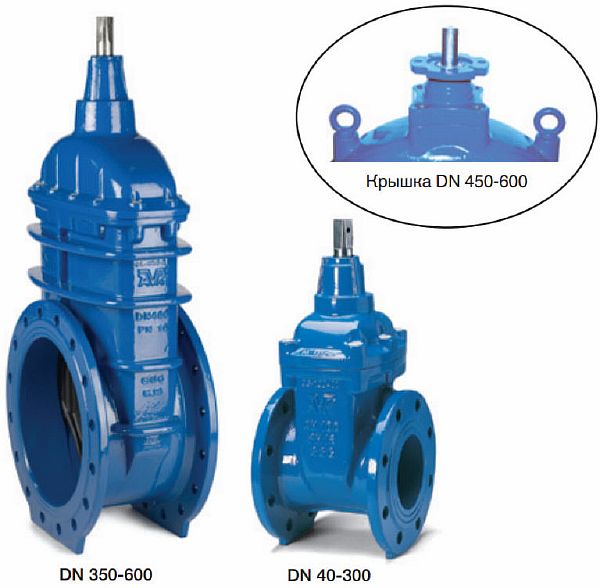
Lifting the gate causes the wedge to move relative to the seat, aligning its bore with the bore in the stationary part, allowing the working fluid to pass through. Rotation can be performed manually or remotely.
- Parallel.
Such devices are designed to operate at pressures of 2–200
atmosphere.
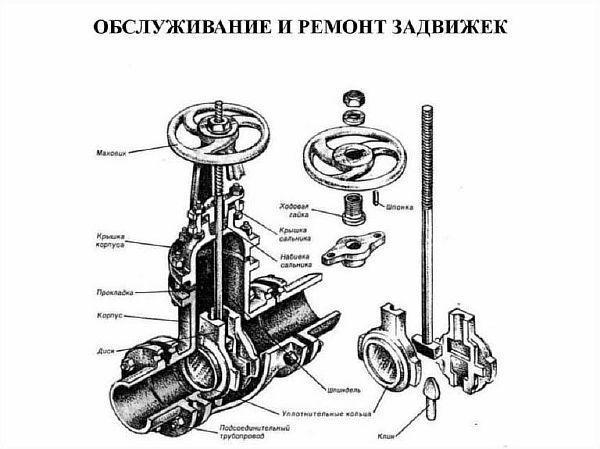
The working fluid and the device's shutoff elements, in the form of two plates, are located in the chamber. The shutoff plates are attached to the actuator stem. When the actuator stem rotates, they open, allowing water or steam to pass through the pipeline.
All presented valves have a number of common parameters, including:
- Connection to the product pipeline is made using flanges, couplings or welding.
- Gate valves are not used to regulate the pressure in the pipeline, but only to close or open it in extreme positions.
- Gate valve bodies are made from cast iron, less often from steel.
- All types of this fittings use sealing devices made of rubber, paronite, cardboard, etc.
- Depending on the availability of the device, a manual drive in the form of a flywheel or remote control using an electric drive is used.
Flanged shut-off valves for pipelines are used not only in water supply networks, but also when pumping petroleum products or other liquid media.
In distribution networks, valves and taps with coupling connections are often used on water supply pipelines with diameters DN100 and smaller. These devices are smaller in size and easier to install. Connections are made by screwing onto the threads of the mating component.
A seal on this type of joint is ensured by using various sealants: flax fiber, FUM tape (fluoroplastic sealing material), sealing cords, and special-purpose silicone sealant. This type of connection is less reliable than a flanged connection, but leaks are also quicker and easier to fix.
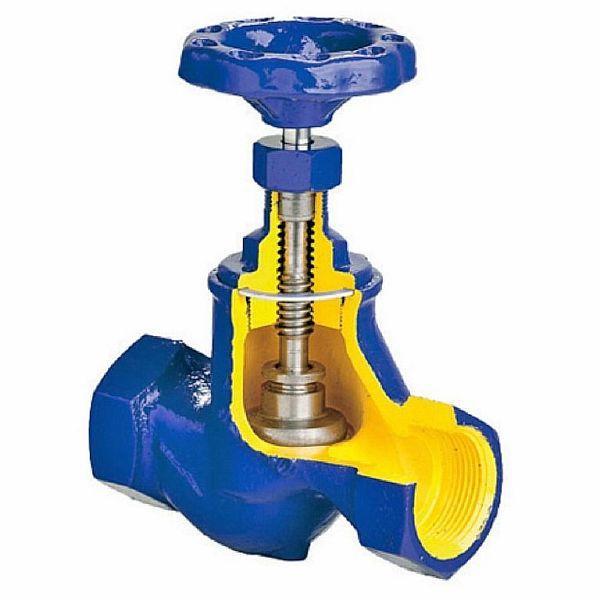
Shut-off coupling fittings for pipelines are used in in-house distribution networks with sizes less than DN 50 at a pipeline pressure of 0.6 atmospheres.
Water shut-off valves for distribution networks
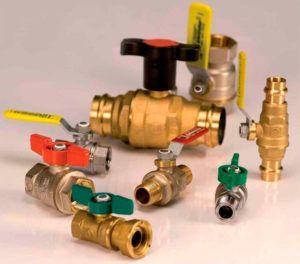 These products, of various types and purposes, are designed to deliver water from the supply tank to the final point of consumption. Their primary purpose is to shut off or open the flow of liquid in the pipeline, as well as regulate the pressure in the network. Simply put, any of these mechanisms, whether a faucet or a valve, allows you to shut off or resume the water supply.
The design of a shut-off valve is quite simple. It is based on a cast iron or brass pipe. A valve is inserted into it, which can partially or completely close the pipe, causing a change in pressure in the pipeline or stopping the flow. The mechanism is controlled by a lever valve of any shape.
Functional purpose of the devices
Water supply system fittings are installed not only in every house but also in every apartment. They regulate the pressure in the house's water supply system and distribute water throughout the apartment, where specified in the design.
Watch the video
Such devices are installed in industrial buildings and spaces where water is used as part of the production process, as well as for sanitary purposes. For this purpose, pipes made of special materials are used, different from those used in residential construction.
Shut-off valves for water supply systems are functionally designed to lock the liquid in the pipe and, if necessary, supply it to the destination in the required quantity.
The materials used to manufacture locking mechanisms can be various substances, but most often these are:
- Cast iron of various modifications.
- Brass.
- Stainless steel, which can safely pass chemically active liquids, which are also often pumped through pipelines.
On the advantages and disadvantages of various classifications of devices
Thanks to their high performance and aesthetic appeal, brass and stainless steel valves are currently the most popular. These valves can last up to fifteen years in a water supply system.
Despite this, research into increasing the durability of plumbing fittings using new materials is ongoing. This has resulted in the development of polymer-based fittings that can be used indefinitely, provided they are not subjected to harsh mechanical stress.
Watch the video - classification and types
For plastic water pipes, fittings made of a similar material are used.Otherwise, wear will be uneven at the interface with different materials. The overall service life of the system is determined by the material that wears the fastest.
One of the advantages of plastic water pipes is that they have no threaded connections. The components are joined using soldering equipment or adhesives. These connections are extremely secure and can only be broken by brute force.
Polyethylene pipes measuring 820–1020 mm are primarily used for main water networks. These pipes are used with plastic fittings for water supply systems. These pipes easily withstand the pressures typically encountered in water systems, which in most cases do not exceed 20 atmospheres.
Metal pipes are connected using the same fittings. However, since threaded connections are less reliable, sealants and gaskets must be used.
Let's look at the types and classifications
There are many designs of valves and taps for water supply systems. The most popular are:
- Cranes with crane axle box.
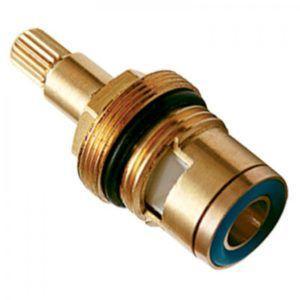
The flow of water through the pipe is blocked by tightening the stem, which acts on a rubber seal that fits onto the seat and seals the passage. The weak point in this system is the seal, which must be replaced periodically. Having a spare seal in the home with these faucets is an absolute must. The bodies of these faucets are made of brass, or less commonly, cast iron.
- Taps and valves with ceramic inserts
This design of water supply shut-off valves has already become common due to the high reliability of the bypass unit.
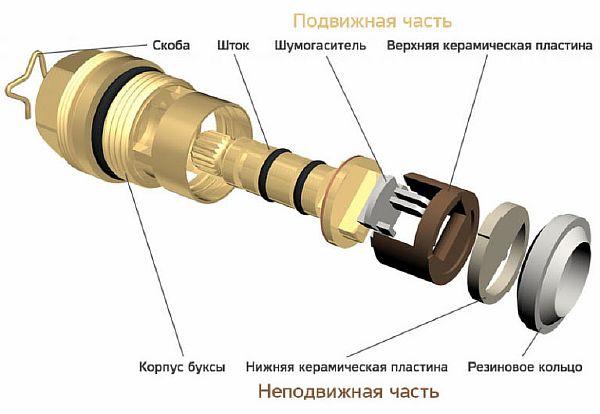
Water is released from the pipe by turning the handle approximately 180 degrees. This aligns the openings in two ceramic plates, opening the passage for water from the water pipe. Due to the high surface strength of the plates, they wear very slowly, and the use of a supporting rubber gasket in the lower (fixed) part of the valve body ensures wear compensation and a tight seal. The valve body (and the valve itself) are made of brass.
- Ball valves.
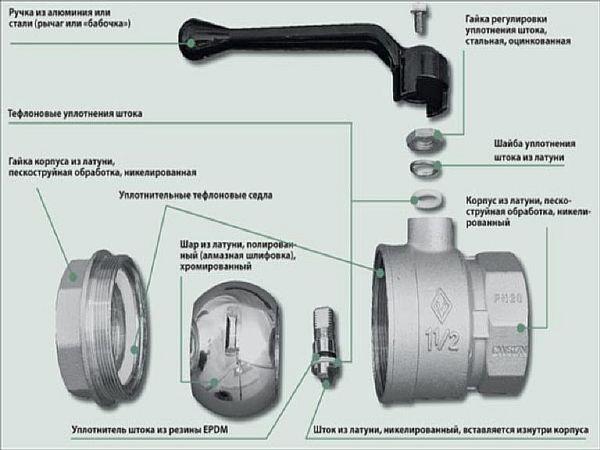
The shutoff element in these devices is a ball made of high-quality brass. It is polished with diamond paste and then nickel- or chrome-plated. The hole in the ball corresponds to the size of the passage. When the handle is turned, the ball rotates 90 degrees, closing or opening the hole. Wear-resistant Teflon rings serve as a seal. This device is not intended for flow control.
In addition to the types of shut-off valves listed above, many others are produced:
- valves for releasing air locks in the heating system;
- emergency pressure relief valves installed on vessels;
- valves for regulating the pressure in the internal water supply system.
Ball valves are used to shut off the pipeline in emergency cases.
Technology and production methods
The production of pipeline fittings is a complex technological process that includes a series of sequential steps that ensure the production of reliable and marketable products.
Watch the video
The technology for producing shut-off valves for pipelines includes the following steps:
- Marketing in the market of relevant products with the aim of determining the effective (sellable) range of products.
- Design and survey work to create models and types of products that are efficient in both quality and manufacturing costs.
- Development of production technology, determination of the optimal composition of equipment.
- Development of methods for effective non-destructive quality control of products.
- Developing effective advertising for your products.
- Logistics and product distribution.
The technology for producing shut-off valves for pipelines can be represented as follows:
- Purchasing raw materials for production. Incoming quality control of raw materials and components.
- Production of blanks for the manufacture of fittings by casting from cast iron, brass and other suitable materials.
- Heat treatment of cast blanks to give them the required mechanical properties.
- Mechanical machining of work surfaces to achieve the required flatness and surface finish. Turning of threaded connections.
- Applying a protective coating using galvanic plating. Nickel plating is commonly used.
- Assembly of plumbing fittings using parts of our own production and components purchased through cooperation.
- Final quality control of finished products and transfer to the finished product warehouse. It should be noted that intermediate quality control operations during valve manufacturing are performed after each process step. For example, after casting and galvanizing, ultrasonic testing is mandatory to detect voids and other imperfections.
- Sales of finished products.
Companies intending to sell their products abroad must certify them according to ISO 9001. Importantly, this standard regulates not only the final product but also the entire production process, starting with document management.
Watch the video
Technical documentation
The general requirements for the production of shutoff valves for pipelines and oil pipelines are regulated by GOST R 53673-2009. Operating rules and installation features are covered by a number of SNiPs (Building Codes and Regulations) regarding the relevant requirements.