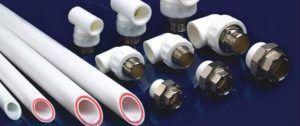
 Pipeline products made from this material are becoming increasingly popular due to their inherently superior performance properties compared to metal ones. Factors that determine their advantages include the following:
- durability – the guaranteed service life of polypropylene water pipes is 50 years for cold water and 25 years for hot water supply and heating networks;
- Polypropylene pipes are not coated on the inside with limescale deposits, which are the main cause of failure of metal analogues;
- Convenience and ease of installation, which determines higher productivity when creating piping systems.
Fittings for polypropylene pipes, structurally reproducing products of similar purpose for metal water supply systems, are more durable and reliable.
Types of reinforcement
All products intended for the construction of a water supply network can be classified as follows:
- Shut-off pipeline devices – include a valve for shutting off full or partial flow of the working medium.
- Adjusting devices – manage the capacity of the product pipeline.
- Protective fittings – is triggered when an emergency situation occurs in the network, blocking the flow of the conducting medium.
- Safety devices – are designed to relieve excess pressure in the network in automatic mode.
- Distribution and mixing – to change the direction of flows or mix them (mixer).
- Separating devices – are used to remove products that are in different phase states, for example – steam into one pipe, water into another.
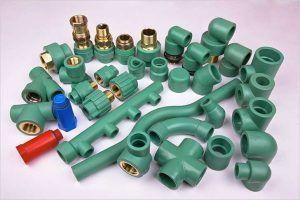
The variety of products allows you to create water supply networks of any level of complexity.
Shut-off valves
Shut-off valves for polypropylene pipelines include ball valves and various valves. They can be made entirely of polypropylene or a combination of plastic and metal.
The latter is selected based on the principle of high corrosion resistance and durability.
Ball valvesTheir purpose is to completely open or close the flow of liquid through the network, meaning that such a device has two main positions: "open" or "closed."
ValveThis type is used as a regulator of the flow rate of the working fluid and can operate in various positions, closing or opening the system cross-section.
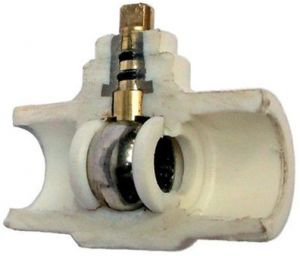 The main characteristics that shut-off valves meet are:
- The limit for the working fluid temperature is 95OHowever, some manufacturers have now mastered modified plastics that are capable of stable operation at 110O.
- Maximum network pressure up to 20 bar.
- The service life of cold water supply networks is 50 years.
- The same indicator for hot water supply is 25 years at an operating temperature of 75OWITH.
The following types of devices have been developed and are in use:
- non-separable ball valve;
- The disassemblable version includes a union nut, straight, for radiators;
- the same, corner radiator;
- ball valves with one or two detachable connections;
- valves at angles of 90 and 45O.
Shut-off valves for the presented types of polypropylene pipes are available in gray or white. When selecting pipeline components, single-color versions are typically selected.
Video
A distinctive feature is the installation method. Shut-off valves can have a threaded connection for use when transitioning from metal to plastic, or a soldered connection when connecting to plastic.
About the advantages and disadvantages of plastic reinforcement
The advantages of such products include the following:
- their price is significantly lower than that of metal analogues;
- durability;
- high tightness throughout the entire service life;
- resistance to corrosion and limescale formation;
- ease of installation, making it suitable for self-installation;
- there is no need for maintenance.
Video
- shut-off valves made of polypropylene are non-separable; if they break, the entire unit will have to be replaced;
- inability to regulate the flow rate with a ball valve.
Considering the low price and ease of replacement, such disadvantages can be easily ignored.
How to choose
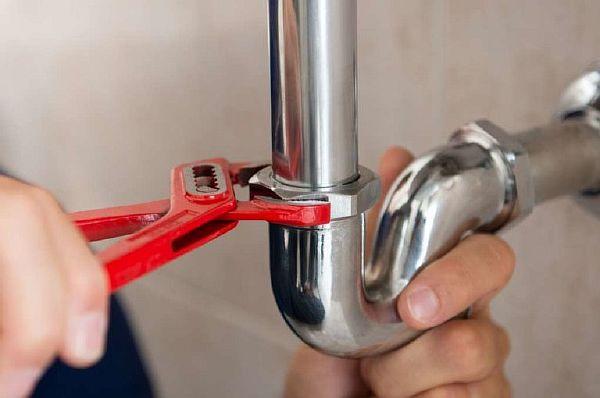
First of all, if you have no experience with plumbing work, it is advisable to involve a specialist who can objectively evaluate the quality criteria of the product when selecting fittings:
- Instead of purchasing goods at the market, you should prefer to go to a specialized store where the quality of the goods is carefully checked;
- its comparative cheapness should be a warning sign - everyone knows where there is a free lunch;
- A necessary condition for purchasing is the integrity of the product body; chips, cracks, and even scratches are unacceptable;
- It is necessary to find out the manufacturer’s data, including checking the quality certificates and the manufacturer;
- it is necessary to ensure that the connection dimensions of the fittings correspond to the size of the pipes;
- the rotary element of the tap or valve must correspond to the installation location in the system so that it is convenient to use;
- Find out the material of the locking element. If it is made of plastic, the product will be cheaper, but metal parts are more durable. The choice is up to the buyer;
Video
Plumbing fittings
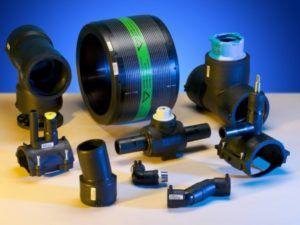
It is divided into types based on shape and size. Its main purpose is to form pipelines of various types with a given configuration.
Video
- Couplings used to connect pipes in straight sections.
- Adapters – used to connect pipes of different sizes.
- Corners – used to change the direction of system elements at a right angle or a 45° angleO.
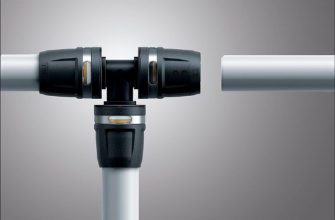
- Tees – for creating branching networks while maintaining the nominal bore or reducing it.
- Expansion joints – used to dampen vibrations from pumping equipment and compensate for thermal expansion of pipes in hot water and heating systems. They also protect pipelines from damage caused by water hammer.
Plumbing fittings for polypropylene pipes also include a transition element from a metal pipeline to a plastic one.
This is the so-called "American", in which a metal part for a threaded connection is pressed into the polymer part. The second part welded to a polypropylene pipe using a special soldering iron.
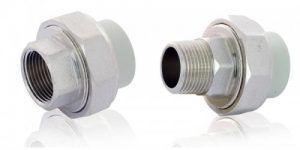
The design of this type of fitting allows it to be used repeatedly.
Select sizes
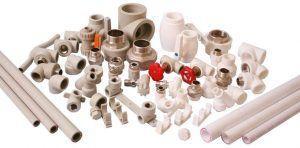 As a rule, fittings for polypropylene pipes have sizes of 20, 25, 30 or 40 mm, which are most commonly used for pipelines in private homes and internal distribution systems for hot and cold water supply in residential buildings.
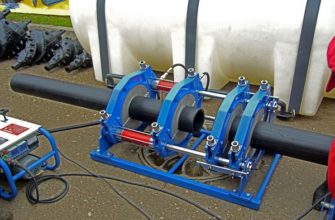
The market offers these products in sizes up to 160 mm, but this is an industrial-grade material. Plumbing fittings for polypropylene pipes are installed in water supply systems using welding.
Gravity drainage systems
Video
The advantages of these pipes are obvious:
- The smooth inner surface of polypropylene pipes does not allow any fibrous materials to get stuck, preventing the formation of blockages;
- Plumbing fittings for polypropylene pipes, such as tees, elbows, bends, and other fittings, are connected to them via a socket and a rubber cuff. Applying silicone sealant to this connection ensures a secure seal.
- fittings for polypropylene pipes, the dimensions of which for gravity-flow systems range from 25 to 160 mm, and the pipes themselves are tens of times lighter in weight than similar cast iron ones, which facilitates their delivery to the site and distribution for installation.
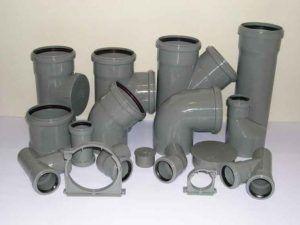
Fittings for polypropylene pipes measuring 110 mm are used for toilets and central risers, for bathrooms and shower cabins the dimensions are 40–50 mm, for riser branches it is preferable to use pipes of 65–75 mm, The external sewerage network is constructed from pipes measuring 110–160 mm, depending on the estimated volume of drainage..
The fittings for polypropylene pipelines are standardized in size for connection with pipes and do not require any modifications before installation or during assembly.
Conclusion
Polypropylene pipes and fittings have revolutionized construction, water supply, and sanitation technology.
Video
The welding technology, which we've intentionally omitted, can be learned in detail from the device's operating instructions for this operation. We hope this information is helpful. Good luck!