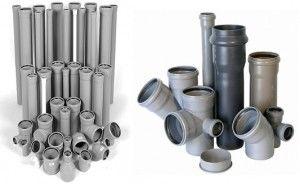
 PVC sewer pipes were among the first to find application in the piping industry.
When tested in field conditions, only these products yielded positive results: after 50 years of operation in the ground, the water supply system demonstrated full suitability for further use for the same period.
European countries have appreciated the reliability and environmental friendliness of PVC products – today their use reaches 80%.
Advantages of PVC pipes
Currently, no other species can successfully compete with them. This is due to the following advantages of use.
- Their thermal conductivity approaches that of insulating materials.
- They are bacteriologically and toxically safe.
- They are classified as highly flammable materials with a flash point of 500°C.
- Resistant to chemical (deformation, corrosion, rust) and physical influences.
- Inert to acids, alkalis, etc.
- They have excellent hydraulic properties, which is especially important in horizontal sections of sewerage systems.
- Their permeability remains constant over time, thanks to their smooth inner surface. This also prevents the growth of germs and bacteria.
- They are distinguished by their resistance to wall overgrowth.
- PVC sewer pipes can be used in a wide range of temperatures – they retain their properties from -20°C to +60°C, and are capable of withstanding even hotter environments – close to 100°C – without releasing harmful substances.
- Easy to install and take the desired shape,
- Even if there is a large amount of sand in the drains, the wear resistance is high.
- Service life is at least half a century.
All specified properties, the range of tubular products and fittings for them must comply with the standard values given in the GOST and TU tables, according to which these products are manufactured.
Scope of application
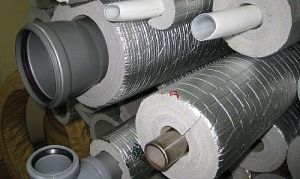 First of all, for its intended purpose – for gravity drains of new or reconstruction of existing sewer systems (external – Ø 110 mm and above, internal – starting from Ø 50 mm – see table).
- During the construction of entertainment complexes – water parks, swimming pools and fountains.
- In the chemical industry – for removing aggressive compounds.
- For transporting beverages – milk, carbonated and alcoholic products.
- For agricultural purposes, they are used to make drinking bowls for livestock and for irrigation.
Purpose depending on the product range
Their range corresponds to the tables of sizes used in sewer networks - both external and internal.
The selection is made based on the specific needs of the task at hand. To simplify this process, a unified standard has been created regulating their dimensions. The determining factor is the diameter. Table 2 presents the range of sizes of PVC products manufactured for sewer systems.
Manufacturers label these products by their outside diameter and wall thickness. The inside diameter is determined by subtracting the outside diameter from twice the wall thickness.
- Internal sewerage is installed from pipes of sizes 50, 110 and 125 mm.
- External – starting from Ø 110 mm.
- Between buildings – 160 mm in diameter.
- Along the street – starting from Ø 200 mm.
When installing communications outside of buildings, the dependence of the rigidity of the structure on the expected load is taken into account:
Table 1.

PVC pipes Ø 110 mm
PVC sewer pipes Ø 110 mm have the widest range of applications - both in the installation of internal and external communications.
Their capacity allows them to be used in a small house or apartment, if the amount of plumbing in it is standard.
External PVC sewerage systems Ø 110 are installed if necessary:
- remove wastewater outside buildings and residential premises;
- install external sewerage systems in cottages and low-rise buildings;
- to implement a surface drainage system - as a continuation of linear and point drainage systems.
The widespread use of Ø 110 pipes is economically and technically justified. This is facilitated by:
- their lightness and elasticity;
- They are easy to install and, if necessary, can be removed.
What does a gravity-fed system entail?
- Drainage is carried out by gravity, when pipes measuring 110 mm are used:
- for continuous discharge of wastewater at a temperature not exceeding 80°C;
- for short-term discharge of wastewater at a temperature of 95°C.
When laying PVC sewer systems Ø 110 mm, the following should be taken into account:
- mandatory slope – 10-20 mm/m – to ensure full water collection volume;
- the installation depth must correspond to the level of soil freezing in the region (average value – 1-1.5 m);
- When filling the system, there should be no stones or construction debris to avoid damage;
- The soil above the sewer should not be compacted.
Pipelines made of 110 mm PVC pipes can be concreted provided they are first wrapped with parchment and waterproofing material.
PVC pipes Ø 50 mm
Sewer pipes Ø 50 mm – products with a small diameter, correspond to the beginning of the size range of sewer pipelines (Table 2).
Used:
- when installing external and internal sewerage systems;
- for drinking water supply and in heating systems;
- for creating plastic drainage systems inside buildings, connecting plumbing to them, as well as for draining wastewater – domestic and storm water;
- Internal PVC drainage system Ø 50 mm is installed in rooms equipped with high-temperature water drainage – from washing machines and dishwashers.
The socket connection ensures quick and easy installation.
Pipes Ø 50 mm have the required rigidity, are resistant to high temperatures, and are installed without the use of fittings.
If installation and operation are carried out correctly, the service life of such sewerage systems can be quite long – several decades.
The pipes are Ø 50 mm and gray in color, with a smooth surface. They have a socket for a connecting ring.
Comes with a cuff.
Technical features of pipes Ø 50 mm
The maximum temperature of the passed liquid is 70°C.
Short-term exposure (up to two minutes) to hotter liquid – up to 95°C – is possible.
- There is a tendency to extinguish when ignited.
- There is no reaction to all substances that can be used in the household.
- There are no emissions of toxic compounds.
- Resistant to the release of acids - organic and inorganic, alkalis.
- High strength allows it to withstand pressure of 12 MPa.
An important task when laying pipelines is to ensure the absence of internal pressure.
The range of sizes of PVC sewer pipes produced
As Table 2 shows, diameters and wall thicknesses are interrelated. They have fixed values and comply with SNiP 2.04.01085. This document also defines the formulas for calculating all sewer system parameters. If necessary, pressure, temperature, and connection angles can be calculated. For sewer system installation in a house, the basic parameters are sufficient for calculation.
Table 2.
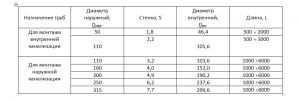
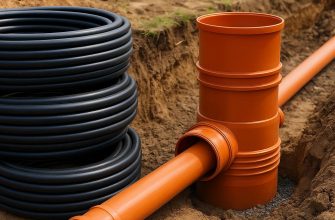
The sewer pipes presented in Table 2 for installation of internal systems are made with a gray surface, for external communications they are painted red.
Let's sum it up
- When designing a sewer system, it is necessary to accurately calculate the pipe sizes for installation at a specific site in order to ensure the required throughput without purchasing elements with a larger diameter than is economically and technically justified.
- A prerequisite for normal operation is the free flow of air to prevent the formation of a low pressure area during flushing, when the water seal will be sucked inward.
- If the system is installed correctly, it will work for a long time and without any unpleasant surprises.
All these qualities make PVC sewer pipes the most popular among all those used today.