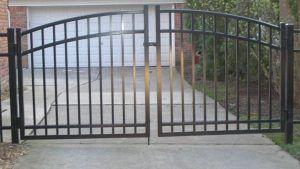
 An entrance opening for a site consisting of a gate and wickets, maybe a lot speaks about its owner as a person and is one of the indicators of social status.
An entranceway harmoniously integrated into the property's exterior becomes its face, so special attention is paid to this element.
One of the popular materials for making gates and wickets are square or rectangular hollow products, allowing you to make gates from a profile pipe with your own hands with minimal labor and financial costs.
To make such a structure with your own hands, you only need to have confident skills welding work and be able to work when cutting profiles.
Material characteristics
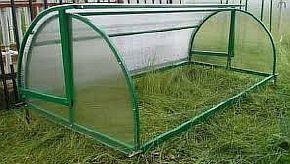
Profile pipes were developed as a structural material for the production of frame furniture and the creation of metal bases for various types of structures, such as gazebos, greenhouses and hotbeds, etc.
The size range includes profile pipes from 20 x 20 mm with a wall thickness of 1–1.5 mm to 150 x 150 mm with a wall thickness of up to 5 mm. The primary manufacturing method is welded products with a single longitudinal seam.
The material for such pipes is low-carbon steel with high weldability; metal of any degree of deoxidation is used; the marking indicates the possibility of using steels of calm casting, semi-killed or boiling.
Let's consider the types of structures
The main designs used in the manufacture of these products are swing or slidingThe latter can be double-leaf or single-leaf. The site dimensions and the location of access roads are important factors in determining the design.
Gates and wickets can be either closed or translucent, with various decorative elements. The color scheme should match the fence and roof of the house. Bending of profile pipes within the permitted dimensions is widely used.
What gates should I install?
The choice is determined by the specific conditions of the driveway's location. If you plan to install outward-opening swing gates, you need to measure the distance from the driveway to the road.
Video
With a gate width of 3.5 meters, the minimum clearance must be 6 meters, otherwise, opening the gate may obstruct traffic. Most gardening communities do not have these requirements.
The only option left is swing gates that open inwards to the property; in such cases, the distance from the gates to the house must be at least 5 meters.
Sliding gates require a minimum clearance of 7.5–8 meters from the outermost post to the property line. They can be equipped with an upper or lower support along which the fence slides. The first option involves constructing a supporting structure above the entrance, which will limit the vertical clearance for vehicles.
The construction of such a structure itself is not cheap. A load-bearing structure with a bottom-mounted structure is much cheaper, but its operation requires constant maintenance to clean the channel, which will accumulate dirt. In winter, problems can be much more serious due to freezing of the channel.
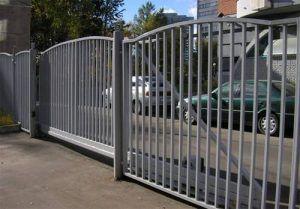
Choosing a sliding design with double-leaf gates is no more difficult than the single-leaf version and is used when there is insufficient space for a single-leaf sliding design.
The sequence of events when making sashes with your own hands
Video
Like any structure, gates require certain operations to be performed in a strictly defined order:
- Determining the design of the entry section taking into account the criteria outlined above.
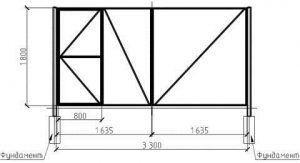
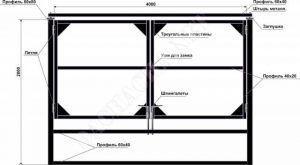
- When developing a draft design for a gate made from profile pipe yourself, drawings are essential. This will allow you to consider all the design details and make efficient use of available materials. Before starting the project, you should determine the availability of materials and their dimensions. This information will be needed during the design process.
Determining the depth of soil freezing in the construction region is a crucial factor in determining the depth of the foundation pits for supporting structures. Insufficient pit depth can lead to seasonal movement of the supports, which can lead to their displacement, with predictable consequences.


- The final dimensions of the gate and wicket leaves should be selected after the posts have been installed and concreted, with adjustments made if necessary depending on the actual location of the supports.
- Prepare a detailed specification for each sash separately, indicating the cross-sectional dimensions and length.
- The parts are prepared by cutting them using a grinder, and each part is marked separately using a tape measure and chalk.
- The sashes must be assembled on a frame. This can be made from scrap lumber left over from house construction. The main requirements for the frame are that it be strictly horizontal and flat. A carpenter's level must be used during installation. The frame components must be fastened together with temporary fasteners.
- Lay out the frame components on the jig. Secure the components in place using any convenient method; clamps are best. Check the angles with a square and the diagonals with a tape measure. When constructing a gate frame from profile tubing yourself, it's crucial to ensure the diagonals of the gate panels are aligned, ensuring they fit together and creating a visually cohesive structure.
- Tack the parts together, recheck the diagonals, and then install the braces. A smaller profile pipe is used for these parts. The braces can be cut to size and tack-welded. To strengthen the frame, 3-4 mm thick sheet steel angles can be used instead of braces. They are welded along the contour of the mating parts.
- The second sash is made in a similar manner.
All work on assembling the sashes is carried out with the participation of at least one assistant.
Manufacturing of gate frame
Video
The gate's supporting structure is the frame, which supports the gate posts and wickets. The supporting parts are made of 150 x 150 mm profile tubing with a 4-5 mm wall thickness. Frame assembly is essentially the same as installing the gate leaves and is performed as follows:
- All parts are laid out on a frame and assembled using tacks with diagonal checks.
- When building posts yourself, the length of the buried portion is determined based on the soil freezing depth in the construction region. For example, in the Moscow region, this value is 1.8 meters. The frame is assembled permanently without installing the top tie.
- To install the support structure, two pits must be dug for the posts to a frost depth plus 20 cm. This work is most easily accomplished with a 200 mm diameter garden auger or auger. A 15-20 cm thick drainage layer of sand and gravel is placed at the bottom.
- The pits are connected by a trench 50 cm wide and deep.
- A drainage layer also needs to be installed at its bottom.
- Reinforcement can be done using a road mesh with a cell size of 50 x 50 cm.
- The bottom layer of mesh is laid 5 cm from the drainage, using broken bricks as a base. The second layer of reinforcement is placed 10 cm from the first. The mesh sections are secured together with binding wire.
- The upper crossbar of the frame is attached at ground level, the lower one – at a distance of about 30 cm below the upper one.
- The frame must be installed in the prepared pits, carefully aligned horizontally and vertically, and then concreted to ground level, taking into account the thickness of the final pavement, if any. The concrete must fully cure for at least 30 days. However, after 7 days, it is permissible to concrete the interior of the posts using rebar. After this, the upper openings must be sealed with sheets of sheet metal and two M16 studs welded to their centers to secure the upper crossbar. If tall vehicles are required to access the crossbar, the crossbar can be removed.
- The sashes are installed on site by welding the hinges with a vertical seam.
- Upon completion of the work, it is necessary to carry out anti-corrosion treatment of all metal structures.
Video
Gate leaf design
To perform this operation, various materials are used:
- Profiled sheet. Due to its design, this material significantly enhances the load-bearing capacity of the gate leaves, increasing resistance to wind loads. Almost any color scheme is available. Decorative elements are made as bent parts from 40 x 4 mm steel strip and 14 mm diameter rod.
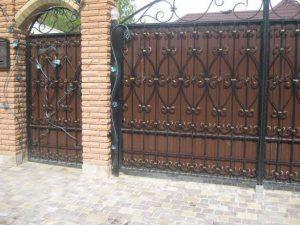
- Wood veneering is considered the least expensive method, yet still delivers a highly effective result.
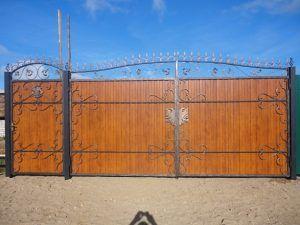
The use of such material assumes that the fence around the site is also made using boards. See just like you can weld a fence from profile pipes on one's own.
- unconventional materials – cellular polycarbonate
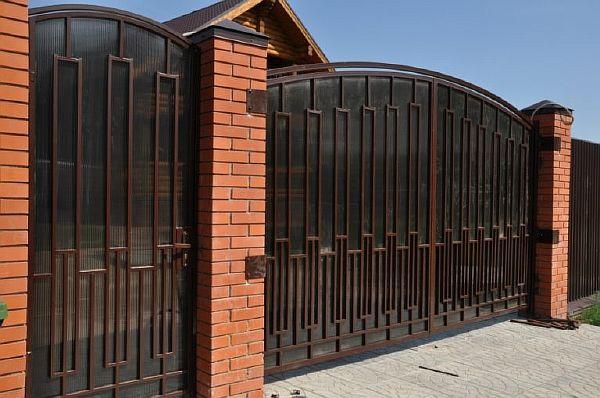
In addition, the following are used:
- wooden and metal picket fence;
- steel sheet and products made from it;
- sheet plastic.
Conclusion
Making a gate from a profile pipe with your own hands is not a particularly difficult task for someone with intermediate skills and sufficient competence to perform simple calculations.
We hope these considerations will be helpful in successfully implementing your plans. Good luck!
Video