The drainage system is an important component of site improvement; its basis is drainage pipes for removing groundwater.
They can be made of different materials and have different diameters. They should be selected based on the specific site conditions.
This is what this article will be devoted to.
- What is the purpose of a drainage system?
- Types of drainage elements
- Plastic products
- Diameters of drainage parts
- Which drain should I choose based on its characteristics?
- Elements for storm drainage
- Selection of drainage products for groundwater drainage
- Drainage pipe manufacturers
- Laying a drainage pipe yourself
- Cleaning the drainage system
- Conclusion
What is the purpose of a drainage system?
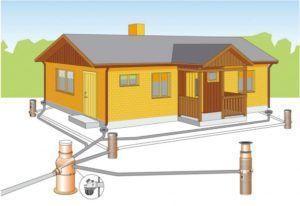 The installation of drainage for the removal of groundwater is mandatory:
- in the area adjacent to a large body of water;
- on a site with marshy soil;
- if there is a high level of humidity in the area;
- when a large amount of precipitation falls on the area.
Drainage is necessary to dry out the yard by removing excess water coming from various sources:
- it could be precipitation;
- melt water;
- subsoil and irrigation water.
Due to excess water:
- Plants can die. Waterlogged soil prevents oxygen from passing through, leaching out the nutrients needed by plants.
- Softening soil can cause building foundations to sink, which could damage your home.
- Garden beds and paths become deformed.
To prevent such problems, drainage systems are installed to remove groundwater and other water.
Types of drainage elements
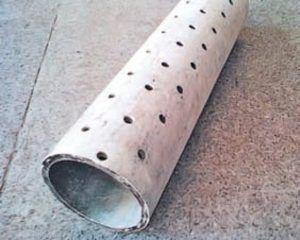 Depending on the material of manufacture, the drainage pipeline can be:
- ceramic;
- reinforced concrete;
- asbestos-cement;
- polymer.
Pipes made from the first three materials are rarely used now, as they have many disadvantages:
- They are heavy, making their transportation and installation quite expensive. Installation requires the use of specialized equipment.
- Installing ceramic, concrete, and asbestos-cement pipelines is equally challenging and should only be performed by specialists.
- These network products have poor performance characteristics. Their components are usually not perforated. The pipes must be perforated manually. As a result, they clog faster and require regular cleaning.
Plastic products
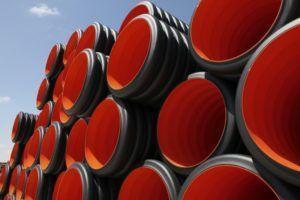 Polymer products for groundwater drainage outperform their counterparts made from other materials. Their advantages include:
- long service life;
- sufficient level of strength;
- resistance to aggressive chemical environments;
- low weight, thanks to which the pipes are easy to lay, this process is carried out quickly;
- Due to the smoothness of the inner walls, deposits do not build up on them, so the pipeline does not become clogged for a long time;
- the use of geotextiles during installation prevents siltation of the structure;
- You can bury the system yourself; this does not require any special skills or equipment;
- Plastic drainage is inexpensive.
Products are manufactured from three types of polymer:
- polyvinyl chloride (PVC);
- low-density polyethylene (LDPE);
- polypropylene (PP).
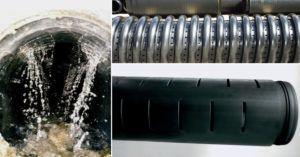 PVC drains are the most popular. Polymer products can be:
- single and double layer;
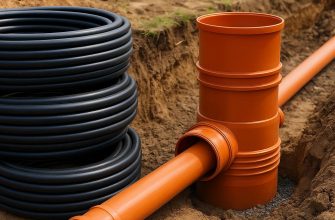
- flexible (supplied in coils up to 50 meters long);
- rigid (their length can be 6-12 meters);
- perforated (fully or partially);
- wrapped in filter material.
In addition, plastic drainage products are divided into strength classes (ring stiffness). They are designated by the letters SN and the numbers 2, 4, 6, 8, and 16.
Diameters of drainage parts
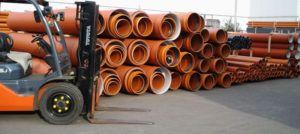
Drainage structures come in various diameters, from 50 millimeters to 425. This allows for the construction of drainage networks with varying capacities. For the removal of significant volumes of water. a large cross-section network is required - 30-40 cm.
For household networks, products with a diameter of up to 20 cm are generally sufficient. Drains with a diameter of 11 cm are most popular in public areas.
To calculate the network diameter, it is necessary to take into account the characteristics of the site:
- Moisture level and soil type.
- Filtration coefficient.
- The depth of soil freezing.
- The size of the water inflow, etc.
When draining a property up to 400 m², 11 cm diameter pipes are sufficient. Pipes of the same size are also used to drain a building's foundation. The groundwater drainage radius of an 11 cm diameter pipe is 5 meters.
Watch the video
The drainage system can be wrapped in geotextile. This will filter debris. The trench width should be 0.4 m wider than the cross-section of the network elements.
For large areas, large-diameter drainage pipes (20 cm) are used for ditches. Their depth is approximately 8 m, taking into account the compressive load from the soil.
Large-diameter pipes (LDPs) with diameters of 31.5 and 42.5 cm are used for shaft installations and are most often used to construct drainage wells. These products can withstand maximum compressive loads.
Which drain should I choose based on its characteristics?
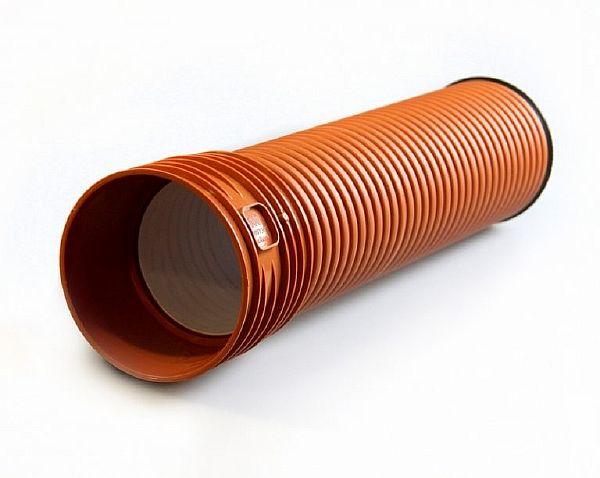
Flexible single-layer products equipped with perforation, can be used at a depth of no more than 3 meters. The ring stiffness category of the product can also indicate the desired burial depth. For example, SN-2 products can be buried no deeper than 2 meters, while SN-4 products can be buried no deeper than 3 meters.
For double-layer drainage Smooth inner walls. The outer layer is corrugated. In most cases, the strength of such products is SN-6. When laying drainage networks, two-layer elements no longer than 4 meters are used. They can be wrapped in geotextile or coconut fiber as a filter layer.
Flexible single-layer perforated and corrugated products belong to strength class SN-8. They are available with or without a fabric filter. They can be installed to a depth of up to 10 meters. Double-layer drains of this type are buried no deeper than 8 meters. They are not equipped with a filter.
Elements for storm drainage
In a stormwater drainage system, liquid is drained by gravity, meaning no external compression is applied. Therefore, there are no special pressure requirements for this type of drainage system. The only important strength parameter is that the stormwater drainage system must be able to support the weight of the backfill when buried.
Thermal resistance requirements for products are also minimal. Storm drains are not used at high temperatures. The only requirement is that the drains must not lose their strength in winter, when temperatures drop below freezing. A properly designed and installed storm drainage system will prevent moisture from stagnating, eliminating the risk of network freezing.
When pipes are laid underground, they are exposed to aggressive chemicals dissolved in water or present in the soil. Therefore, the most important criteria for selecting drainage components are their inertness to such compounds and resistance to corrosion.
The most important quality of a stormwater network is its throughputThe required drainage diameter is determined during the system planning stage. Most commonly, elements with a diameter of at least 11 cm are used for water drainage.
Watch the video
Another condition for the efficient operation of storm sewers is the lowest possible hydraulic resistance within the pipes. The walls of the pipes should be as smooth as possible. This will prevent dirt and debris from settling on them.
Storm drains can come in varying lengths. However, it's best to choose elements with the maximum length. This will reduce the number of connections in the system, increasing its efficiency and reducing installation costs.
Selection of drainage products for groundwater drainage
Building foundations can be eroded by subsurface moisture at depths of up to 2 meters. Groundwater can also contain dissolved substances that contribute to the deterioration of building materials.
Waterproofing is of little help in this case. The best option is to bury the drainage pipe. When designing it, the soil type and its moisture content must be taken into account.
Excessive moisture in the soil leads to freezing, rotting, crop diseases, and waterlogging. To prevent this, choose corrugated drainage systems made of low-density polyethylene.
The optimal types of pipes for different types of soil are presented in the table:
| Soil type | Recommended pipe type |
| Crushed stone | perforated products not wrapped in filter textiles |
| Sandy, sandy loam | pipes wrapped in a geotextile filter in a crushed stone embankment |
| Clayey | products with or without filter wrapping in a 20 cm thick crushed stone embankment |
| Loamy and combined | products in a filter wrapper made of geotextile material |
Watch the video
Drainage pipe manufacturers
More and more factories are opening to produce pipes, including those for drainage systems. However, the products most often used are those produced by trusted and well-known manufacturers. Among the Russian companies are:
- SK-Plast;
- Corsis;
- Politek;
- Ruvinil;
- Nashorn;
- Perforcor;
- Kama-Polymer.
Among foreign manufacturers, products from the following companies are in demand:
- Rehau (Germany);
- Wavin (Netherlands);
- Uponor (Italy);
- Ostendorf (Germany);
- Polieco (Italy).
In fact, the technology for making drains is the same everywhere. Therefore, all factory-made products are of roughly the same quality. The only difference is the cost.
Laying a drainage pipe yourself
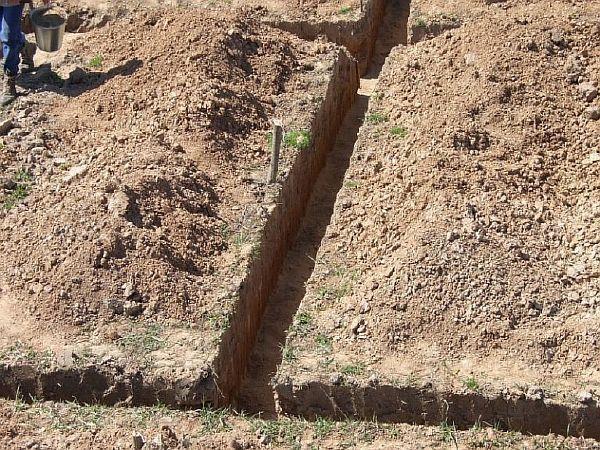
Before installing the drainage system, it's necessary to calculate its size and select the optimal type of pipe. A site plan will be required for the project. Geodetic data can also be obtained from the regional land use department:
- Seasonal depth of groundwater.
- Soil characteristics and structure.
- The average annual volume of precipitation and flood moisture falling on the site.
Knowing these parameters, professionals will perform the necessary calculations and determine the depth to which drainage pipes should be buried and their diameter.
Watch the video
The arrangement of the network for liquid drainage is carried out as follows:
- First, the yard is marked out according to a pre-prepared plan. Strings are stretched along the marked lines.
- A trench is dug along these axes. Its depth is determined by calculation. To determine the trench width, 0.4 m is added to the pipe cross-section.
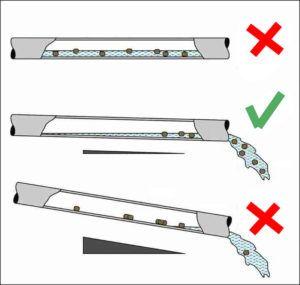
 Before making a ditch, it should be taken into account that the slope of the pipeline should be at least 3 degrees towards the inspection wells.
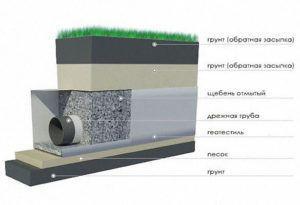
- A bed of river sand (10 cm thick) and crushed stone (20 cm thick) is poured onto the bottom of the dug ditch. This is then carefully compacted.
- Next, drainage pipes are installed on the fill to drain groundwater. They are first wrapped in geotextile.
- If necessary, the drainage components can be cut with a hacksaw. Couplings should be used to connect the components.
- After installing the groundwater drainage structure, it's important to check its slope. To do this, stretch a construction cord along it.
- Inspection manholes should be installed where the branch ditch turns and where the pipeline's slope changes. They should be covered with lids to prevent debris from clogging. These manholes serve to monitor and clean the structure.
- At the final stage, the deep drainage is covered with backfill. Crushed rock is spread over the pipeline, followed by a layer of sand, and finally, the excavated soil is placed back in place. All layers are carefully compacted.
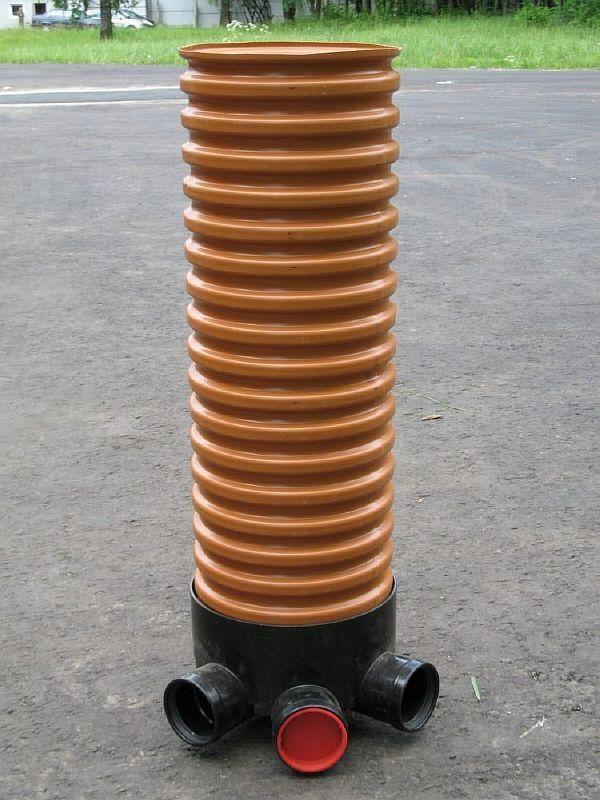
The structure is discharged into a ditch, a nearby body of water, or a storm drain. At the end of the outlet pipe a check valve is installedWhen it's impossible to construct such an outlet, a collection well is installed. Once it's completely filled with water, it's pumped out.
When installing drainage to remove liquid on a property, remember that the driveway also needs to be equipped with a pipe. A pipe with maximum ring stiffness will need to be buried in the ditch there.
 When installing a drainage system, avoid mistakes that could impair its operation. The most common ones are:
- Insufficient drainage depth. This could lead to an imbalance in the area's water balance.
- Using drainage products unsuitable for site conditions leads to rapid network failure.
- Incorrectly selected network slope. This will lead to problems with groundwater drainage on the site.
Cleaning the drainage system
When maintaining a groundwater drainage system, it's important to periodically check for clogs or malfunctions. If any problems arise, they are promptly addressed.
You should also regularly check the groundwater level in your yard. This will help you understand how effectively your drainage system is removing excess water. Timely preventative maintenance and repairs will not only extend the life of your drainage system but also prevent the risk of accidents.
The drainage system should be flushed regularly. This will prevent clogging or clear it if it has already occurred. For maximum cleaning effectiveness, it's important to choose the most appropriate method for each individual case. There are three methods.
The first method uses a regular garden hose. It's inserted into the drain line and delivers pressurized jets of water. These jets flush out deposits and debris from the inner walls of the system.
A garden hose is flexible, and the water pressure from a household water supply is not very strong. Therefore, this method is used to clear minor blockages in short sections of the drainage system.
The second cleaning method uses a compressor. It's more effective than a regular hose. It delivers mixed air and moisture into the drainage system, effectively and quickly cleaning the network from the inside. When using a compressor, the pressure can be adjusted, making this method suitable for most clogged drains.
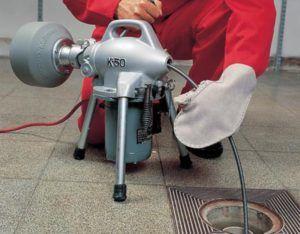 The third method is hydrodynamic. It uses a compressor pump and a hose with special nozzles. These nozzles force water into the drains under high pressure. The jets of water remove deposits from the pipe walls. The system is then flushed under high pressure to remove any remaining dirt. This cleaning method is the most effective.
By choosing any of the three methods described above, you will need access to both ends of the drainage line. Water will flow in from one end, and drainage will be provided from the other.
Conclusion
Watch the video
Laying a drainage pipe in a ditch yourself is entirely feasible. However, it's best to entrust the necessary calculations and design of the drainage system to professionals.
The actual installation of the pipeline is not that difficult. The main thing is to strictly follow the installation rules, maintain the correct network slope, securely connect its components, and install inspection manholes.