Let's determine the slope of the sewer pipe: the larger the pipe diameter, the smaller the angle. The maximum slope for sewer pipes should not exceed 15 cm per 1 m (0.15). To calculate the minimum slope, which is optimal for a particular case, we need to know the length of the entire sewer system.
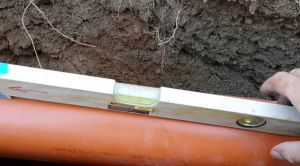 Wastewater disposal plays a crucial role in creating comfortable living conditions for human life. Plumbing systems that handle domestic and wastewater are gravity-fed, and therefore, the primary requirement for their proper functioning is the creation of slopes toward the flow of liquid.
SNiP 02.04.21-85 specifies the required slope of a sewer pipe to ensure unimpeded drainage: 0.03 for pipes with a diameter of 40-50 millimeters and 0.02 for 85 and 100 millimeters. Essentially, drain pipes should be installed with the specified slope toward the drain of 3 and 2 millimeters for each linear meter of the water supply.
When determining the appropriate slope for a sewer pipe, the properties of the materials from which it is made must also be taken into account. For plastic pipes, which are widely used in construction for gravity-fed systems, this slope is somewhat lower than for pipes made from other materials.
This is due to the higher quality of the internal surface and, consequently, the higher flow rate of wastewater. It should be understood that excessive slope of the sewer pipe can be harmful. With rapid drainage, the pipe cross-section can be filled to the limit and then an airlock forms behind it, preventing the liquid from escaping.
- Online calculator for calculating slope
- Standardization of the slope angle of the sewer system per linear meter
- Formation of runoff and its composition
- External sewerage networks
- Sloping a sewer pipe in a private home – DIY
- Regulatory documents on the installation of internal and external networks
- Maximum slope angle
- Minimum slope angle
- Minimum slope angle for products of different diameters
- How to calculate the minimum slope angle?
Online calculator for calculating slope
Enter data for online calculation of sewer slope.
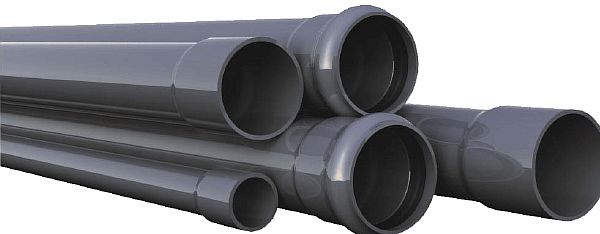
Standardization of the slope angle of the sewer system per linear meter
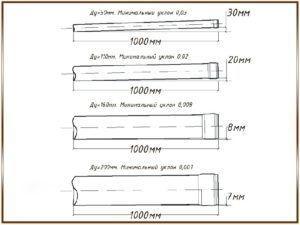 It seems natural to assume that exceeding the slope of an indoor sewer system can only have a positive effect, allowing wastewater to reach the collector more quickly. However, if water moves through the pipe too quickly, fibrous and solid particles settle on its walls, which gradually lead to blockages.
Mechanically clearing such a blockage deteriorates the quality of the pipes' internal surfaces, which worsens free drainage. The lifespan of such drainage systems typically does not exceed one year.
The slope angle of a sewer pipe per 1 meter for pipes of different sizes has different standard values.
To get a complete understanding of how a domestic wastewater sewer system works, let's follow the process from start to finish.
Formation of runoff and its composition
Water is collected by connecting the system to each console of the water supply network. The following are the flow-forming objects:
- The kitchen sink is the source of the most harmful substances for the drainage system—solid kitchen residues and fatty deposits. From a sink with a trap, wastewater is diverted via a flexible corrugated tube into a sewer pipe with a diameter of 32–50 millimeters. Smaller diameter pipes can have a sewer slope of 50 millimeters per meter.

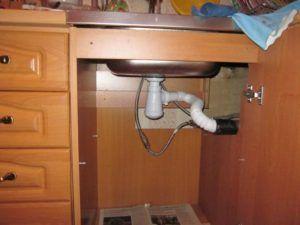
- The next object in a gravity drainage system could be the sink. This is also a source of hazardous waste, introducing the most unpleasant thing into the drain: hair. When mixed with grease from the sink, hair creates strong, difficult-to-clean plugs. To ensure their unimpeded removal, a sewer pipe with an internal diameter (DN) of 32 is installed with a slope of 50 millimeters per meter.
- The third draining object is the bathtub. It is connected to the sewer system via a double trap for the drain and overflow holes.
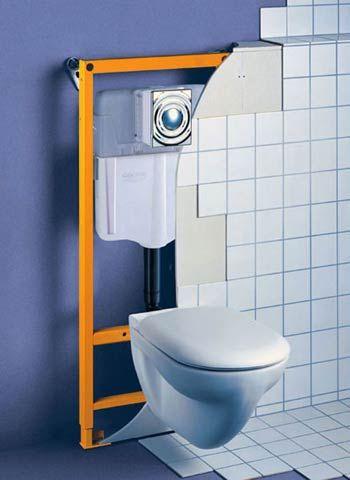
- The apartment wastewater system also includes a toilet that produces fecal waste.
The entire in-house drainage system consists of pipes of the required diameter, installed at a uniform slope throughout. The total length of the sewer network is typically no more than 6 meters, which, for a DN 50 sewer pipe in an apartment, is 18 cm.
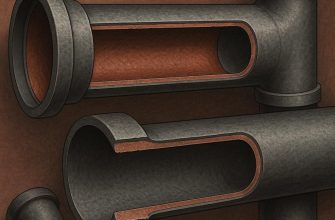
Cast iron sewer pipes have traditionally been used for apartment drainage systems. This material is corrosion-resistant even when exposed to highly chemically active sewage.
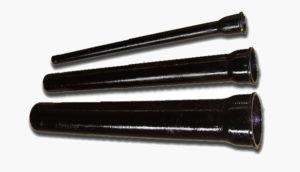 Pipe connections were made through a socket, into which a rubber ring-shaped seal was factory-installed. After pipe-to-pipe installation, the connection was calked, which required the use of malleable cast iron, such as spheroidal graphite cast iron.
Plastic pipes, which gained popularity in the 1990s, are increasingly replacing traditional materials, being easier to install, lighter, and quite reliable. Connecting pipe components is done in the same way, using silicone sealant.
In sewage systems, pipes of the following sizes are usually used: DN 40, DN 50, DN 80 and DN 100 millimeters with internal sewerage slopes per 1 meter according to SNiP from 0.035 to 0.02In this case, the 100 millimeter size is used for the installation of a common section at the convergence point of the sewer system lines.
External sewerage networks
The installation of external wastewater removal systems for a home involves installing a gravity-fed pipeline connected to a collector. Here, too, the key to successful operation is creating a specific slope toward the drain. How do you calculate the slope of a sewer system? You can use the following ratio:

Where:
- V – drain flow velocity, m/sec;
- H – degree of filling of the pipeline;
- d — pipe size;
- K – coefficient of slope of the drain pipe.
 However, you can solve the problem more simply and calculate the slope of the sewer pipe online using the built-in calculator.
The slope of the external sewer system ensures unimpeded drainage of yard and block networks. For a 100-millimeter cross-section, the slope of the sewer pipe per meter, according to SNiP, must be at least 2 millimeters. This ensures uninterrupted and reliable drainage of wastewater of any origin.
The main parameter considered when calculating the slope is the water flow velocity in the pipeline. This is also regulated by regulatory documents, in particular the SNiP (Building Code) "Slopes of Gravity Sewers."
According to this set of rules, the minimum flow rate is 0.7 meters per second. This document also regulates other aspects, such as the specifics of stormwater drainage design on the site.
One of the key parameters is the fill level of the drainage system. According to regulations, it must be more than 30% of the cross-section. This figure depends not only on the flow rate of the liquid in the pipe, but also on its size and the quality of the internal surface.
To control the slope of the sewer pipe indoors and outdoors, levels of various designs are used:
- Water-based levelers have two glass inserts at the ends of a flexible tube. They are marked with a scale with divisions down to 1 centimeter. This type of level provides the most accurate readings for determining slope angles. It's easy to make one yourself.
- Bubble.
- Magnetic.
- Laser.
The rules for using these devices are set out in the operating instructions.
In multi-story residential buildings, the flow of sewage water occurs almost continuously, reaching its maximum in the evening.
When installing a drain pipe in a private home, the following mistakes should be avoided:
- The pipeline must not be allowed to sag between the support points. To achieve this, they must be installed as frequently as possible. It's important to remember that the pipe in the trench will be subject to pressure from the soil that will be used to fill the trench after installation.
- Horizontal sections of the external sewer system are also unacceptable. Ideally, the external sewer section should be straight.
- When laying a drain, seasonal soil movements on the site must be taken into account; that is, the only way to guarantee the drain's stability is to place it below the freezing depth of the soil.
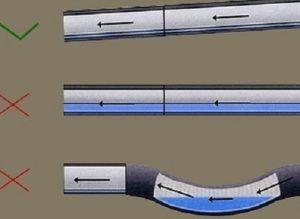 According to SNiP (Building Code and Regulations), the slope of an outdoor sewer system for a 160-millimeter diameter drain should be no less than 0.8 cm per meter. Gravity systems are a traditional solution for collecting and discharging wastewater. A proper sewer system slope in a private home ensures long-term system operation and prevents clogs.
A steep slope can cause the entire channel to overflow, causing the traps on the consoles to be torn off. This will cause the entire sewer system to flow into the living space. It's also important to remember that excessive slope increases the flow velocity, creating noise.
Sloping a sewer pipe in a private home – DIY
Modern private homes are typically equipped with a drainage system. Even if the city sewer line is located a considerable distance away, septic tanks are installed or special collection tanks are constructed.
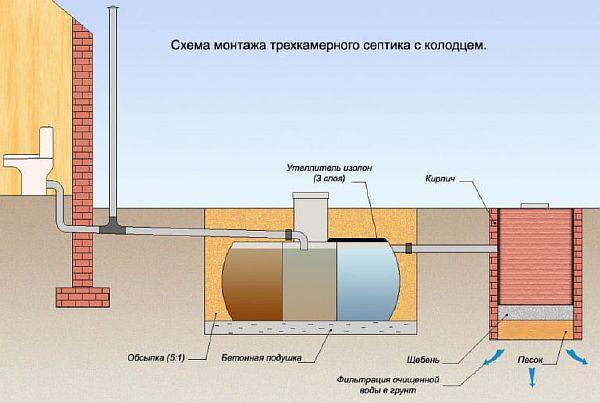
The rules for installing a sewer network are governed by the same standards: the slope of an internal sewer system per 1 meter, according to SNiPs, has the same values as the slope of a sewer system in an apartment in a city building.
The same materials and components are used for installing the internal network. The slope standards for outside the residential building also remain the same.
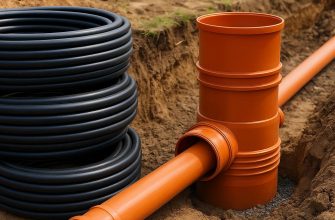
For the external sewer circuit in a private house, you can use pipes with a size of 100 millimeters, and if the number of people living in the house is small, it is possible to use 80 millimeters.
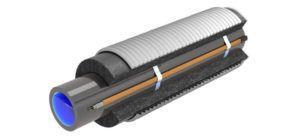
The pipeline is laid in a trench at a depth no less than the ground freezing level. If this seems excessive (for the Moscow region, this depth is 1.8 meters), a shallower, insulated main can be installed or a heating cable with an automatic activation switch on the drain pipe when the ground temperature drops below freezing can be installed.
 Requirements for the angle of inclination in a private home are subject to the same standards as for other devices.
All work on installing a drainage system for a country house can be carried out as follows:
- Determine the required piping parameters for internal and external drainage systems.
- Create a preliminary design of the pipeline indicating the reference to the horizon at various levels.
- Install an internal sewer system in accordance with SNiP requirements. The system should exit the interior through a short 80 or 100 mm riser. The riser should then be connected to the external sewer system via an angled adapter.
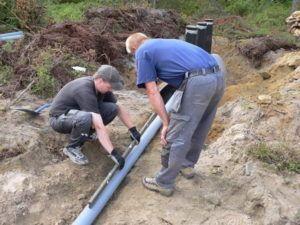
- Dig a trench for the external section. Consider the depth of soil freezing if the pipeline is not insulated according to the design. The trench depth is determined based on the subsequent backfill.
- Place a 15-20 cm layer of sand on the bottom of the trench, compact it, and water it for better compaction. Use a spirit level to check the level of the trench bottom and the sand fill relative to the horizon while digging.
- Install pipe supports on the sand bedding. Concrete blocks or bricks can be used for this. When installing, adhere to the sewer pipe slope requirement of 110 millimeters. The number of supports depends on the length of the trenches, and the distance between them should not exceed one meter. This is because the pipe will be under pressure from the soil that will subsequently fill the trench.
- After laying the pipe on the supports, it's necessary to test the system's functionality by running a test run of water through it. If the sewer pipe slope requirement of 100 mm is met and water flows through it without leaks, the trench can be sealed. First, the pipeline is carefully covered with a layer of sand, compacting it along the sides and on top of it. Once everything is completely sealed, the trench is backfilled with previously excavated soil and the topsoil is reclaimed.
- When installing a complex, branched sewer drainage system on a property with additional wastewater sources, the same rules for pipe slope for a private home's sewer system apply. However, it becomes necessary to install inspection wells at the intersection of two or more systems. In this case, the depth of the junction is consistent with that of the main system, which discharges wastewater to the outside.
If a municipal sewer line runs near your home, it's advisable to connect your wastewater drain to it. This will require permission from the Gorvodokanal (city water utility) that manages the system, which will incur certain costs. However, this will eliminate the need for subsequent septic tank or cesspool cleaning.
Regulatory documents on the installation of internal and external networks
Any documents concerning the construction of any given facility are created based on extensive experience gained during their construction and operation. Therefore, failing to comply with their requirements is costly.
Regarding the topic under consideration, these are:
- SNiP 02.04.21-85 Water Supply and Sewerage Systems for Buildings. It addresses the design, construction, and operation rules for sewerage systems for in-building use.
- SNiP 02.04.03-85 "Sewage. External Networks and Construction" recommendations address the design, construction, and operation of external networks.
All necessary requirements and approvals can be found in the specified documents.
Maximum slope angle
During construction, it is sometimes necessary to increase the slope angle. This option is also discussed. in the first of the above documentsThe maximum slope of a sewer pipe, "taking into account local conditions," can reach 0.15 meters in size, that is, up to 15 centimeters per meter of pipeline.
However, we would like to remind you that in such a situation there is a risk of silting up the system – water will leak through, but contaminants will remain.
Minimum slope angle
The minimum slope of sewer pipes is determined by flow velocity and its resistance to the inner surface of the pipe. If the horizontal deviation is too small, waste products can accumulate, leading to frequent blockages.
It's also important to avoid a reverse slope in the sewer system, which causes wastewater to flow in the opposite direction. If the minimum slope isn't maintained, over time the sewer system may sink to a horizontal position, or even to a reverse slope.
Minimum slope angle for products of different diameters
The standard unit of measurement for the optimal slope is cm/m, that is, how many centimeters should it drop? one-meter section of pipelineThis value directly depends on the pipeline diameter, as elements of different cross-sections have different hydraulic resistances and therefore require an individual approach.
So, for a sewer pipe with a diameter of 40 or 50 millimeters, the minimum slope value is 0.03 (3 centimeters per meter of pipeline), the slope of a 110 millimeter sewer should be 0.012 (1.2 cm/m), for 150 mm the minimum value is 0.007 (0.7 cm/m), for 200 mm the minimum value is 0.005 (0.2 cm/m).
The difference is due to the different nature of fluid movement depending on the cross-section. Water moves more easily through a larger-diameter pipeline because there is less pressure loss due to friction against the pipeline's internal walls.
How to calculate the minimum slope angle?
The minimum sewer slope is not measured in degrees. In all reference literature, the minimum sewer slope is given as a decimal fraction, which is the ratio of the slope height to the length of the corresponding section of pipe. To calculate the sewer slope, that is, the difference between the beginning and end of a section, multiply its length by the slope:
H=L*x, where H is the difference in height, L is the length of the section, x is the minimum value of the slope angle.
The main thing when calculating is to pay close attention to the dimensions, that is, if the slope value is taken in standard cm/m, then the length of the section should also be presented in meters.
Example: There is a section of pipeline with a diameter of 150 millimeters and a length of 6 meters. According to existing regulations, the minimum slope angle for this diameter is 0.8 centimeters per meter of length. Then, substituting these values into the formula, 0.8 x 6 = 4.8 cm/m. This means the vertical distance between the start and end points of the section should be 4.8 centimeters.
Self-installation of internal and external sewerage systems is entirely possible and does not present any particular difficulty.
But, when starting this work, you need to thoroughly familiarize yourself with those few and simple rules that must be strictly followed.