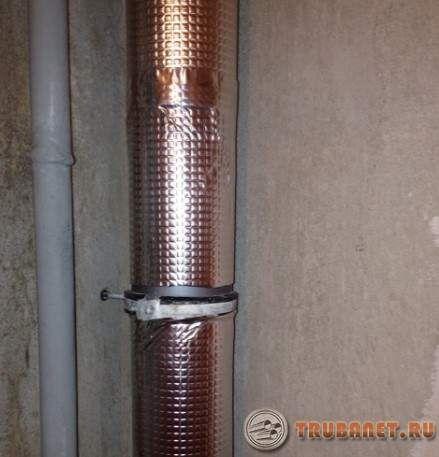
 Soundproofing sewer pipes in apartments is a pressing issue. High sound transmission rates in city apartments are well-known, and the noise of water flowing through the pipes significantly reduces the comfort of residents.
Therefore, it is necessary to take drastic measures to reduce the noise produced by the sewer system.
Noise in sewer pipes occurs for many reasons, including:
- Insufficient thickness of the walls of the drainage system pipes.
- Material of manufacture.
- Incorrect placement of walls and pipes in the apartment.
- Incorrectly selected seal.
Types of insulation for sewer networks
Deciding whether soundproofing for sewer pipes is necessary and which one is best isn't difficult. However, to do so, you'll need to thoroughly study all the different types. Then, making the right choice won't be a difficult task.
To solve the problem of soundproofing the drainage system in an apartment, the following methods are recommended.
- "Silent" pipesSome manufacturers produce products called "quiet." They are made of high-density polypropylene, and their multi-layered construction provides excellent sound dampening. Currently, the only drawback of these products is their high price.
- Soundproofing materialsA drainage system, tightly covered with sound-insulating material, operates silently. It is divided into the following types.
- Most often, for such work they use foamed polyethylene, which not only provides excellent sound insulation but also boasts high thermal insulation properties. Furthermore, it prevents condensation on pipes, preventing the growth of mold and mildew.
- No less often, noise levels are reduced by using rolled insulationThis is not a new product on the construction market, and its popularity has not diminished over the years.
- And one more material that can be encountered in such works is soundproofing tape.
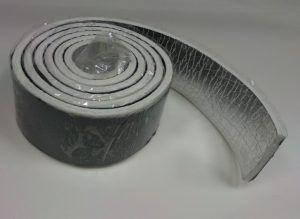
The list of insulation materials can be supplemented with the following main types:
- polyethylene foam;
- fiberglass;
- mineral wool;
- various porous materials;
- synthetic rubber.
Each of the soundproofing materials presented above has its own unique characteristics and properties that must be taken into account when installing in an apartment.
If this is not taken into account, the sound insulation may simply be unsuitable for the sewer pipes installed in the apartment.
IMPORTANT! Soundproofing pipes is a very important task that requires care. Do not allow the drainage system coating to become damaged.
Sewer riser
Many people are interested in how to soundproof a sewer riser, as it's where most of the noise comes from.
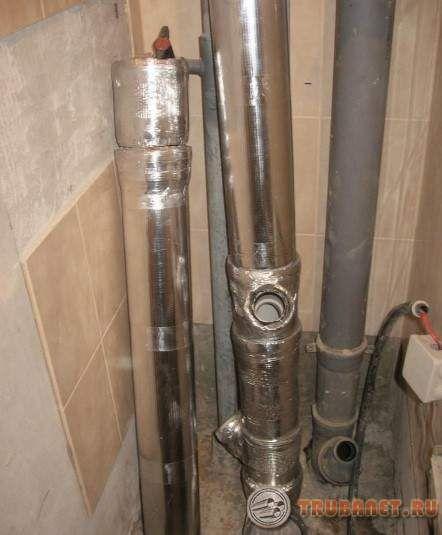
And the noises it creates in an apartment are conventionally divided into:
- ShockIt's caused by the interaction of fluid flow with the pipe walls. It's impossible to eliminate completely, but it can be reduced.
- AirThis is the sound of air through which a stream of water passes.
- StructuralIt appears after vibrations of pipe materials and network elements that come into contact with each other.
It is the third type that must be dealt with, as it creates the most serious problem.
To do soundproofing yourself you need:
- Prepare the material and cut out a piece from it that will correspond to the dimensions of the riser's circumference.
- This part is secured with construction tape. It's important that the edges are butted together. Positioning them any other way will reduce effectiveness.
- Soundproofing membranes for sewer systems are recommended to be tightly secured, using multiple layers. This increases the structure's weight and reduces resonance. As a result, structure-borne sounds become less noticeable.
- If necessary, a decorative box can be constructed around the sewer riser. This also has a positive effect on sound insulation in this situation.
How to do soundproofing yourself
Soundproofing a sewer riser yourself is a completely doable task for any home handyman.
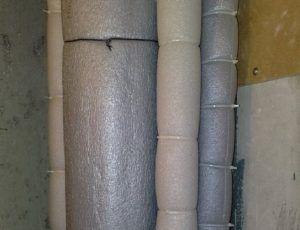
Buildings made of silent pipes are assembled as follows.
- The vertical height of the pipe network is measured and pipes of the required length are cut.
- The cut areas are cleaned with a file, done at a 45-degree angle.
- Mounting clamps with damping pads are placed on the wall.
- The assembly is carried out taking into account the individual characteristics of the silent network.
- The holes in the ceilings are sealed with polypropylene sleeves. Their diameter should be 0.5-1 cm larger than the cross-section of the silent drain pipe.
Video
IMPORTANT! It is strictly forbidden to install monolithic plugs that tightly seal the sewer system. It is advisable to use components that have vibration-absorbing properties.
How to soundproof a toilet yourself
Soundproofing a toilet riser is performed after a detailed examination of the underlying causes. Such noises in an apartment arise from improper design and the wrong type of components.
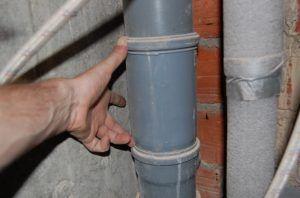
Steel is considered the noisiest material for such a network. Polymers operate almost silently. Cast iron is practically completely silent due to its heavy weight and wall thickness.
IMPORTANT! The thicker the riser wall, the less noise it emits. Experts recommend taking these details into account before installation. They also recommend installing pipes made of sound-absorbing plastic when replacing them.
The selection of this product on the construction market is vast, and choosing it is easy. Pipelines made of this material are completely noise-free.
Watch the video
If it is necessary to soundproof an existing riser in an apartment, then special building materials are used for this purpose.
After wrapping them around the riser, it needs to be secured with tape. This type of construction isn't particularly attractive, so constructing a decorative box can save the situation.
How to install a silent sewer system
As mentioned above, this option is the most suitable for this job.
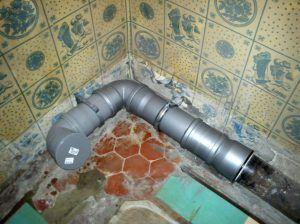
However, this type of pipe rolling line is distinguished by its specific design and structure.
- The inner layer is smooth polypropylene containing mineral particles.
- The middle layer is also made of polypropylene with mineral additives.
- The top layer is a high-strength polymer.
You need to work with such pipes strictly according to the instructions, and then the structure will serve faithfully for a very long time.
Video
Toilet soundproofing can also be achieved with a foam or polystyrene casing. This type of covering not only reduces the noise generated by the apartment's drain system but also provides excellent protection for the pipes.
This insulation is laid very simply.
- First, use a well-sharpened knife to make a cut along the casing.
- They wrap the structure.
- The joint is sealed with construction tape.
Sound absorption can be improved by using specially designed fittings. A fastening element with a rubber gasket will prevent the riser from rattling.
Unattractive foam rubber can be used to conceal the box. You can also build a cabinet for this purpose.
Features of the DIY insulation process
Watch the video
[sociallocker]
Simply covering the elements of the pipe network with a damping building material and thinking that the problem is over is a big mistake.
Measures must be taken to dampen vibration. According to building regulations, pipes that pass through the ceiling in an apartment must be concealed in a special sleeve.
The role of such a sleeve can be played by a regular piece of large diameter pipeThe empty space between the sleeve and the pipe is filled with a noise absorber and an acoustic sealant is added to dampen vibration.
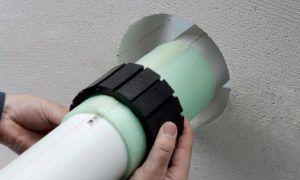
In practice, things turn out quite differently. Builders don't always comply with this requirement, and the soundproofing in the apartment doesn't meet the required standards.
Anyone who finds even an empty sleeve in their drain system can consider themselves fortunate. After all, you can easily install insulating material in it yourself.
And so it turns out that the sewer pipes simply pass through the ceiling, making hard contact with it. This leads to increased noise in the apartment.
To reduce noise, it's necessary to reduce the contact between the ceiling and the pipe. To do this, use a hammer drill to make a recess around the perimeter of the riser and fill it with soundproofing sealant.
After this, the section near the ceiling is wrapped with soundproofing material. The material is secured with construction tape and filled with cement mortar.
Video
Once the cement has set, the structure continues to be wrapped. This completes the soundproofing of the sewer pipes in the apartment. To ensure complete silence, it is recommended to soundproof the walls, ceiling, and floor.
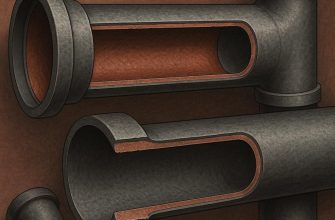
My wife has been complaining for a while that it's very loud in our apartment when our neighbors flush their toilets. Now I have a more or less clear idea of how to fix this problem. I think I can handle it myself.