Heisskraft first began operations in 1998. From the very beginning, its management relied on the experience of German engineers in matters such as providing engineering equipment for buildings and structures.
The Heisskraft brand offers the widest range of products, including Heisskraft polypropylene pipes.
What makes Heisskraft pipes different from others?
It is worth noting the resistance to aggressive chemicals, including:
- Alkalis.
- Acids.
- Solutions with salts, but with water as a base.
It can be concluded that Heisskraft polypropylene pipes are of high quality.
The company uses only high-quality raw materials to produce polypropylene products, ensuring their thermal stability.
They can withstand temperatures reaching 110 degrees Celsius for short periods. They are frost-resistant and can operate reliably even at -60 degrees Celsius.
Even if the liquid inside freezes, the pipes retain their shape. Upon thawing, the structure and coolant return to their original dimensions.
The main production material is polypropylene grade PP-R. The products are widely used for supplying cold, and hot water.
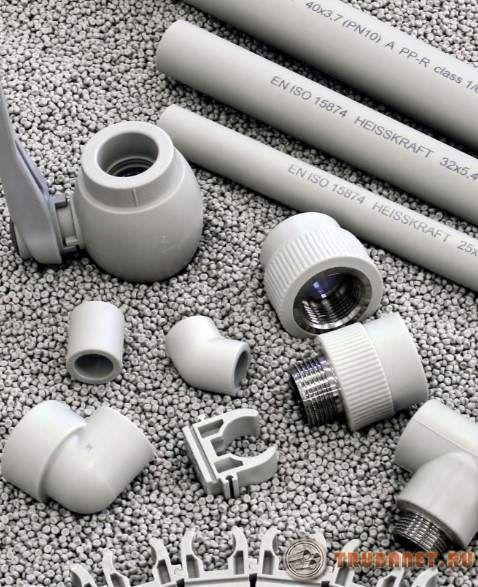
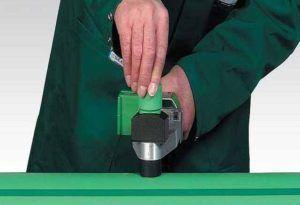
The ability to weld easily is a characteristic feature of this material. Installers especially appreciate this quality when doing their work.
It is worth noting the easy and quick installation; there is no need to use metal fittings for this.
That is why the pipeline itself remains stable relation to corrosion processesEven stray currents do not cause any significant damage to the structure.
What other distinctive properties are there?
Heisskraft produces pipes that can be used to construct pipelines for various purposes.
The calculations for service life depend on the type of liquid and its characteristics.
In particular, concentration, pressure, and temperature parameters must be taken into account. Highcraft produces only high-quality pipes.
About the features of installation and operation
Heisskraft produces pipes and fittings made from a polypropylene copolymer designated PR-R 80.
They fully comply with not only Russian but also international standards.
The series showing the maximum working pressures for operation was adopted for systems with heating and water supply.
- 1.0 MPa.
- 0.8 MPa.
- 0.6 MPa.
- 0.4.
Operation classes are established depending on the purpose of the pipeline.
A number of pressure systems designed for internal piping require socket-and-socket connections and welding. Detachable connections should be located where the fittings will be installed. Pipe installation is also carried out in various ways:
- In the canals.
- In the mines.
- In the ground.
- Hidden behind a layer of plaster.
- Open.
If pipelines made of PR-R material are installed, they require additional protection from ultraviolet rays.
When a pipe runs through a wall, protection from mechanical damage becomes important. There's a high risk of the pipe being crushed or rubbing against a rough surface. There are two possible scenarios:
- Sliding inside a case fixed to the wall.
- Stationary pipe during operation.
The restriction elements together with the couplings will help to fix the pipeline in the same position.
In this case, only soft plastics are used to make the casing. The gap between the casing and the pipeline is where fibrous materials are placed.
Fire baffles are used to prevent flames from spreading along walls during fires.
Highcraft aluminum-reinforced polypropylene pipes
This is a full-fledged pipe made of polypropylene, technically bonded to aluminum foil. On the outside, there's another layer, also made of polypropylene, for additional protection.
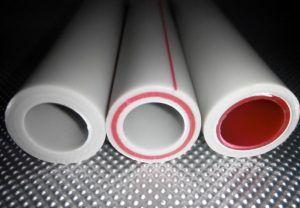
This series of pipelines, compared to other available alternatives, boasts the lowest coefficient of thermal expansion. The manufacturer itself states that the Heiscraft brand belongs to the fourth performance class.
And it is included in underfloor and radiator heating kits, with both high and low temperature settings.
Before welding, such PP pipes can be cleaned. This involves removing the aluminum foil layer along with the polypropylene.
They are removed only to the depth of the weld, using a special tool designed for this type of work. Highcraft is larger and is most often used in heating systems.
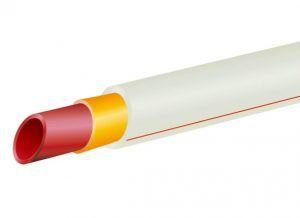 However, recently, pipes with an additional layer of fiberglass reinforcement have become increasingly popular. This is because their installation is simpler and faster.
However, only aluminum reinforcement methods have achieved superior mechanical properties and improved performance. In this case, aluminum foil acts as an oxygen barrier, which also improves performance.
There's only one drawback, but it's more common in lower-priced items. Over time, certain imperfections appear in the exterior, appearing as bubbles or bulges.
However, the mechanical and operational properties of the Heisskraft polypropylene pipe itself are not affected by this.
Aluminum reinforcement inside
This variety deserves a separate discussion. It was invented in Turkey and was the result of rapidly growing competition.
It was initially presented as a polypropylene pipe that required absolutely no cleaning before welding. Many installers appreciated this innovation, as it increased work speed.
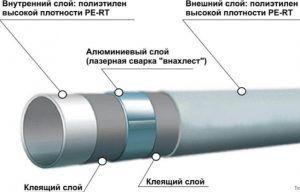
But they proved short-lived, delaminating and cracking too quickly. It turned out that the aluminum itself also suffered from corrosion during use, potentially leaking toxic aluminum compounds into the water.
Manufacturers attempted to use end-graining technology to solve the problem, but it didn't always work. And it was impossible to test the installation quality in practice.
Therefore, the use of internally reinforced pipes quickly became pointless. Conventional Heisskraft polypropylene pipes began to be used.

I'm already fed up with the pipes. The fittings are bursting right in the wall for the second time. The pressure in the house is high, and the pipes hum at night, which is apparently causing cracks in the seams. What should I do in this case? What kind of pipes are best to install?