Installing refrigeration equipment can be a problem if the living space is small.
The refrigerator is quite bulky, so when choosing a place in the kitchen for the unit, you should adhere to certain rules and regulations established by the manufacturer.
Find out if it is possible Install a refrigerator under heated floors – Is this combination possible or not?
- Can I place a refrigerator next to a heating radiator?
- General principles for placing household appliances in a small kitchen
- What happens if you place a refrigerator next to a heating radiator?
- What distance should there be between a refrigerator and a heating battery? Standards
- What to do if there is no other way out?
- Alternative installation options
- What to do if there are no other options?
- Helpful tips
Can I place a refrigerator next to a heating radiator?
Installing a refrigerator next to a radiator can lead to irreversible consequences. Situations where the only other option is to place the appliance near the radiator are quite common. As a result, the unit doesn't operate at full capacity, overheats, breaks down, etc.
General principles for placing household appliances in a small kitchen
The operating instructions specify certain subtleties regarding the placement of the refrigeration unit. If these cannot be observed due to a small kitchen area, adhere to the following guidelines:
- Regularly ventilate the room where the refrigeration equipment is installed. The air in the room should not be dry, so monitor the humidity level.
- Permissible distance. The distance between the top of the unit and the ceiling must be at least 10 cm.
- Avoid placing the refrigerator next to a stove, cooktop, or oven. The side wall becomes very hot, which can negatively impact the operation of the appliance. If it's not possible to move the unit to a safe distance, use a heat-insulating partition (available at a hardware store).
- Placing the unit near a window is also prohibited. When exposed to direct sunlight, refrigeration equipment heats up. To cool the unit, the motor works several times harder, consuming more electricity. If this load is constantly applied to the appliance, it will quickly wear out and fail.
- Install the appliance level or tilted back no more than 2°C. This will ensure the doors close tightly.
- Do not place the unit near other kitchen appliances. This will impair air circulation. Maintain a minimum distance of 5-10 cm between objects.
- In order to save space, Buy a small refrigerator or one that fits into your kitchen cabinets.. Kitchen manufacturers take into account the correct placement of refrigeration equipment at the design stage.
If there is no space for the unit in the headset, it can be ordered separately according to individual measurements.
What happens if you place a refrigerator next to a heating radiator?
Freezer manufacturers do not recommend installing their products near radiators. Most often, the unit malfunctions due to such contact. Normal operation is when the refrigerator starts periodically and then stops after a certain period of time.
In this way, it maintains the temperature in the storage chambers set by the person.
When the appliance's walls are heated by the radiator, the temperature in the compartments rises, causing the refrigerator to operate continuously. This is done to bring the microclimate in the storage chambers closer to the set parameters.
Active motor operation leads to increased energy consumption and compressor damage. Light consumption will be 20% higher than usual.
If the unit stops functioning and the warranty card is still valid, the service department has every right to refuse repairs, as the operating instructions specified in the refrigerator's documentation have been violated.
Placing a refrigerator near a radiator negatively impacts not only the equipment itself but also the indoor climate. The unit will block the heat source, making the room colder than it should be.
What distance should there be between the refrigerator and the radiator?
heating standards
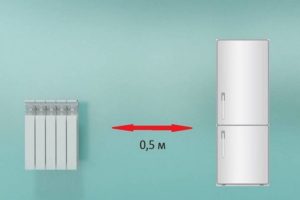
To prevent refrigeration equipment from overheating, place it at least 30-50 centimeters away from heat sources. Do not occupy the remaining space with furniture or any household appliances.
For those who own a small kitchen, it is difficult or even impossible to adhere to this rule.
If you only have room for a refrigerator near a heating appliance, consider built-in models, as they are already insulated and less sensitive to warm air.
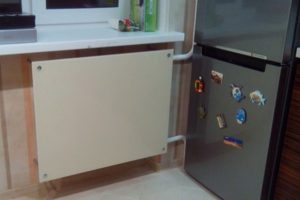
Another option to avoid negative consequences is to install a protective screen between the unit and the heating battery.
What to do if there is no other way out?
Besides purchasing a built-in refrigerator and insulating the unit, there are several other methods for protecting your appliance from warm air. There are several options, so everyone can find their own solution.
Alternative installation options
Refrigeration equipment can be installed not only in a small kitchen area, but also used for placement in other rooms and places in the apartment:
- Pantry. Typically, the room is used for storing supplies or unneeded items, without considering the pantry area as a refrigerator location. This option may seem inconvenient, as you'll have to regularly go to the pantry for groceries and it may not be possible to carry everything you need in one go.
But if the balance is between convenience and efficient, long-lasting performance of household equipment, then it is more appropriate to choose the second method. - LoggiaThe room is usually adjacent to the kitchen, so you won't have to walk far for groceries. This layout requires one condition: the loggia must be glazed and heated.
- HallwayIn standard apartments, the room is located right next to the kitchen. There are practically no inconveniences in terms of walking to get food. To make the refrigeration unit look more attractive in the hallway, you can install it in a closet.
- HallFew people will appreciate this refrigerator placement method, as the living room is a relaxation area and the main room from an interior design perspective. However, if other options are lacking, this solution will save space in the kitchen and keep the unit in working order.
- Stairs (the place under them).This option is suitable for owners of houses or two-story apartments. If you're concerned about a freestanding appliance being too conspicuous, you can surround it with cabinets and drawers for storing groceries, dishes, or other items. A built-in model can be conveniently concealed in a custom-made cabinet.
- Corridor. In this case, calculations must be made before installation. The equipment should not interfere with free movement, as hallways are often narrow.
- Bedroom. Installing a refrigerator in a bedroom is extremely rare. It's not exactly convenient. But with a little imagination, the appliance can be seamlessly integrated into the room's decor. Having a refrigerator nearby doesn't interfere with sleep, as modern models operate silently and pose no health risks.
If installing refrigeration equipment requires dismantling part of a wall, permission from the housing inspectorate is required, as this could cause problems when selling the apartment. Concealing the changes will be impossible. The owner will be forced to pay a fine.
What to do if there are no other options?
Repair service specialists admit that if the kitchen is small or has an inconvenient layout, it is permissible to place refrigerators near radiators, but only if the appliances are insulated from the heating pipes.
The unit can be protected using methods accessible and acceptable to everyone:
- Turn the refrigerator sideways toward the heating element. This should cover more than half of the radiator. Separate it with a panel. It should be more than 20 cm above the heat source.
The partition can be created from the following materials:- Foil. It has reflective properties. It will "reverse" the flow of warm air, thereby reducing the heating of the refrigerator surfaces. Use plywood, drywall, or other similar materials as a base.
- Modern thermal insulation materials: polystyrene foam or polyurethane foam.
- If a heating or hot water pipe runs near refrigeration equipment, insulate it. Use a heat-resistant material, such as fiberglass or foamed polyethylene.
Installing a refrigerator using the methods described above will require some financial investment. However, the unit will operate more efficiently and last longer, eliminating the need for repairs if it breaks. You'll also save on electricity, as a properly functioning refrigerator doesn't consume much electricity.
Helpful tips
Those who have already encountered difficulties installing refrigeration appliances near radiators and kitchen owners whose units have failed due to external overheating offer helpful advice:
- Consider purchasing a built-in model. This option can be installed near a radiator, but only if no other installation method is available. This method is suitable for those who plan to custom-order the cabinetry, can choose the right size, and have the budget. These refrigerators typically cost 1.5-2 times more than standard models.
- If your refrigerator is located near a radiator, defrost it twice a month. This will reduce the load on the condenser and extend its life.
- Make sure the door closes completely and fits snugly against the refrigerator body. Otherwise, the unit's condenser will overload. For the same reason, avoid leaving the door open for long periods of time, especially if the refrigerator is installed near a radiator.
- Before installation, carefully read the manufacturer's instructions for the equipment. Each appliance has its own requirements. Some models are prohibited for use in the kitchen, while others are perfectly acceptable. All information is included in the instructions or data sheet.
Installing refrigeration equipment requires following a number of rules. Placement next to heating appliances can adversely affect the performance of household appliances. This can be remedied by using insulating materials or installing a partition. Alternative placement methods exist that can be successfully utilized.