When buying heating radiators, it's important to maintain a comfortable temperature in your home during freezing temperatures. To do this, it's important to understand the parameters indicated on the radiator, particularly the center-to-center distance.
- What is the radiator center spacing?
- The difference between height and center distance
- Dependence of section capacity on center distance
- Radiator sizes and installation distances
- Bimetallic
- Aluminum
- Steel
- Cast iron
- Installation Features
- How to choose a battery based on its center distance?
- Is it possible to increase the wheel center distance yourself?
What is the radiator center spacing?
The battery specifications list its main characteristics, including the center distance. This value is almost always represented by numbers in the radiator model name (for example, RAP-350, Rococo 790, or ALUX 200).
Experts sometimes refer to this parameter as the center-to-center, inter-nipple, or connection distance. These are all the same value, i.e., the distance between the axes (centers) of the intake and exhaust manifolds of a radiator or an individual section.
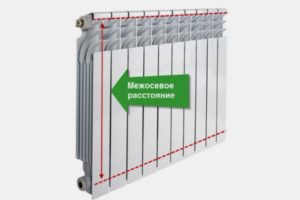
This indicator is important in private homes with natural water circulation in the heating system. A radiator with a large center-to-center distance prevents water from stagnating, improving the performance of the radiator itself.
The difference between height and center distance
Radiator models may have the same center-to-center distance, but their mounting heights may vary. This depends on the design, materials used, and manufacturer. These values should not be confused. This is especially important when installing radiators in niches or under windows.
For example, bimetallic battery with a center distance of 500 mm has a standard installation height of 570 to 590 mm.
When choosing the right model, it's important to consider both the center distance and the radiator height. It's important not only to "squeeze" the unit into the allotted space, but also to maintain the recommended distance from walls, floors, and overhangs. Otherwise:
- there will not be enough space for the air flow to move;
- the efficiency of the heater will be greatly reduced.
Standard (and most popular) center distances are 300, 350, and 500 mm. Almost all manufacturers offer devices with these values. Models with center distances of 200, 400, 600, 700, 800, and 900 mm are also quite common. In single- and exclusive models, this number can reach 2000 mm.
Radiators with a small center distance are considered to be those with a value of up to 450 mm.
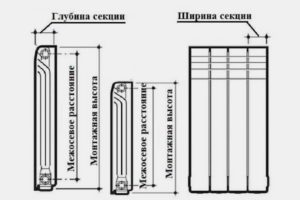
Dependence of section capacity on center distance
The center-to-center distance of a radiator determines an important parameter—section power—which ultimately determines the heat output of the device. The following relationships apply:
- In models with a connection distance of 500 mm, the section has a capacity of 0.2-0.3 liters.
- If the distance from the inlet to the outlet is 350 mm, the volume will be 0.17–0.2 liters.
- In radiators with a 200 mm index, the cell volume varies from 0.1 to 0.16 liters.
Radiator sizes and installation distances
Depending on the type of material, a radiator can be bimetallic, steel, aluminum, or cast iron. This directly affects the size, overall parameters, and weight of the product.
Modern household radiators are manufactured with the specifics of the Russian heating system in mind. Each device has its own advantages and disadvantages, depending on its type. Cast iron and aluminum radiators are the most popular in Russia.
During the construction of Soviet and post-Soviet houses, radiators with a center-to-center distance of 500 mm were installed, which is why devices with this indicator are especially popular in Russia and the countries of the former USSR.
Bimetallic
At first glance, they look very similar to aluminum radiators. However, in a bimetallic radiator, the intake and exhaust manifolds (vertical heat pipes) are made of stainless steel and topped with an aluminum casing.
The devices are not subject to corrosion, are resistant to water hammer and can be used in apartments connected to the central heating system.
The main advantages of this device include the following:
- High strength characteristics and reliability.
- Small cross-sections of vertical channels do not require large volumes of coolant.
- Resistance to negative factors and environments.
- Ease of maintenance and repair.
- Can be used in any heating systems.
- Good heat dissipation.
- Warranty period: 20-25 years.
Disadvantages of the species:
- High cost compared to equipment made of aluminum and cast iron.
- Small diameter vertical passages in a central heating system can become clogged.
- Sometimes, due to the different expansion coefficients of aluminum and steel, creaking sounds occur.
Some companies produce semi-metallic radiators, in which only the vertical tubes are made of steel, increasing the device's rigidity. Otherwise, this type of radiator has the same characteristics as aluminum.
Dimensions of bimetallic radiators from popular brands:
| Model | How many sections | Center-to-center distance, mm | Length, mm | Height, mm | Section size, mm | Depth, mm |
| Rabena Bimetall 500/1-12 | 1, 4, 6, 8, 10, 12 | 500 | 80-960 | 552 | 80 | 85 |
| Grandini 350/1-14 | 1, 4, 6, 8, 10, 12, 14 | 350 | 80-1120 | 430 | 80 | 82 |
| Style 350/1-12 | 1, 4, 6, 8, 10, 12 | 350 | 80-960 | 425 | 80 | 80 |
| Tenrad 500/1-10 | 1, 2, 4, 6, 8, 10 | 500 | 80-800 | 550 | 80 | 77 |
| Grandini 500/1-14 | 1, 4, 6, 8, 10, 12, 14 | 500 | 80-1120 | 580 | 80 | 80 |
| Style 500/1-12 | 1, 4, 6, 8, 10, 12 | 500 | 80-960 | 575 | 80 | 80 |
| Radena Bimetall 350/1-12 | 1, 4, 6, 8, 10, 12 | 350 | 80-960 | 403 | 80 | 85 |
| Tenrad 350/1-10 | 1, 2, 4, 6, 8, 10 | 350 | 80-800 | 400 | 80 | 77 |
Aluminum
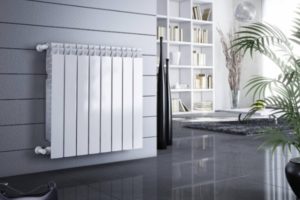
They are the second most popular radiator in Russia. This type of radiator can be extruded or cast, the latter being more popular due to its durability and corrosion resistance. They are designed for pressures ranging from 6 to 25 atm.
Aluminum models are available in a variety of finishes and offer the best balance of cost and thermal efficiency. Center-to-center spacings range from 200 to 800 mm, with 350 mm and 500 mm being the most popular.
Main advantages:
- Optimal heat dissipation.
- Lightweight and compact.
- Easy to install and transport.
- Economical energy consumption.
- Can heat up in a very short time.
- Rust resistance.
- You can regulate the temperature in the room.
- The warranty period is 15 years.
- Modern design.
Cons:
- Low convection capacity.
- Possibility of damage from water hammer and leaks.
- They can only operate in the absence of a thermal oxidizer, so they are not recommended for installation in buildings with central heating.
- Increased gas formation.
Sizes of aluminum batteries from popular brands:
| Model | How many sections | Center distance, mm | Length, mm | Height, mm | Section size, mm | Depth, mm |
| ALUX 200/1-16 | 1, 4, 6, 8, 10, 12, 14, 16 | 200 | 80-1280 | 245 | 80 | 100 |
| Torex C 500/1-14 | 1, 6, 8, 10, 12, 14 | 500 | 75-1050 | 570 | 75 | 70 |
| ALUX 350/1-16 | 1, 4, 6, 8, 10, 12, 14, 16 | 350 | 80-1280 | 395 | 80 | 100 |
| Calidor Super S4 350/1-14 | 1, 4, 5, 6, 7, 8, 9, 10, 11, 12, 13, 14 | 350 | 80-1120 | 428 | 80 | 96 |
| ALUX 500/1-16 | 1, 4, 6, 8, 10, 12, 14, 16 | 500 | 80-1280 | 545 | 80 | 100 |
| Calidor Super S3 500/1-14 | 1, 4, 5, 6, 7, 8, 9, 10, 11, 12, 13, 14 | 500 | 80-1120 | 578 | 80 | 100 |
| BiLUX AL M 300 | 1 | 300 | 75 | 370 | 75 | 75-80 |
| Torex B 350/1-14 | 1, 6, 8, 10, 12, 14 | 350 | 80-1120 | 420 | 80 | 78 |
| BiLUX AL M 500 | 1 | 500 | 75 | 570 | 75 | 75-80 |
Steel
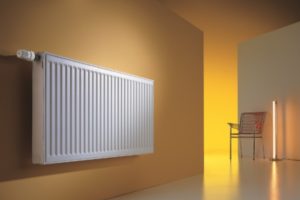
Standard steel panel radiators come in heights up to 900 mm. However, there are also special models that can reach heights of over two meters. Steel tube radiators are available in heights up to 3000 mm. Some manufacturers can produce even taller radiators if required. Center-to-center distances range from 245 to 845 mm.
Pros:
- High heat transfer rate.
- Savings when installed in autonomous systems in private homes.
- Resistant to mechanical impacts and aggressive environments.
- Safety.
- Reasonable price.
- Attractive design.
- Wide range of sizes.
- Easy to install.
- Service life up to 20 years.
Cons:
- When checking the system at the beginning of the heating season, welded joints may not withstand hydraulic shocks.
- Despite the large amount of mechanical impurities in the coolant, small pipes can become clogged.
- When the coolant is drained in the summer, the steel is subject to corrosion.
Radiators vary by type. Examples of steel panel radiator dimensions:
| Type | Center distance, mm | Height, mm | Length, mm | Section size, mm | Depth, mm |
| 21 | 245-845 | 300-900 | 400-3000 | 80 | 70-102 |
| 10 | 245-845 | 300-900 | 400-2600 | 80 | 50-63 |
| 33 | 245-845 | 300-900 | 400-2600 | 80 | 157-164 |
| 11 | 245-845 | 300-900 | 400-3000 | 80 | 50-66 |
| 22 | 245-845 | 300-900 | 400-3000 | 80 | 90-105 |
| 20 | 245-845 | 300-900 | 400-3000 | 80 | 70-102 |
Cast iron
The most popular option in Russia, cast iron is the metal used for radiators, making them ideal for long-term operation in centralized heating systems. The standard center-to-center distance is 500 mm.
Since their invention in 1857, cast iron radiators have brought warmth to homes across the globe. While most Western countries have stopped using them for heating, they remain quite common in the CIS.
Why is cast iron popular despite the wide selection of modern appliances?
- Reliability and durability.
- High heat resistance, maintaining integrity even when heated to +150°C (applicable to steam heating systems).
- Very high corrosion resistance.
- Ability to withstand operating pressure in the range of 6-9 atmospheres.
- Service life is over 50 years.
- The coolant circulates well even with minor clogging.
- Heat is retained for a long time even after the heating medium is turned off.
- Low cost.
Cast iron radiators also have their fair share of disadvantages:
- Increased thermal inertia.
- Bulky and heavy compared to similar products made from other metals (for this reason, many brands make cast iron appliances on special legs).
- Instability to hydraulic shock.
- Problems with care and maintenance due to the complex shape of the cells.
- Not the most aesthetically pleasing appearance.
Installation Features
The process of installing any type of radiator involves many standard steps. First, remove the old radiators (if any) and mark the locations for the new ones. In the second stage of installation, you'll:
- Prepare and hang the battery yourself.
- Install a shut-off valve.
- Connect the heating pipes, observing the center-to-center distance of the radiator.
Regardless of the dimensions, it is important to select the correct dimensions of heating batteries and install them according to standards.
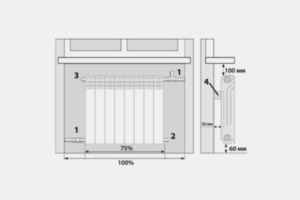
Depending on the direction of heat flow, the radiator can be positioned horizontally or slightly inclined. The latter will make it easier to remove air pockets ("bleed").
The radiators can be connected to the network from below, from the side, or diagonally, and each block is equipped with a separate valve and a Mayevsky tap so that individual radiators can be repaired without having to completely shut down the entire system.
The dimensions of household appliances must be calculated in advance to know their useful power.
How to choose a battery based on its center distance?
Once you've verified that the heating unit is the correct height and depth, you need to calculate the number of sections for each individual room. To do this, calculate the heating capacity required to heat the unit using the following formula:
- A room with one external wall and a window receives 100 watts of heat per square meter.
- If two walls face outward and there is one window, you need to take the heat consumption as 120 W per square meter of the room.
- When there are two walls facing outwards and two windows, the standard value is 130 W per square meter.
The diagram will provide accurate results for rooms with a height of 2.5 to 2.7 meters. If the ceiling is non-standard, it is recommended to use 40 W of heat per cubic meter of room volume as the consumption indicator.
For example, we're calculating the heating output for a room with one exterior wall and one window, with an area of 20 square meters. In this case, we need to multiply 100 W/sq. m by 20 sq. m, which equals 2000 W. This is exactly how much power is needed to fully heat this room.
The resulting power is then used to determine the radiator's dimensions, based on the heat output of one section. Typically, the heating power values for sections are calculated taking into account the difference between the average temperature of the coolant and the room air, which is 70°C (technical specifications state: at DT = 70). What does this mean?
- at a room temperature of +22°C, the water should be around 100°C;
- Meanwhile, in a private house the indicator is rarely even equal to 70°C, and at this temperature the battery emits 30% less heat, which should be taken into account.
To avoid mistakes, subtract 30%, or better yet, 50%, from the power indicated on the product card.
Once you've determined the actual power of one section, divide the previously determined heating capacity (in our case, 2000 W) by this value. This will give you the required number of sections.

Once you've determined all these values, you can move on to the height and center distance. Choose the former based on the space under the windowsill and keeping in mind that there should be a gap between all surfaces. The latter depends on the location of the inlet and outlet pipes in the room; there are several options:
- Measure this distance from the current battery (which you want to replace), and use this value when choosing a new device;
- If there was no radiator in the room before, and the pipes for it have not yet been connected, everything depends on your wishes;
- If you have a battery, but you are ready to change the pipes leading to it, then there are also no restrictions.
If you're placing a heating unit in a recess under a windowsill, and the option with the required parameters doesn't fit under the window, here's the solution:
- you need to divide the number of sections by 2, you get not one device, but two;
- then the first battery will occupy 75% of the length of the window opening, and the second one will occupy the rest (it can be placed close to the side wall and have access to the air duct).
If the radiator is too small for the niche and therefore unsightly, you should select radiators with smaller center-to-center distances and heights. These radiators have lower heat output, meaning the overall length of the heater will increase after recalculation.
Is it possible to increase the wheel center distance yourself?
It's unlikely you'll be able to change the width between the axles of the battery yourself. However, you can modify the inlet and outlet pipes leading to it—it'll be much easier and cheaper.
The center-to-center distance is an important parameter for any modern radiator. These dimensions determine the height of the unit, and therefore its suitability for installation under a window. This value is indicated on the marking and name of the heating appliance.