The heat output of a heating radiator is a coefficient that determines the amount of heat received from the heating device per unit of time and is measured in W/(m² K).
This technical parameter is the primary indicator of a radiator's effectiveness in creating a comfortable indoor climate. The heating equipment manufacturer is required to indicate this value in the accompanying documentation for its products.
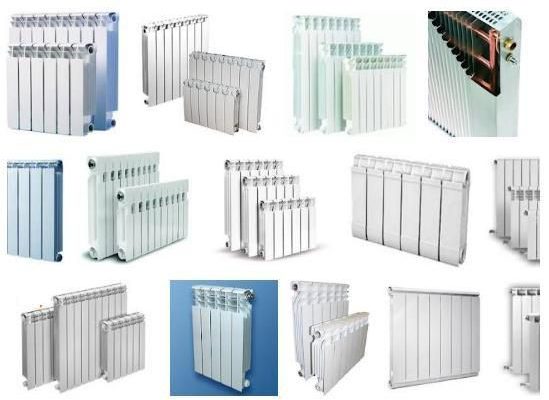
The power of heating radiators is calculated in wattsSome manufacturers claim a heat flow rate for their products, expressed in calorie/hour. To convert this to watts, they use a standard, where 1 W = 859.845 cal/hour.
The heat transfer of a single section or panel of a hydronic heating system is calculated taking into account primary and secondary factors. These include the material of construction, coolant temperature, heat exchange area, the device's connection diagram, its location, and other factors. If the radiator consists of several sections or a single panel unit, the power is calculated and specified by the manufacturer for the entire unit.
- How to calculate the heat output of heating radiators per square meter
- Table of values of reduction factors
- Thermal power output standards
- Comparative tables of heat transfer indicators of different types of radiators
- Comparative table of heat output of 1 section of heating radiators depending on operating pressure, volume and weight
- Comparative characteristics depending on the type of heating devices
- Heating radiators with better heat output
- Dependence of the radiator heat transfer on the coolant temperature
- How to increase the heat transfer coefficient
- How to improve the efficiency of an existing heating system
- How to improve efficiency at the design stage
- How to calculate the heat output of one section of a heating radiator
- Heat output of panel heating radiators
How to calculate the heat output of heating radiators per square meter
In the accompanying documentation, the consumer will find the thermal output of a single section or an entire panel of specific dimensions. These parameters are quite relative and should not be relied upon 100%. They require further adjustment to achieve realistic values. To determine this, it is necessary to calculate the radiator's thermal conductivity.
First, we need to dispel the common belief that aluminum batteries have the highest heat output due to the properties of non-ferrous metal. It's worth noting that batteries are not made of pure aluminum, but rather of its alloy with silicon—silumin—which has significantly lower heat output.
The same can be said, in part, about steel, bimetallic, and cast-iron radiators. The power ratings listed in the heating appliance's data sheet are accurate when the difference between the average coolant temperature and the room air temperature is 70°C.0 C. This phenomenon is called temperature difference and is denoted by the symbol – Δt. Calculation is made using the formula:
Δt = (tfiling + treturn lines)/2 – t air
Following the manufacturer's logic, the calculation result should be 70 degrees. Then, the average coolant temperature can be calculated using the formula:
(tfiling + treturn lines) = 2(Δt + t air)
For example, based on the manufacturer’s stated thermal power of one bimetallic section – 200 W, Δt = 700 C, average room temperature - 220 C, we get the result:
(tfiling + treturn lines) = 2(70 + 22) = 1840 WITH
Taking into account the standard difference of 20 degrees between the supply and return, their value is determined separately:
tfiling = (184 + 20)/2 = 1020 WITH
treturn lines = (184 - 20)/2= 820 WITH
A real heat transfer calculation shows that one section is capable of producing 200 W, provided that the water in the supply pipe is boiling, and the coolant leaves the outlet pipe at a temperature of 82 degrees.
Such a phenomenon is simply impossible in practice. The fact is that domestic water heating boilers are unable to heat water above 80 degrees. Even under these maximum conditions, the coolant will enter the radiator at a maximum temperature of about 77.0 C, and Δt will be approximately 400 C. From this we conclude that the actual heat output of one section of a bimetallic radiator will not be 200, but only 100 W.
To simplify the calculation, you can use a heat transfer table with reduction factors. To do this, use the formula above, using the planned temperature in the house and the coolant, to calculate Δt.
Table of values of reduction factors
Table 1.
| Δt | TO |
| 40 | 0.48 |
| 45 | 0.56 |
| 50 | 0.65 |
| 55 | 0.73 |
| 60 | 0.82 |
| 65 | 0.91 |
| 70 | 1 |
The corresponding coefficient is found in the table and multiplied by the rated thermal power of one section of the bimetallic radiator. That is, in this case, to heat 1 m2 the room will have a heat output of 200 W x 0.48 = 96 W.
For heating 10 m2 The area will require approximately 1 kW of heating power, and the required number of sections will be 1000/96 = 10.4. If the room has two windows, two radiators of 10 and 11 sections each should be installed under them.
Thermal power output standards
When designing heating systems for buildings and structures, the regulatory document SP 60.13330.2016 is used. This set of rules governs, among other things, the development of internal heating systems in newly constructed and reconstructed buildings and structures. The SP was developed based on the requirements of SNiPs GOST 30494-2011 and GOST 32415-2013. Based on these standards, a heating output standard of 1 kW was adopted for a room with an area of 10 square meters, a ceiling height of up to 3 meters, one external wall, and one window.
When adjusting the initial conditions for heating a room in one direction or another (larger or smaller area, different number of windows, etc.), to accurately determine the nominal heat output, correction factors are introduced into the calculation:
K1 – window structure
- double frame – 1.27;
- double glazing unit – 1.0;
- triple glazing unit – 0.85.
K2 – wall insulation
- low – 1.27;
- 2-brick masonry + thermal insulation – 1.0;
- high quality – 0.85.
K3 – Swindows/Sgender
- 0.5 – 1.2;
- 0.33 – 1.0;
- 0.1 – 0.8.
K4 – average indoor temperature in winter, degrees
- 35 — 1.5;
- 20 – 1.1;
- 10 – 0.7.
K5 – number of external walls
- 1 – 1.1;
- 2 – 1.2;
- 3 – 1.3;
- 4 – 1.4.
K6 – a room above the room
- cold attic – 1.0;
- attic – 0.8.
K7 – ceiling height, m
- 2.5 – 1.0;
- 3 – 1.05;
- 3.5 – 1.1.
The final result is divided by the heat output of one radiator section. The quotient is rounded up to the nearest whole number (10.4 – 11 sections).
Comparative tables of heat transfer indicators of different types of radiators
As mentioned above, heat transfer is measured in W/m2This value is considered an expression of the heating appliance's efficiency. When choosing the type and design of heating radiators for the consumer, a comparison of their heating outputs plays a decisive role.
Based on these specifications, experts publish various tables online listing the thermal output of bimetallic, aluminum, steel, and cast iron radiators. Here, you'll find data on the thermal output of heating appliances.
Comparative table of heat output of 1 section of heating radiators depending on operating pressure, volume and weight
Table 2.
| Type of devices with an interaxial distance of 500 mm | Thermal power, W | Working pressure atmospheres | Capacity, liter | Weight, kg |
| Aluminum | 180 | 20 | 0.27 | 1.45 |
| Bimetallic | 200 | 20 | 0.20 | 1.2 |
| Steel | 120 | 20 | 0.20 | 1.05 |
| Cast iron | 140 | 10 | 1.2 | 5.4 |
Comparative characteristics depending on the type of heating devices
Table 3.
| Characteristics | Aluminum | Bimetallic | Steel | Cast iron |
| Structure | Sectional | Sectional | Panel | Sectional |
| Divorce | Side | Side | Lateral/Vertical | Side |
| Anti-corrosion resistance | Average | High | Average | High |
| Type of coolant | Water | Water/antifreeze | Water/antifreeze | Water |
Heating radiators with better heat output
Based on numerous consumer reviews, expert testing, and comparisons of results, bimetallic radiators are recognized as the best in terms of heat output. In descending order, aluminum radiators rank first, followed by steel radiators. Cast iron radiators remain the last in this category.
The material used to manufacture space heating products, their cost, and the quality of the coolant used play a significant role in this ranking. Despite the superior qualities of bimetallic radiators, they remain the most expensive. Opting for aluminum radiators is the optimal solution. However, their use is limited to autonomous heating systems, where the coolant quality can be maintained at a high level.
For the same reason, but in reverse, they are completely unsuitable for installation in multi-story buildings with a centralized heating network. As for steel appliances, they transfer heat quickly, both during heating and cooling.
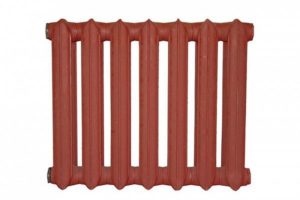
Finally, if the consumer is not concerned about the aesthetics of the heating appliances' appearance and the heat output requirement is low, then the ideal solution would be to install MS-140 cast iron radiators.
Dependence of the radiator heat transfer on the coolant temperature
The rated thermal power of one section of the radiator is calculated for standard values of the coolant temperature at the inlet (900 C) and exit (700 C) heating appliance. These conditions apply to centralized heating networks.
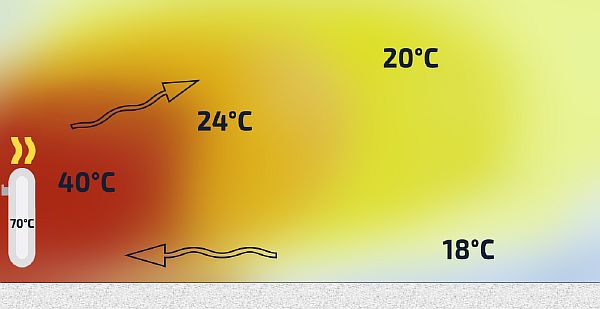
In autonomous heating systems for private homes, the temperature difference may be different. In this case, the heat output of a single section may differ significantly from the manufacturer's stated values. The heating power of a heating device is directly proportional to the temperature of the coolant in the supply pipe. The higher the temperature, the greater the heat output of the radiator. Conversely, the lower the coolant temperature, the lower the heating power of the radiator.
To avoid unexpected temperature fluctuations, use thermostats, which are installed into the pipework at the radiator inlet. Thermostatic heads come in manual, semi-automatic, and automatic versions, controlled online.
How to increase the heat transfer coefficient
Based on the above, it becomes clear that the actual heat output of any heating appliance may differ significantly from the manufacturer's stated technical specifications in its product documentation. Real-world operating conditions of heating radiators can cause cumulative heat loss, reducing the efficiency of the heating system in a home or apartment.
There are two options for increasing the heat transfer coefficient: improving the operating conditions of the existing heating system and using optimal methods for placing and connecting heating radiators, as determined at the design stage.
Using the example in the figure below, we will analyze heat loss in a building's heating system.
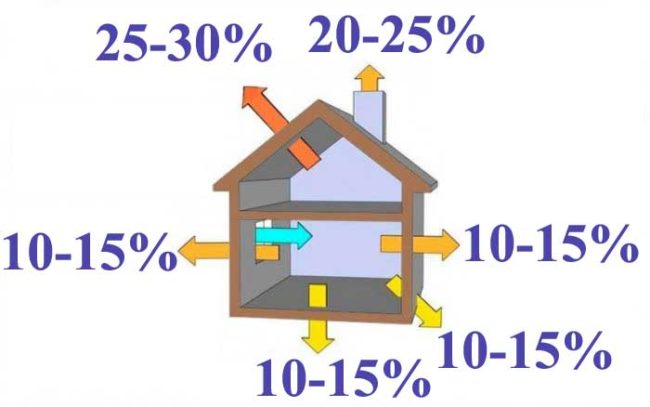
- Heat losses through the roof are: 25 - 30%.
- Through windows: 10 - 15%.
- Heat loss through the floor: 10 - 15%.
- Losses through walls: 10 - 15%.
- Adjacencies: 10 - 15%.
- Through a pipe (if there is stove heating): 20 - 25%.
We suggest using it online calculator for calculating heat loss in a house.
How to improve the efficiency of an existing heating system
To improve the efficiency of an existing heating system, experts recommend the following measures:
- insulate the enclosing structures outside the home (walls, foundation, basement and attic);
- replace old wooden window frames with double-glazed windows;
- stick foil screens on the walls behind the radiators;
- periodically open the Mayevsky taps to release air locks in the radiators;
- If the walls are cold, they are insulated from the inside with thermal insulation materials.
After completing these measures, homeowners will immediately notice improved heat output from their heating appliances. For internal wall insulation, the building materials market offers a wide variety of materials, from cork sheets and textured plaster to gypsum tiles and decorative polyurethane panels, which will not only insulate rooms but also enhance their appearance.
How to improve efficiency at the design stage
To avoid inadequate heat transfer by heating devices in new buildings, the following rules are followed at the design stage.
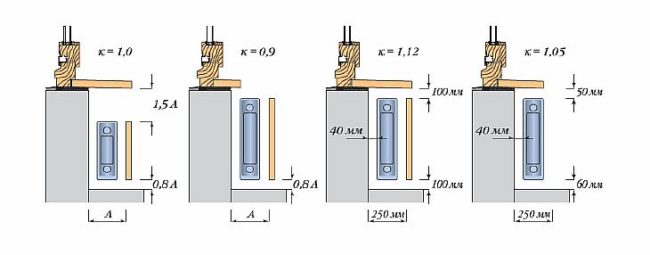
Rule 1Radiators are installed under windows. These can be special niches or suspended under window sills, with or without screens. Screens conceal the radiators' appearance but can also reduce their heating output. In some cases, screens are used deliberately to reduce heat flow by 10-15%, thereby preserving heat for other rooms.
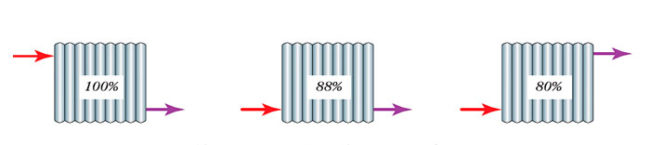
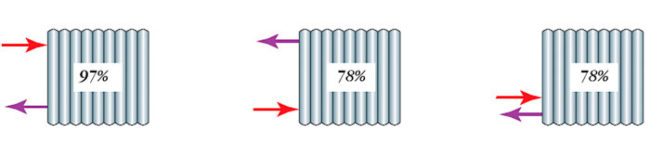
Rule 2The connection method significantly influences the efficiency of heating devices. This can be either single-sided or double-sided. A double-sided connection helps bring the radiator's output closer to the stated heat transfer rating. Experience shows that if there are fewer than 20 sections in a single room, single-sided radiator connection is preferable.
The photo below shows the efficiency of sections with double-sided pipe connections.
The photo shows the efficiency of sections with one-sided connection of pipes.
How to calculate the heat output of one section of a heating radiator
We suggest you use the online calculator, to determine how many sections a bimetallic radiator has needed per 1 m2.
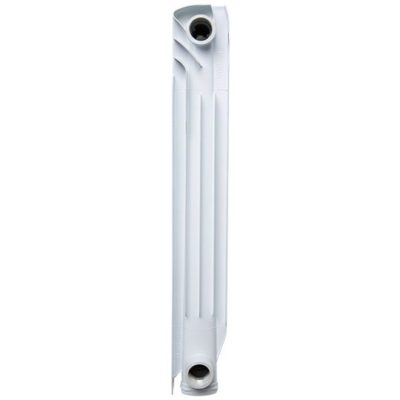
The sectional design of the heating units allows for varying the number of units in each radiator. This makes it possible to regulate the heating output by increasing or decreasing the heat-transfer surface area of the radiators.

Sectional radiators are available in bimetallic, aluminum, and cast iron. As mentioned above, all sections are supplied to the heating market with a pre-specified rated thermal output, calculated for standard operating conditions of the heating appliances.
Every calculation of radiator heat output must take into account the specific characteristics of the rooms where they are installed. For this purpose, correction factors have been developed (see the previous chapter, "Thermal Output Standards"). By substituting these actual values into the calculation, the final thermal output of the first section of the radiator is obtained.
Heat output of panel heating radiators
Unlike sectional devices, steel heating panels are non-dismountable products.
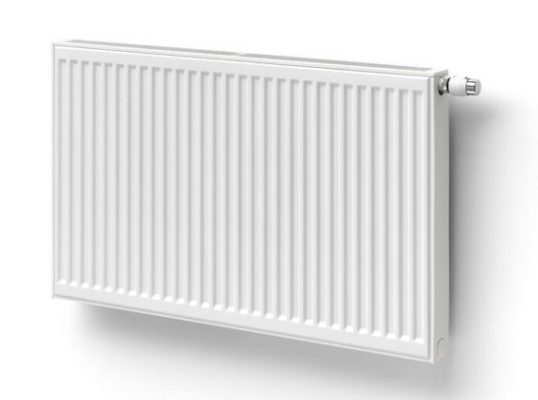
In the accompanying documentation, the manufacturer indicates the nominal thermal power of the panel, calculated for Δt = 700 C at an average room temperature of -220 C. The heat transfer of the device is calculated by substituting the actual value of Δt and entering correction factors.



Good afternoon! In a private house, we have aluminum radiators (batteries) with a center distance of 500 mm in a total of 80 sections, which amounts to 14 radiators, and with a center distance of 350 mm in a total of 14 sections, which amounts to 3 radiators. My question is: with this number of radiators, can the heat consumption be 3.5 Gcal per month? Also, can you provide an expert opinion, and how can we contact you?
Hello. We cannot provide you with an expert opinion, as we do not have permission for such activities. All information on this website is for informational purposes only. Heat consumption is affected not only by the number of radiators installed; the heat loss of the building itself must also be taken into account. See here. https://fixit.washerhouse.com/en/onlajjn-kalkulyatory/raschet-teplopoter-doma-kalkulyator-onlajjn.html and here https://fixit.washerhouse.com/en/onlajjn-kalkulyatory/rascheta-moschnosti-kotla-otopleniya.html