Precisely determining the number of sections of a bimetallic radiator capable of effectively heating a square meter of room ultimately impacts the overall economic efficiency of the heating system for an apartment or private home. A bimetallic radiator consists of several elements, each consisting of a steel pipe enclosed in an aluminum casing.
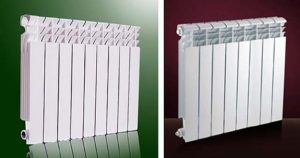
The average heat output of a bimetallic section is approximately 160–180 W (data sheet). This value is used as the initial parameter for the preliminary calculation of the number of sections for a bimetallic radiator. To heat a 10 square meter room, a radiator with a power output of 1360 W is required.
The number of sections for a bimetallic radiator is calculated by simply dividing the above two values: 1360/180 = 7.55 sections. The result is rounded up, meaning 8 sections will be required to heat this room.
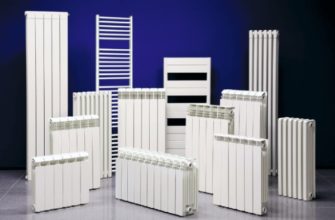
Currently, manufacturers and distributors of water heating appliances, in an effort to accommodate customers, publish online calculators. This service allows consumers, without having to delve into calculations, to calculate in just a few clicks the required number of sections, not only for a bimetallic radiator, but also how many sections are needed to assemble cast iron or aluminum radiators, as well as the size of a steel panel heater. A convenient online calculator for calculating the number of sections is presented in the next chapter.
- Online calculator
- Why is it dangerous to roughly calculate the number of radiator sections?
- Data required for calculation
- Heat loss coefficients
- Calculation methodology
- Parameters influencing the calculation result
- Calculation of the number of bimetallic sections per 18 m2
- Model of a bimetallic radiator
- Connection type
- Room layout
- Determination of thermal pressure
- Room conditions
- Calculation of the thermal power of 1 bimetallic element
- Calculation of the total number of sections for 18 m2
- How to assemble a sectional radiator yourself
- Why is it necessary to calculate the number of heating battery sections?
Online calculator
Enter the radiator connection diagram in the online calculator
Why is it dangerous to roughly calculate the number of radiator sections?
The above method is quite approximate., Not taking into account A multitude of factors influence the calculation result. The rated power of a single element of an aluminum or bimetallic battery is quite relative. After all, its value can only be obtained under specific conditions, where the heating temperature of the bimetallic fin is equal to 1000C, ceiling height up to 3 meters, there are no cold (external) walls in the room and there is only one window.
It would seem that calculating the heating capacity of bimetallic radiators for an apartment with ceilings no higher than 2.7 meters is quite simple. Simply multiply the standard heating power (136 W) of one bimetallic segment by the number of square meters in each room. The result is divided by the heating power of one segment, as stated by the manufacturer. But this is where the danger of approximate calculations lies.
Relying only on the passport data and without taking into account the characteristics of the room, you can incorrectly calculate how many radiator sections are needed per 1 m2This can lead to insufficient heating of the room or, conversely, force the removal of excess heat through forced ventilation. For an accurate calculation, it is necessary to consider all the nuances of the room's conditions.
Data required for calculation
As a rule, the accompanying documentation specifies the maximum heat output of one bimetallic segment—this averages 180 W under optimal heating conditions, although associated heat losses due to local room characteristics must be taken into account.
In the calculation that determines the number of sections, reduction factors are used.
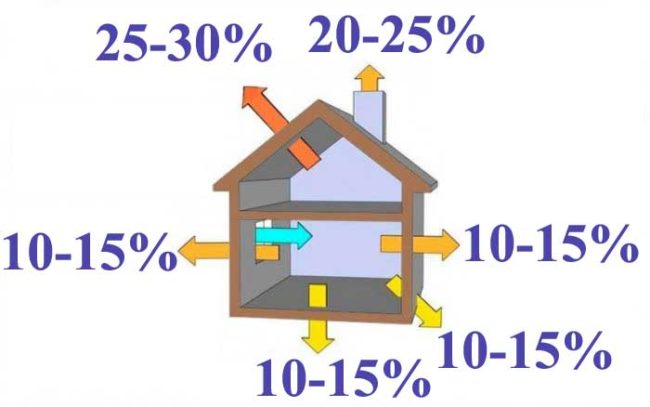
- Roof heat loss is 25 – 30%.
- Windows 10 – 15%.
- Floor 10 – 15%.
- Walls 10 – 15%.
- Adjacencies 10 – 15%.
- Pipe (if any) 20 – 25%.
Heat loss coefficients
For the design of heating systems, a set of rules was developed and approved based on SNiPs GOST 30494-2011 and GOST 32415-2013. SP 60.13330.2016 regulates the standard heat output of 1 kW for a 10 sq. m. room with a ceiling height of up to 3 meters, one external (cold) wall, and one window.
To bring the initial data into line with the actual operating conditions of the heating battery SP, the following coefficients were developed to correct heat losses.
K1 - takes into account the frame structure:
- double window frames – 1.27;
- double glazing of fiberglass windows – 1.0;
- triple – 0.85.
K 2 - takes into account the thickness of the walls:
- wall of 1 brick – 1.27;
- brickwork in 2 bricks - 1;
- high degree of thermal insulation – 0.85.
K 3 is the ratio of window area to floor area:
- 1/2 – 1.2;
- 1/3 – 1.0;
- 1/10 – 0.8.
K 4 is the average indoor air temperature in winter:
- 30 degrees – 1.5;
- 20 – 1.1;
- 10 – 0.7.
K 5 — number of cold vertical fences:
- 1 – 1.1;
- 2 – 1.2;
- 3 – 1.3;
- 4 – 1.4.
K 6 - space above the room:
- Cold under-roof volume – 1.0;
- attic or residential floor of an apartment building – 0.8.
K 7 - ceiling height:
- 2500 mm – 1.0;
- 3000 mm – 1.05;
- 3500 mm – 1.1.
After entering the correction factors into the calculation, the resulting figure is divided by the heat output of one section. The number of sections is rounded up to the nearest whole number. For example, if the result is 10.4, then 11 sections are used.
Calculation methodology
It is used to determine the actual temperature difference Δt (the difference between the average temperatures of the coolant in the radiator and the air in the room). The calculation is based on the formula:
Δt = (tfiling + treturn lines)/2 – t air
Considering the standard Δt = 700 C and the average air temperature in the room is 220 C, get:
(tfiling + treturn lines) = 2(70 + 22) = 1840 WITH
Taking into account that the basic standard for the temperature difference between the supply and return is 200 C, determine their meaning:
tfiling = (184 + 20)/2 = 1020 WITH
treturn lines = (184 - 20)/2= 820 WITH
In reality, this is simply impossible. The fact is that the boiler can only produce a maximum of 80°C of water.0 C, and the maximum temperature that will reach the heating battery will be 770 C. Δt will be approximately 400 C. Therefore, the actual heat output of the first section will be 100 W, not 180 W. To simplify the heat output calculation, a table of reduction factors is used.
| Δt | TO |
| 40 | 0.48 |
| 45 | 0.56 |
| 50 | 0.65 |
| 55 | 0.73 |
| 60 | 0.82 |
| 65 | 0.91 |
| 70 | 1 |
The rated power value is multiplied by the corresponding coefficient. This means that to heat one square meter of room area, a heat output of 180 x 0.48 = 86.4 W is required. Rounding up, this means that to heat 10 m2 Approximately 1 kW of heat output will be required. So, dividing 1 kW by 86.4 W yields 1000/86.4 = 9 sections.
When the ceiling height is greater than 2.5 m, the calculation is based on the room's volume. For this purpose, the coefficient K7 is included in the calculation (see the heat loss coefficients section above).
Parameters influencing the calculation result
As mentioned earlier, the rated heat output of a single element, stated by the manufacturer in the accompanying product datasheet, is calculated for optimal room conditions. This determines the standard number of radiator segments required to fully heat one square meter of space.
Each room, whether in an apartment or a private home, has its own unique heating requirements. These parameters can vary significantly from standard values.
Only heating engineers can effectively and accurately calculate the number of heating elements in bimetallic radiators. When making their calculations, they consider a large number of parameters that influence the final results.
To avoid tiring the reader with the specific intricacies of a professional approach to this matter, we will focus on the basic data required for accurately calculating the segments of bimetallic heating batteries:
- the material from which the walls are built;
- thickness of enclosing structures;
- average ambient temperature in winter;
- type of window frames (double wooden frames, double or triple glazing);
- the presence of a heated or cold room above the room;
- number of cold fences;
- room area;
- ceiling height.
A correction coefficient is selected for each parameter. The seven most commonly used coefficients are listed above.
Calculation of the number of bimetallic sections per 18 m2
To make it clearer how the entire process of selecting the number of sections in a radiator occurs, we can consider the calculation, for example, for a room with an area of 18 m2Initially, the most common room heating conditions encountered in practice are selected:
- bimetallic radiator model;
- connection type;
- room location;
- determination of thermal pressure;
- room conditions;
- calculation of heat transfer of a bimetallic section;
- calculation of the total number of sections for 18 m2.
Model of a bimetallic radiator
Let's assume a hypothetical buyer has chosen an ATLANT Eco 500/96 sectional bimetallic radiator. The number 500 indicates the center-to-center distance between the sections of the upper and lower manifolds. Bimetallic radiators are also available with a 350 mm center-to-center distance.
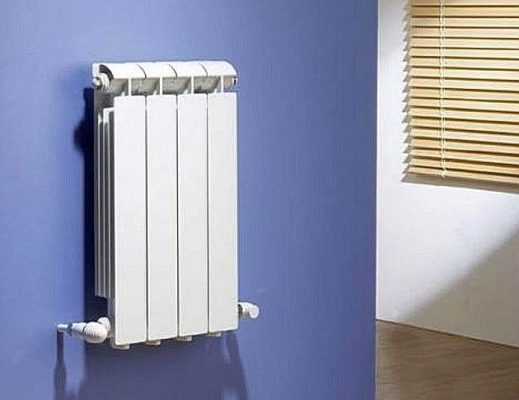
In the characteristics of this model, the manufacturer indicated the power of one section as 160 W with a thermal pressure of Δt = 700C. One segment is designed to heat 1.8 m2These passport data will need to be adjusted to the actual heating conditions of the room.
Connection type
Radiators can have either single-sided or double-sided pipe connections.
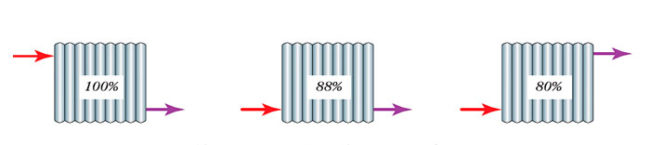
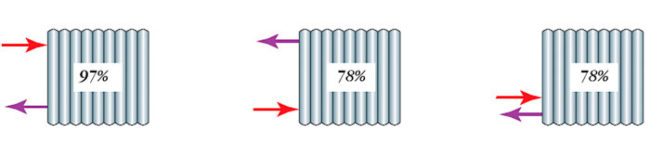
In this case, the radiator was selected with double-sided pipe connections, with the coolant inlet located at the top and the return flow exiting through the lower opening.
Room layout
The room may be a room in a private house or apartment. It's also important to consider what's located above the room: a heated or cooled space in the house or apartment.
In this case, they choose a room in an apartment with a residential upper floor.
Determination of thermal pressure
The previous chapter, "Calculation Methodology," provided an example of calculating actual thermal pressure. In this case, the thermal pressure would be 700 WITH.
According to the table, the corresponding coefficient is 1.0.
Room conditions
The previous chapter, "Heat Loss Coefficients," listed room conditions that can significantly affect the calculated output of a bimetallic radiator. This example uses average data and the corresponding coefficient values:
- the ceiling height is taken as 3 m. (1.05);
- the space above the room is the residential floor (0.8);
- number of cold (external walls) – 1 (1.1);
- the average room temperature in winter is 200 C (1,1);
- the ratio of window and floor areas is 1:3 (1.0);
- thermal insulation of walls – masonry in 2 bricks (1.0);
- window frame structure – double glazing (1).
Calculation of the thermal power of 1 bimetallic element
The manufacturer's stated power rating of a single heating element of the ATLANT Eco 500/96 radiator is 160 W. The thermal head coefficient is 1.0, which does not change the original value of 160 W. Applying all heat loss coefficients, the final heat output of the first section is calculated.
160 W x K-1 x K-2 x K-3 x K-4 x K-5 x K-6 x K-7 = 160 x 1.05 x 0.8 x 1.1 x 1.1 x 1.0 x 1.0 x 1.0 = 160 x 1.0164 = 162 W.
Calculation of the total number of sections for 18 m2
Calculations have confirmed that one bimetallic section will heat 1.8 m2 area of the room, maintaining the average air temperature in winter within 200 WITH.
Therefore, to heat a room with an area of 18 m2 You will need an ATLANT Eco 500/96 battery, consisting of ten sections.
How to assemble a sectional radiator yourself
You may not find a segmented battery with the required number of sections available for sale. In that case, you can purchase individual sections and assemble them yourself.
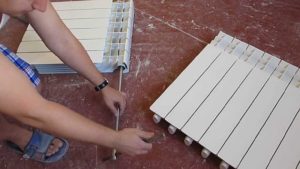
Their advantage is that the homeowner can always increase or decrease the radiator's heat output by adding or removing sections. Fittings (nipples with external threads), ring gaskets, and connecting pipes are purchased along with the segments.
Assembly is carried out using a special wrench. Since the sectional design has multiple joints, poor assembly of the radiator can cause leaks at the section joints. Therefore, screwing the segments together into a single unit requires extreme care.
Why is it necessary to calculate the number of heating battery sections?
An accurate calculation of bimetallic sections is impossible without a properly formed initial database. It is necessary to determine the volumes heat loss of the room, make the right choice of the radiator manufacturer, find out the coolant temperature at the inlet and outlet of the radiator, and also determine a comfortable temperature in the room.
Based on these figures, you can confidently calculate the number of sections of a bimetallic radiator needed to heat 1 m² of room space. Correctly calculating the number of segments in a single radiator will significantly reduce heating costs.
The sectional design of heating devices allows for the selection of the required number of sections in an existing residential heating system by dismantling them or, conversely, installing additional segments.