If you're planning a new home or a major renovation that involves redesigning your heating system, choosing radiators can be one of the most challenging aspects.
It is important to choose the right heating batteries, and to do this you need to know how they differ from each other based on size, and how their location depends on this.
- What does the size of a heating radiator affect?
- Standard dimensions of heating batteries
- Width: thin or thick
- Length
- Minimum height
- Types and sizes of radiators
- Standard radiators
- Low radiators
- High batteries
- Flat radiators
- Non-standard radiator sizes
- Dimensions of heating batteries made from different materials
- Cast iron radiators
- Aluminum radiators
- Bimetallic radiators
- Steel radiators
- Other size parameters and what they affect
- Center distance
- Depth
- Determining the volume of a section
- Power and size
- How to choose the right size and number of radiator sections?
- With standard arrangement
- With an original interior
- What will make the choice easier?
What does the size of a heating radiator affect?
The size of each radiator determines its capacity and the subsequent calculation of the number of sections. It's difficult to determine the width of a 10-section heating radiator without knowing its other parameters, such as: Center distance and what it affects.
Since the main purpose of a radiator is to effectively heat a room, the selection of batteries must be carried out according to clear rules and in compliance with all recommendations.
Standard dimensions of heating batteries
The center-to-center distance of most radiators is 500 mm. The legendary Soviet-era "accordion" cast iron radiator had (and still has) the same dimensions.
When replacing old cast iron radiators that have already served for many decades, you can find other batteries of the same size as a replacement.
The reference data for one section of such a standard radiator is as follows (using the classic model MS140 as an example):
- the distance between the centers of the connections is 500 mm;
- installation height – 588 mm;
- length – 93 mm;
- the depth of each section is 140 mm.
Width: thin or thick
This refers to the distance between the outer walls of the appliance. This value varies and can range from 75 to 140 mm, depending on the manufacturer and material.
In exceptional cases, you can find wider products, but too thin radiators are only available electric (convectors), but this does not apply to our material.
Length
The length is the gap between the left and right side walls. More than 90% of products on the market are 80 mm long. Sometimes it's a little longer, sometimes a couple of centimeters shorter. Any other length is difficult to find commercially; such radiators are custom-made.
This doesn't apply to cast iron radiators. They, as we noted above, are somewhat longer (wider).
Minimum height
Today, heating appliance stores offer radiators of various heights, but the range is dominated by three main sizes, which also differ in the distance between the pipes connecting to the radiator.
Standard-height radiators are considered to be 500 mm. A reduced-height radiator is 380 mm – this type of radiator can be installed under a low windowsill, near a hallway door, or anywhere else where the heating elements need to be as concealed as possible. Low-height radiators are 200 mm.
The lower the height of the product, the lower the section power, therefore, to compensate for heat transfer, low batteries are usually longer than standard ones - that is, they accommodate a larger number of sections.
Types and sizes of radiators
Let's take a closer look at the possible dimensions of radiators, based on their types.
Standard radiators
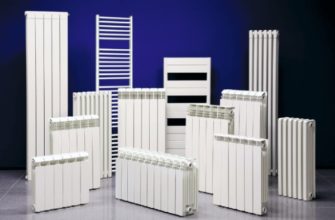
Standard battery parameters depend on the material from which it is made. The following options are available:
- Aluminum – with a depth of 80-100 mm, their height is 575-585 mm.
- Bimetallic batteries can have a height of 600 mm and a length from 400 to 3000 mm.
- Conventional steel radiators are usually 600 mm in height and 400-3000 mm in length (width).
- The standard for a cast iron battery (modern) today is 588 mm.
Low radiators
All heating units with a center-to-center distance of no more than 400 mm are considered low-profile. There can be a wide variety of models in this range. Much depends on the material used:
- Steel. This group typically includes the lowest-profile batteries. The smallest models are available with a center-to-center distance of just 150 mm and an overall height of 200 mm.
- Cast iron. A low cast iron radiator could be, for example, a model with an interaxial distance of 200 mm, while the installation height is 330-340 mm.
- Aluminum. There are models with a mounting height of only 245 mm, but there are also higher ones.
- Low bimetallic batteries. They can have a height of 245-264 mm, but the most common options are 350 mm high - almost every manufacturer offers such models.
The lowest radiators are designed for non-standard installation: they are attached to the floor rather than to the wall. More precisely, they are built into the floor (and are considered convectors) – they are distinguished by being installed flush with the floor and do not protrude beyond its height. They are also sometimes installed in windowsills.
Low-profile radiators are also available in copper, copper-aluminum, and tubular designs. Their height does not exceed 215 mm.
High batteries
Even in their standard form, such solutions look quite unusual. Manufacturers often give them original shapes or paint them in unusual colors.
There are models combined with a shelf or mirror – such radiators serve both as a heating device and as a decorative element in the interior.
It's impossible to find tall radiators made of cast iron—they're usually no taller than a meter. The same goes for bimetallic radiators—they're not produced taller than 760-860 mm.
Special steel models can be up to 2200 mm tall. Steel tubular radiators, depending on the brand, can be up to 3000 mm tall, and taller versions can be made to order. Other radiator types typically don't offer taller options, but the selection is quite decent.
Flat radiators
Sometimes the user doesn't care as much about the height of a product as its depth. If you need flat batteries, the choice in this regard is quite limited.
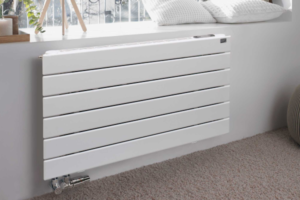
Some brands produce radiators with a depth of 52 mm, which have a decent power output of up to 161 W. Panel radiators are also considered flat radiators—based on the number of panels, their minimum depth can be 60 mm. Their thickness, incidentally, is also quite thin.
Tubular radiators can also have a modest depth - for example, radiators with two columns of pipes can be 50 mm thick, and those with three columns of pipes can be 100-110 mm thick, all the rest can be 135 mm or more.
Cast iron and bimetal are not flat. If you require a strictly flat heating system, consider baseboard heating – these units are installed around the perimeter, are 30 mm deep, and 100-120 cm high.
Non-standard radiator sizes
In addition to standard radiator sizes, there are also unusual options. These can be used in non-standard buildings or for design purposes when creating a unique interior. These are often designer products that:
- They are not used when installing central heating systems – they are more often ordered for houses with individual heating;
- usually monolithic, not sectional.
Dimensions of heating batteries made from different materials
The dimensions of heating appliances directly depend on the materials they are made of. Let's look at the radiator size chart based on their type.
Cast iron radiators
The "classic" in this line is the MS-140-500-0.9 model. Sizes are as follows:
- Standard – 140x588x93 mm.
- Low options – 140x388x93 cm.
- Tall models – 203x661-954x76 mm.
Calculating the dimensions of a radiator composed of a certain number of sections is easy. If the radiator has 7-10 sections, add an additional 1 cm to account for the paronite spacers. Before installing it in the niche, you also need to take into account the length of the flush valve.
Aluminum radiators
While aluminum batteries weren't made during the Soviet era (due to a shortage of the metal), the number of such models on the market has only increased since the early 1990s. Their thickness/height/width dimensions are as follows:
- Standard ones are 80-10x575-585x80 mm.
- Low ones have dimensions of 180x200-400x40x80 mm.
- Tall ones can be 95x590x80 mm in size.
The heat output of one section depends on the fin area and the depth of the product. Typically, it's 180-200 W.
Bimetallic radiators
These radiators are typically available in the same sizes as aluminum radiators. Their steel core doesn't affect the product's dimensions, but it does affect some operating parameters and cost.
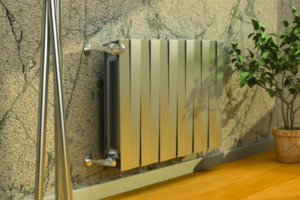
The dimensions of steel batteries are usually as follows:
- length – from 80 to 82 mm;
- depth within 75-100 mm;
- height – from 550 to 580 mm.
The heat output of one bimetal section is 10-20 W lower than that of aluminum.
Steel radiators
The dimensions of this type of radiator can be seen using tubular models as an example. The dimensions are as follows:
- standard steel radiators have a height of 600 mm and a width of 400-3000 mm;
- for low variants the height is 400-500 mm, the width is also 400-3000 mm;
- High steel batteries with the same width can be up to 700-900 mm in height.
Other size parameters and what they affect
There are some parameters that you also need to pay attention to, in addition to the height and width (length) - these are the center distance, depth and volume of the section.
Center distance
In the device instructions, the center-to-center distance may also be indicated as “center-to-center,” “inter-nipple,” or even “connecting dimensions.”
This parameter refers to the center-to-center length between the radiator inlets or sections. It is measured in millimeters. This value is often included in the product name, for example, Magica400 or RAP 500 – the numbers 400 and 500 refer to the center-to-center distance.
From a technical standpoint, it determines the distance between the pipes during radiator installation. This is especially important when replacing an old radiator with a new one of similar dimensions.
Depth
Knowing this parameter is especially important if you're planning to install the product in a niche or directly into a wall. Typically, a single section is 80 to 100 mm deep, but there are models with a section depth of 125 mm, and very compact sections with a depth of 60-65 mm.
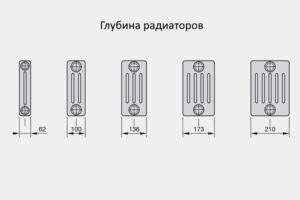
The temperature of the coolant (liquid) is also important - the higher the temperature, the narrower the battery you need.
Determining the volume of a section
When choosing heating radiators, the internal diameters of which can vary significantly, you need to be able to correctly determine the section size.
The recommended value for heating is often used as a guide. For example, panel-type buildings require 41 watts of heating power per cubic meter of volume. For modern homes with high-quality double-glazed windows and externally insulated walls, a value of 34 watts per cubic meter can be used.
An approximate calculation looks like this:
- Let's take as a basis a room of 4 by 5 meters with a ceiling height of 265 cm.
- Using a simple mathematical formula – Length x Width x Height – we calculate the volume of the room, in this case it is 53 cubic meters.
- We multiply this figure by 41 W, and then divide the resulting value by 1000. As a result, 2.17 kW will be needed for heating.
- Knowing the heat output of one section of any radiator, we calculate the required radiator capacity. For example, suppose you've chosen a bimetallic model with a single-section power of 170 W. Divide 2.17 kW by 170 W to get 12.8 sections. Round up or down to get 12 or 13 sections.
Power and size
This parameter can only be found out from the documentation for the device, and the manufacturers' advertising claims are often far from the actual figures.
Power depends largely on the battery's surface area—the number of fins and their dimensions. Why, then, can the power of two seemingly similar models be completely different? Because they're adding it in, trying to sell unsaleable products.
On average, the power of one section is 170 W – this is typical for the heat output of radiators made of cast iron, aluminum, or bimetallic alloy with a center-to-center distance of 500 mm. If the power output is significantly higher, it's worth checking the technical documentation.
A power output of 170 watts is achieved by heating the radiator to 90 degrees Celsius at a room temperature of 20 degrees Celsius, which is rarely done for energy savings. Typically, the maximum heating temperature is 60-70 degrees Celsius. Meanwhile, the room temperature is 22-24 degrees Celsius, which is 2-4 degrees higher than it should be.
Under these conditions, the actual heat output of one section drops to 120-130 W. This means that a standard 10-section radiator can be used in a room of 12-13 square meters with one large window. However, the building must be insulated, and the unit itself must not reach high temperatures.
How to choose the right size and number of radiator sections?
Calculating the dimensions of the sections and the required number in the radiator is a crucial step in installing traditional heating systems. The layout, whether standard or custom, is also important.
With standard arrangement
The dimensions of the radiators and the material they are made from affect the power they can generate when heating the coolant. With a standard length of 800 mm, it's necessary to determine the appropriate height. To do this, select the installation location and determine the vertical component.
The figure is usually between 350-500 mm. Next, you need to calculate the depth and number of sections—usually 10, but as you already know, other options are available. The thickness is calculated from the volume—divide the cubic value by the length and height.
In a small room such as a bathroom or toilet, it is advisable to install a narrow radiator that would cover the gap between the ceiling and the floor.
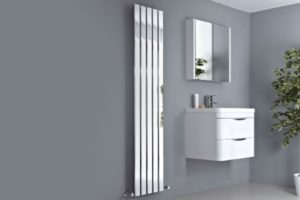
With an original interior
When it comes to design, a custom solution often comes at the expense of the appliance's technical specifications. This is especially true for cast iron products.
Nuances:
- Our cast iron radiators are rugged in appearance, but they heat very well, while European devices, although elegant, are not as powerful.
- There are retro-style radiators – they have a nice appearance, but the price is steep.
- As for aluminum, they have almost the same shape (except for those made to order), but a wider range of colors and dimensions also vary, so you can choose a battery for installation in almost any location.
- Bimetallic radiators come in straight or curved shapes, fitting perfectly into interiors without sharp corners.
Whatever the material, it's important to study the technical documentation to calculate the number of sections needed for a given room. If you like a particular design but the radiator is underpowered, you can:
- add an additional heating source by hiding it in a niche or in the floor;
- combine traditional heating with underfloor heating.
It's difficult to calculate all the necessary parameters on your own, so for custom-made products, it's worth consulting with the manufacturer. They'll be happy to help you with the calculations, ensuring the battery will both satisfy your aesthetic needs and perform its primary function perfectly.
What will make the choice easier?
To make it easier to choose heating radiators based on their dimensions, you can seek help from specialists – they will help you with the calculations, and then you can do the work yourself.
Another helpful tip: When calculating the radiator's dimensions, you can use cardboard or paper to draw a full-size representation of the radiator and place it against the wall at the intended installation location to ensure the unit will fit properly and all utilities will be connected correctly.
Choosing a heating radiator is a challenging, but entirely achievable task if you pay attention to all parameters. Consider the length, height, and width of the radiator. The center-to-center distance, section volume, and power rating are also important. By taking everything into account, you'll not only be able to perfectly integrate the radiator into your interior but also ensure effective heating without breaking the bank.