The heating market is filled with a wide range of bimetallic and aluminum radiators. These models are beautifully designed, compact, and lightweight. Both types of heating devices fit harmoniously into any interior, even the most sophisticated. But the question arises: which radiators are better—bimetallic or aluminum?
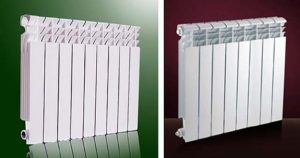
In the competitive battle for control, heating radiator manufacturers are working hard to create ever more advanced models. They strive to develop bimetallic and aluminum radiators that most efficiently transfer heat from the liquid coolant into the interior space.
- Comparative analysis of bimetallic and aluminum radiators
- Aluminum radiators
- Manufacturing technology
- Design Features
- Difficulty of installation
- Operating temperature
- Working pressure
- For what premises
- Heat transfer
- Reliability and service life
- Interaction with the coolant
- Price
- Pros and cons
- Pros
- Cons
- Bimetallic radiators
- Manufacturing technology
- Design Features
- Difficulty of installation
- Operating temperature
- Working pressure
- For what premises
- Heat transfer
- Reliability and service life
- Interaction with the coolant
- Price
- Pros and cons
- Pros
- Cons
- What batteries should you choose for your apartment?
- Choosing radiators for a private home
Comparative analysis of bimetallic and aluminum radiators
Despite all the external similarities between the two types of products, there is a difference between them quite a big difference, covering many features and characteristics. Consumers often face the problem of determining which heating radiators are better—aluminum or bimetallic. Each of these two types of heating batteries has its own pros and cons.
In this article, we aim to convey to consumers all the advantages and disadvantages of these types of heating radiators. By comparing their quality characteristics with the local conditions of their home or central heating system, consumers will be able to more easily choose one model over another.
Aluminum radiators
Non-ferrous metal models have appeared on the heating equipment market relatively recently. In fact, these products are not made of aluminum, but rather of its alloy, silumin, which contains 12–14% silicon and trace amounts of various metals. Compared to aluminum, silumin is stronger and more wear-resistant.
The main advantage of silumin heating panels is their complete resistance to corrosion. These products are extremely popular with owners of both small homes and large mansions. To fully appreciate the advantages of silumin heating units, consider the following characteristics.
Manufacturing technology
Products made of silumin produced by extrusionFor this purpose, a mold is made for pouring molten metal (flask).
A distinctive feature of the process is that the mold is filled by forcing the molten alloy under pressure through a hole in the flask. This process produces a high-density device, completely eliminating the formation of voids in the metal.
Design Features
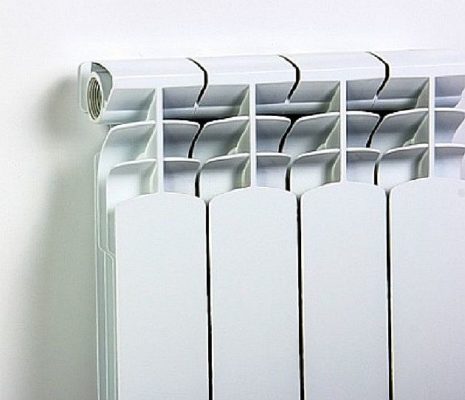
There are two manufacturing methods: monolithic panels and prefabricated sections. In both cases, each section consists of a standard set of components. These are two collectors (a horizontal upper and lower collector) with a diameter of 25 mm. They are connected by vertical oval-shaped shafts with vertical convection fins on the sides and front of the radiator.
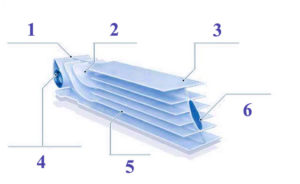
Section arrangement:
- Radiator housing.
- Polymer coating.
- Frontal finning.
- Horizontal channel with thread.
- Lateral ribbing.
Unlike monolithic radiators, prefabricated units consist of sections connected by steel nipples with multi-directional threads and gaskets. Standard aluminum heating units consist of 3, 4, 5, 6, 8, 9, 10, 12, 15, 17, and 21 sections. Fin heights are 200, 250, 300, 350, and 500 mm.
Prefabricated designs allow homeowners to choose the number of sections for each model. This plays an important role in determining whether aluminum or bimetallic radiators are better for an apartment.
Difficulty of installation
All silumin models are wall-mounted radiators. They are installed on brackets secured to the walls. Due to the lightweight nature of silumin, heavy supports are not required for mounting the radiators. A hammer drill and dowels may be required for mounting the heating elements. If the radiator is connected to plastic pipes, a welding machine and plastic adapters will be required.
The installation process is straightforward. A few conditions must be met during installation. The top surface must be horizontal, the gap between the wall and the back of the radiator must be at least 4 cm, and the gap between the top of the unit and the bottom of the windowsill must be 5–7 cm.
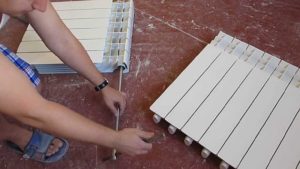
In addition to prefabricated panels, radiators are assembled by twisting sections together with nipples and gaskets directly on-site. The process is so simple that anyone can assemble a sectional structure of the required size themselves.
Operating temperature
Aluminum radiators can withstand hot water at its maximum temperature – 1000 C. In autonomous heating systems of private houses, water is replaced by a synthetic liquid heat carrier with a maximum heating temperature of about 1300 C, which silumin can withstand.
To prevent temperature extremes from occurring, a thermostat is installed in the heating system. Heating panels are also equipped with thermostatic valves that prevent overheating.
Thermostats come with manual and automatic settings, and the most expensive devices can be adjusted online using a smartphone via the Smart Home system.
Working pressure
Silumin is the primary material used in modern aluminum radiators. Due to its brittleness, it cannot withstand the pressure surges found in centralized heating systems. These radiators are rated for a maximum pressure of 16 atmospheres. Some models can withstand up to 20 atmospheres.
Peak pressure in central hydraulic systems can reach 40 atmospheres, not to mention water hammer, where this figure can be even higher. For this reason, it's clear that bimetallic radiators are best installed in apartments, while aluminum radiators are best installed in private homes, where such negative effects are absent.
For what premises
There are no specific restrictions in this regard. Silumin withstands high humidity conditions perfectly. The only limitation is that radiators should not be installed in rooms where there is a risk of freezing temperatures. If the coolant freezes, the radiator will simply rupture.
Heat transfer
Aluminum products are unrivaled in terms of heat transfer. A single section of a silumin radiator can produce up to 200 watts of heat.
Half of the heat is emitted by the device, and the other half is delivered to the room via convection. The radiator's surface is completely heated within a few minutes.
Reliability and service life
Silumin, the material used to make heating radiators, is quite fragile. They should be placed in locations where there is the least risk of accidental mechanical impact.
According to the manufacturers, the devices are designed for a service life of 10–15 years.
This is the minimum service life under the most adverse operating conditions. If the batteries are properly installed, filled with clean coolant, and undergo regular preventative maintenance, they can operate trouble-free for twice or even three times longer.
Interaction with the coolant
The material is corrosion-resistant as long as it comes into contact with clean water. Synthetic fillers may contain additives that are aggressive to non-ferrous metals. Contaminated hot water is common in centralized heating systems.
Highly acidic coolants can corrode silumin, which can cause radiator failure and flooding. In autonomous heating systems, it's easier to monitor the coolant's purity and inertness by installing additional filters. This creates favorable operating conditions for the heating radiators.
Price
When comparing prices for aluminum radiators and bimetallic counterparts, an objective comparison can only be made between branded devices.
An analysis of the heating technology market offers shows that anodized batteries are 10–15% cheaper than bimetallic ones.
Pros and cons
Batteries made from silumin, while having positive characteristics, also have a number of disadvantages. Both should be considered.
Pros
The advantages of this type of product include the following:
- silumin, retains all the positive characteristics of aluminum, while giving the metal additional strength;
- High heat output. The heating panel surface heats up almost instantly. The radiator reaches its maximum temperature within minutes;
- The optimal dimensions of the products allow them to be compactly placed under windows without going beyond the width of the window sills;
- The sectional design of the batteries allows for the dimensions of the heating panels to be tailored to each individual case;
- Affordable prices for non-ferrous metal batteries for the average consumer.
Cons
The disadvantages of silumin products include the following:
- fragility of the metal, which is fraught with destruction due to pressure drops and water hammer in the heating system;
- Along with rapid heating, the batteries also cool down quickly, which negatively affects the heating of the entire room;
- During the summer season, it is forbidden to drain the coolant from the system, as this creates a risk of internal corrosion;
- The risk of corrosion is much higher for plain aluminum products than for anodized models.
Bimetallic radiators
At the end of the last century, the engineering idea of combining aluminum, a good heat transfer material, with strong and reliable steel in a single product found its practical application in bimetallic radiators. The invention of this type of heating device made it possible to eliminate direct contact between the non-ferrous metal and the coolant by finning the steel body of the radiator itself.
Due to their properties, these heating units can withstand contaminated hot water in centralized heating systems. If you need to decide which radiators are best for your apartment—aluminum or bimetallic—it's best to choose the latter.
Manufacturing technology
The process of manufacturing bimetal radiators consists of several stages. First, a housing is created from steel tubes. The tubes are welded together into a single manifold on an automated line, then pressed, threaded, and blown. The steel section is placed in a mold (flask). Molten material is injected under pressure through a hole in the flask, forming the fins.
The finished sections are sanded and painted in two stages. First, the radiators are dipped in a paint bath under electrical voltage. During the anaphoresis process, the paint penetrates deeply into the silumin, forming a durable layer over the entire surface of the radiator. Finally, the sections are sprayed with an epoxy-polyester compound. After heat treatment, the radiators acquire their finished appearance.
Design Features
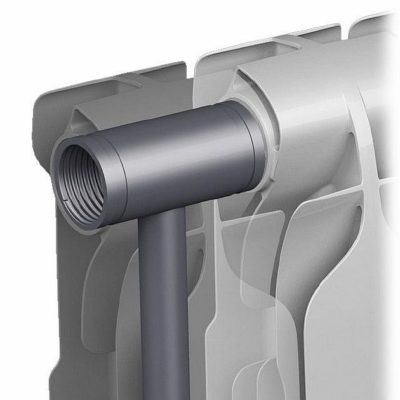
A bimetallic radiator differs from an aluminum one in that the coolant only contacts the steel and cannot attack the aluminum frame. Because of the steel manifold, the heating panels weigh significantly more than their aluminum counterparts. At the same time, bimetallic radiators are much stronger than silumin radiators.
Difficulty of installation
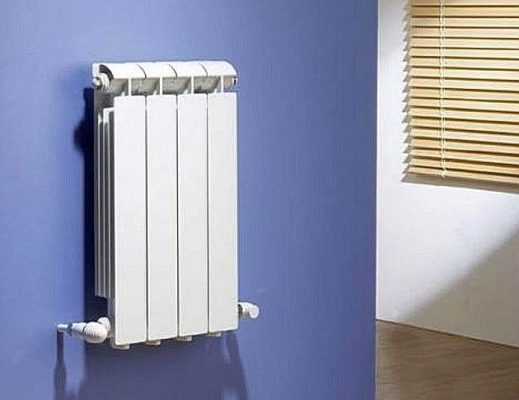
Unlike monolithic heating panels, bimetallic radiators are assembled from several sections. A single unit can contain three or more than a dozen. The radiators are assembled by twisting the sections together using double-threaded nipples and gaskets.
Both monolithic and sectional radiators are supported by brackets mounted into the walls. Installation rules are the same as for silumin radiators (see the chapter of the same name in the aluminum radiators section above).
Operating temperature
When deciding which radiator to choose based on operating temperature, the answer is unequivocal in favor of bimetallic products.
The steel manifold can withstand heating temperatures above 1000 WITH.
Experience shows that most boilers can increase the maximum heating temperature of the liquid coolant to 900 C. There are autonomous heating systems in private houses, where water vapor is used as a coolant, which can be heated up to 1300 C and above. In this case, the question of which radiators are better does not arise. The only alternative to these radiators in this regard is cast iron.
Working pressure
When it comes to maximum operating pressure in heating radiators, bimetallic products remain the leaders. When comparing these permissible parameters, silumin radiators fall far behind bimetallic ones.
As mentioned earlier in this article (see the section on aluminum radiators), centralized heating systems suffer from fluctuations in operating pressure in radiators in multi-story apartment buildings. There's also a risk of water hammer, where peak pressure can reach 40 atm. Only bimetallic, steel, and cast iron radiators can withstand these negative effects.
For what premises
Just like aluminum appliances, bimetallic radiators can be installed in rooms with high humidity. Since the water flows inside the steel pipes, the radiators are protected from damage in the event of freezing.
Steel is a fairly durable material and, thanks to its thickness (2–3 mm), it can withstand exposure to temperatures below freezing in areas where there is a risk of freezing.
Heat transfer
Compared to aluminum radiators, bimetallic radiators are slower-acting devices. They heat up more slowly and cool down just as slowly. Aluminum radiators have high thermal conductivity, averaging 160–180 W/m.2 silumin surface of the radiator.
We invite you to familiarize yourself with Top 18 Bimetallic Heating Radiators — rating of the best models.
Therefore, bimetal is inferior to aluminum in terms of heat transfer. This is because a steel manifold cannot absorb as much heat from the coolant as silumin. Based on various calculations conducted by branded heating appliance manufacturers, bimetal's heat transfer is 1.5 times lower than that of aluminum appliances.
Reliability and service life
Bimetallic radiators are very popular with consumers due to their long service life (15–20 years). Manufacturers typically guarantee trouble-free operation for this period.
Silumin, as the most brittle material, does not come into contact with the coolant, while steel collector pipes successfully withstand peak pressure drops and the effects of aggressive impurities in hot water. With regular preventative maintenance of the central heating system, bimetallic radiators can last indefinitely.
Interaction with the coolant
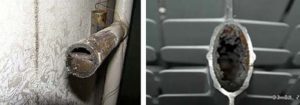
The steel manifolds of bimetallic radiators have anti-adhesion properties and do not contribute to the formation of deposits on their inner walls from contaminated coolant. Despite this, experts recommend flushing the heating system with cleaning agents if heat transfer deteriorates.
Of all types of heating radiators, only cast iron, steel, and bimetallic ones can be used in steam heating systems, where the coolant temperature can reach 130 degrees or more.
Price
You can find a large number of offers for bimetallic sections. Despite the significant price differences, it's possible to estimate the average cost of bimetallic sections based on certain characteristics.
For example, to heat a well-heated room, you will have to spend about 19 - 20 thousand rubles on the purchase of bimetallic heating devices.
Pros and cons
Batteries made from two materials, steel and silumin, have both positive and negative properties.
An objective assessment of the pros and cons in this regard is especially important when it is necessary to determine, in specific room conditions, which is better: aluminum or bimetal.
Pros
The advantages and benefits of bimetallic radiators include the following:
- long service life – 25 years;
- high threshold of maximum heating temperature – 130 degrees and more;
- resistance to pressure changes and water hammer up to 40 atmospheres;
- corrosion resistance;
- The versatility of the design allows you to replace damaged sections or change their number in one battery.
Cons
Along with their advantages, bimetallic radiators also have some disadvantages:
- When draining the coolant during the off-season, there is a risk of corrosion of the inner surface of the steel collector;
- the small flow diameter of the collector pipes results in lower heat transfer than that of aluminum devices;
- The price of bimetal is approximately 20–30% higher than the price of aluminum products.
What batteries should you choose for your apartment?
Apartments are heated by a central heating system. All of its disadvantages should be considered when choosing between aluminum and bimetallic radiators.
As can be seen from the above material, the question of which batteries are better, aluminum or bimetallic, is decided in favor of the latest heating devices.
Choosing radiators for a private home
Autonomous heating systems in private homes eliminate many of the drawbacks of centralized heating networks. Therefore, it is much more cost-effective to equip private homes with aluminum radiators.
Silumin products significantly outperform bimetallic materials in terms of heat transfer and cooling inertia. The low cost of aluminum radiators plays a significant role when choosing them for heating private homes.

It was precisely because of the heat output that we chose aluminum radiators for our home, plus the low cost.