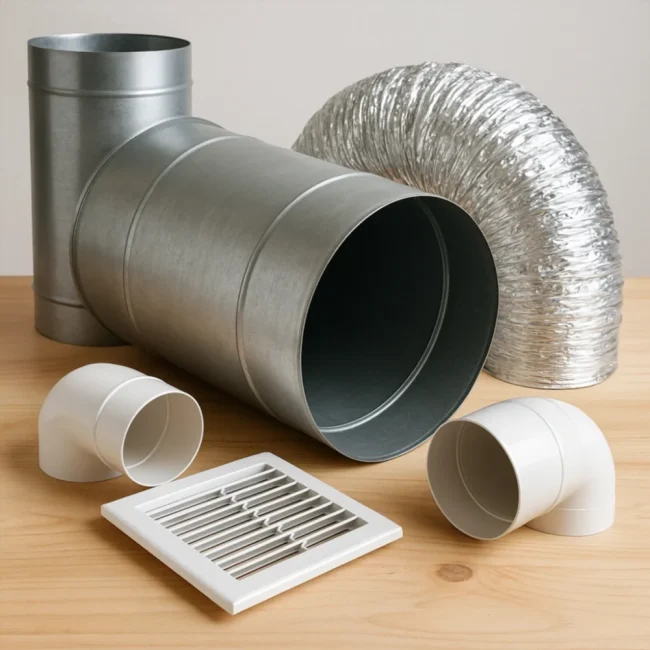
Creating an effective ventilation system is one of the most important stages in the construction or renovation of a private home. A comfortable indoor climate, the health of residents, and the durability of building structures largely depend on properly managed air exchange. And one of the key issues facing any homeowner is choosing the right air ducts.
200mm ventilation ducts are often the optimal option for most residential spaces. This article explains the reasons for choosing this diameter, what materials to use, and how to choose and install the right ventilation system.
- Why is duct selection so important?
- Why exactly 200 mm?
- Air duct materials: what to choose for a private home?
- Metal air ducts
- Plastic air ducts
- Flexible air ducts
- Air duct shape: round or rectangular?
- How to correctly calculate ventilation for a home?
- Tips for installing air ducts
- Common mistakes when choosing air ducts
- Result
Why is duct selection so important?
Ventilation removes excess moisture, unpleasant odors, carbon dioxide, and other contaminants, while simultaneously providing fresh air to the premises. Insufficient or poorly designed ventilation leads to mold growth, poor occupant well-being, and increased heating and air conditioning costs.
Air ducts are the "lifeblood" of ventilation. Their diameter, material, shape, and installation quality directly impact:
-
the volume of air that passes through the system per unit of time;
-
noise level;
-
pressure loss;
-
energy efficiency of the entire system.
The choice of pipeline diameter is one of the most important factors, and ventilation ducts with a diameter of 200 mm are often recommended here.
Why exactly 200 mm?
Ducts with a diameter of 200 mm are considered universally suitable for ventilation of the average residential building. Here are several reasons for their popularity:
-
Optimal balance of throughput and sizeThe 200 mm diameter allows for the required air exchange rate within a relatively compact size.
-
Versatility of applicationThese air ducts are suitable for both fresh air supply and exhaust.
-
Noise reductionWith a large diameter, the air velocity decreases, which means the noise level also decreases.
-
Simplifying calculations and installationStandard diameter air ducts are easier to connect to ventilation units and fittings.
Of course, when designing a system, it's important to consider the specific parameters of the building—its area, ceiling height, number of occupants, and even the climate zone. But in most cases, 200mm ventilation ducts are the optimal solution.
Air duct materials: what to choose for a private home?
There are several main types of materials available on the market for air ducts. Each option has its own advantages and disadvantages.
Metal air ducts
-
Galvanized steel — the most popular material. It is characterized by high strength, corrosion resistance, and relatively light weight.
-
Stainless steel — used less frequently due to its high cost, but is indispensable in conditions of high humidity (for example, in swimming pools, saunas).
-
Aluminum - a lightweight, corrosion-resistant material, but less durable than steel.
Metal air ducts are durable and withstand temperature and pressure fluctuations well. However, their installation requires professional equipment, and they offer poorer noise insulation.
Plastic air ducts
-
Lightweight, affordable, easy to install even without special skills.
-
They have good sound insulation.
-
Chemically inert, not subject to corrosion.
However, plastic pipes have operating temperature limitations (usually up to +70 °C) and are less durable than metal.
Flexible air ducts
-
Made of multilayer foil reinforced with a spiral.
-
Easy to install in confined spaces.
-
Can be used as a temporary solution or on short sections of the system.
Flexible air ducts are not suitable for long main lines, as they have high aerodynamic losses.
Air duct shape: round or rectangular?
Most often used in private homes round air ducts, especially with a diameter of 200 mm. They provide:
-
minimal air resistance;
-
uniform distribution of air flows;
-
lower noise level compared to rectangular ones.
Rectangular air ducts are used less frequently, usually in conditions of limited space, for example, in interfloor ceilings.
How to correctly calculate ventilation for a home?
Proper ventilation calculations begin with determining the required air exchange rate. This depends on the room's intended purpose:
-
living rooms - 1-2 exchanges per hour;
-
kitchens - 6-10;
-
bathrooms - 6-8;
-
dressing rooms and storage rooms - 1-2.
After this, the total volume of air the system must pass is calculated. The formula is simple:
V = S × H × n,
Where:
-
V — required air volume (m³/h),
-
S — area of the premises (m²),
-
H — ceiling height (m),
-
n — air exchange rate.
Based on the obtained data, the duct diameter can be selected. For example, 200 mm ventilation ducts can handle approximately 1000–1200 m³/h at moderate air velocity (3–5 m/s), which is sufficient for ventilation of most private homes up to 250–300 m².
Tips for installing air ducts
-
Minimize the number of turnsEach bend increases aerodynamic drag.
-
Use smooth curves instead of sharp corners to reduce pressure losses.
-
Insulate the air ducts, especially if they pass through cold attics or basements. This will prevent condensation and heat loss.
-
Install check valves on exhaust lines to prevent backdraft.
-
Plan inspection hatches for ease of maintenance and cleaning of the system.
Common mistakes when choosing air ducts
-
Incorrect diameterA small diameter results in noise and insufficient air exchange, while one that is too large results in unnecessary costs.
-
Choosing the wrong materialFor example, the use of plastic pipes near high temperature sources.
-
Poor insulationWithout it, ventilation can become a source of heat and moisture leaks.
-
Ignoring air exchange standardsCutting corners on design results in discomfort and health problems.
Result
Selecting air ducts is a task that requires attention and a competent approach. Air ducts for ventilation 200 mm In most cases, they prove to be the best solution for a private home: they provide the necessary throughput, optimal noise levels, and ease of installation.
It's equally important to select the right duct material, taking into account all the building's layout features and the region's climatic conditions. If you have any doubts about the calculations, it's best to consult with professionals: competent ventilation design will pay off in comfort, durability, and health for years to come.