From our article, you'll learn how and when to inspect underfloor heating, and why it's essential to do so at the time of purchase.
We'll also cover how to measure voltage with a multimeter, how to test the underfloor heating cable or film, and how to check the temperature sensor and thermostat. We'll also explain how to test a heating system without a multimeter.
- Check at the time of purchase
- We check the voltage in the network with a multimeter
- How to test underfloor heating for continuity using a multimeter
- High power consumption
- Low power consumption
- Lack of resistance in the system
- How to check a temperature sensor with a multimeter?
- How to test a thermostat and relay
- How to test without a multimeter
Check at the time of purchase
Underfloor heating should be inspected at the time of purchase. The heating device comes with documentation detailing its technical specifications and resistance level.
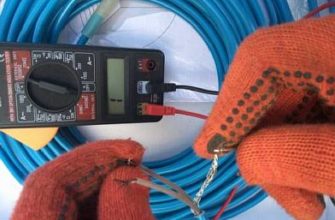
At the buyer's request, the seller should demonstrate all the equipment's functions. Using a multimeter or tester, you can measure the insulation resistance by setting the device to high resistance mode. The obtained data should match the information in the technical documentation.
It is recommended to test heated floors before purchasing them, otherwise you risk purchasing equipment that does not work.
We check the voltage in the network with a multimeter
If your installed underfloor heating isn't heating, the first thing you need to do is check that there's power in the network. There's an indicator on the thermostat for this purpose. If it's lit, the temperature setting may be off or the minimum value may be reached.
If the indicator light is off, there's no voltage, and you need to check the circuit breaker on the panel. Sometimes, the circuit breaker trips, which indicates a short circuit.
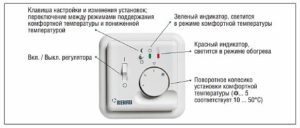
To locate the fault, disconnect the power and the floor cable from the thermostat. Then, use a multimeter to test the section between the panel and the thermostat.
If the multimeter shows zero resistance, the wiring is damaged in that section. If the device shows a higher value, the fault should be looked for elsewhere.
First, you need to determine whether there's electrical current at the thermostat's input. If the test reveals a short circuit, the device is faulty. Otherwise, the problem should be looked for in the power cable.
A multimeter can be used to measure both resistance and voltage in a heated floor.
How to test underfloor heating for continuity using a multimeter
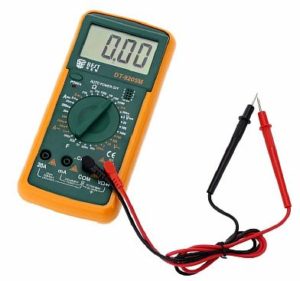
To test an electric underfloor heating system for continuity with a multimeter, whether it's the cable, mats, or film, be sure to turn on the beep. This is done using the icon located near the ohmmeter scale.
When the probes touch each other, a sound is heard—this indicates a closed circuit. If the probes touch the underfloor heating wires, a buzzer sounds. If there is no buzzer, we conclude that the wires have broken.
You can measure the resistance of your underfloor heating element with a multimeter. Divide the reading by 220 watts (the line voltage) to determine the current flowing through the cable.
This value must be multiplied by the voltage (220V) to obtain the power consumption. It must match the manufacturer's specifications, with a 5% discrepancy permissible.
Any discrepancies on the higher side indicate the presence of faults in the heater.
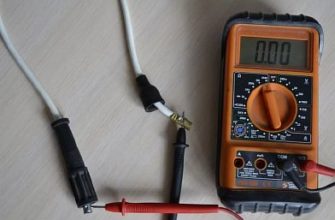
When installing film-based underfloor heating, you can use a multimeter to measure the resistance of the entire system or each individual strip. If the readings don't match the specifications, the problem lies with the film. Therefore, you should check the integrity of the wires and the quality of their connections.
High power consumption
If the measured power consumption significantly exceeds the manufacturer's specifications, a short circuit has occurred. This usually occurs when the insulation layer of the wires is damaged.
In this case, one area will heat up strongly, while another will not heat up at all. Operating in this mode leads to to high electricity consumption, in addition, the system will quickly fail.
This problem can be solved by removing the finishing material in the area where the insulation is damaged and repairing the defective section of the wire.
Repairs involve insulating the exposed wire strands with electrical tape. If the cable is located under a concrete screed, this can be quite difficult.
Low power consumption
If the underfloor heating system's power rating is significantly lower than its rated value, and the resistance reading is infinite, there is an open circuit. Continued operation in this mode will cause the cable to burn out.
To troubleshoot the problem, you need to locate the break. But first, you need to disconnect the system from the power supply and the regulator. A high-voltage generator or thermal imager can be used to locate the break. By passing them over the flooring, you'll hear a sound where the break occurred.
This is where the trim should be removed to gain access to the broken wire. The broken wires are protected, connected with a sleeve, and clamped with pliers.
The sleeve, pre-installed on the section, is heated with a heat gun, causing it to compress, thereby sealing the wire. After this, the finishing material can be installed in the room.
Lack of resistance in the system
Zero resistance indicates a short circuit. If the trim is missing or easily removed, the fault can be found by simple inspection. Where the short circuit occurred, the insulation layer will be damaged (melted, burned, or exposed).
The repair work consists of restoring the insulating layer.
How to check a temperature sensor with a multimeter?
The temperature sensor is a resistor-based device, so it has its own resistance, which can be easily checked with a multimeter. Since the sensor is located between the heating elements, the resistance of its resistor is affected by the temperature of the heated floor. The higher the temperature, the lower the resistance. For example, if the floor is heated to 5 degrees Celsius, the device will read 22 kOhm; at 40 degrees Celsius, it will read 6 kOhm.
Before testing the temperature sensor, remove the controller's faceplate and unscrew the mounting block. Then, using a multimeter set to ohmmeter mode, measure the sensor's resistance.
It is compared with the factory settings. A discrepancy of more than 5 kOhm, or a value of 0, indicates a faulty device and requires replacement. This is easy to do if the sensor installation instructions were followed and it is housed in a corrugated tube. Simply remove the device from the tube and replace it.
There are modern models of thermostats that display information about sensor failure on their touch screen.
How to test a thermostat and relay
A thermostat is a device used to adjust and control the heating system. The most common faults in thermostats are the relay or capacitor.
Repairing them is expensive, so it's more practical to simply replace the entire unit. However, there is one possible cause of underfloor heating failure: poor wire connections to the controller terminals. This issue is easy to fix yourself. Simply tighten the screw connections.
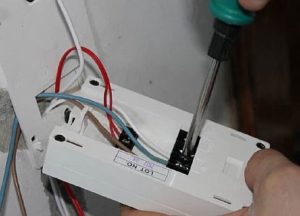
Before testing the thermostat, first check that the device is connected correctly according to the diagram. If everything is OK, disconnect the heating elements from the controller and check for voltage at the contacts.
To do this, set the minimum temperature and apply 220 V. Using a multimeter, measure the voltage across the contacts; it should match the 220 V input.
After this, you need to ensure the relay is working properly. A step-by-step check consists of the following steps:
- The thermostat is set to the minimum temperature value.
- The voltage is supplied and measured; it should be equal to 220 W.
- The toggle switch is switched to On mode.
- Set the device to the maximum temperature; you should hear a click, indicating the relay switches if the device is working properly. At this point, the pressure at the contacts leading to the heater should be 220 W.
- The lowest temperature is set again, and again the relay should turn off the voltage supply.
How to test without a multimeter
If you don't have a multimeter, there is a method for checking the operation of a heated floor using a regular light bulb.
Thermostat testing steps:
- Connect the thermostat to the power supply according to the diagram. Terminal L is the live terminal, and terminal N is the neutral terminal. Connect the temperature sensor and the light bulb to it; the latter serves as an indicator.
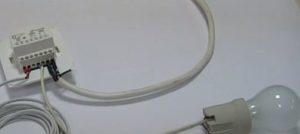
- Disconnect the controller from the power supply using the toggle switch.
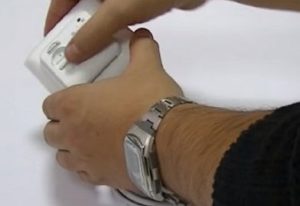
- Set the lever responsible for the temperature level to maximum.
- If the thermostat is in working order, the light will come on.
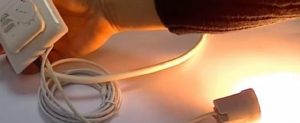
You can also test a floor heating sensor without a multimeter in a similar way. Follow all the steps above, but set the thermostat to the medium temperature instead of the maximum.
The sensor is then held in the hand. The temperature should then be set back to maximum. At this point, the light will come on. When the temperature sensor warms up from the heat of the hand, it will go out. Once it cools, the sensor will signal the thermostat, and the light will come on again.
There's another way to test an electric underfloor heating thermostat without a multimeter:
- turn off the power supply in the panel;
- connect the underfloor heating wires to the electrical panel directly, without a thermostat;
- Turn on the power supply and wait half an hour, then see if the floor heats up; if so, the problem is in the regulator.
It's important to check your heated cable or infrared floor several times. First, when purchasing the heating device, then after installing the heater (before pouring the screed and installing the finishing coat), and then when starting up the heating system.
Additionally, testing is required if the floor stops heating during operation. It's best to connect a multimeter for this test, but if one is unavailable, you can test it with improvised means.