Hydronic underfloor heating systems are gaining popularity every year. The pipes are a crucial component of this system. Today, the construction market offers a wide variety of pipes for hydronic underfloor heating systems from various manufacturers. Therefore, choosing the right underfloor heating system can be challenging with all this variety.
This article will explore the pros and cons of each type. It will help you understand the product's features and purchase a high-quality pipe at an affordable price for installation in a heated floor system in a private home or apartment.
- Characteristics of pipes for water-based underfloor heating
- What pipes are suitable for underfloor heating?
- Polymer
- Metal
- Metal-plastic
- How to calculate the length of a pipe for underfloor heating?
- Selecting the optimal diameter
- Which pipe is best to use for underfloor heating?
- Manufacturers rating
- Video: Which pipe is best to choose and why
Characteristics of pipes for water-based underfloor heating
Installing a hydronic underfloor heating system is a complex and labor-intensive process, especially when using a concrete screed and requiring reinforcement. Therefore, strict requirements are placed on the pipes planned for installation within the "pie."
Important! The use of standard PVC water pipes is prohibited.
Because they cannot withstand high loads that arise due to high temperatures and pressure created in the pipeline.
The main requirements for the piping system in a water-heated floor system, whether in a private home or apartment, are durability and watertightness. It's essential that a sudden temperature change prevents the system from becoming depressurized.
After all, with a screed, it's difficult to find and fix a defect. Furthermore, it must withstand the aggressive chemical compounds found in the coolant and mechanical stress. The elasticity of the circuit—it must bend easily—is also crucial.
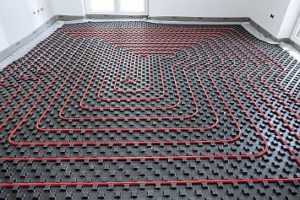
When choosing a coil for hydronic underfloor heating, don't forget about thermal conductivity. The higher the coefficient, the more efficient the system. Also, consider the degree of expansion when heated; up to 0.25 mm/mK is considered acceptable.
The pipes are produced in coils of a specific length. When purchasing, please remember that the loops must be solid, without joints.
Please note! Pipes for heated water floors must be marked to indicate their suitability for use in heated floors.
What pipes are suitable for underfloor heating?
Contours are made from various materials, and their strength and cost are influenced by their properties and characteristics. Each model has its pros and cons.
Polymer
Polymer is a common material used to manufacture several types of pipes for hydronic underfloor heating systems. It is chemically neutral, making it more resistant to high temperatures, up to 95 degrees Celsius.
Please note! Polymer pipes intended for installation in hydronic underfloor heating systems are marked PN 10. If marked, the maximum temperature for such pipes is 55 degrees Celsius.
There are several types of polymer pipes:
- Cross-linked polyethylene is a new type of polyethylene in which the molecules are cross-linked. This results in a material with a stable structure and improved quality characteristics.
Let's consider its properties:
- not subject to corrosion and chemicals;
- elastic - pipes made from it are flexible and can be easily bent at any angle without the use of special equipment;
- has increased resistance to sudden temperature changes;
- The product has a small roughness coefficient inside - this reduces hydraulic resistance.
Please note! Cross-linked polyethylene coils have structural memory—when heated, the product returns to its original shape.
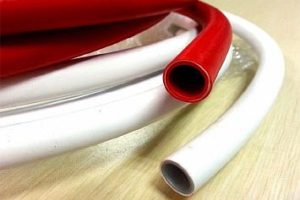
This pipeline is produced in several types, depending on the cross-linking technology:
- PEX-a - peroxide crosslinking, polyethylene is heated under high pressure in the presence of peroxides, the resulting material is durable and elastic, it can withstand heating up to 95 degrees;
- PEX-b - cross-linking is performed using silane technology, polyethylene is exposed to chemicals, most often silane, which gives it resistance to oxidation and makes it rigid;
- PEX-c - the finished product is irradiated with electrons, it is rarely used on the Russian market;
- PEX-d - nitrogen, the production process of this type is complex, so it is not widespread.
All types of PEX pipes can be used for underfloor heating systems. However, PEX-b and PEX-c are more popular due to their flexibility and shallow bending angles. PEX-a, on the other hand, has a higher degree of cross-linking, requiring specialized equipment for installation. Furthermore, this model is significantly more expensive than its counterparts.
- Polyethylene with increased heat resistance (PE-RT) is a modified type whose main component is octene. This material differs from PEX pipes in that it is seamless and requires no additional cross-linking, as its structure has a stable molecular lattice.
A unit with a PE-RT coil operates silently, even when the coolant passes through it under high pressure. It can withstand high sub-zero temperatures. The service life of heat-resistant polyethylene is measured in decades.
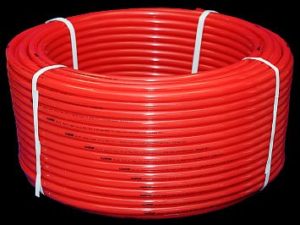
This type of PE tolerates high temperatures and pressure well, but not for long periods. Furthermore, it is not resistant to aggressive substances and lacks structural memory.
However, PE-RT is increasingly being used in the "pie" of water-heated floors due to its affordability.
- Polypropylene pipes offer many advantages and are designed for plumbing and radiator heating systems. However, they cannot be used in underfloor heating systems because they:
In addition, they are subject to thermal expansion, even if reinforced - when pouring the screed, the pipes will experience increased internal pressure, which will affect their durability.
Therefore, despite the low price of polypropylene pipes, it is not recommended to install them in the construction of warm water floors, but if you still decide carry out installation using polypropylene materials, read the article on the best way to do the installation.
Metal
Metal pipes are produced:
- Copper pipes are not often used. Firstly, the cost of copper pipes for underfloor heating is significantly higher than other models. Secondly, installing copper pipes is a rather complex process, requiring specialized equipment and strict adherence to technical regulations. Therefore, installing a hydronic floor system using these pipes yourself is not possible.
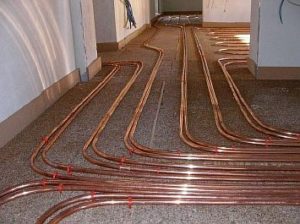
However, it's worth noting that copper coils have ideal characteristics for placement in a hydronic underfloor heating system. Because copper:
- excellent heat conductor - ensures high heat transfer;
- durable and corrosion-resistant;
- plastic - if the technology is followed correctly, the bending radius can be minimal;
- has high mechanical strength and is not afraid of high temperatures.
Please note! Many manufacturers coat the product with a polymer film, which protects it from the aggressive effects of chemicals found in the concrete screed.
- Corrugated stainless steel pipes are a relatively new addition to the market, but have already proven themselves to be highly reliable. Made of stainless steel, they are corrosion-resistant. They are also equipped with an additional protective polymer coating.
It's worth noting the pipeline's excellent flexibility and ability to maintain its intended bend, which is important when laying complex circuits. Furthermore, the product's flexibility completely eliminates the possibility of circuit breakage.
It is also impossible not to mention the resistance of corrugated pipes to various types of impact: mechanical, temperature and chemical.
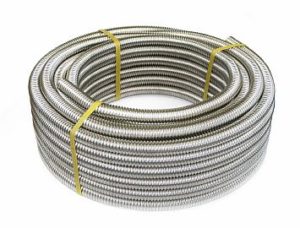
The pipes are produced in coils, 30 or 50 meters long. This isn't always enough to form a complete loop. However, the method of connecting these pipes with fittings is so perfect that the joints can be placed under screed. This is the only type of pipeline whose joints are permitted to be filled with concrete.
The price of this model is quite high, which is why installing corrugated pipes in heated floors is not popular.
Please note! VGP steel pipes are strictly prohibited for use in the installation of underfloor heating systems.
Metal-plastic
Metal-plastic piping is welded and joined using laser or ultrasound. This type is often used in underfloor heating systems. One of the reasons is the excellent flexibility of plastic; it can be easily bent even without heating. It is durable, resistant to temperature fluctuations, and environmentally friendly.
The product is sold in lengths of up to 50 meters, allowing for seamless loop installation in small spaces. For larger areas, lengths of up to 90 meters are available.
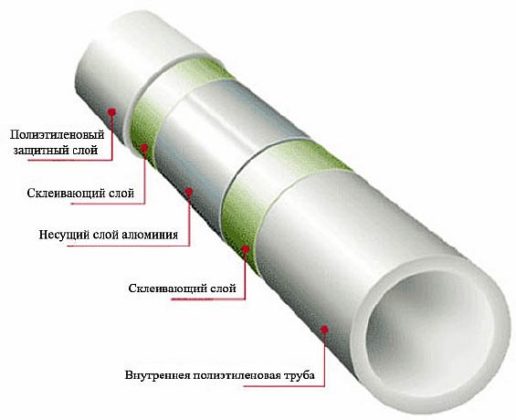
A plastic pipeline with a metal interlayer is a multilayer structure consisting of:
- inner layer - cross-linked polyethylene;
- metallized - aluminum foil of different thicknesses;
- external - a thin polymer coating for protection against mechanical damage.
For your information! This metallized design prevents corrosion, as the surface inside is smooth, which prevents deposits and reduces hydraulic resistance.
A variety of connecting fittings for metal-plastic pipes makes installation quick and easy. And with proper installation and operation, the product will last for over 50 years.
Another advantage of metal-plastic products is their high thermal conductivity, compared to cross-linked polyethylene hose, allowing for rapid heating of the surface. A disadvantage is the possibility of kinking the pipe, which requires removal of that section of the product, as it lacks the ability to return to its original shape.
How to calculate the length of a pipe for underfloor heating?
Watch the installation video to learn how to calculate and which pipe materials to choose and why.
The size of the underfloor heating circuit should be determined during the design phase. Its length depends on the installation pitch. Standard pitches range from 100 to 300 mm.
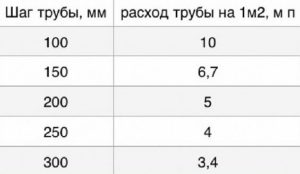
The simplest method to calculate the length of a pipeline is to take the average value: 5 meters of circuit per 1 m2, with a step of 200 mm.
A more accurate way is to use the formula
L = S / N * 1.1, where:
L — contour length;
S — area of the room;
N — laying step;
1.1 — stock of the product for turning.
The calculation for each floor loop must be done separately, and then all the figures added together. Also, don't forget to add the distance from the floor to the manifold.
Please note: If the resulting measurement exceeds the permitted loop size of 120 meters, the room must be divided into several loops.
You can make the calculation process easier by using an online calculator to determine the length of the pipeline.
Selecting the optimal diameter
When choosing the loop diameter, consider the loop length and the thermal conductivity of the material. Common sizes used in underfloor heating installations are 16, 20, and 25 mm.
When determining the diameter of a product, the following points must be taken into account:
- the smaller the diameter of the pipes, the greater the hydraulic resistance, and the level of heat exchange decreases;
- The larger the cross-section, the thicker the screed must be, which increases the load on the floors and reduces the ceiling height.
Important! If the length does not correspond to the diameter of the circuit, this may lead to the hydraulic resistance exceeding the technical capabilities of the circulation pump.
For a pipeline length of 70 meters, a pipe diameter of 16 mm is recommended. For a loop length of 90 meters, a 20 mm diameter is suitable, and for 120 meters, a 26 mm diameter is recommended.
When choosing the diameter of a product, it's important to consider the heat transfer rate of the pipe material. When installing a copper or metal-plastic coil, it's best to use a 14 or 16 mm diameter circuit. When using polymer pipes, use a 20 or 25 mm diameter circuit.
Which pipe is best to use for underfloor heating?
The choice of pipe for underfloor heating depends on the characteristics of the material and the room, as well as your budget. If budget and floor structure allow, copper is the ideal choice.
However, metal-plastic or PEX pipes are more commonly used when installing hydronic underfloor heating systems. When comparing the two types, they have virtually identical characteristics:
- the connection of elements is carried out without the use of tools and does not require much experience in this work;
- the installation process does not take long;
- The pipes bend well.
It's worth noting that a metal-plastic product has high thermal conductivity and heats up quickly, but its cost is also an order of magnitude higher than that of cross-linked polyethylene.
When analyzing the reliability of both types, cross-linked polyethylene ranks first, as the joints are secured with special sealed sleeves. Metal-plastic circuits have exposed pipe and fitting connections, which can lead to leaks during use.
Cross-linked polyethylene also leads in strength. For example, periodic thawing and freezing of a floor with PEX pipes will not affect the circuit, but a metal-plastic pipe can rupture.
Please note! When installing underfloor heating systems, do not use heavy steel pipes, as they will increase the load on the floors.
Manufacturers rating
In addition to specifications, when choosing a tubular product, it's important to pay attention to the brand and manufacturer. It's best to choose proven brands that are popular in the market.
The main and well-established manufacturers include:
- Rehau is a German manufacturer. It specializes in PEX pipes for underfloor heating and water supply systems, featuring sound-absorbing properties and an oxygen barrier. The company produces several product series, which vary in color: white, red, and orange. The warranty period is 10 years, and with proper use, it will last for over 50 years. This brand's products boast high thermal insulation, durability, and flexibility.
- Sanext (Italy) produces multilayer PEX circuits. They offer noise and gas protection. The warranty period is 10 years. The permissible bending diameter is 10 cm. The company promises trouble-free operation for up to 50 years.
- Uponor is a Finnish manufacturer. They offer a vast selection of metal-plastic and polyethylene fittings that are resistant to corrosion and chemical degradation. Protective layers protect the pipes from mechanical stress.
- Emmeti (Italy) produces metal-plastic and PEX-polyethylene pipes. The company maintains process control, and all products are certified for quality.
- Valtec is a joint venture between Italy and Russia. The company produces kits for standard conditions and has also developed fittings for non-standard spaces. This brand's underfloor heating kits are easy to install yourself. The products are excellent heat conductors and are resistant to chemicals.
Purchasing high-quality materials guarantees efficient and long-lasting underfloor heating. Furthermore, with the right choice, you can create an economical and aesthetically pleasing underfloor heating system in your apartment.