A thermostat is a device without which underfloor heating will not function effectively, and its selection must be approached responsibly.
This article will help you learn about the different types of thermostats and which one is best for underfloor heating. We'll also install and configure one of the models together.
- Classification
- Mechanical
- Digital electronic
- Programmable
- Review of the best thermostats
- Teplolux TR 520
- National Comfort 711
- Varmel RTC 70.26
- Thermo Thermoreg TI-200
- Terneo SX
- SpyHeat ETL-308B
- Rexant R70XT
- Nest Learning Thermostat 3.0
- Menred RTC 70.26
- Grand Meyer HW500
- Electrolux ETA-16
- Devi Touch
- Caleo 520
- Almac IMA-1.0
- Which thermostat is better to choose?
- Step-by-step installation instructions
- Setting up the thermostat
Classification
Manufacturers offer a wide range of thermostats to choose from. They vary in features and price.
Mechanical
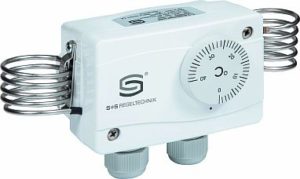
A mechanical regulator is simple, reliable, and inexpensive, but has a short lifespan. It allows you to set the desired room heating level, but it's impossible to visually determine the current temperature.
They are produced in two types:
- Mixing unit with three-way valve — is selected when installing hydrofloor systems. Its function is to regulate and mix hot and cold flows, and then direct the coolant at the desired temperature into the pipeline. A disadvantage is the need for a separate water heating hose.
- An electromechanical device, its purpose is to regulate electric floors.
Digital electronic
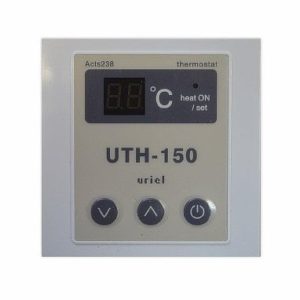
The model is similar to mechanical models. It features a digital display (which displays readings) and a temperature sensor for the underfloor heating and air. Parameters are set manually.
Pros:
- the ability to connect to other control systems;
- flexible regulation program;
- availability of remote control.
Temperature control can be achieved with an accuracy of 0.5 degrees. The downside is the high price and difficulty of self-regulation.
Programmable
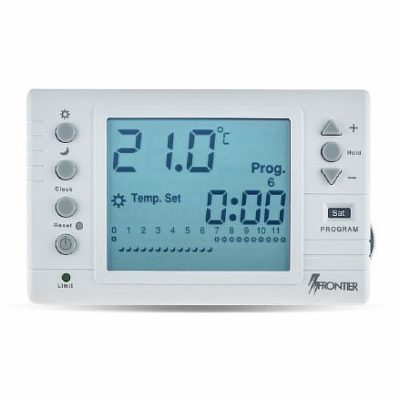
This innovative multi-tasking model allows you to set and control the heating mode, as well as program the heating level for an extended period. The controller allows you to set the heating to turn off when the house is empty, or to increase the temperature when the temperature drops.
Installing such a device saves energy and is safe—it automatically shuts off when the desired temperature is reached. However, purchasing and installing such a thermostat is expensive, and it's also not easy to operate.
Review of the best thermostats
To control underfloor heating systems, thermostats are essential. They are installed in each room, but if the space is small, one per apartment is sufficient.
There are a variety of regulators available from different brands: mechanical, electronic, programmable, single or multi-channel, wall-mounted or rail-mounted, so the choice can be difficult.
We'll look at popular models from trusted companies that offer a great balance of price and quality, making your choice easier.
Teplolux TR 520
Teplux TR 520 — an inexpensive model. It's easy to adjust the temperature of your heated floor. The device is electronic and programmable, so you can pre-program it to turn on, so it'll be warm when you get home.
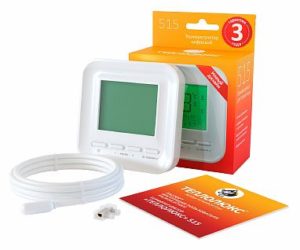
The controller features a graphic display that shows the selected programs and the current room temperature. A temperature sensor and user-friendly interface make adjustments easy.
Main characteristics:
- the minimum temperature is 5 degrees, the maximum is 35;
- power - 3500 W;
- communication current - 16 A;
- Warranty period: 3 years.
Advantages of the model:
- low price;
- beautiful display - will fit into any room;
- the ability to adjust the heating level for any day;
- “anti-freeze” mode;
- Air temperature adjustment is available.
The disadvantage is that after disabling, you need to reconfigure it.
The thermostat is suitable for electric and water heated floors.
National Comfort 711
The model is affordable and comes with a comprehensive set of features. It includes a floor and air temperature sensor and a large backlit graphic display. The controller features a self-diagnostic function, the results of which are displayed on the screen. The warranty period is one year. The device saves up to 30% of its lifespan.
The downsides of this model are its poor protection, so it is not recommended for use in a bathroom or shower. It may also cause problems when pressing the buttons (as they are not very well located).
Varmel RTC 70.26
This electronic, wired mechanical thermostat allows for easy and precise heating adjustments. It features a graduated dial. It's designed for both electric and hydronic systems. It operates at a minimum temperature of 5°C and a maximum of 40°C. It has a 3600W load rating. It comes with a 1-year warranty.
It's installed in a mounting box. Its advantages include on/off buttons. It also has a remote sensor with a 3-meter cable. Its disadvantage is that it makes a clicking sound when switching.
Thermo Thermoreg TI-200
A simple, inexpensive device with an indicator and temperature sensor. It allows you to accurately set and maintain the desired heating level. The heat setting is controlled by a scale, and a two-pole switch makes it easy to turn off the controller.
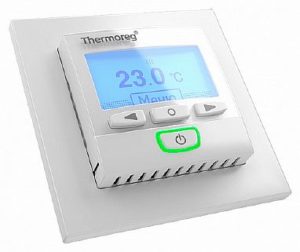
Mechanical type device. Operating temperature from 5 to 40 degrees Celsius. Maximum load: 3600 W. Guaranteed service life: 3 years.
This type has many advantages: it is compact, inexpensive, easy to operate, and has an anti-freeze function.
Disadvantages: inability to adjust heating by days of the week, lack of display.
Terneo SX
This smart underfloor heating thermostat features a touch panel. It's a popular choice when remote control is required, as it can be controlled via smartphone. Its simple interface makes it easy to configure.
Hysteresis can be adjusted to reduce the number of switching cycles. Installation is simple—it fits into a metal box on the wall.
Terneo SX It has a number of useful features: a timer, child lock, and an away mode. The device is equipped with a temperature sensor.
Main characteristics:
- temperature level from +5 to +45;
- thermostat power 3000 W;
- Warranty period: 3 years.
The advantages include a low price, ease of operation, a quick screen response to touch, and the ability to track statistical data on operation and power consumption.
Disadvantages: connection to the smartphone does not work the first time, low-quality plastic.
SpyHeat ETL-308B
This compact, easy-to-use, high-quality, and affordable mechanical thermostat has a pleasing appearance and provides long, trouble-free operation. The housing features a temperature switch, indicator, and an off button. Adjustments are made by turning the knob.
Disadvantage: possible clicking sound when the heating relay is triggered.
Specifications:
- minimum temperature - 15 degrees, upper limit - 35;
- maximum power - 3600 W;
- there is a temperature sensor;
- service life - 2 years.
Rexant R70XT
An affordable, compact, mechanical, wired thermostat with simple controls. The switch operates smoothly, allowing for single-degree temperature adjustments. The housing features a system-on indicator. The device is mounted in a junction box. This reliable and long-lasting thermostat is ideal for everyday use.
Temperature adjustments are available from +5 to +35 degrees Celsius. Power level is 3500 watts. Warranty period is 1 year.
Nest Learning Thermostat 3.0
This model is the third generation of this type. Externally, the controller is identical, but has a larger disk and higher resolution (320 by 320 pixels).
The device features a large display and new features: automatic scheduling, programming, automatic shutdown, and an alert in case of a malfunction. Operation is simple and can be controlled via a smartphone via the internet. Installation is also quite simple. The warranty is 2 years.
The only downside is the high price.
Menred RTC 70.26
An affordable, concealed-mount, mechanical thermostat for electric floors with a remote sensor. Wired controls allow you to adjust floor heating.
The maximum load is 3600 W, with a temperature range of 5 to 40 degrees Celsius. The thermostat is equipped with a light indicator. The warranty is 3 years.
The installation of the device is simple; it is installed in a mounting box.
Grand Meyer HW500
A versatile, affordable electronic programmable controller, controlled by pushbuttons and lockable. It features multiple modes and is equipped with built-in and wired temperature sensors that can operate individually or together.
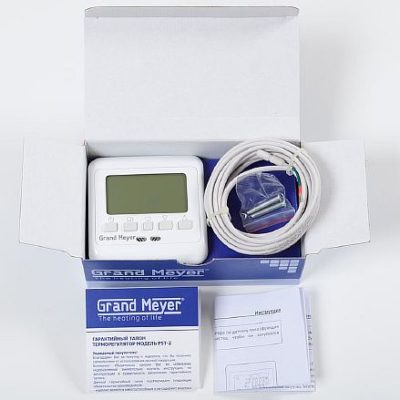
The backlight turns on automatically and turns off after 20 seconds. The advantage of this design is that the settings are saved when turned off. The device is compact, yet has a modern design with a bright display. Temperature control is also available.
The disadvantages include a click when turned on and no lock when turned off.
Operating temperature range is 5–35°C, with the possibility of increasing the limits to +99°C. Power 3600 W, communication current 16 A. Warranty period is 2 years.
Electrolux ETA-16
This electronic device features a small display and a minimal number of icons. The screen is bright and lights up when you press any button. The interface is intuitive, making it easy to adjust the control knob, set, and maintain the temperature at a preset level. The device is equipped with a temperature sensor.
The regulator has a modern design, so it will not spoil the design of the room.
Temperature settings range from 5 to 50 degrees Celsius. Power output is 3500 watts. The warranty period is 3 years.
Devi Touch
This model is suitable for underfloor heating and heating systems. It has a maximum load of 3680 watts. It features a microprocessor control unit and a touchscreen display. Operating temperatures range from 5 to 45 degrees Celsius. A 5-year warranty is included.
The Devi programmable thermostat offers a variety of options, including freeze protection, unoccupied room protection, and open window protection. Its energy-saving unit significantly reduces heating costs. The air temperature can be adjusted. Furthermore, the device is multifunctional and easy to set up.
The downside is that the instructions are unclear and do not show how to connect the cable to the controller.
Caleo 520
A surface-mounted device with touch-sensitive controls. It features a backlit display that displays the temperature. It also features a keypad lock.
The simple setup process and ease of use, as well as the device's low power consumption, are noteworthy. The temperature range is from 0 to 40 degrees Celsius. The warranty period is two years.
Additional advantages include a reasonable price and a modern design. Disadvantages noted by users include relay clicking.
Almac IMA-1.0
Almac IMA-1.0 — A modern, electronic, affordable, and well-built device. It's designed for heated floors and air conditioners. It's equipped with both a portable and a built-in temperature sensor.
Temperature adjustment is easy. A positive feature is the adjustable hysteresis, allowing for precise setting of the lower and upper temperature limits.
Technical indicators:
- extreme temperatures - from -50 to +110 degrees;
- power - 3600 W;
- warranty - 1 year.
Which thermostat is better to choose?
The choice of a regulator must be approached responsibly, because the level of comfort in the home, as well as energy and money savings, depend on it.
When selecting a thermostat, you need to consider:
- The device type—mechanical, electronic, or programmable—depends on your preferences, floor and room characteristics, and budget.
- Sensor type—remote or built-in. It's difficult to say which sensor is better; it should be selected based on the type of underfloor heating and thermostat model.
- Power - it should exceed the power of the heating system by 20%, this will extend the life of the device.
- Installation method: surface-mounted or built-in.
- Design is your choice.
To choose a thermostat for underfloor heating based on cost-effectiveness, it's important to consider the feasibility of purchasing an expensive model with a variety of features. For small spaces, mechanical or electronic devices with minimal options are recommended.
Compared to programmable types, their features are minimal, but sufficient for setting a comfortable temperature in a room of this size. When heating a large house, a programmable unit is more energy-efficient; it allows for easy development of a flexible operating mode, potentially saving up to 65% of electricity.
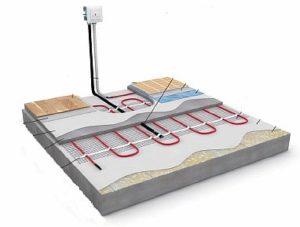
When choosing a model, you should also consider the electrical system type. If the device is needed for underfloor heating, a device with a current of up to 3 amps will be sufficient. For electric heating, a device with a current of 16 amps is sufficient.
Step-by-step installation instructions
For a thermostat to function and accurately determine the temperature, it's not enough to choose the right one; it's also crucial to install it correctly. Installation is usually straightforward, but we've decided to give you a visual guide.
Regardless of which regulator you decide to install, you should start by choosing a location for it. It should be convenient for use. The device should be located close to outlets and the door, and at least 1.5 meters above the floor. It should not be mounted near a window.
Usually, the thermostat comes with instructions that you should read.
Sequence of actions:
- Before starting work, de-energize the installation site;
- the wires from the underfloor heating should already be connected to the socket box;

- Afterwards, the sensor is installed - it is placed in the corrugated pipe, one end is led out into the socket box, and the other is placed between the heaters (cable or infrared film floor plates);
- the insulation is removed from the floor wires - by 6 cm;
- the cable screens are connected to the yellow-green wire, then everything is placed in the socket box;
- The top panel of the thermostat is removed - you need to insert a straight screwdriver into the groove below, press it until the cover snaps off;
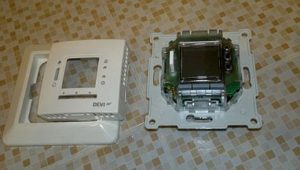
- The floor wires are connected to the required terminals of the controller according to the diagram;
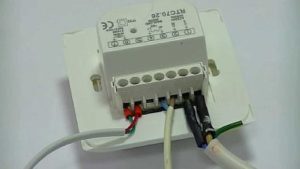
- the wires are carefully bent and the device is inserted into the socket box;
- the frame is installed and the top panel is secured.

The underfloor heating thermostat is connected, all that remains is to check its operation.
Setting up the thermostat
All thermostat settings are described in the operating manual. If the model is not programmable, simply use the dial to set the desired heating level.
Setting up a programmable thermostat is more complicated and requires following a certain sequence:
- The day of the week and the current time are set.
- Check which temperature sensor is enabled. Typically, it's the floor sensor, but if there are multiple, it's recommended to enable both.
- Select from the "menu": "Morning," "Night," "At Home," or "Away." Set the time and temperature, then confirm the settings.
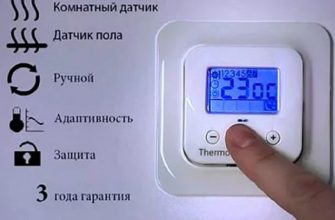
You can program the controller so that the heated floor will heat during the day and turn off at night.
It's clear that underfloor heating can't operate effectively without a thermostat. Which model to choose is up to you. However, it's important to consider the underfloor heating's characteristics to avoid purchasing a sophisticated, expensive model for a heating system that will work well with a simpler device.