Many people wonder if it's possible to install laminate flooring over heated floors. Experts give a definitive YES!
In this article, we'll cover this topic in detail. After reading, you'll know which type of laminate flooring is best for which type, the installation technology and nuances, and much more.
Previously, this type of flooring was considered incompatible with underfloor heating, as it doesn't tolerate heat well. Tile, linoleum, and other materials were preferred for underfloor heating.
The development of the building materials market has led to the production of materials specifically designed for installation over heated floors. High-quality laminate flooring for heated floors surpasses parquet in a number of ways.
Underfloor heating is convenient for a number of reasons:

- Due to its large area, it heats the room quickly and evenly;
- no need for steam heating batteries;
- You can walk on the floor barefoot even in winter.
It's a good idea to install underfloor heating in children's rooms. Even during cold weather, children will find the floor warm to play on. However, choosing the right laminate flooring for each flooring type is not a simple matter.
- Characteristics of laminate for underfloor heating
- How to choose laminate flooring for underfloor heating
- For electric with heating cable
- For electric with heating mat
- For infrared film or with rod mats
- For water floors
- With built-in heating
- Selecting underlayment for different floor types
- Foamed polyethylene
- Extruded polystyrene
- Cork
- Laminate flooring markings for underfloor heating
- Laying laminate flooring on heated floors
- Related videos
Characteristics of laminate for underfloor heating
Why you shouldn't use regular material on a heated surface:
- release of formaldehyde, which is harmful to health, when heated above +27°C;
- the low thermal conductivity of the material did not allow the room to be heated effectively;
- Incompatible with hydronic underfloor heating due to its low water resistance, it quickly deteriorated due to temperature fluctuations caused by the thermostat. The flooring warped, and its lifespan was no more than 1-2 seasons.
Not every material is suitable for underfloor heating. Choosing laminate flooring for underfloor heating isn't easy. The industry produces specialized brands that are distinguished by:
- good thermal conductivity;
- slight evaporation of formaldehyde when heated;
- coating thickness less than 9 mm;
- heat resistance;
- more reliable connection of lamellas than usual;
- high water protection (for coatings with water heating).
Heat-resistant materials have special markings. Be sure to check for them before purchasing. The following markings are used:
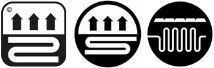
- Underfloor heating is a phrase that translates from English as "floor heating." This type of laminate flooring is suitable for electric, cable, or infrared heating.
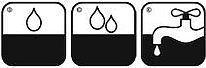
- Warm Wasser or H2O – water-resistant for underfloor heating with water heating.
Only use grades that are compatible with the flooring being installed. It's unacceptable to install electric heating slats on a surface heated by water pipes. While it's possible, it's pointless. Waterproof slats are much more expensive.
It's unwise to use laminate flooring for underfloor heating without the actual underfloor heating. It will only make things worse. Its characteristic feature is high thermal conductivity, so the floor will remain constantly cold, even if the rooms are well heated by radiators. This is cost-prohibitive—in this situation, it's better to choose regular laminate flooring.
The above markings are not sufficient for choosing a material. To ensure the coating remains maintenance-free for a long time, it's important to approach the selection process with particular care. Be sure to review all additional specifications.
Laminate flooring for heated floors with water and electric heating systems is categorized into E0 and E1. It's best to choose E0, as formaldehyde emissions from the slats begin at temperatures of 30°C and above. E1 is slightly worse in this regard, with a threshold of 28°C, but emissions remain within sanitary limits at temperatures below 30°C. For spaces where children live and play, E0 is definitely the best choice.
The thickness of high-quality laminate is at least 7 mm.But the "thicker is better" rule doesn't apply here. For good thermal conductivity, the board shouldn't be thicker than 9 mm. If possible, go with 9 mm—it's more durable.
The abrasion resistance class of the flooring is very important. It determines its lifespan. The material should be selected based on the intensity of floor use. The more traffic the floor receives, the higher the abrasion resistance class should be.
For living rooms, choose grades 21 and 22. For staircases, hallways, and corridors, it's best to choose at least grade 22. Bedrooms can use a lower-grade flooring material, while children's rooms and living rooms can use a higher-grade material. Therefore, the flooring should vary from room to room.
Install the most durable laminate flooring in the kitchen, if you decide to install it there. Class 32 is suitable for this purpose, and 33 is even better. Generally, classes 31 and above are considered commercial grade, but if possible, it's best to choose class 33 for the kitchen. You won't regret it.
With this choice, the floor will last at least 10 years, maybe 15 or even longer. These figures can be extended. To do this, simply protect the flooring in areas of high wear. Place a rug in the hallway. Protect the metal legs of chairs and stools with plastic or rubber pads. The solution is simple, and it will delay repairs for years.
Abrasion classes can be designated by the letters AC. The relationship is as follows:
| Abrasion resistance class, marking for underfloor heating | Abrasion resistance designation EN 13329 | Where is the best place to lay carpet in a residential building? |
| 21 | AC1 | Bedrooms, offices |
| 22 | AC2 | Living rooms, children's rooms |
| 23 | AC3 | Corridors, stairs, hallways |
| 31 | AC3 | Hallways, dining rooms, kitchens |
| 32 | AC4 | kitchens |
| 33 | AC5 | kitchens |
Since there are heating elements under the covering, the material's heat resistance is important, especially for laminate flooring with hot-water heating. Water in the pipes can reach temperatures of up to 40°C. Electrical appliances also risk overheating. Laminate flooring that can withstand overheating is marked with this symbol. B1.
Thermal conductivity shouldn't be forgotten either. The worse it is, the higher your heating costs and the less effective the room's heating. Refer to European standard EN4725. According to this document, the thermal resistance of a floor covering installed over underfloor heating should not exceed 0.15 K/W per 1 m². This value applies to laminate flooring with an underlay.
The indicator for laminate should not exceed 0.05-0.10 K/W per 1 m2, substrate - 0.04-0.06 K/W per 1 m2.
Laminate slats expand when heated and contract when cooled. Therefore, they must be able to "float." Therefore, glue-down laminate slats are not recommended for underfloor heating. Such flooring may begin to warp after a couple of seasons.
For the kitchen, it's advisable to choose moisture-resistant laminate flooring. There's a high risk of spills, and cooking creates steam in the air.
When installing a heated toilet, it is essential to install only a moisture-resistant floor covering, even if you plan on electric heating.
How to choose laminate flooring for underfloor heating
Determining which laminate flooring is best isn't easy—there's a huge variety. The choice of underfloor heating type will determine the material you choose.
There are currently four heating system options to choose from:
- hot water pipe;
- electric with heating mats or with cable;
- infrared, in the form of film, rod mats;
- with built-in heating element.
For electric with heating cable
Electric underfloor heating produces considerable heat. The cable spacing is large, so the floor is heated unevenly. The optimal laminate thickness for underfloor heating with a heating cable is 9 mm.
It must be heat-resistant, able to withstand temperatures up to 30°C, and preferably higher. Look at the markings—the laminate must be approved for use with electric heating.
This type is good for heating in the south, but is undesirable in the north, as the electricity consumption is significant.
For electric with heating mat
The heating mat has closer spacing between the rods. The coating's characteristics are identical to those of a heating cable, but thinner lamellas are possible. The application is identical to that of a heating cable.
For infrared film or with rod mats
The best option for DIY installation, underfloor heating under laminate is the simplest. It doesn't require a screed for the working layer, unlike options with hydronic heating and cables. It's easy to install and repair. It delivers uniform heating, and the infrared film is thin. This allows for the use of thin underlayment and thin laminate.
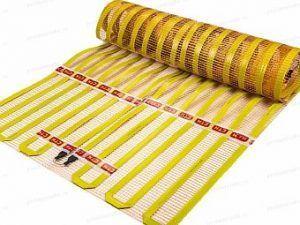
Infrared underfloor heating is the most cost-effective option. It's suitable for heating in northern regions as it's the most economical.
Infrared floor material has a special symbol or label. This is also mentioned in the instructions for use.
If you've decided on the rod mat option, it's better to buy solid carbon mats. This material is convenient and easy to install.
For water floors
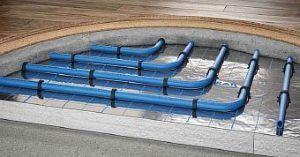
Hydronic underfloor heating consists of pipes laid on the floor with a circulating coolant—usually water, sometimes antifreeze. The pipes are made of copper, plastic, or a combination of metal and plastic. Copper is the most efficient, while polyethylene is less expensive.
Hydronic underfloor heating requires skilled and careful installation. Never connect pipes to the central heating system. This is prohibited, as it can cause water leaks and flooding. The water temperature in the radiators exceeds the permitted 30°C.
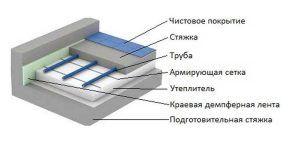
Consequently, such heating can be done either in private houses or with the installation of an individual boiler, gas or electric.
This is a simple and common option, but since the pipes are quite thick, they need to be enclosed in a screed, over which a backing is laid. A film with a foil layer is placed under the pipes. The backing is used without a metallized layer.
When water is heated, temperature fluctuations occur, causing condensation. A vapor-permeable underlayment is essential. Laminate flooring is suitable for 8 mm thick water-based floors and is water-resistant. Choose brands that can withstand flooding, which can occur if the system loses its seal. Flood-resistant slats will not warp after drying.
Since underfloor heating with water is most often installed in kitchens and bathrooms, it is worth choosing a material designed for intensive use.
With built-in heating
This is the newest type. The heating element is already embedded in the lamella layer. Different brands have a heating intensity of 40-70 W/m.2The power rating is stated on the packaging. Higher-performance brands are designed for colder regions.
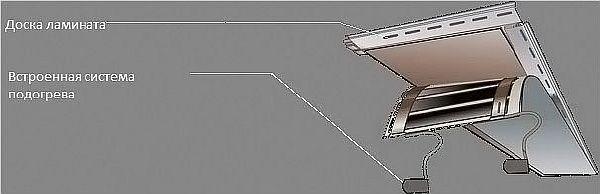
This material resembles infrared film. The contact wire from each board is routed under the baseboard.
It's better suited for underfloor heating when installed by yourself. Simply level the floor and lay the underlay. Laying over the slats is no different from regular laminate flooring. You can combine unheated slats if you need to create unheated areas in the room, for example, under furniture. They come in the same size.
This option is the most economical, with heat loss one-third less than traditional infrared film heating. The system itself is more efficient, warming the room faster than all other options.
Selecting underlayment for different floor types
The same underlay is used for electric and water heating, but not all of it is suitable for one case or another.
It is mandatory to use. Otherwise:
- the slats will not lie flat on the floor;
- When walking on the floor, the conductive elements will be damaged and break;
- Electricity will be wasted unproductively on heating the supporting structures of the floor.
The underlay for electric floor heating is easy to identify by its appearance. It's foil-coated.
The material is laid on the floor with the foil facing down. The mirror reflects heat and directs it upward. Therefore, the underlayment material is designed to allow heat to pass through freely. As stated above, its thermal resistance should not exceed 0.04-0.06 K/W per 1 m.2.
The substrate must meet the following criteria:
- conduct heat well;
- do not emit harmful fumes when heated;
- not be destroyed or deformed due to temperature changes;
- be vapor-permeable to prevent condensation from accumulating underneath.
Currently, there are three backing materials that meet all of these criteria.
Foamed polyethylene
The most common material. Available in various thicknesses, it's popular due to its low price. It cuts easily, making it convenient for working in rooms with complex shapes. Mat joints are easily secured with tape.
Extruded polystyrene
The best option for electric heating. Suitable for hydronic heating. More expensive than polyethylene, but has better thermal conductivity and is more durable. Perforation allows for good vapor permeability.
Cork
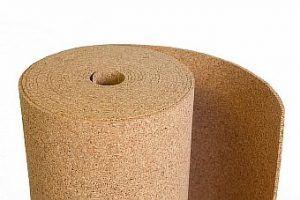
The best material for standard laminate flooring. Suitable for water-heated floors. However, it's not recommended for electric underfloor heating. Cork is too good an insulator for this. It's much more expensive than synthetic materials.
Laminate flooring markings for underfloor heating
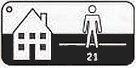
Each manufacturer specifies all the material's characteristics. Flooring characteristics are presented in the form of icons. They are straightforward, and most are intuitive. All of them are listed below.



Laying laminate flooring on heated floors
Before installing underfloor heating, the surface must be perfectly level. Self-leveling flooring is usually used for this purpose. If the surface level difference in the room is too large, a screed must be installed first.
The number indicates the coating's abrasion resistance class. A private home is for domestic use, while a multi-story building is for commercial use (office, store, etc.). The number of figures indicates the intensity of use. Figure 1 indicates low intensity (bedroom, study), 2 indicates medium intensity (living room, hallway), 3 indicates high intensity (hallway, kitchen, stairs), and 4 indicates very high intensity (commercial use only).
We invite you to familiarize yourself with Step-by-step instructions on how to install underfloor heating under laminate flooring on a concrete floor.
The screed must dry completely after pouring. There's no need to rush. It's better to wait longer. The minimum time is one week. However, we recommend waiting 3-4 weeks – this will ensure the surface doesn't warp after the work is completed.
The cement surface should be primed and left to dry for a day. Then the underlayment is laid with the foil facing down. The joints between the underlayment pieces are carefully sealed with special tape.
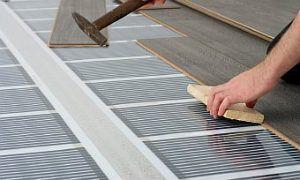
For self-installation, it is best to use film covering or infrared mats.
Any heating system should be tested before installing laminate flooring. After turning on the system and ensuring it is in good working order, with no faulty heating elements, the heating can be turned off. For water-based underfloor heating, thoroughly check for leaks.
Underfloor heating installation is only carried out on a floor surface that has cooled to room temperature. The laminate flooring should be brought into the room where it will be installed and left there for three days prior to installation. The recommended installation temperature is 16-32°C.
After the flooring is installed, before using the laminate, the heating is turned on for several days, increasing by 5 degrees each day until it reaches 27°C.
You can lay laminate flooring on heated floors yourself, even if you have no experience laying it.


In my apartment building, underfloor heating is a very pressing issue. It's generally adequate in winter, but in the off-season it's chilly, especially when walking on the floors, especially if you have children. Laminate flooring is a great solution! I'm not a big fan of linoleum, but the options suggested in this article intrigued me. The main thing now is to choose the right laminate flooring, and then we can get to work.