A hydronic underfloor heating system is a complex structure consisting of many components. One of these components is the circulation pump, which determines how efficiently the floor operates.
Today we'll explain the different types of pumps and their characteristics. You'll learn how to select and calculate the capacity of a circulation pump for underfloor heating, and how to install a heating system using one.
- Purpose
- Types of pumps
- With a wet rotor
- With "dry"
- Industrial
- Speed classification
- Underfloor heating pump performance
- Marking
- Body material
- Pressure, power and flow rate - calculation of indicators
- Selecting a pump for underfloor heating
- Installing a pump on a heated floor
- How to install a pump
- Installation diagrams
- Pump installation process
- Malfunctions and how to fix them
- Operation and maintenance
Purpose
The main function of the circulation pump is to ensure optimal pressure in the pipeline to ensure uninterrupted circulation of the heating medium. This minimizes interruptions in the operation of the underfloor heating system due to air pockets in the pipes.
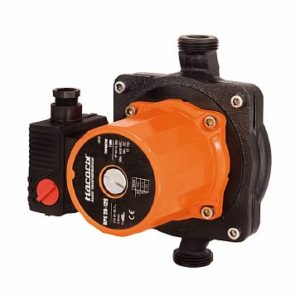
Refusing to use a unit for the sake of saving money when installing water-heated floors (in any room - kitchen, bathroom) will affect their efficiency.
Types of pumps
A circulation pump is auxiliary equipment that creates forced movement and distribution of fluid through pipes. A typical model consists of a housing with connections for pipes and blades that circulate the coolant.
The selection is large, but there are only a few types..
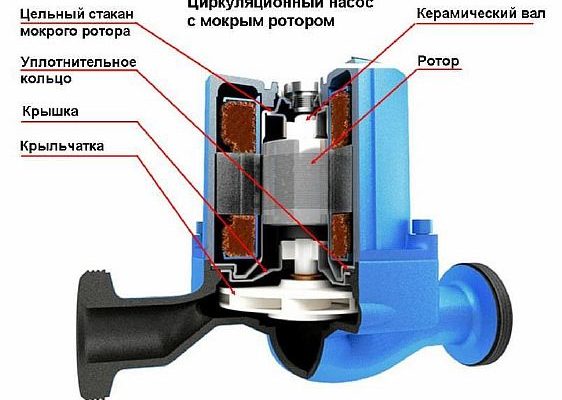
With a wet rotor
In this mechanism, the rotor comes into contact with water. The rotating shaft draws in liquid, and under pressure, it moves forward. In this pump, water serves as a lubricant.
This equipment has a low power consumption, so it is used in hydronic heating systems installed in areas up to 400 m². These pumps are reliable, quiet, and energy-efficient, consuming little electricity.
With "dry"
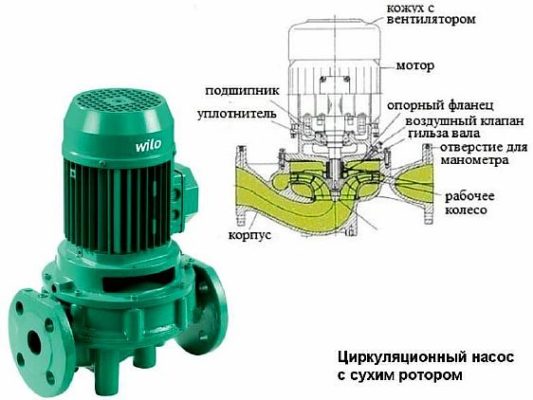
In "dry" models, the rotor does not come into contact with the coolant; it is located in a special sealed container. Rubber rings or seals act as insulation. This mechanism is not adversely affected by hard water. This type has greater power, higher than "wet" models.
The main drawback is noise. Furthermore, the equipment requires constant maintenance, such as cleaning and lubrication.
Industrial
Industrial pumps are a dual design, making them convenient to use during periods of severe frost.
If necessary, the second unit is activated, increasing efficiency and increasing the coolant circulation through the underfloor heating pipes. Furthermore, if one unit breaks down, the second can be activated.
Speed classification
Pumping equipment is also classified by speed and can be:
- single-speed - has one temperature setting;
- Multi-speed - several speed modes, they are used in heating systems with different temperature indicators.
When installing heated floors, a three-speed pump is recommended.
Underfloor heating pump performance
In heated floors, the same settings are installed on the mixing unit, as in battery systems. They have different characteristics and performance indicators.
Marking
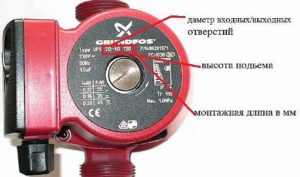
All household appliances are marked with numbers, for example, 25/40-130. The first digit (25) is the thread diameter of the inlet or outlet, indicated in millimeters.
The second two numbers (40) represent the lifting height created by the device—4 meters. The final numbers (130) represent the device's edge-to-edge size.
Body material
If the pump for underfloor heating is selected and installed correctly, then any model can be installed.
However, if the oxygen permeability level is incorrectly calculated or not taken into account at all, a cast iron model is unsuitable due to the presence of an oxidizing agent. In this case, stainless steel or polymer devices should be used.
Pressure, power and flow rate - calculation of indicators
These motors have low power and pressure, the water flow rate is also not high, so their power consumption is not significant (40 - 150 W).
Calculating these indicators is simple, let's look at an example:
- Performance - for a warm water floor when heating a building with average insulation, and an area of:
- 80 — 120 m2 — 1.5 m3;
- up to 160 m2 — 2;
- up to 200 meters - 2.5;
- up to 240 - 3;
- up to 280 - 4.
That is, to heat a house of 100 m2, a pump with a capacity of 1.5 m3 per hour is suitable.
Calculating the pump performance for underfloor heating using water as the heat carrier is as follows:
Q = 0.86 * Pн / (t пр.т — t обр.т), where:
- Pн — power in kW;
- tобр.т — indicator of the temperature of waste water;
- tpr.t — degree of heating of the liquid at the inlet.
When constructing a system with several loops, the volume of coolant passing through each circuit is first calculated, all results are added together, and the performance of the entire device is obtained.
- Pressure is necessary for the coolant to overcome hydraulic resistance. It is affected by the length of the pipeline and the material it is made of.
The pressure is calculated based on the motor power and the number of branches. For a 100 m² area using a pump capable of pumping 1.5 m³/hour, with seven loops installed, the pressure will be 0.2 m³/hour.
You can calculate the pressure using the formula:
H= (П*L + ΣК) /(1000),
- H — pressure;
- P — hydraulic resistance,
- Pa/m; L is the size of the longest branch;
- K — power reserve.
Selecting a pump for underfloor heating
How to choose a circulation pump for underfloor heating? It's important to consider the system's specifications, room size, and potential heat loss. Models 25/40 and 25/60 are recommended.
Avoid installing a motor with a large power reserve; it's unnecessary and will only increase energy costs. If the area is large, it's better to use several smaller units.
For rooms up to 100 m² (with 7 circuits), a 25/40 unit is recommended. It delivers a water flow of 1.7 m³, with a pressure of 2 meters, and consumes 50 watts per hour. For rooms over 120 m², a 25/60 unit is recommended. It consumes 80 watts, with a flow rate of 2.8 m³ and a pressure of over 3 meters.
If the apartment has poor insulation and there is significant heat loss, then a pump with increased capacity should be selected.
Wet units are most often used for heated floors. For areas up to 400 m², they are reliable, offer adequate performance, and are quiet. When installing floors in a multi-story building, dry units are recommended, as they are more powerful and capable of recirculating water in large-diameter lines.
It's not enough to simply calculate the parameters of a pump designed to circulate water in a heated floor; it's also necessary to select the type and material from which it's made. If antifreeze is used, a cast iron unit should not be used, as it has strong oxidizing properties. Otherwise, a stainless steel or polymer unit can be installed.
Additionally, it's recommended to purchase products from reputable companies. It's best to choose trusted European manufacturers, such as the Danish Grundfos or the German Wilo. There are also companies producing budget pumps, such as DAB (Poland) and Sprut (China).
There's no need to skimp when purchasing; the warmth and comfort of your home directly depends on this component.
Installing a pump on a heated floor
Before you begin installing a circulation pump on a heated floor, you should choose its location and installation diagram.
How to install a pump
Regardless of where the pump is installed, the rotor must be horizontal. Although vertical installation is possible, it will result in a loss of up to 30% of its power.
If there is noisy equipment, it is permissible to install it under the floor.
Installation diagrams
When installing warm water floors, it can be installed:
- on the supply pipe, behind the mixing manifold;
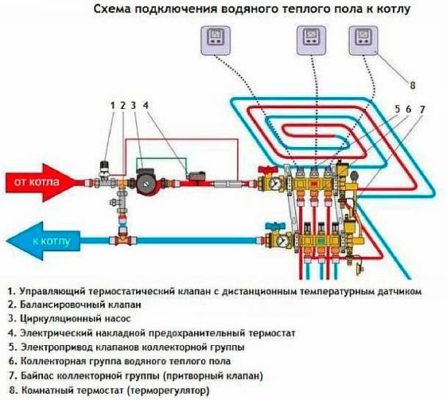
- on the return pipe, in front of the boiler.
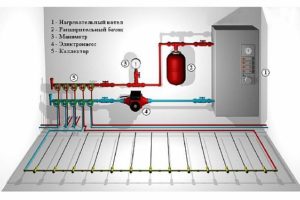
Experts often place the device on the supply pipeline, which helps prevent air from entering the system.
There's also a two-pump design. If the house is two stories high, one pump is installed on each floor, which simplifies the heating system adjustment process.
Pump installation process
Once the area for installing the pump has been determined, you can begin its installation:
- First, a bypass pipe must be installed at the location where the device will be installed. To do this, the main pipe is cut.
- Threads should be formed at the ends of the pipe where ball valves will be installed.
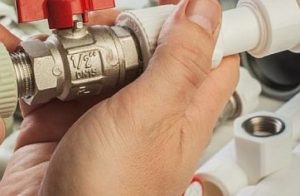
- A device is installed, in front of which a filter is placed.
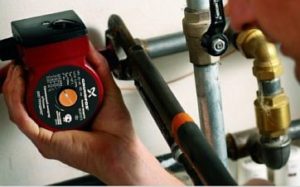
After this, the coolant supply valve and the air bleed valve are opened.
Then, a trial test of the system is carried out. The system should be turned on initially at low speeds.
Malfunctions and how to fix them
Problems can arise during the operation of a circulation pump. One such problem is salt deposits on the impeller when using water as a coolant. This process is especially active when the water temperature exceeds 55 degrees Celsius. Therefore, most models have a thermostat that shuts off the pump to allow the water to cool to the desired temperature.
Even so, salt will still gradually accumulate. While the system is operating, this doesn't significantly affect the pump. However, when the underfloor heating is turned on after a long period of inactivity, the pump may fail because salt clogs the rotor. This problem is easily solved by manually rotating the impeller.
Another potential issue is air locks. Air locks in a pipeline or unit are caused by improper installation or operation of the equipment. There are several ways to avoid this:
- Removing air locks in the main pipes - this is done before turning on the heating;
- By installing separators or air valves;
- When carrying out periodic maintenance of equipment, this is especially important when unheated areas appear.
To avoid air locks, abrupt changes in temperature and pressure in the system should not be made.
Operation and maintenance
To extend the life of underfloor heating pumping equipment, it is necessary to follow a number of rules during installation, operation, and maintenance:
- Avoid overtightening the connecting parts, as modern models are made of alloys that are not very strong. To ensure a tight system, it is recommended not to use tow; instead, modern tapes are recommended, which can withstand high pressure without requiring overtightening of the connecting parts.
- Install the device in an accessible location so that it can be easily replaced if it breaks. It also requires regular preventative maintenance, which includes inspecting the seal. If large amounts of impurities are present in the water, they harden and cause damage. These deposits must be removed, and a filter should be installed to reduce their formation.
- Bleed the air before starting the system, and preventively once a month by opening a dedicated valve. Air in the line impedes water flow, causing cold spots to form. This triggers the pump to turn on unscheduled, causing it to start more frequently. This reduces its lifespan and, consequently, shortens its service life.
- Lubricate the mechanism once a year, especially the “dry” type device.
It is not recommended to abruptly change the pressure or temperature in the system. During freezing conditions or after summer, the temperature should be increased gradually.
In conclusion, it's safe to say that underfloor heating systems won't function effectively without circulation equipment. Choosing the right pump for your underfloor heating system is entirely up to you. However, if you're unsure about installing the equipment yourself, it's best to hire a professional.