With a wide range of tile adhesives for underfloor heating available on the market, choosing the right one can be challenging. First, you need to understand the ingredients and differences between them. Then, it's a good idea to review existing manufacturer ratings and choose the one that best suits your needs.
When choosing, it is important to consider not only gender characteristics, but also experience in carrying out such a procedureTo ensure that the tiling will last for many years, the technician must accurately follow the instructions and rules indicated on the packaging and described in this article.
Let's get acquainted with the types of glue
Choosing the right adhesive can often be difficult for buyers, especially those with no experience installing underfloor heating. Adhesives are typically classified by their main active ingredient. They come in the following types:
- A synthetic polymer adhesive with a single main component—resin. The adhesive comes in the form of a paste, sold in a plastic bucket. It's best suited for those without previous experience, as it hardens within 20-25 minutes after application. This time allows for minor errors to be corrected and surface imperfections to be smoothed out.
- Polymer – with two different resins. This two-component product hardens very quickly, so it should be used immediately after preparation, once all preparatory steps have been completed. A key advantage is its increased plasticity and adhesiveness, resulting in resistance to sudden temperature changes and the ability to be used even when laying the material on complex substrates.
- A cement mortar consisting of finely dispersed particles. Despite the wide selection of polymer-based products, this option remains the most popular. The addition of additional modifying agents enhances the product's adhesion. A key advantage is the ability to precisely calculate the dosage, ensuring it's sufficient for a single application, allowing for multiple uses of the same package.
The main element that provides heat resistance is a plasticizer, which is used as an additive. These substances allow the adhesive to expand and contract with temperature changes without losing its adhesive properties.
Choosing the best flooring adhesive is difficult; each of the above types has its own characteristics, advantages, and disadvantages.
Important to know! It's worth noting that when selecting tile adhesive for heated floors, the weight of the tiling material is not a priority, as it is when selecting, for example, wall adhesive. There are some other characteristics that are important to consider.
What parameters do we pay attention to when choosing?
Adhesives for porcelain tiles installed over heated floors have special requirements due to the challenging operating conditions. Before purchasing, it's important to familiarize yourself with the following parameters:
- Resistance to temperature fluctuations. Typically, underfloor heating adhesive and porcelain tiles themselves have different expansion coefficients. This parameter means that the adhesive will contract and expand as the temperature increases or decreases. If the coefficient of expansion is low, microcracks will form on the adhesive surface, ultimately leading to separation and damage to the tile surface. It is important to choose a highly elastic adhesive; however, even with this, additionally ensuring a strong bond at the expansion joints will be necessary.
- The adhesive's adhesion to the surface. In most cases, cement-based adhesives cannot provide sufficient adhesion to tiles, so it's advisable to choose polymer-based adhesives or cement-based adhesives with a high plasticizer content. These improve adhesion to smooth artificial stone.
- Durability. As noted earlier, the weight of the tiles isn't as critical as when laying tiles on walls (due to gravity), but it's still worth considering, especially when choosing an adhesive for porcelain tiles. Before purchasing, ensure the adhesive can withstand heavy and multidirectional loads. Otherwise, it will disintegrate within the first year of use.
- Time for complete curing. It's important to select an option with an adjustment time of up to 2 hours, and a possible adjustment period of at least 15 minutes. This will avoid wasting expensive materials, especially when working with complex surfaces like porcelain stoneware. It will also ensure proper placement of the tile, improving the quality of the renovation work.
Which tile adhesive is best for heated floors? The one with the highest ratings for all the above parameters.
Manufacturers rating
There are many manufacturers of tile adhesives on the market today, including Ceresit, Bergauf, and others. They differ not only in composition and application method, but also in their intended use.
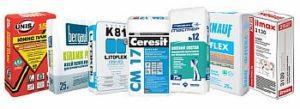
Some types are suitable only for certain types of underfloor heating and tiles, while others have a wide range of applications.
Ceresit
Ceresit underfloor heating adhesive is the most popular imported option. It's manufactured in Germany but has also gained widespread popularity among Russian consumers. Its high elasticity makes it suitable for use with various types of underfloor heating and finishing materials.
Ceresit is ideal for porcelain stoneware and ceramic tiles (choose models CM No. 14, 16, 17, or 117). Tile adhesive for marble (CM 115) is also popular.
The advantage of Ceresit for underfloor heating is the highest German quality, which ensures the possibility of use for many years.
Another advantage is that it is manufactured exclusively from safe and environmentally friendly components. The resulting tile mixture is environmentally friendly and safe for health, and does not emit hazardous substances even at high temperatures.
However, it's important to strictly follow the instructions on the packaging and in the included instructions. If the mixture is specified as suitable only for concrete, it should not be used on other surfaces (wood, plastic, metal).
What you need to know about CM 14 Extra floor tile adhesive:
- Viability – 2 hours (time until hardening);
- the technician can make adjustments to the tile placement within 15 minutes after the initial application;
- when carrying out repair work, the air temperature should be 5-30 degrees Celsius;
- grouting of seams is allowed no earlier than one day after installation;
- degree of adhesion – 0.8 MPa;
- The coating created with Ceresit adhesive for underfloor heating can be used at temperatures from -30 to +70 degrees.
Bergauf
This Russian-German brand produces Keramik Express adhesive. Its distinctive advantage is its quick-drying mixture; tiles can be walked on within four hours of installation.
This reduces the waiting time before grouting, but also reduces the time required to adjust the material's position. Recommended for professionals with prior experience in this type of work.
What you should know about this tile adhesive for heated floors:
- the viability of the diluted mixture is 45 minutes;
- a single coating should be no more than 0.6-0.8 m2;
- changing the position of the material is only allowed for 10 minutes;
- It is allowed to grout the expansion joints after 4 hours;
- The operating temperature should be from -10 to +70 degrees.
This tile mix is the best option for installation on a solid base that is not subject to deformation (for example, concrete).
Knauf
This brand offers a wide range of floor adhesives, but for underfloor heating, a special mixture—Knauf Flex—is required. This tile adhesive is ideal for installation on complex substrates (gypsum fiberboard or old tiles).
The characteristics are among the best: high elasticity and adhesion (1 MPa), excellent waterproofing.
The prepared solution can be used for 3 hours, with a 10-minute adjustment time. The permissible temperature during installation is 5-25 degrees Celsius, and during operation, from -30 to +80 degrees Celsius. Grouting of the resulting joints is permitted only three days after installation.
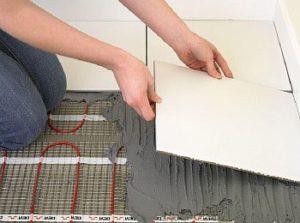
What is important to know:
- Before laying tiles, the heated floor must be fully warmed up at least once and then cooled down for 24 hours;
- If the air temperature in the room during installation of tiles on a heated floor is below 10 degrees, you need to turn on the heating to 15 degrees;
- Before placing electric heating mats, it is necessary to prime the base with a special mixture of the same brand;
- If the room has high humidity, the surface must be covered with Knauf Flachendicht.
Litokol
This manufacturer produces a domestic cement mix for heated floors (model K80). The dry mix is prepared before installation. This tile adhesive for heated floors has the following properties:
- Viability – 20 minutes;
- The adjustment period is 1 hour, which is one of the highest values compared to analogues;
- The room temperature during installation is 5-40 degrees;
- Operation is permitted within a temperature range of -30 to +90 degrees;
- Grouting of the seams is possible after 24 hours.
If you decide to use a polymer tile adhesive for your floor, this manufacturer recommends Litoelastic adhesive mixture. It should be used within 45 minutes of mixing, with an additional 45 minutes allowed for any adjustments.
Unis
Unis tile adhesive is domestically produced, but is comparable in quality to the European Ceresit. Most products available are universal and suitable for all types of surfaces.
The advantage of this tile mixture is its complete environmental safety, making it suitable even for finishing heated floors in children's rooms. Another advantage is its increased adhesion (1.2 MPa).
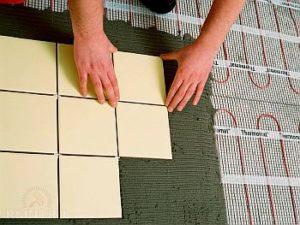
Features of the Eunice adhesive for underfloor heating:
- the pot life of the finished adhesive solution is 180 min.;
- the period until the composition applied to the tile dries is 20 minutes;
- the period of possible correction is 10 minutes;
- grouting of expansion joints – after 24 hours;
- Can be used at temperatures from -50 to +70 degrees.
There is no need to use such glue on a deformed base.
Prospectors
A Russian manufacturer produces "Starateli Plus" tile adhesive, which is designed for installing flooring materials. It is approved for use only on surfaces that are not prone to deformation.
The prepared mixture can be used for up to 4 hours after application, allowing only 15 minutes for tile adjustment. The adhesion strength is 0.5 MPa, sufficient for most types of tile coverings.
Osnovit
The Russian brand Osnovit produces "Maxiplix T-16" specifically for underfloor heating. It has an extended pot life (4 hours) and a 15-minute adjustment time. Ideal for simple surfaces (such as cement screeds).
Choosing the best tile adhesive
To choose the right tile adhesive for porcelain tiles installed over heated floors, it is necessary to consider the room's characteristics (the ability to ensure the required temperature during installation and operation), the complexity of the floor covering (a concrete screed is the easiest, while old tiles or gypsum fiber surfaces are the most labor-intensive), and the type of underfloor heating system.
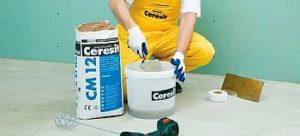
Ceresit is a good choice for water-based flooring; even novice floor installers can use it. For electric installations, we recommend Knauf (if no additional screed is being created) or Bergauf (if a screed is planned).
If you're looking for a budget option, consider Russian brands. For example, Starateli glue offers increased elasticity and is relatively inexpensive.
Installation instructions
To work you will need to prepare the following tools:
- Notched trowel;
- Adhesive (suitable for underfloor heating systems);
- Ladle, trowel, brush;
- Deep priming agent (it must be compatible with the selected tile adhesive for underfloor heating);
- Mixer;
- A container of suitable volume for preparing tile adhesive;
- Level;
- Tile cutter;
- Facing material;
- Rubber mallet.
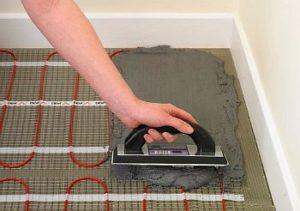
Steps for laying tiles on a heated water floor using glue (using a concrete screed without deformations as an example):
- Removing dust and other debris from the screed (best to vacuum).
- Apply a primer to the surface to improve adhesion. The mixture should be applied only to a dry screed. To check this, cover a certain area with plastic film overnight. If water drops appear on the film in the morning, the floor needs to be dried further. The primer should completely cover the surface without any gaps.
- Preparing the adhesive solution. Follow the instructions exactly. Mix all ingredients with a mixer, then add water.
- Tile preparation. To improve adhesion, priming the inside of the future tile is recommended.
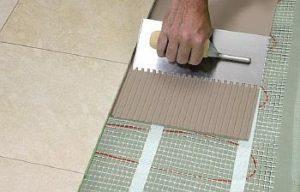
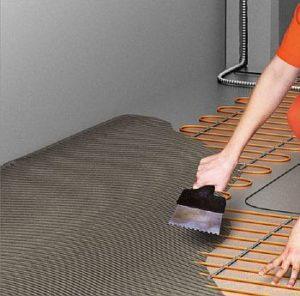
- Apply underfloor heating adhesive to the screed, using a trowel to smooth the layer. Don't cover a large area at once; it's better to apply the mixture gradually.
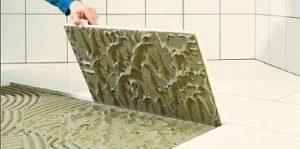
- Apply the mixture to the tile (the thickness should be minimal – up to 0.5 cm).
- Lay the tiles, leaving equal gaps between them, using plastic crosses (they can be removed after 2 hours).
- When the tile adhesive for underfloor heating has completely dried, grout the joints.
Features of application
When installing electric or water-heated floors, beginners often make certain mistakes:
- Incorrect installation in the expansion joint areas (this is where tiles often come loose). Apply adhesive on top and elastic sealant underneath.
- Use a universal adhesive for all surfaces. It's best to choose a specialized option, as its adhesion is significantly higher than that of general-purpose adhesives.
- Before purchasing underfloor heating tiles, check for any defects. If any are discovered after purchase, take this into account when choosing the layout. These defects can also be compensated for by applying a thicker layer of tile adhesive.
- Installing tiles on slightly dried adhesive. In this case, the ceramic tiles will come off quite quickly; it's best to reapply the adhesive.
- Avoid walking on tiles until the specified time has passed, allowing them to fully harden. If someone accidentally steps on the flooring, carefully remove the dislodged tile and replace it and the adhesive layer.
The choice of tile adhesive for underfloor heating must take into account many factors, especially the type of existing flooring, the type of tile, and the type of heating system.
It's also important to rely on the specialist's experience if you're performing the procedure yourself. If you don't have that experience, it's best to choose products with a long correction time and durability.
Video materials
Watch the video