Underfloor heating is becoming increasingly popular today. This is especially true for residents of country cottages looking to create a more comfortable atmosphere in their homes.
Manufacturers produce several types of heated floors, the structure and performance features of which influence both the choice of finishing coating and the choice of underlay.
- What is the purpose of a thermal insulation underlay?
- Types of substrates
- Expanded polystyrene boards
- Cork material
- Damper made of foamed polyethylene
- Foil backings
- Wood-based materials (OSB and chipboard)
- Features of choosing a substrate
- By type of underfloor heating
- By type of flooring
- By type of foundation
- Laying technology
- Related videos
What is the purpose of a thermal insulation underlay?
The underlayment is a thermal insulation material that functions like a "thermos" and a waterproofing layer that protects against moisture. It is positioned between the base and the heat transfer fluid, thereby softening the pressure exerted on the base. The main function of the underlayment is to retain and transfer thermal energy upward, rather than allowing it to escape into the floor.
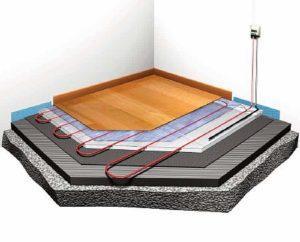
A properly installed underlayment affects the quality of heating. Even the most powerful and expensive heating system will be ineffective if the wrong insulation is chosen, as heat will be wasted.
For your information: According to the technology, the underfloor heating system must transfer heat to at least 80% of the floor surface.
To achieve this result, it's necessary to use a low-conductivity insulating material in this layer of the pie. This quality allows the heat to be reflected and directed upward. Therefore, the underlayment for underfloor heating, whether hidden under the concrete screed or positioned in the middle of the structure, is key to effective heating.
Choosing a good underlayment isn't easy. You need to consider its practicality and technological advancement, ease of use, and the required rigidity. Such a product won't be cheap, but it will last a long time and significantly increase the floor's efficiency.
The best underlay can be determined by the presence of:
- good hydro- and thermal insulation properties;
- increased reflective properties;
- resistance to temperature changes, if it can withstand heating up to 90 degrees;
- resistance to deformation;
- fire resistance.
In addition, it must be environmentally friendly.
Types of substrates
Various products that meet the above requirements can be used as a substrate.
Watch the video
Expanded polystyrene boards
Polystyrene foam boards for underfloor heating (we suggest you explore this covering in more detail) — a versatile product, as it has a low thermal conductivity compared to other models. It is manufactured using polystyrene foaming.
The finished product consists of air contained in sealed cells, which allows heat to be retained. A 10-cm-thick sheet has the same thermal conductivity as 0.35 m of wood, 4.8 m of reinforced concrete, and 1.5 m of brick wall.
The foam sheet consists of the following components:
- polystyrene - 2%;
- gas - 98%.
Characteristics of polystyrene:
- thermal conductivity - 0.028-0.034 W/m*K, the indicator varies depending on the density of the product;
- water resistance - 0.019-0.015 mg/m*h*Pa;
- moisture absorption - 0.4%, which is 10 times less than that of standard foam plastic;
- strength - at 10% deformation is 0.25-0.50 MPa.
Despite all the positive aspects, polystyrene also has disadvantages:
- poor sound and waterproofing;
- flammability;
- deformation under the influence of chemical compounds (acetone, solvent).
Non-pressed or autoclaved polystyrene foam is not suitable as a thermal insulation layer, as these varieties are more fragile.
Polystyrene sheets are produced in several types:
- Uncoated polystyrene sheets with studs—their disadvantage is that the studs easily break off during installation of the heating unit. The average price per sheet is 600 rubles per square meter.
- Polystyrene sheets with studs and a plastic coating are 2 cm thick. The coating protects the studs; the average price for a coated sheet is 680 rubles per square meter. The studs securely hold pipes of any material, whether metal-plastic or polyethylene, eliminating the need for additional fasteners.
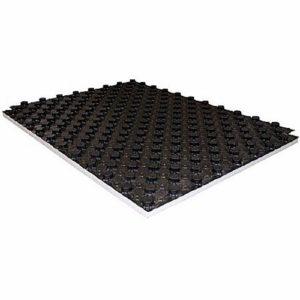
- Smooth polystyrene underlayments have a lower density and range from 2 to 10 cm in thickness. A 2 cm thick slab costs about 100 rubles. These slabs do not secure the pipes; anchor clamps are required for this.
Cork material
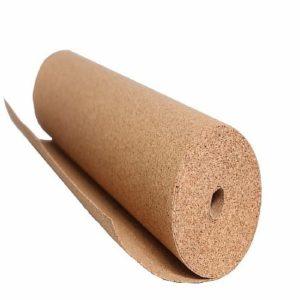
Cork gaskets are made from tree bark, which is pre-crushed and pressed. The main advantage is that they are made using natural and environmentally friendly raw materials. Therefore, the products are safe for health and hypoallergenic.
In addition, the cork has positive aspects:
- resistance to deformation - after mechanical impact on it, it takes its original shape;
- high sound insulation - this is ensured by the porous structure;
- good degree of thermal insulation;
- ease of cutting and laying.
The product is sold in rolls or sheets. The difference between roll and sheet underlayment is thickness: rolls range from 2 to 4 mm, while mats range from 4 to 10 mm.
Cork, like any raw material, has its disadvantages:
- moisture sensitive;
- During installation, waterproofing of the base is required;
- does not tolerate static loads well.
It is not recommended to use standard cork underlayment for hydronic underfloor heating. It is better to install cork with a rubber interlayer, where the binder is rubber.
Damper made of foamed polyethylene
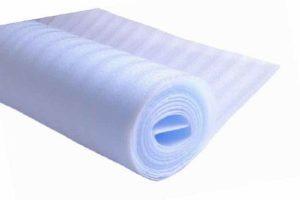
Polyethylene foam backing is the most affordable option. The production process involves forcing molten material through a cellular mold, which is then heat-treated and pressed. The result is an elastic, air-filled fabric.
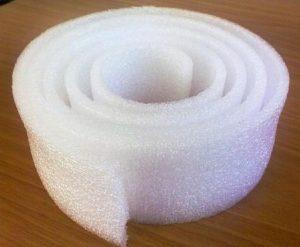
Polyethylene foam substrates are produced in two types:
- Uncrosslinked – gas-filled cells measuring 3 mm. The product is manufactured in thicknesses from 0.8 to 3 mm, and in lengths of 1 or 1.5 meters.
The main advantages of this type:
- increased moisture resistance;
- small thickness;
- low price.
But this model has more disadvantages: it's short-lived, wears out quickly, has a density of only 25 kg/m3, sag under weight, and loses flexibility. Furthermore, its thermal conductivity is 0.55 W/(m°C), indicating that the material doesn't retain heat well.
- Cross-linked polyethylene foam boards have a dense structure, as the technology promotes the formation of cross-links, which reduce the size of air cells.
Main characteristics:
- high strength;
- high density - 33 kg/m3;
- the level of noise insulation reaches up to 18 dB;
- thermal conductivity coefficient 0.031 W/(m°C);
- are produced in two types: rolls and mats, the thickness of which is from 1 to 20 mm;
- service life up to 15 years.
The main disadvantage is the high cost.
Foil backings
A foil-coated underlayment is widely used. A huge advantage is that it can be based on extruded polystyrene foam tiles, foam plastic, polyethylene foam, or cork. The use of metallized film significantly improves the underlayment's performance.

A reflective outer coating made of aluminum or polyester serves as the reflective outer layer. It increases the efficiency of the water system to 98% and ensures uniform heat distribution. The degree of heat reflection depends on the size of the foil layer. An important property of this material is its resistance to deformation and its ability to withstand heavy loads.
It is worth noting the special property of lavsan: it has the ability to retain its reflective qualities and moisture-retaining properties, even after prolonged contact with concrete screeds.
Wood-based materials (OSB and chipboard)
A wood-chip base is used when installing underfloor heating using the Finnish method. This option eliminates the need for a concrete screed.
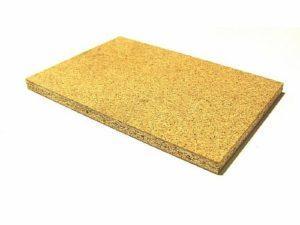
The technology involves laying underfloor heating pipes into pre-drilled grooves. The foundation is rigid with chipboard sheets or slats, which are fastened with wooden joists.
The peculiarity of this type:
- ease of installation;
- strength;
- environmental friendliness;
- versatility – can be installed under any type of flooring.
The disadvantages of this substrate are that it does not tolerate moisture well; it is recommended to lay a foil film between the pipe and the wooden base to improve the hydro- and thermal insulation properties.
For your information! It's worth noting that experts do not recommend using marked underlayment as insulation for heated floors. However, this product does make the process of laying the slabs more convenient.
Features of choosing a substrate
Selecting an underlayment carefully is crucial, as it affects not only the performance of your underfloor heating but also the atmosphere in your home. Therefore, when purchasing insulation, professionals recommend paying attention to the following points and making your choice based on the parameters listed below.
Video
By type of underfloor heating
It is necessary that the substrate meets the requirements set by the heating system manufacturers:
- A foil-coated underlay with a reflective coating is used for this type of underfloor heating system. This type of mat is inexpensive and ideal for space-saving living spaces, but it is not recommended for basements. Film-coated models are better for underfloor heating systems; although more expensive, they offer improved thermal properties. An excellent solution for underfloor heating systems is a backing made of extruded foam with studs; it offers superior quality and ease of installation, as the pipes are laid in grooves. Rolled cork or expanded polystyrene are also good options.
- Electric flooring – foil-clad roll or tile insulation is suitable. An aluminum reflective layer is not recommended; vacuum deposition is better. If the height allows for a thicker pie, then it's worth using expanded polystyrene with a 2-3 cm thick foil layer. If height is limited, 2-3 mm polyethylene foam can be used as thermal insulation.
For the infrared floor model, you can choose chipboard sheets or magnesite boards, but you will first need to lay a foil film.
By type of flooring
The lighter the weight of the floor covering, the less durable the underlayment can be.
When installing laminate flooring, you can use foamed polymer, and when using ceramic tiles, which will be laid on a concrete screed, you need a backing made of extruded material, which has increased strength.
Under linoleum, only a solid base or an additional thin concrete screed is required.
By type of foundation
Almost any type of underlay can be laid on both a concrete subfloor and a wooden one.
The only feature when installed on a wooden floor is an increased level of waterproofing and fire resistance.
Laying technology
Underlayment installation is simple and can be done independently. When installing underlayment for underfloor heating, its thickness must be selected based on the type of system and the conditions it will be used in.
The reflective side of the insulation should face the heat source. There should be an air gap of 15–20 mm between it and the finished floor to allow for air circulation and condensation.
The main thing is to follow the established rules:
- Carrying out calculations - determining the amount of material; it is better if the insulating layer has a minimum of seams.
- Preparing the base - it must be level, as any unevenness will eventually show up on the surface.
- Laying a waterproofing layer - this can be cork, chipboard, etc. Before this, it is necessary to lay a thick polyethylene layer, which will serve as a waterproofing barrier.
- Underlayment installation (roll or sheet) – it is laid loosely, with a mandatory overlap onto the walls. The material must fit snugly against the vertical surfaces covered with damper tape.
- Connection - roll-type sheets (laid in an overlapping manner) or mats (located end to end) are joined using tape.
After this, you can begin installing the heating system. If you're installing hydronic or electric underfloor heating, and using a pre-studded foam underlayment or a grooved wooden underlayment, simply place the pipes or cables into the grooves.
If the substrate is smooth, additional fixation will be required. Then, a screed must be poured, although there are ways to install underfloor heating without it. After that, you can begin applying the final coating.
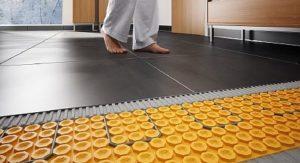
Installing an infrared floor mat is an easier option. The roll material is simply unrolled onto a flat surface and secured with tape. A concrete screed is not required; simply lay a polyethylene film on top and install the flooring.
To summarize, the underlayment is a structural layer that's essential when installing any underfloor heating system. Avoid skimping on this material, as repairs to the system will be much more expensive.
Properly installed hydro- and thermal insulation will ensure heating of the room and reduce energy costs.