For the construction of heated floors laid in a concrete screed, it is recommended to use reinforcement, which gives strength to the structure.
Mesh for hydronic underfloor heating or cable systems comes in various types and is made from various materials. In our article, we'll cover common models and their intended uses in detail.
Purpose of the grid
Is reinforcing mesh necessary when installing heated floors? While laying it is not mandatory, experts recommend its use. It can achieve a number of positive effects, such as:
- Increased strength and durability - it will protect the structure from deformation when the system heats up, and therefore from cracking.
- Even distribution of load on the base from furniture and finishing coating.
- Reducing cement consumption during mixture preparation.
- Reducing the thickness of the screed, while this does not affect the strength properties of the device.
- Possibility of fixing heating elements to it.
- Increased system performance. Prevents the heating cable or coolant pipes from coming into close contact with the subfloor. The cement mortar must penetrate the space between them, which increases the floor's heat transfer.
In addition, the use of a reinforced structure allows for the most even surface.
Types of reinforcing meshes
Reinforcing mesh comes in a variety of types, each with its own characteristics and features that significantly improve the efficiency of the heating system. They come in various mesh widths, from 5 x 5 to 30 x 30.
Video
Metal
The metal mesh used for floor screeds is made from wire with a diameter of 2.5 to 6 mm. Roll sizes can be up to 25 meters, minimizing the number of joints. Reinforced products are also manufactured using thinner wire, but these are typically smaller in size.
The cells are square, increasing strength and preventing the structure from stretching during reinforcement. The surface is serrated to improve adhesion to the concrete.
In addition, the mesh coating has a protective galvanized layer that protects against the negative effects of moisture and components found in the solution.
For your information! In the reinforced lattice, the pitch and size of the cells are calculated in such a way that excess metal consumption is not allowed and the necessary strength of the concrete base is created.
The use of a metal structure allows for high-quality reinforcement of underfloor heating. It is suitable for pouring a thick cement layer and ensures long-term shape retention. Heating elements, such as water pipes or electrical cables, are also attached to the grating.
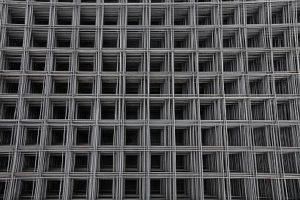
The main advantage of metal reinforcement is its strength; even if several cells are damaged, the overall integrity is not affected.
The main disadvantage is corrosion, which causes voids to form, resulting in the structure collapsing.
Composite
Composite mesh is made from fibers that contain basalt or carbon.
Its main advantage is:
- resistance to chemicals and water;
- light weight;
- low thermal conductivity;
- long service life, since it does not corrode;
- plasticity, which facilitates installation;
- affordability.
A disadvantage of this type of reinforcement when used for underfloor heating systems is its low heat resistance. When heated to 200 degrees Celsius or higher, the product may become deformed.
But in our case, achieving such temperatures is impossible, so the use of mesh material is acceptable.
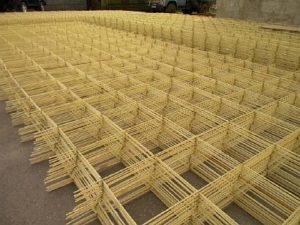
The mesh structure ranges in thickness from 4 to 14 mm. It is produced in the form of sheets or rods connected with binding wire.
Fiber reinforcement
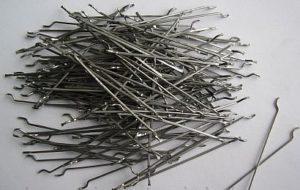
This is a type of composite reinforcement based on fiber. The fiber length ranges from 6 to 20 mm. If a strong concrete base is desired, fibers of 5–6 cm should be used.
Using this model significantly improves the quality of the resulting surface, but it is not possible to attach a heating cable or water system circuit to it.
Types of fiber:
- glass - its use reduces the consumption of cement mixture by up to 15%;
- basalt - intended for floors exposed to the environment;
- polypropylene - the fibers have a thickness of 15-25 microns, a length of 0.6 cm, the use of this fiber allows you to avoid the formation of tiny cracks in concrete;
- steel - the most durable and widespread model.
Plastic
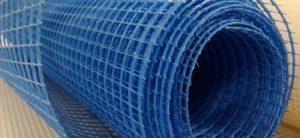
Using plastic mesh for underfloor heating screeds with a water or electric circuit is an excellent solution. The resulting structure is lightweight, durable, and resistant to moisture and corrosion.
It's sold in rolls 2 meters wide and 50 meters long. The cells come in various sizes. Its main purpose is to strengthen the screed and reduce stress.
Advantages of plastic grille:
- concrete shrinkage does not damage the mesh, it only stretches;
- easy transportation and installation;
- increased strength - this is achieved by the peculiarity of the technological process in the production of plastic types of reinforcement (double-base orientation of threads, no knot connection is used);
- low cost compared to metal construction;
- the reinforcing material is easy to cut with scissors during installation;
- plastic does not shield the wiring.
Popular manufacturers
Many companies produce reinforced mesh structures used for screeding electric or hydronic underfloor heating systems. The most popular manufacturers include:
- Armplast specializes in fiberglass products used in electric underfloor heating systems. Fiberglass products are also used to reinforce plaster or mortar.
The advantages of fiberglass reinforcement from Armplast: it is corrosion-resistant, has a long service life, is lightweight, is twice as strong as steel, has a coefficient of expansion similar to concrete, and is non-conductive.
- Fibrasnab manufactures reinforced products from welded metal rods. The company's mesh is highly rigid due to its nearly perfectly square mesh. Optimally selected wire spacing prevents material waste.
Fibrasnab products are made from 0.65 mm thick steel in 25-meter rolls, reducing the number of joints. They are galvanized to protect against damage and extend their service life. The adhesion of the mortar to the surface is enhanced by the angled ribs of the mesh.
- Tepakh products are manufactured using polypropylene extrusion. This method produces products with increased strength and flexibility. Tepakh mesh is an excellent option for laying screeds up to 8 cm thick under hydronic or electric underfloor heating systems.
The company's products are distinguished by their resistance to deformation during concrete shrinkage, their light weight, their resistance to external chemical attack, and their ease of cutting, which simplifies installation.
- Gridex specializes in the production of basalt fiber. Basalt fiber has low thermal conductivity, making it ideal for underfloor heating systems. Furthermore, it is resistant to aggressive environments, making it ideal for reinforcement with cement-concrete mortar.
Gridex impregnates basalt mesh products with acrylate, which improves the material's adhesion. The standard mesh size is 25 x 25 mm.
- LenStroyDetal manufactures high-quality products made from steel rods coated with a protective galvanized layer. Using metal products significantly increases the service life and strength of concrete surfaces.
The company manufactures a mesh for heated floors from wire with a diameter of 4 mm and a cell size of 100 x 100 mm.
Video
Which mesh to choose and why
Today, the market offers a wide variety of reinforcing mesh models from various manufacturers. When choosing a mesh covering for a water-based or electric underfloor heating system, preference should be given to:
- Square models with 150 mm cells, or at most 100 mm, are recommended. After all, the pitch of hydronic underfloor heating elements is typically 150 mm, so cells of this size are optimal for their installation.
- A reinforcing product manufactured on a CNC machine is preferable because it is smoother than a homemade one. Moreover, homemade ones often have inconsistent cell sizes.
- The mesh, with a rod thickness of 4 mm, fits well on polystyrene sheets and is convenient for fixing water pipes or cables to it.
In addition, when choosing a styling model, it is worth considering:
- the consistency of the cement-sand mortar, because it must freely penetrate through the cells;
- level of mechanical loads - the higher the indicator, the smaller the cell size.
Video
Installation technology
When constructing a heated floor with the installation of a reinforcing mesh, it is important to install it correctly.
For your information! Regardless of the type of reinforcement chosen, reinforcement is applied across the entire floor, with a small gap left from the walls.
When pouring a large area, overlapping the tiles is acceptable, and the pieces are joined with wire. For non-standard surfaces with steps or transitions, the contours of the base must be matched.
The mesh is mounted on fasteners in a suspended position, at a distance of 2 cm from the rough base.
Video
Preparatory work
If the foundation is ready, it needs to be leveled and any uneven areas filled. Then, lay a polyethylene film for waterproofing and a thermal insulation layer. The perimeter of the room should be sealed with damper tape to compensate for temperature changes.
Before pouring the screed on the ground, it's necessary to prepare the "layer"—gravel and sand, a layer of thermal insulation, and a layer of waterproofing. Only then should the masonry mesh be installed and the mortar poured.
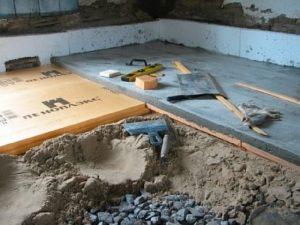
If reinforcement is carried out on a backfill foundation, then two layers of reinforcement should be made.
Laying the mesh
Proper placement of the mesh is crucial when reinforcing. It is placed at a slight height above the base. This height is determined based on the thickness of the electric or hydronic underfloor heating screed and the diameter of the mesh rods.
To create a gap between the base and the reinforcement, you can place wooden blocks, pieces of brick, or metal profiles underneath. These supports should allow the mortar to penetrate under the heating elements.
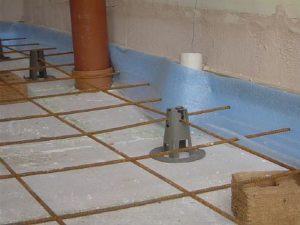
Reinforcement should be placed in the lower third of the concrete layer. Supports should be placed where the bars intersect.
To make installation easier, you can purchase ready-made stand accessories, which come in the shape of crowns, stands, or stools. The strips are laid with a 10 cm overlap, spaced about 2–3 cm from the walls.
Important! The distance between the supports depends on the thickness of the planned screed.
The process of laying a composite or plastic structure is different:
- After the “pie” is formed, 1/3 of the solution is poured in and leveled;
- then, a mesh is placed on top and pressed into the screed layer;
- The cable or pipes of the water-heated floor are laid on top and filled with the remaining solution, the surface is leveled using previously installed beacons.
Plastic and composite meshes can be placed directly on the water system pipes, but there is a risk of voids appearing during pouring.
Fastening heating elements
The easiest way to secure a water-heated floor circuit or cable to the grid is to use clamps.
For your information! When exposed to hot water, the clamps become softer and easier to secure. To do this, soak the clamps in hot water for 10 minutes.
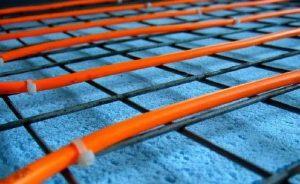
You can fix it using fastening tape or wire, but the option with clamps is more convenient and practical.
Features of reinforcement
There are some general rules that must be followed when reinforcing heated water or cable floors:
- regardless of the type of reinforcing material, to increase the strength and elasticity of the cement and sand solution, it is added It is recommended to add plasticizers;
- It is prohibited to touch the product with the rough coating; it must be inside the mortar layer;
- It is unacceptable for the mesh to be dirty;
- reinforcement elements must not protrude onto the surface of the screed.
In addition, before starting work, you should read the accompanying documentation attached to the reinforcing product.
What can replace the mesh?
When constructing a warm water or electric floor, the mesh is often replaced with special bosses, which can be separate or mounted on polystyrene insulation, to which the heating elements are attached.
If time permits, you can make your own reinforcing structure from rebar or metal sections. To do this, lay the bars on top of each other to form a lattice and connect them using spot welding or wire.
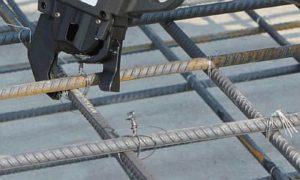
To strengthen the screed of warm floors of a small area, it is permissible to use panser mesh from beds.
To ensure a smooth surface when constructing a heated floor system, it's recommended to reinforce the concrete screed. The surface can crack during heating, and the presence of a mesh in the screed prevents this. Furthermore, this product makes the floor more level and significantly increases its service life.