If you decide to install underfloor heating in your apartment or house, and opt for an electric system rather than a water-based one, you need to understand that in addition to installation costs, you will incur ongoing electricity costs. Therefore, it's important to calculate in advance how much electricity the underfloor heating will consume.
The article presents the characteristics of all electric floor models, their advantages and disadvantages, as well as a comparative analysis of the energy consumption of each type.
We've also compiled a comprehensive collection of professional advice that will help reduce operating costs and save your family money.
- Types of electric underfloor heating
- Electric cable
- Heating mats
- Infrared film
- Rod floor
- Calculation of electricity costs by type
- Electrical cable and mats
- Infrared heated floor
- Energy costs depending on the finishing coating
- Calculation of energy costs for electric floors depending on the type of premises
- Comparative analysis of the consumption of heated floors by type
- Factors that reduce energy consumption
- A thermostat is an indispensable device for reducing costs.
- Video materials
Types of electric underfloor heating
Today, the market offers a wide range of electric floor-standing systems. They are divided into several types.
Below, we'll detail the technical specifications of each type and calculate energy consumption per square meter per hour and per month depending on the room type. We'll also explore how the finish affects energy consumption.
Electric cable
An electric cable is a wire that is laid in any pattern, but most often in a "snail" or "serpentine" configuration. The structure is then filled with a concrete screed, which reduces the room's height by an average of 5 cm. The specific power of such a cable ranges from 0.01 to 0.06 kW/m², and its choice depends on the frequency of the turns.
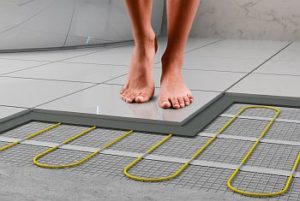
The power consumption of one meter of cable ranges from 10 to 60 watts. To cover 1 square meter of surface, approximately 5 meters of cable are required, meaning that heating requires an average of 120 to 200 watts of electricity.
Heating mats
Heating mats are a structure made of cables laid in a specific pattern on a special mesh. They are usually installed under a screed and are ideal for installation in rooms with high humidity.
This model is designed for rooms with low ceilings, as the "pie" thickness is only 3 cm. The mat power is up to 0.2 kW/m2.
The average power consumption per square meter of a heating mat is 120–200 W.
Infrared film
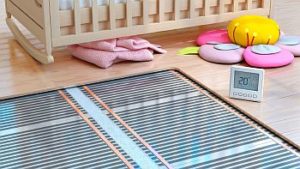
Infrared underfloor heating is a thin polymer film with a carbon layer applied to it. When heated, the carbon radiates heat.
IR film doesn't affect ceiling height. On average, it takes about 150-400 watts of electricity to heat 1 m² of film.
Rod floor
A rod floor is an infrared type, but instead of carbon plates, it contains rods. Its energy consumption is 120–200 watts per square meter.
Calculation of electricity costs by type
To determine how much current an electric underfloor heating system consumes, we will consider a number of the following factors: heat loss, base thickness, and degree of thermal insulation of the room.
The formula will help you calculate the amount of electricity consumed:
W=S*P*0.4, where
- S — area in m2;
- P — power;
- 0.4 is the coefficient of the heated useful area.
Electrical cable and mats
To determine the amount of electricity consumed and the costs associated with its payment during the operation of a cable system, it is necessary to take into account a number of factors:
- The heated area is the unfurnished portion of the room. Typically, this is 12–15 square meters; this is where the cable or mats will be laid.
- To heat 15 square meters of floor space, an average cable with a total power rating of 2100 W/h is required. Consumers often purchase imported products designed for 230 volts. In our conditions, such cables cannot operate at full capacity, consuming no more than 1930 W.
- 1930 W is the power consumed by the underfloor heating cable at maximum load. The heating temperature can reach +45°C. A comfortable temperature is considered to be up to +23°C. Under these conditions, the floor can consume approximately 965 W.
- According to calculations, to maintain a comfortable atmosphere, the cable must be heated for 20 minutes every hour. Consequently, the power consumption for heating 1 m2 of floor is no more than 322 W/hour.
You can pay less for the energy consumed by cable-based electric underfloor heating if you use a two-tariff meter.
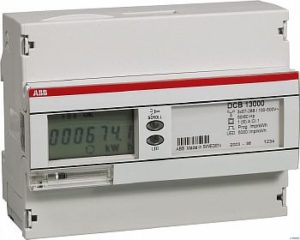
Additionally, when using a cable, to determine the amount of electricity consumed, you need to calculate its length. This is easily done using the formula:
L=l/a
Where:
- l — wire length:
- a — the step between cable loops.
By multiplying this value by the power of the wire (120-200 watts), you will get the amount of electricity consumed by the heated floor per 1 m2.
Infrared heated floor
If infrared underfloor heating is used, the energy consumption, as with any heating system, is affected by the level of room preparation. Furthermore, the film's wattage is an important factor. When used as the primary heating system, the wattage is 220 W/m²; when used as a supplementary heating system, the wattage is 150 W/m².
Please note! 220W film requires 5-7 minutes of heating per hour, while 150W film requires 12 minutes. However, their energy consumption will be the same on average.
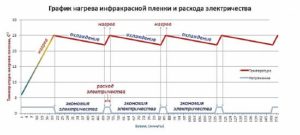
How many Do heated film floors consume energy? per month, let's take a 50-square-meter room as an example, with a film power of 150 W. To do this:
W=50*150*0.4=3000 W or 3 kilowatts in 60 minutes.
To calculate monthly consumption, you need to:
3000 / 60 minutes x 5 minutes (running time per hour) x 12 hours per day x 30 days per month = 90,000 W/month or 90 kW
The resulting figure is multiplied by your region's tariff—that's how much you'll spend on electricity. Naturally, this figure is approximate and applies to the use of a day-night meter.
With proper calculation and planning, costs can be significantly reduced..
Energy costs depending on the finishing coating
When choosing a finishing material for installation over electric underfloor heating, be sure to check the product for compatibility with the heating device. Ceramic tiles, linoleum, or parquet are most commonly used over underfloor heating systems.
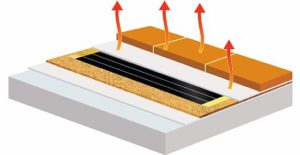
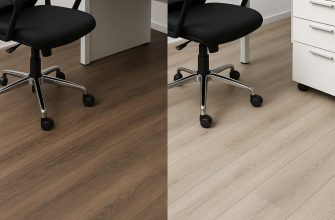
It's worth noting that the energy consumption per square meter of electric underfloor heating is also affected by the finish, or more specifically, its thermal conductivity. If you choose laminate or wood flooring, your heating costs will increase, as they have low thermal conductivity.
Ceramic, linoleum, or carpet are ideal and cost-effective materials. They heat the surface quickly and require minimal energy.
Calculation of energy costs for electric floors depending on the type of premises
There are certain standards according to which a device with its own power is recommended for each room:
- in living rooms, kitchen and hallway - up to 120 W per m2;
- in the bathroom - 150 W/m2;
- in the loggia - 200 W/m2.
In addition, the system's capacity is affected by its intended purpose—whether it is primary or additional heating.
For example, if underfloor heating is the primary heat source in a 20 m² room with a usable area of 8 m², heat loss will be 2 kW/hour. Based on this data, the power is calculated:
- heat loss/area = 2/8 = 0.25 kW/m2
If you live in a region with a harsh climate, you should add 25%.
Comparative analysis of the consumption of heated floors by type
All electric floors use induction heating, meaning they heat the surface using electric current. This converts electrical energy into thermal energy with approximately the same efficiency. The installation method and floor covering affect the energy consumption of underfloor heating.
The following factors are of great importance:
- Thermal insulation and reflectivity of the underlying material;
- The degree of heat loss in the screed is important for structures installed in the screed.
Having analyzed the above, we can conclude that:
- The most energy efficient heating devices are those that are placed directly under the decorative item;
- Installing high-quality insulation with a reflective surface and isolating the edges of the screed from the walls will reduce the differences between models in terms of cost effectiveness.
Despite slight differences in energy consumption between different types of electric floors, there are still differences. Film has the most significant consumption—220 W/m2, with a maximum heating level of +40°C.
When installing the cable in a screed - 150 W/m2Therefore, if the design allows, it's more economical to install the cable system in the screed. With high-quality thermal insulation, the device will heat the screed for about 8 hours, which will then transfer the heat to the room.
However, the difference in power consumption between different types of systems is insignificant when installed in small spaces. The costs for installing them throughout an entire apartment vary significantly.
Factors that reduce energy consumption
As already mentioned, installing electric underfloor heating in every room of an apartment will incur significant costs, which will impact your family budget.
However, there are ways to reduce energy consumption:
- Carrying out high-quality insulation – good thermal insulation reduces consumption by 35–40%.
- Installing a multi-function meter reduces the cost of electricity used at night by about half. This is especially true since the heating is mostly on when people are home, which is usually in the evening and at night.
- Install heated floors in open areas. Laying them under furniture is not only unprofitable, but also prohibited by the system manufacturer.
- Use of finishing coatings with good thermal conductivity.
- Installing a programmable thermostat, especially in residential areas, can help you save up to a third on energy costs.
- In sparsely populated rooms, not maintaining a high heating temperature will waste unnecessary energy.
Moreover, if you reduce the heating level by just 1 degree, it will not have a significant impact on the atmosphere in the room, but the savings will be 5%.
Climate conditions also play a significant role. The greater the difference between indoor and outdoor temperatures, the greater the power consumption.
A thermostat is an indispensable device for reducing costs.
The thermostat deserves special mention—its use can reduce energy consumption by up to 40%. It is recommended to install the device in the coldest part of the room. When the temperature drops below the set value, it will turn on the heating, and when the desired level is reached, it will turn off.
Most regulators are designed for a current of 16 amperes; such a device can withstand a load of no more than 3500 watts.
The type of thermostat largely influences electricity consumption. They come in:
- mechanical - the design is simple and inexpensive, the daily working time is about 12 hours;
- programmable - equipped with several modes that allow you to control the operation, such a device functions for only 6 hours a day.
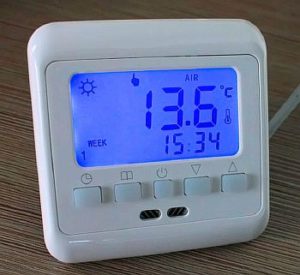
Let's use an example to determine which type of thermostat will be more energy-efficient. To do this, we'll use the following formula:
Рд = t * Ptotal;
t — device operating time;
Ptotal— power.
When installing a mat with a voltage of 900 W and using a mechanical regulator:
Pd = t * Ptot = 12 h * 900 W = 10,800 W = 10.8 kW
If a software controller is installed, then:
Pd= t * Ptot = 6 h * 900 W = 5,400 W = 5.4 kW
From this calculation it is clear that using a programmable controller will significantly reduce your costs.
If underfloor heating is used as the primary heating system in all rooms, several controllers connected to a single centralized system will need to be installed.
When considering installing electric underfloor heating in a house or apartment, it's important to conduct all necessary calculations, taking into account the maximum winter load. Only after weighing all the pros and cons should you decide to install such a system.
Video materials
The video provides a detailed breakdown of how much electricity a Caleo heated floor consumes.

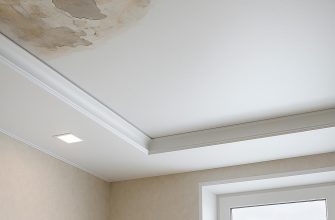

High-quality thermal insulation. The less heat loss in your home, the less energy it requires to heat it and maintain the required temperature. Experience shows that high-quality thermal insulation can reduce costs by 30-40%.
More often, consumers purchase foreign products designed for a voltage of 230W. Voltage is measured in volts.
Thanks for the comment, we've corrected it.
Please correct the typo in the phrase:
“…Most regulators are designed for 10 amps…”
Thanks for the comment. We've fixed it.