Heating is a pressing issue for most cities in our country. Central heating doesn't always provide adequate comfort, so many are considering installing an independent system.
One option for such heating is to install underfloor heating from a water heater.
- Is it possible to connect underfloor heating to a boiler or not?
- Types of boilers
- Flowing
- Cumulative
- How a water heater works
- Which boiler should I choose?
- Design features of a heated floor connected to a boiler
- Wiring diagrams for underfloor heating and boilers
- Installation and connection of heated floors to the boiler
- Video
Is it possible to connect underfloor heating to a boiler or not?
When installing water-heated floors, owners of apartments or private houses should:
- make a structure that will heat the air in the room to the required level;
- choose a cost-effective option in terms of installation and operation, which will not cost much.
We suggest you find out in advance The structure and operating principle of a water-heated floor and the possibility of combining the system with various devices (radiators, three- and two-way valves, etc.)
Gas or electric boilers are used to heat the coolant. Gas boilers are most often installed in private homes. Such equipment cannot be installed in apartments with central heating.
Furthermore, connecting to the main heating system requires special permission. Therefore, an alternative solution is needed—installing an electric boiler.
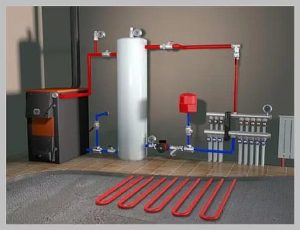
A boiler is a device for heating water using electricity for domestic purposes. However, it's worth noting that it was not originally designed to heat water for underfloor heating. Therefore, this would place additional strain on it, which could result in its failure.
While it's still possible to power the floor from a boiler, it won't heat large areas. This option is ideal only for a bathroom or toilet.
Please note! Correctly calculating the load on the electric heater is essential.
Types of boilers
A water heater is an electric boiler equipped with a tank that stores heated liquid. Designs with a capacity of up to 100 liters are used for domestic purposes, while those with a capacity of up to 300 liters are used for industrial purposes. An industrial type is recommended for underfloor heating installations.
According to their design, boilers can be instantaneous or storage.
Flowing
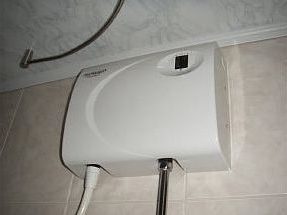
A flow-through heater is a compact tank with a square heating element that connects to the cold water supply. When turned on, the water heats up almost immediately. These heaters have a power rating of 6-10 kW, so they place a significant load on the electrical system.
A flow-through water heater is not suitable for underfloor heating.
Cumulative
A storage heater is a container with two housings, between which is a protective layer of thermal insulation material (polyurethane foam). The outer housing is made of enameled steel.
The inside of the flask is coated with glass enamel, applied using a spray process, resulting in a smooth, scale-resistant surface. Furthermore, the enamel is unaffected by salts present in the water and is not subject to corrosion.
Some models have an internal coating made of glass porcelain rather than glass enamel. The surface is high-quality, but cracks may form if exposed to high temperatures for long periods of time. However, manufacturers guarantee that the device will operate reliably for at least 10 years.
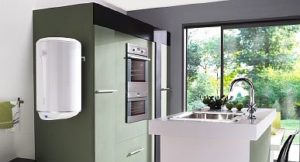
Another type of coating used for boilers is stainless steel with titanium, which can withstand high temperatures. A water heater with this coating will last for many years.
A heating element (a tubular heater) is located inside the tank; it heats the coolant. The heating element is housed in a metal tube, which prevents it from becoming scaled. Additionally, the flask contains a magnetic anode—a rod containing positively charged particles that neutralize the negative charge.
This helps reduce corrosion. The rod requires periodic replacement, as it wears out quite quickly. The water heater is equipped with pipes through which cold water is supplied and hot water is discharged.
Please note! Electric water heaters with capacities of 250-300 liters, specifically designed for use in heating systems, are now available on the market. They differ in the location and size of the supply and return openings.
The standard power of storage models is 1.5–3 kW. The device resembles a thermos; water is heated and then slowly cooled, thereby maintaining a high temperature for an extended period.
These types also feature a thermostat, allowing you to set the desired heating temperature for underfloor heating. Once the desired temperature is reached, the boiler automatically shuts off, promoting efficient energy consumption.
Boilers come in horizontal and vertical designs. The vertical design is recommended for underfloor heating systems.
Important to know! To heat 15 liters of water to 60 degrees, you'll need a 1 kW heating element, which takes 1 hour. A 100-liter tank will reach this temperature in 3 hours with a 3 kW heating element.
How a water heater works
An electric boiler operates by mixing cold and hot coolant. Heated water rises to the top, while cold water remains at the bottom, where it is heated.
The process of operation of a water heater is as follows:
- The storage tank is filled with water through a special connection. The inlet is equipped with a safety valve that retains the liquid and prevents it from flowing back.
- The required temperature is set on the thermostat, but not more than 80 degrees.
- The heating element turns on automatically and water heating begins.
- The hot liquid rises upward and is released through the intake pipe located at the top of the tank.
- The coolant moves through the intake pipe into the floor pipeline.
Which boiler should I choose?
A continuous-flow electric water heater is practically unsuitable for underfloor heating systems. Its main drawback is its significant energy consumption.
The only suitable option for underfloor heating is a storage water heater. When choosing the type of heating element, pay attention to the equipment's power, as this determines how intensely and quickly the coolant is heated, as well as its volume.
Please note! Devices with a power output of 6–10 kW are specifically designed for installation with heating systems. Their main drawback is their high power consumption.
When calculating the power of an electrical appliance, keep in mind that heating an area of 10 square meters requires a water heater with a power of 1 kW, so a household model of a water heater for underfloor heating is not suitable. It is only suitable for small spaces, such as a bathroom or toilet.
The second pointOne important factor to consider when purchasing a water heater is the tank capacity. The larger the volume of hot coolant, the less frequently the water heater will need to be turned on, thereby conserving resources.
Design features of a heated floor connected to a boiler
When designing a floor heating system from a boiler, it is necessary to take into account:
- the size of the pipeline and the number of branches, the longer the circuit, the slower the circulation of the liquid will be;
- Heating element power - if the lower threshold of the heated room matches the boiler power, then after some time the efficiency of heating the coolant may decrease. The solution is to buy a heater with a 20% power reserve.
Furthermore, the system requires constant maintenance, including periodic descaling of the storage tank and heating element. This procedure will help keep the underfloor heating pipes in good condition and extend their service life.
It is recommended to connect the boiler in a bathroom or room located close to the heated room.
To increase the device's performance, the structure must be equipped with a circulation pump.
By following all of the above points, you can build a hydrofloor that can provide heating for your apartment.
Wiring diagrams for underfloor heating and boilers
There are several schemes for connecting underfloor heating to an indirect water heater. Let's look at the simplest ones:
- A three-way valve is the key to connecting two circuits: the underfloor heating system and the water heater. This valve distributes the coolant between them. It is controlled automatically by a thermostat on the heater. This system facilitates rapid heating of the water in the boiler, while allowing for complete shutdown of the hot water supply to the floor lines. Once the set temperature is reached, the valve is activated and the supply is resumed. This piping method is suitable for continuous boiler use.
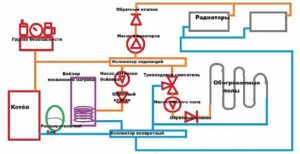
- With two forced-circulation pumps—this option is recommended for intermittent, seasonal use. One is installed on the supply pipe before the water heater, and the other on the floor circuit.
A thermostat is used to power the circulation pump, so it only operates when the temperature drops below the normal level. Heating accelerates, and forced circulation is activated. This system does not have a three-way valve, and the connection is made using tees.
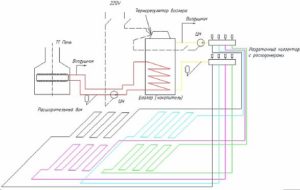
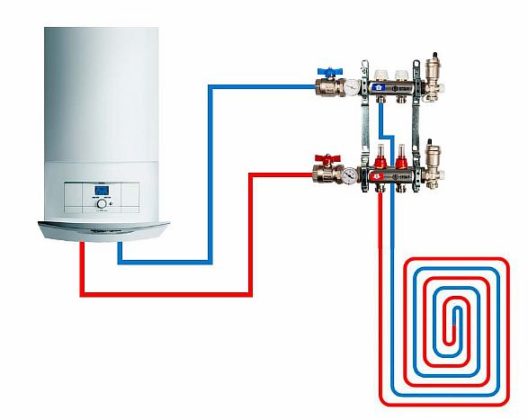
- Using a hydraulic manifold—this method is recommended for boilers with a capacity of 200 liters or more and with multiple heating circuits. A system with a hydraulic manifold simplifies the design and eliminates the need to install pumps on each floor circuit. The hydraulic manifold ensures equal coolant pressure in all circuits. However, installing the piping this way is difficult without experience.
Installation and connection of heated floors to the boiler
For clarity, let's look at how to install underfloor heating from a water heater, using a 3 kW heating element to heat a 30 m2 area, with the installation of a three-way valve.
We'll need a recirculation boiler with outlets for connecting hot and cold water supply hoses. The recommended diameter for the outlets is 2.6 centimeters. Additionally, you'll need the necessary tools to avoid distractions during installation.
The sequence of construction of hydro floors from a water heater is as follows:
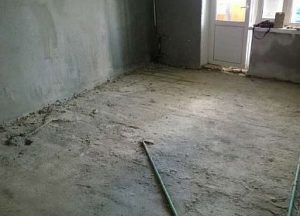
- Preparing the subfloor - it should be leveled and cleared of debris.
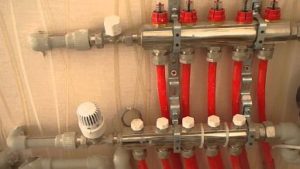
- Installation of the collector unit - it must be fixed to the wall or mounted in a specially equipped metal box.
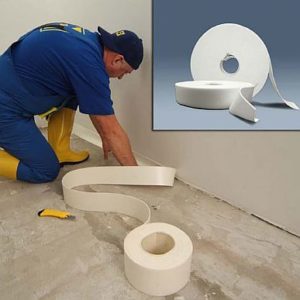
- Covering the perimeter of the room with damper tape will help maintain the integrity of the concrete screed.
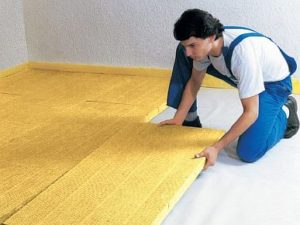
- Waterproofing and thermal insulation – polyethylene film can be used as a waterproofing material. The choice of thermal insulation materials is vast, from standard foam plastic to polystyrene foam mats with studs.
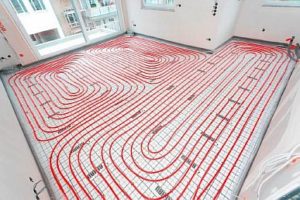
- The water circuit can be installed using copper, polyethylene, or heat-resistant plastic pipes. The heating elements are installed according to the planned layout and at the specified spacing. The pipes can be secured to the reinforcing mesh laid on the thermal insulation with plastic clamps, or secured between the grooves of the polystyrene boards.
- Connect the circuit to the distribution manifold - one end to the cold tap, and the other to the hot tap.
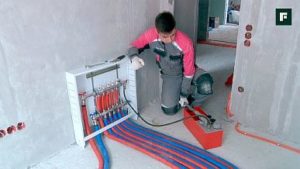
- The boiler is connected to the distribution unit using metal pipes.
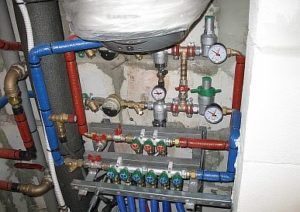
- Installation of a three-way valve with a thermal head on the manifold to regulate the temperature level of the warm water floor.
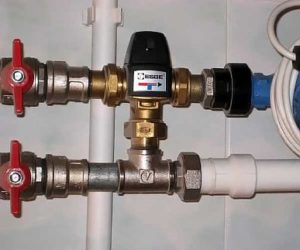
- Connecting a circulation pump to a heated floor ensures the flow and required pressure of water in the floor piping.
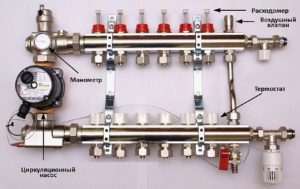
- Installing an expansion tank is essential for removing excess water from the heating system. It should be mounted on the cold metal pipe near the boiler outlet. An air bleed tube should be installed upstream of it.
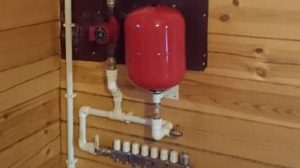
- A system performance check is performed to identify potential leaks and malfunctions. Pressure testing is performed for 24 hours under operating pressure.
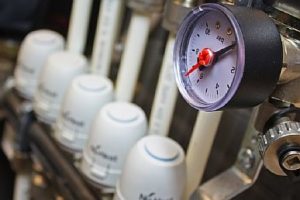
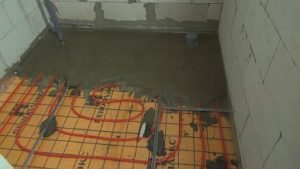
- Pouring the screed—the floor contour is filled with concrete. This procedure is performed under pressure in the pipes. The concrete layer must be allowed to dry thoroughly, which will take about a month.
- Laying the finishing coating - it is laid only on a completely dry concrete base.
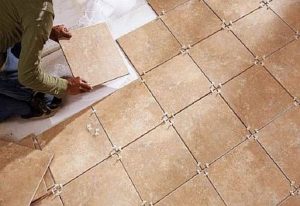
The water system should only be turned on once the screed, as well as the tile adhesive if ceramic tiles were used as the floor covering, have dried. The temperature should be raised gradually to operating temperature over several days.
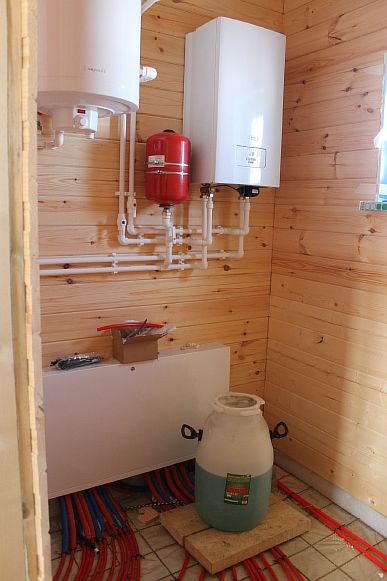
This system operates by heating water in a tank, which is then discharged through a manifold into the floor circuit. The used coolant is returned through a distribution unit to the return line.
If the water temperature exceeds the required level, the three-way valve automatically shuts off the hot water supply and opens the cold water supply. The mixing process takes place in a special chamber. When the heating medium reaches the required temperature, the thermostatic valve closes the cold water supply.
The heater and manifold are equipped with separate automatic temperature control devices. The device on the manifold controls the coolant flow in the floor heating system, while the device on the heating element controls the water temperature.
You can install underfloor heating from a water heater in both a house and an apartment. Installation is simple; the main thing is to follow the instructions and process. Furthermore, the low cost of installation is crucial, as a water heater costs less than an electric boiler.
However, it should be noted that operating such a heating system requires significant energy consumption. Therefore, whether to heat your home with a conventional radiator or underfloor heating from a boiler is entirely up to you.


In my opinion, hydronic underfloor heating is the most economical and efficient solution for high-quality home heating. If you can install a gas boiler, that's perfect. But an electric boiler shouldn't cause any problems either. A circulation pump and a three-way valve are a must! Firstly, this will significantly speed up the heating process, and secondly, it will save energy.