Today, heated floors are quite common in homes. They can serve as primary or supplemental heating.
However, for this system to function effectively, it is important to understand how water-heated floors work and install them correctly.
- How does a water-heated floor work and how does it work?
- How does underfloor heating work in combination with radiators?
- The design and operating principle of the system when connected to a boiler
- Operating principle of a mixing unit (three-way and two-way valve)
- Distribution manifolds
- Installation of water-heated floors
- Popular component manufacturers
- Video tutorials
How does a water-heated floor work and how does it work?

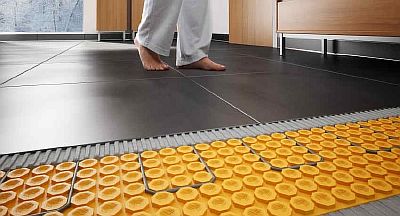
Underfloor heating is a reliable and economical system that creates comfortable conditions for people. Thanks to its design, the temperature at the bottom of the room will always be several degrees higher than at the top.
The system itself is a structure of pipes placed between the subfloor and the finished floor. The circuit includes a supply and return line. The design can pour concrete screed, or be laid using the flooring method.
In addition, the structure is equipped with a manifold unit, which is equipped with control devices. Heating is achieved by a hot coolant circulating within the circuit, and the movement of the coolant itself is ensured by account of a special circulation pump.
Installation of hydronic heating systems requires permission, as they are connected to the main heating system. Underfloor heating is typically installed in private homes; it's less common in apartments due to the risk of flooding neighbors below. Alternatively, in your own home, you can connect to a separate boiler.
The "pie" of a water-heated floor looks like this:
- base;
- waterproofing;
- thermal insulation layer;
- pipes;
- concrete screed;
- finishing coating.
Please note! The standard pipe size is 16 mm, with a permissible circuit length of 80 cm and a diameter of 20–120 cm.
The average thickness of a water floor "pie" ranges from 18 to 23 cm.
Hydronic underfloor heating is a low-temperature system, heating the circulating fluid to between 35 and 45 degrees Celsius. Its power depends on the temperature of the coolant. When heating the water to 45 degrees Celsius, the power will be 140 watts. Therefore, when heating a house solely with hydronic underfloor heating, the coverage area should be at least 70%.
Besides being energy-efficient, a water circuit filled with concrete retains heat for a long time. The downsides include the long time it takes for the concrete layer to heat up and the heavy construction, which not all floors can support.
There are a number of underfloor heating connection schemes, and we will examine the operating principles of some of them in more detail in this article.
How does underfloor heating work in combination with radiators?
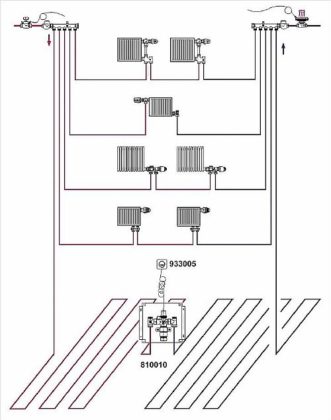
There are cases where underfloor heating can only be installed in combination with a radiator. Radiators will serve as the primary heating source, often installed near a window. Underfloor heating is installed as an additional heating source, either in the center of the room or in specific zones.
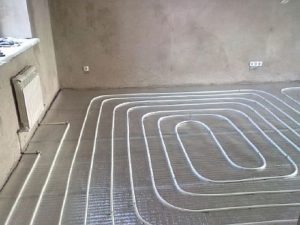
With the right flooring chosen, the combined system can be installed in rooms of any purpose and in buildings with any number of floors.
The advantage of installing underfloor heating on the ground floor is that warm air flows will rise to the ceiling and heat not only this floor, but also the floor of the next floor, where only radiators are installed.
There are several ways to implement this system. One is to install a T-connector at the inlet and outlet, with a radiator connected to one end and underfloor heating connected to the other.
Furthermore, underfloor heating can be easily connected to an existing radiator system using a wireless thermostat, which simplifies and speeds up both the installation process and the connection process.
The design and operating principle of the system when connected to a boiler
A boiler is the equipment responsible for heating the coolant. When installing underfloor heating, it is unnecessary if the system is connected to the central heating system.
An important point to keep in mind when using a floor heating system with a standalone boiler is that the water temperature should not exceed an average of 45°C. This is especially true for a gas boiler, as:
- It operates effectively at maximum temperatures of 70–90°C, but when the temperature drops, the efficiency decreases and fuel costs increase;
- If the boiler operates at lower temperatures, condensation will form, which will reduce its service life.
To avoid these issues, it is recommended to purchase a boiler with the required temperature differences (condensing).
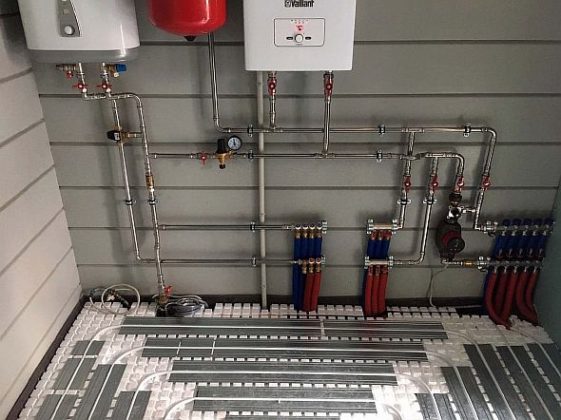
Another option is to install underfloor heating from an electric boiler, but this is an expensive resource. Electric boilers come in:
- With Ten, the equipment is not expensive, but it often breaks down.
- Electrode heaters—their operation depends on the quality of the coolant, or more precisely, the conductivity of the liquid. This type of device requires periodic maintenance—electrode replacement. To start it, you need drinking water or a special liquid, which can be purchased with the equipment.
- Induction hobs are the most expensive, but they're also the most energy-efficient. They heat water quickly and consume minimal electricity.
When considering boiler-powered, water-heated floor heating systems from an efficiency standpoint, pellet and briquette-powered units come second to gas. Solid fuel systems require constant ash and slag removal from the firebox. A longer-burning boiler is available, though it's more expensive, but requires refilling on average once a week, and combustion products need to be removed much less frequently.
Today, there are also combination boiler models on sale; they operate on solid fuel and electricity. There are automatic heating elements, which turn off when the set temperature is reached and then turn on again.
Please note: Liquid fuel boilers are rarely used in underfloor heating systems, as they must be located in a separate room due to the odor and noise they produce.
Operating principle of a mixing unit (three-way and two-way valve)
The mixing unit consists of two main components: a circulation pump and a control valve. The pump circulates the coolant, while the valves regulate the flow of hot water to maintain the desired heating level.
The mixing unit can be placed in the manifold cabinet or in the boiler room, on the comb.
Mixing devices come in two types:
- A three-way mixing valve is used to mix heated water from the boiler with the cooled coolant. When equipped with a servo drive, the valve can be controlled either by a thermostat or by weather-dependent controllers. This mixing valve is considered universal, although it has several disadvantages:
- There is a possibility that the valve will open the supply of hot coolant (90 C) into the system; this can most often happen when the device is started, which will cause the pipes to burst;
- This type of valve has a low throughput capacity, which is insufficient for heated floors, which will affect the heating level of the coolant.
However, this mixing unit is not replaceable in large rooms, more than 200 m2.
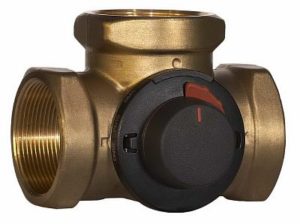
2. A two-way valve is the best option, as it continuously mixes in cold coolant, and only the water coming from the boiler is regulated. This prevents the floor from overheating, thereby extending its lifespan.
This design is used only in small areas – up to 200 m2.
These are the main mixing units used in the installation of water-heated floors.
For your information! Some three-way valves are equipped with a thermostatic function. There are also models with an electric-thermal actuator and smooth adjustment, which is ideal for underfloor heating.
How does the system work when connected via a pump-mixing unit?
Another option for installing underfloor heating in a private home is to install a pump-mixing unit. It is mounted behind the radiator, which serves as the heat source. Connection to a boiler is also possible.
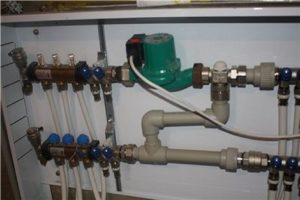
A hydronic underfloor heating system with a pump-mixing unit operates by mixing the hot coolant supplied by the heating source with the cold wastewater. This entire process occurs in the mixing unit. Balancing valves can be used to regulate the flow of cold and hot coolant.
A water-heated floor with a pump-mixing unit is considered one of the most efficient systems, easily maintaining comfortable indoor conditions. It can be purchased ready-made or assembled yourself.
Distribution manifolds
The distribution manifold is a crucial component responsible for regulating underfloor heating. It is designed to evenly distribute the coolant throughout the loops. It is equipped with openings for hot water supply and cooled water collection.
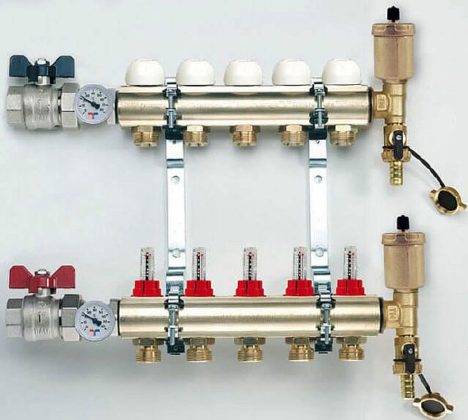
All manifold circuits must be equipped with thermostatic valves, which can be used to regulate the temperature in each underfloor heating loop, and flow regulators. This design, coupled with a temperature sensor, allows the room temperature to be maintained at a preset level, sensitively responding to changes in the outside weather.
Each room is equipped with a thermostat that controls several actuators, one actuator for each branch. Some thermostat models feature a programmable function, allowing you to set the desired operating mode or the heating on/off time.
In addition, the manifold allows air to escape from the system through the drain valve, and the shut-off valve serves to balance and drain the water.
For convenience, the manifold unit is hidden in a special metal cabinet, which is installed on the wall or in a niche.
Installation of water-heated floors
Before work on installation of water-heated floors A pipe laying diagram is prepared and a list of necessary materials is compiled.
The step-by-step process for installing underfloor heating looks like this:
- Preparing the base - if there are cracks or large differences in level, they should be sealed with a special solution or a thin layer of rough screed should be poured.
- Installing the manifold cabinet with all the necessary equipment is recommended before laying the flooring, as this work is messy and will result in dust and debris.
- Waterproofing - the base must be covered with waterproofing material to protect it from moisture.
- Installing damper tape—it should be applied around the entire perimeter of the room; it will prevent the structure from deforming when heated.
- Thermal insulation – the required thermal insulation layer on a concrete floor is 7–10 cm. Extruded polystyrene foam is ideal for this purpose. There are also grooved slabs for laying and securing pipes.
There is thermal insulation material with a foil layer, it helps reflect heat in the desired direction.
Laying pipes is the heart of underfloor heating, so their selection must be approached seriously.
Pipes are:
- metal-plastic - they are difficult to install, are heavy, and bending them requires special equipment;
- polypropylene - have high thermal conductivity, but such a contour requires reliable fixation, since it tends to take its original shape;
- Corrugated stainless steel - the most popular, easy to install, with a high degree of thermal conductivity and available in different sizes;
- copper ones are strong and durable, but they are expensive and difficult to install on your own;
- Polyethylene PERT and PRX are often used because the product is elastic and has good performance characteristics.
Pipe installation is carried out according to the planned pattern (snail or snake) and at the specified pitch. The circuit can be secured to the pre-installed reinforcing mesh with plastic clamps.
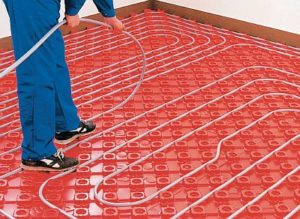
When laying a mat with bosses as thermal insulation, the pipes are laid between the grooves and thus securely fastened.
- Connection - pipes should be connected to the supply and return of the underfloor heating.
- Floor pressure testing should be performed before pouring the screed to check for leaks and ensure proper operation. Testing is performed at elevated pressure for 24 hours.
- Pouring the screed—its thickness depends on the pipe diameter and averages 5–7 cm. When pouring the concrete, there must be pressure in the pipes.

- Initial floor activation: Do not turn on the system until the concrete mixture has completely dried, which will take about a month. To prevent cracking of the screed, the temperature should be raised gradually, starting at 20 degrees Celsius and increasing by 3-4 degrees Celsius every day until the operating temperature is reached.
- Laying the finishing flooring can be any material, as long as it's compatible with the heating system. Underfloor heating works well with ceramic tiles.
Please note! When installing a floor using the dry method, the construction process consists of installing wooden joists, slats fixed across them, and piping laid between them.
Popular component manufacturers
When installing hydronic underfloor heating, choosing the right components is easy, as most manufacturers of these systems also produce accessories. Furthermore, some manufacturers have begun producing mixing units, eliminating the need for a separate circulation pump.
The most trusted manufacturers that produce polymer pipes with a service life of over 50 years include:
- «Valtec»;
- "De Dietrich";
- «Acv»;
- «Ctc»;
- "Buderus".
In addition, these companies produce control panels that allow you to monitor the system's operation from anywhere in the home.
In conclusion, it can be said that hydronic underfloor heating is more efficient than other types of heating devices. After all, energy is not wasted on heating the air under the ceiling.
If you decide to install heated floors, carefully study all possible installation schemes for these systems, as well as how hydronic heated floors work in an apartment or house, to choose the best option for you.
Video tutorials