Underfloor heating without a screed is recommended for spaces where pouring a concrete screed is not possible. Such floors are installed in homes with wooden partitions (as they may not be able to support the weight of the concrete) or in homes with low ceilings (a thick layer of screed will make them even lower).
The main advantages of these heated floors are their light weight, quick installation, and the fact that they don't take up any usable space. Furthermore, installing these floors without concrete pouring is less expensive.
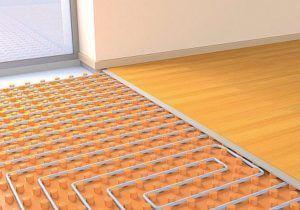
For your information! The advantage of this design is that the height of the pie is only 50 mm, unlike a concrete screed, which has a minimum height of 80 mm.
- Options for the decking system
- Polystyrene boards
- Wooden floor
- Stages of installing a water-heated floor without screed
- Material for laying
- Drawing up a drawing
- Preparing the floor before installing the flooring system
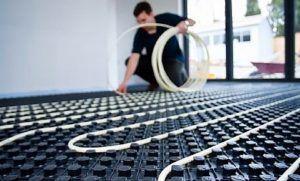
- Laying the polystyrene base and installing pipes
- Water-heated floor on a wooden base
- Installation of electric underfloor heating without screed
- Mistakes when installing underfloor heating without screed
- Video instructions
Options for the decking system
There are two ways to install heated floors without pouring a screed. Each option has its advantages and disadvantages.
But these systems share a common feature: ease of installation and dismantling. They also have poor moisture tolerance, so a waterproofing layer is essential.
Polystyrene boards
Polystyrene, also known as foam plastic, retains heat well, has a high level of sound insulation, and is resistant to rot. The boards are made of lamellas—special heat-distributing elements—that are available in aluminum or galvanized. The standard thickness of polystyrene boards for underfloor heating without screed is 30 mm. They are available in the following forms:
- plates with grooves where heating elements are placed;
- smooth mats.
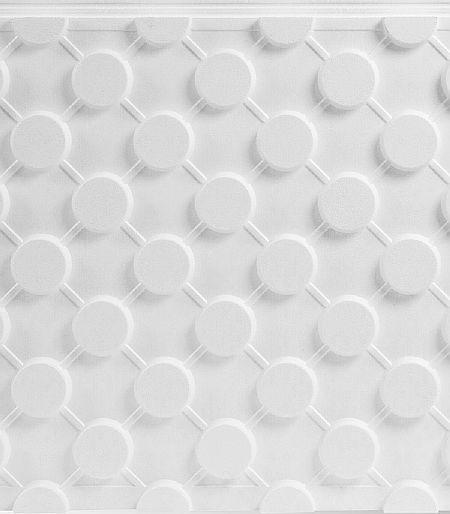
It's easier to install underfloor heating on mats with studs, with pipes or cables laid between them. The mats can be installed on both concrete and wood floors.
Wooden floor
Wooden structures are recommended for installation in homes with wooden beam floors; they can be laid on any type of foundation. These include:
- Modular - they are sold ready for assembly, they have special grooves where heating elements are placed.
- Slatted – these can be made from MDF or chipboard. The planks should be at least 2 cm thick, 130 mm wide, and have a moisture content of no more than 10%.
Like polystyrene, the wooden system perfectly withstands temperature fluctuations and has high sound and heat insulation.
However, underfloor heating without pouring also has its disadvantages:
- lower level of heat transfer and reliability than with a system with a concrete screed;
- The structure is less rigid, it inevitably contains voids, and this will eventually lead to the formation of cracks, gaps, and, as a result, creaking when walking.
These issues are especially noticeable when installing the structure in apartments with wooden floors. While these issues can be easily resolved, it will require both time and effort. Therefore, it is recommended to install it only in areas where other models are unsuitable.
Stages of installing a water-heated floor without screed
It's worth noting that installing hydronic systems without screeds creates less dust and dirt. Furthermore, the advantage of underfloor heating without screeds is the ability to mount them under tiles, laminate, and any other covering, without waiting for the concrete to dry.
Material for laying
Before installing a water-based floor without screed, you need to purchase flooring (tiles, laminate) and all the materials for the structure.
The main function of this structure is assigned to pipes, which can be made of copper, cross-linked polyethylene, polypropylene, or metal-plastic. Polyethylene pipes are most often installed because they are inexpensive, durable, resistant to aggressive environments, and easy to install.
The coolant here can be either water or various antifreezes. The pipes are sold coiled. Loops must not be removed from the reels until the pipe is installed, as this may cause kinks. The material is unwound gradually during installation.
Watch the video
You'll also need galvanized or aluminum sheets; they help evenly distribute heat across the underlying flooring. For waterproofing, consider purchasing polyethylene film.
The planned installation method for a water-heated floor without screed determines which material to buy: polystyrene boards or wooden flooring.
Drawing up a drawing
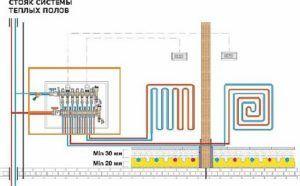
When installing hydronic underfloor heating without screed, a properly designed heating element layout is crucial. Common heating element layouts are spiral or serpentine. Spirals are used for larger rooms, while serpentine layouts are best for smaller rooms. Furthermore, the installation pitch should be calculated, as it depends on the type of subfloor chosen.
Preparing the floor before installing the flooring system
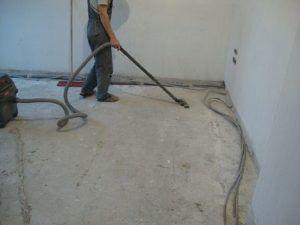
Before installing any type of subfloor, the surface must be prepared. This involves cleaning the subfloor of dust and dirt and determining any differences in surface level. Any deviations of no more than 2 mm are acceptable; otherwise, a thin layer of screed will be required.
A waterproofing layer of polyethylene film, at least 200 microns thick, is laid over the subfloor. The film is overlapped and secured with tape.
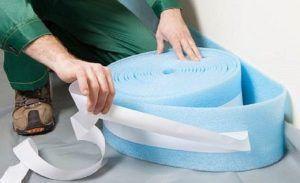
The next step is to place a damper tape around the perimeter of the walls. This helps compensate for the expansion of the structure as it heats up.
Laying the polystyrene base and installing pipes
The installation of smooth polystyrene slabs for underfloor heating without screed and those with studs is identical. The difference lies in the need to cut grooves for the pipes in the smooth slabs.
Step-by-step process for constructing a water-based floor on a polystyrene base:
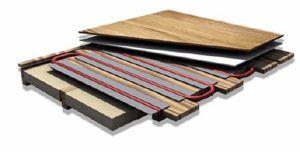
- Polystyrene sheets are laid according to the developed pattern. They must be laid tightly against the walls. The standard thickness of these sheets is 3 cm, with straight or rotating grooves and a pitch of 150 and 300 mm. They are equipped with a snap-on lock that secures the sheets together, creating a single sheet. For maximum adhesion, the joints can be coated with adhesive.
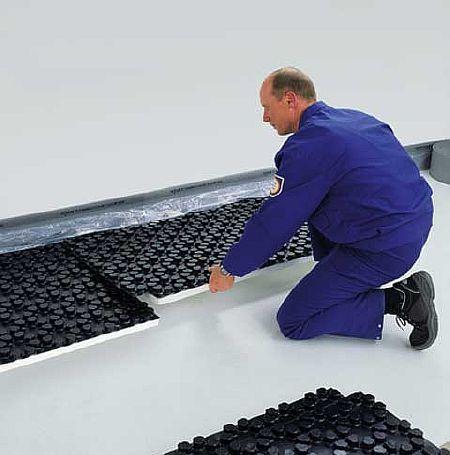
When using plates with bosses, the layout of the heating pipes is more complex, so it is recommended to make marks with a marker.
- Metal plates (made of galvanized steel or aluminum) are placed on top of the insulation in the openings, onto which heating elements are mounted according to the plan. They are equipped with stiffening ribs and have the required diameter.
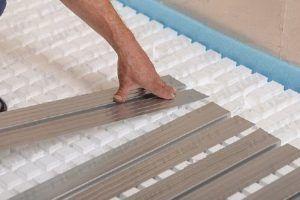
- The pipes are positioned; they can be laid in a serpentine or volute pattern. Where the pipes make turns and extend beyond the edges of the plates, a backing should be laid on the mat to help level the entire structure. Before installation, markings should be made to facilitate the process.
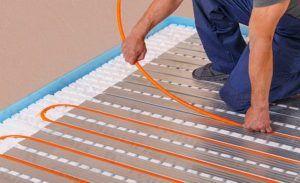
- The system is connected and its functionality is checked.
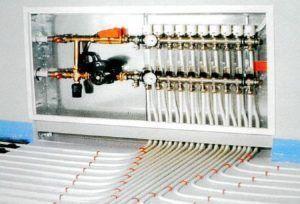
- Next, a waterproofing layer of polyethylene film is laid, secured with tape. It should be overlapped to ensure a more secure waterproofing layer.
- Then comes the substrate, which can be gypsum fiber sheets.
- The final layer is the finishing flooring, which can be parquet or laminate. Other types of flooring can also be installed, but require additional preparation. For example, when installing ceramic tiles, a dry screed made of plywood or plasterboard is required.
Water-heated floor on a wooden base
This system is recommended for installation in wooden houses. As mentioned above, the wooden foundation can be modular or slatted.
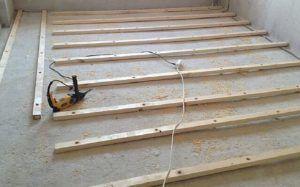
When constructing a water-based floor with a slatted underlayment, unevenness of the base surface of up to 2 mm per square meter is permissible. The process is as follows:- on the prepared base, markings are made of the places where the pipes will run;
- a damper tape is spread out - it is located across the joists or support boards;
- the slats are laid out - they need to be positioned transversely to the support joists, secured on both sides with self-tapping screws, and in places where the pipe is rounded, they are also rounded;
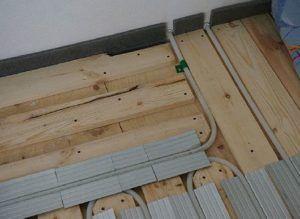
- plates with openings are fixed - they provide uniform heating, they are attached to the rail with screws;
- the pipes are installed - they are placed in the grooves of the metal support, there is no need for their additional fixation;
- additional equipment is installed - a thermostat and a pressure measuring device, and the system is connected;
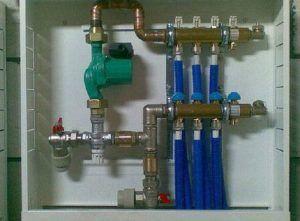
- the functionality is checked;
- waterproofing is laid - polyethylene film can be used;
- the underlay is installed on the floor without screed - these can be gypsum fiber boards, they are laid in 2 layers, the placement principle is staggered;
- The final layer of a warm floor is the finishing coating (tiles, laminate, etc.).
- The modular design of a water-based floor is an easier and faster way:
- the modules are assembled - they are already equipped with openings for laying heating elements, and are fixed together with self-tapping screws;
- pipes are being installed;
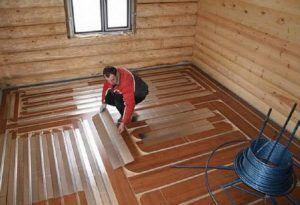
- the system is connected and its functioning is checked;
- waterproofing is laid - polyethylene film is suitable for this purpose; it needs to be placed under the modules and on them after the pipes are installed;
- The last layer is the floor covering.
Installation of electric underfloor heating without screed
The process of laying a cable floor without a screed is much simpler and faster than installing it on a concrete screed.
The work includes the following stages:
- the location on the wall where the thermostat will be placed is determined;
- grooves are made for the temperature sensor;
- the base for the mats is prepared - uneven areas and cracks are sealed, and the surface is cleared of debris;
- the base is laid - if these are polystyrene mats or wooden modules, then they are already equipped with grooves, where the cable is laid; with the rack method, the cable is mounted between fixed slats;
- the cable is laid in the grooves according to the prepared diagram;
- a temperature sensor is placed in a corrugated pipe on the floor;
- the system is connected to the power supply and its functionality is checked;
- hydro and thermal insulation is installed;
- A decorative covering is installed on the cable floor without screed. Ceramic tiles, linoleum, or laminate can be used.
Using electric mats makes the process even simpler, as no additional underlayment is required. The mesh is laid directly on a pre-prepared concrete or wooden base and secured with adhesive tape.
Mistakes when installing underfloor heating without screed
Let's look at the main mistakes that can be made when installing heated floors.
- No measurements are taken – it is believed that measuring a structure before and after installation is unnecessary. However, timely measurements allow for the identification and correction of any issues that could otherwise lead to serious problems with the system's operation.
- Haste during installation - all parts should be carefully secured to avoid having to disassemble the structure later.
- Deep placement of temperature sensors is not recommended, as they often break and require replacement.
- A strong desire to save money—the lifespan and functionality of a system are affected by the quality of the material; the better the material, the more expensive it is. Therefore, it's wiser to use high-quality products than to spend money and time on system repairs later.
Anyone can install underfloor heating on a polystyrene or wood base. This design is not only an excellent solution for heating a room but also a good soundproofing option.
Video instructions
Watch the video
Video