Laminate flooring is becoming increasingly popular as a finishing option for floors, as it looks beautiful and resembles a natural finish. However, its thermal conductivity is significantly inferior to that of natural wood.
An effective solution to this problem is to install a heated film floor under the laminate; it is ideal for this type of flooring.
- The operating principle and advantages of infrared film underfloor heating
- Let's consider the advantages and disadvantages
- Floor structure and equipment
- Heating elements are the “heart” of underfloor heating.
- Let's draw up a diagram
- Which laminate to choose?
- Laying technology
- Preparing the base and laying thermal insulation
- Installation of film infrared emitters
- Connecting a temperature sensor
- Installing terminals and connecting cables
- Connecting the thermostat
- First system startup
- How to lay laminate flooring
- Tips for installing film flooring
- Video instructions
The operating principle and advantages of infrared film underfloor heating
The main methods of heat transfer are:
- convection - heat is transferred by air from object to object;
- rays - when a body heated to more than 60 degrees emits electromagnetic waves up to 100 microns.
Most heating systems operate on the principle of heat exchange: heat is transferred to the air, which in turn distributes it further throughout the room.
Film infrared floors work differently. They have a base layer—conductive strips (copper- and silver-plated), a carbon emitter, and laminating films. The carbon paste is exposed to current, causing it to emit rays that, upon reaching a solid surface (the laminate), heat it. The laminate, on the other hand, heats the room through convection.
The beams have varying lengths, and some of them pass through the flooring, heating the surrounding objects. Therefore, placing furniture above heating elements is not permitted.
Film systems are produced in rolls of 50, 60, 80, and 100 cm. Various lengths are available. A special strip is cut along this strip every 20–25 cm. The power of these film-based underfloor heating systems ranges from 150 to 440 W/m².
This heating system has both positive and negative qualities, although the advantages far outweigh the negative ones.
Let's consider the advantages and disadvantages
- Heat transfer—heating the floor surface where people are located: walkways, rest areas, and work areas. No heat is wasted on heating furniture from below, reducing energy costs. The material itself is more economical to use, as it isn't placed under furniture.
- Film-based underfloor heating is inexpensive, despite the high price of a complete set, compared to other types of flooring. The minimum cost of components is 2,000 rubles, including a temperature sensor, thermostat, electrical wires, contacts, and adhesive tape. Additionally, a square meter of film costs 650 rubles. However, the high cost of the material is offset by the low installation costs.
- The infrared film is resistant to subzero temperatures and can even operate at -70 degrees Celsius. The system remains operational even when left in a cold room for extended periods. This is a definite advantage when using the system in country houses and summer cottages.
- Can be installed in any type of space—homes, apartments, or offices. There's no risk of flooding neighbors, as with a water-based underfloor heating system. The room can be anything—a nursery, a living room, a kitchen, or a bathroom.
- Easy to install and remove. Connecting the elements requires no experience; care and attention are key. Furthermore, installing film-based underfloor heating is quick and easy.
- The infrared radiation emitted by carbon elements is similar to solar heat.
- It requires no maintenance. The power supply is parallel, so if one lane fails, the system continues to operate. And if the entire system needs replacing, it can be easily dismantled.
- Even heating of the room. Importantly, heat is concentrated at the bottom, which is beneficial for human life.
- The floor is warm, you can walk barefoot and put your children on the floor without worrying that they will catch a cold.
- Infrared heated floors last a long time, even with constant use, and do not require technical maintenance.
- There is no invective or convective movement of air flows inside the room, which means there are no drafts and dust does not rise upwards.
There are also disadvantages to such floors, but they are significantly fewer.
- High power consumption (learn how to reduce power consumption), although carbon emitters have high efficiency.
- Risk of short circuit due to water penetration.
- The system depends on the supply of electricity.
- It's impossible to rearrange the furniture without changing the flooring layout. This would require removing the laminate and re-arranging the heating elements according to the new layout.
Floor structure and equipment
The film underfloor heating kit consists of:
- Heating elements with an average width of 500 to 1000 mm. Lengths vary, but no more than 8 meters are recommended. The fabric is cut to the required length using special strips.
- Terminals for circuit connections.
- Temperature sensor - it is responsible for the heating level.
- The thermostat (control unit) can be electronic or electromechanical. While the design and display systems vary, the connections to the power supply, heating elements, and temperature sensor are similar.
- Often the kit includes a cable of the required size.
- There must be insulation material in the form of bitumen tape.
When choosing underfloor heating for laminate flooring, it's important to consider the power rating. Standard ratings are 150 or 220 W/m², though 440 W/m² is not uncommon. Laminate flooring doesn't require more than 150 W; this is sufficient to heat the floor to 40°C, especially since higher temperatures are not recommended for laminate flooring.
You'll need an underlayment for the flooring that's at least 3 mm thick. Ideally, it should have one foil side to reflect infrared radiation from the base, allowing all the heat to rise. It's important that it's non-conductive. You'll need both single- and double-sided adhesive tape.
An infrared film floor is a narrow strip equipped with heating elements, onto which the flooring (laminate) is laid. These models use carbon fiber strips as heating sources, either solid or coated, covered on all sides with lavsan or polyurethane. The thickness of the structure ranges from 0.2 to 2 mm.
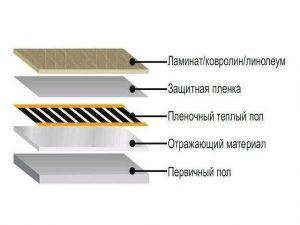
When installed, the structure of the infrared heated floor consists of the following layers and looks like this:
- Laminate is a floor covering.
- The underlayment—vinyl or polyethylene—is suitable. It allows heat to pass through and retains water, which is important.
Heating elements are the “heart” of underfloor heating.
- Heat-reflective material is designed to reduce heat loss. It must be non-conductive. Polyethylene foam insulation or a cork underlay with a reflective layer are suitable.
- The floor base must be solid and level. To achieve this, the concrete base can be filled with a leveling compound, and plywood can be laid on the wooden base.
Let's draw up a diagram
Before purchasing a film flooring kit for laminate flooring, you need to carefully plan and draw a diagram of the heating installation and its connection to the power supply.
When drawing up a diagram, the following points must be taken into account:
- Do not completely cover the floor with film. It should not be installed under furniture, as it will disrupt normal heat exchange. Furthermore, heating will cause deformation of the furniture and laminate, reduce its lifespan, and increase energy costs.
- Heating elements should be placed at a safe distance (250–300 mm) from walls and heat sources.
- It is necessary to roll out the film floor rolls along the large wall of the room, this will reduce the number of contact connections.
- The distance between sheets should be 50 mm. They should not be overlapped.
- To ensure adequate heating, it's sufficient to cover 60-70% of the room with heating elements. It's also acceptable to designate areas for increased comfort, such as a children's room or a relaxation area.
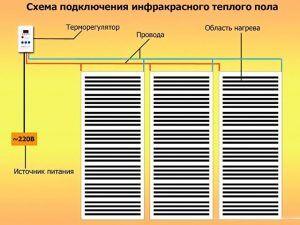
In addition, the location of the system's cable communications should be considered:
- Choose the optimal location on the wall for the control unit; it should be at least 500 mm above the floor and convenient for connecting wires.
- Connecting underfloor heating to a regular electrical outlet is prohibited, as the total system power consumption is high. A separate power line of appropriate cross-section must be planned. For maximum safety, it is recommended to include an RCD in the circuit for protection.
- Most thermostats can be installed in a standard wall outlet. Simply cut a 20x20 groove from the outlet to the floor.
- When planning the wiring, avoid crossing wires. Connection schemes vary, but the most common is one in which the cable is connected to the heating elements at one end.
There are cases when it is more convenient and cost-effective to connect the phase and neutral cables from different sides.
- The area where the sensor will be installed must be indicated on the drawing. It is placed in the center of the film heater. It is recommended to leave at least 500 mm of clearance from the walls. The ideal location is the coldest area in the room.
A precisely drawn diagram will allow you to accurately calculate the required materials and components, and will facilitate the installation of heated floors under the laminate.
Which laminate to choose?
The choice of flooring type is crucial for the proper functioning of underfloor heating under laminate flooring. Inappropriate parquet flooring will warp, provide poor heat transfer, and emit formaldehyde at levels exceeding acceptable levels.
Laminate for film heated floors must meet the following requirements:
- have a locking connection; it is not recommended to use glue for mounting the slabs, as it creates a rigid seam that breaks when subject to temperature changes;
- have high thermal conductivity, for infrared heated floors the coefficient is 0.05-0.10 m2 x °K/W;
- The optimal thickness of the slabs is 8–9 mm; if they are thinner, the locking connection will be destroyed by temperature changes, and thick slabs do not conduct heat well;
- do not emit formaldehyde above the permissible limit when heated; floor coverings of class EO and K1 are suitable;
- be wear-resistant, not lower than class 3, the higher this indicator, the higher the strength of the floor.
Based on these requirements, it's essential to purchase laminate flooring for underfloor heating. Furthermore, the packaging or instructions should contain a special symbol indicating the compatibility of the laminate with underfloor heating.

Laying technology
The main advantage of infrared film floors over other types is their simplicity and the ability to be installed independently.
And laying the finishing coating will not be difficult for home craftsmen without experience in this work.
Preparing the base and laying thermal insulation
Before installing an infrared heated floor, the following work must be carried out: prepare the base and carry out waterproofing.
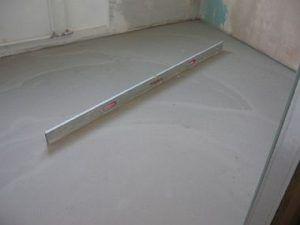
Important! The base must be level and solid, with a slope of no more than 2 mm per meter.
The base must be carefully inspected for cracks and uneven surfaces. If any are found, they should be filled and allowed to dry. Afterward, the surface must be thoroughly cleaned of debris and dust (sweep or vacuum).

If there are significant differences in the concrete base, it is easier to pour a screed made of a leveling compound.
The next step is laying the insulation and thermal insulation material. It is laid around the entire perimeter, right up to the walls, even where the heating element won't be located.
The insulator can be polyethylene foam or cork with a reflective layer. Aluminum foil cannot be used, as it conducts electricity. The insulation is laid out with the foil side facing up.
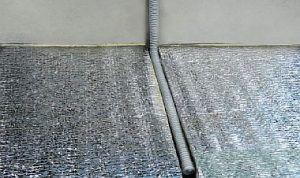
The backing under the film should be 3-4 mm thick. This is important because grooves will be made in it for cable routing. To prevent it from shifting during subsequent steps, secure it with a stapler and connect the strips with double-sided metallized tape.
Next, a recess for the temperature sensor is cut into the insulating material.
Installation of film infrared emitters
The heating film must be laid out according to the provided diagram. Installation must be done carefully to avoid damaging the heating element. It is recommended to cut the film using scissors along the designated strips.
Heating elements should be located at least 20 cm away from walls and furniture, and 1 meter away from heating devices. This is necessary to prevent overheating of the floor and its failure.
The film elements should be laid with the copper busbars facing down and then secured with tape. The permitted length of heating strips is no more than 8 meters.
Do not overlap the film; the distance between strips should be 50 mm. To minimize wiring costs, lay the film toward the thermostat, preferably along a large wall.
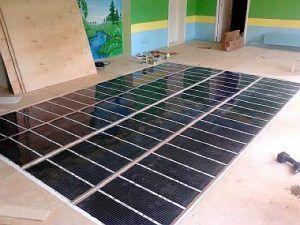
Next, you need to insulate the areas where the busbar was cut, in places not intended for cable connections. For this purpose, you should use bitumen tape, which should be pressed firmly on all sides to ensure a good seal.
Connecting a temperature sensor
The thermal sensor should be placed in the center of the canvas, on the black carbon fiber strip. A recess for the sensor and cable channels should be made in this area of the underlayment when it is laid on the base.
The housing should be secured with bitumen tape. Once the sensor is installed and the wires are connected to the thermostat, the film is replaced and secured with tape. Now the terminals can be installed.
Installing terminals and connecting cables
Terminals are installed at the points where the floor connects to the power supply. To do this, insert the top of the terminal into a special slot, leaving the second plate exposed underneath the film. Using pliers, gently but firmly crimp the clip to ensure contact with the silver portion of the copper busbar.
There are some models of film floors that provide a different method of connecting the terminals - rivets, this is indicated in the instructions.
The next step is connecting the cable. The wires must be stripped, inserted into the terminal, and clamped with pliers. The terminals must be insulated by applying strips of bitumen tape to the top and bottom and carefully connecting them. To ensure a good seal, remove all air bubbles.
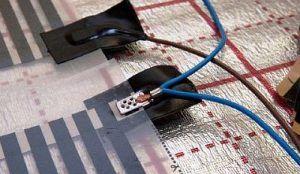
Take note! The bitumen tape has the ability to heat up when first connected to the electrical network and take the shape of the protected unit, thereby creating maximum sealing.
Connecting the thermostat
Laminate flooring requires precise temperature control, so it's better to use an electronic device rather than a mechanical one. The thermostat has a control unit equipped with special connectors for connecting wires. Underfloor heating installation requires all wires to converge at a single point, where the device is located.
To prevent errors when connecting wires, the instructions include a pictogram indicating the areas where grounding, load, and voltage are present.
Important! Twisting of wires is not permitted, as this may cause the structure to overheat.
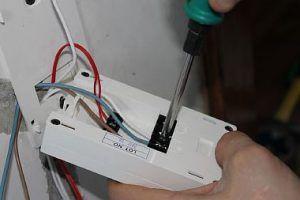
After connecting the cables, they are placed in specially prepared grooves. The thermostat is attached to the planned, convenient location. Now you can begin testing the floor for functionality.
Please note! Electronic thermostats have two sensors: one for air temperature and one for floor temperature.
There are the following options for underfloor heating:
- Using only the floor sensor's readings. For example, the heating turns on when the temperature drops below 25 degrees Celsius, and turns off when it reaches 29 degrees Celsius.
- Using readings from two devices. The heating is planned to turn on when the room temperature reaches 23 degrees Celsius and turn off when the room temperature reaches 26 degrees Celsius, or 30 degrees Celsius, according to the floor temperature reading.
If the floor sensor fails, it needs to be replaced, which requires disassembling the flooring. To avoid such labor-intensive processes, it's best to stock up on an additional sensor and attach it during installation as a backup, connecting the wires to the thermostat.
If the main sensor fails, simply disconnect the broken one from the thermostat and connect the spare one.
First system startup
Before laying laminate flooring, you need to make sure that the floor is functioning properly.
First, you need to check the system's integrity and then start it up. The test temperature can be low, as the main purpose of the test is to check the infrared floor connections. If there is no overheating or sparking, the film is of good quality and the connections are correct. If any problems are detected, you need to repeat the test after fixing them.
Then the system is disconnected from the power supply and the laminate flooring can be laid.
How to lay laminate flooring
Before installing laminate flooring, to prevent water from coming into contact with the heating elements, cover them with insulating material. A 200-micron plastic film is sufficient; it will protect against moisture but will not block infrared radiation. Since the waterproofing is not very thick, it will not alter the surface texture.
Cut the material into strips of the desired length and lay them on top of the heating film, overlapping them slightly. The material should extend 10-20 cm over the edges. Be sure to tape the seams to prevent shifting during installation.
Once the waterproofing layer is in place, you can begin laying the laminate flooring. When installing laminate flooring on a film-covered floor, be careful, wearing soft shoes, to avoid accidentally damaging the film.
Laminate panels are laid directly on the polyethylene film; no additional underlayment is required. Each board has a locking mechanism, so simply join the panels at an angle and then lower them until they click into place. If a gap appears, simply tap with a rubber mallet. The boards are joined together by their narrow sides, and then the laid strips are secured together. Once the tiles are fully installed, a baseboard is installed around the perimeter of the area, concealing all wiring.
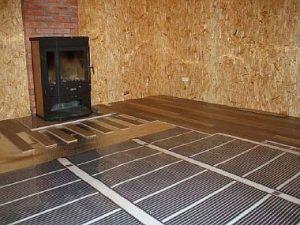
Important! When laying laminate flooring, it is necessary to leave gaps near the walls, as the laminate will expand due to temperature changes.
Once the laminate flooring is installed, you can turn on the infrared film floor and test its operation. However, to allow the laminate to adapt to the new conditions, do not immediately turn the heating on full power.
At first, it is worth setting the indicators within the range of 15 - 20 degrees, and increasing them by 5 degrees every day until the system reaches full capacity.
Tips for installing film flooring
Experts advise laying film floors by adhering to a number of rules:
- Do not connect the film rolled into a roll to the network;
- Installation of underfloor heating should be done at a humidity level of no more than 60% and a positive temperature;
- If damage is detected on the graphite surface of the film, the hole must be insulated on both sides;
- It is not possible to install film flooring under laminate on a wet surface;
- If the heated floor is flooded, you must quickly turn it off and let it dry naturally;
- install the temperature sensor in a freely accessible location so that it can be easily replaced if necessary;
- keep the film floor laying pattern.
Infrared film heating is very popular today because it can heat both apartments and houses. By following the installation instructions, you can quickly and easily install this heating system yourself. Furthermore, if properly configured, it's cost-effective.
Video instructions
Watch the video
Video
Video
Video