Underfloor heating is no longer uncommon; it creates a more comfortable environment in an apartment. The key is to choose the right flooring for this system. It should be durable and have low thermal insulation.
The purpose of the room, for example, for a bathroom, also plays an important role. ceramic tiles will do, laminate for the living room.
In a child's room, a carpet is usually laid, since children often play on the floor. When installing heated floors, it can be replaced with carpet.
- Combining different types of heated floors and carpet: pros and cons
- Types of heated floors covered with carpet
- Water-heated floor
- Electric underfloor heating
- Infrared heated floor
- Infrared film heated floor
- Making a choice
- Installing infrared underfloor heating under carpet
- Underfloor heating under carpet on a wooden floor
- Video tutorials
Combining different types of heated floors and carpet: pros and cons
Carpet is a good thermal insulator, so it's considered unsuitable for heating devices, as the heat will be wasted. This is especially true if you install thick carpeting.
However, tufted carpet is now available; it's thinner than standard carpet and has properties similar to laminate or linoleum. Therefore, it's important to choose the right carpet for underfloor heating.
In addition, to reduce heat loss, it is necessary to lay additional heat insulation in the form of foil film under the heating elements.
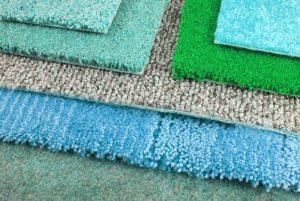
It should be noted that to achieve a temperature on carpet that is similar in feel to floor tiles, you will need to set the thermostat to a value of 3 - 5 degrees higher.
But it's worth it, as this floor covering for underfloor heating has a number of advantages:
- walking on a warm, soft carpet is much more pleasant and comfortable;
- it will provide comfortable conditions both when the system is on and when it is off;
- creates excellent sound insulation;
- easy to install;
- has a huge number of models, different colors and pile lengths.
It is impossible not to note the presence of shortcomings:
- Carpet is suitable for dry and clean rooms;
- Requires constant cleaning;
- May cause allergies in susceptible individuals;
- This type of covering is not appropriate if animals live in the house;
- Excellent thermal insulation is the main drawback, but this can be solved by using the right type of carpet.
Types of heated floors covered with carpet
There's currently a wide variety of under-carpet heating systems available, each with its own unique combination. Let's take a closer look at each type.
Water-heated floor
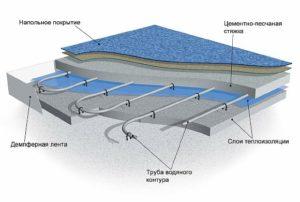
A hydronic floor is a structure made of pipes that carry warm water. Heating is provided by electricity or a heating system. Pipes can be made of metal, polypropylene, copper, or cross-linked polyethylene. Don't skimp on the material; any problems will inevitably lead to the removal of the entire structure, including the finish.
This design is more suitable for private houses equipped with autonomous heating.
Furthermore, this is an excellent solution for rooms with exterior-facing walls; increasing the number of coils near them will help prevent drafts. This model is not recommended for multi-story buildings with central heating.
| Advantages of a water-heated floor | Cons |
| The heating process occurs slowly, which is important for carpets; sudden temperature changes can cause deformation. | Installing a water system is a labor-intensive job. |
| The carpet does not fade because the water moves through pipes, so there are no overheated areas on the surface. | The floor height is raised by 10–15 cm due to the concrete screed. |
The design of a water-heated floor under carpet consists of: a concrete sub-base, a layer of waterproofing and insulation, a MAC mesh, a pipeline, a concrete screed, and carpet.
Electric underfloor heating
Electric underfloor heating uses a heating cable, which carries electricity, instead of pipes. Fiberglass mesh or mounting tape is used for fastening. This system can be installed in any room, and it's easy to do yourself.
The cable system is ideal for houses with ceilings that cannot bear heavy loads.
| Pros | Cons |
| Provides uniform heating, which will not lead to deformation of the coating. | A rapid heating process can lead to overheating of the carpet structure, thereby causing it to quickly fail. |
| Temperature control is adjustable, which is crucial, as carpets should never be heated above 30 degrees Celsius. There's also an option to set a maximum temperature that will be maintained automatically. | Formation of overheating zones in places of contact with furniture, which will cause the coating to burn out and damage the cable. |
| Easy and inexpensive to install. | Significant electricity costs. |
| Installation without concrete screed is permitted; adhesive for slabs can be used instead. |
Despite all its advantages, this type of underfloor heating is not ideal for use under carpet. If one section of the cable is damaged, the entire system will stop working.
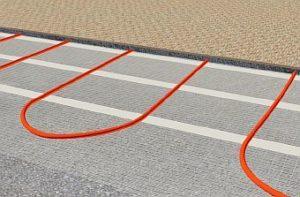
The electric floor pie under the carpet looks like this:
- concrete base;
- waterproofing gasket;
- insulation;
- coolant;
- concrete screed;
- carpet.
Infrared heated floor
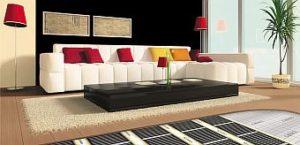
Infrared heating is a type of electric flooring. It's a double-sided roll film with built-in heating elements (graphite strips). The strip model is effective, but only suitable for dry installation.
When connected to a power supply, the strips heat up and emit infrared warm rays that warm the floor covering. This is the best option for carpeting..
| Pros | Cons |
| Heating is uniform, which eliminates deformation. | The main and principal disadvantage of this model is its high cost. |
| Infrared rays act gently, which does not lead to fading of the carpet. | |
| The presence of a thermostat allows you to control the temperature. | |
| Very easy to install and operate. | |
| Minimum energy costs. | |
| If one of the IR bands fails, the entire system will continue to function. | |
| Fireproof | |
| No need for screed |
Infrared film heated floor
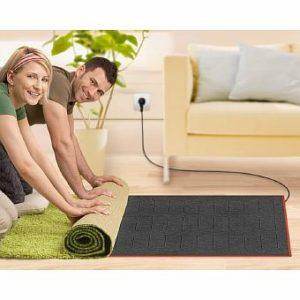
Film-based underfloor heating is an excellent alternative if installing a permanent heating system is not feasible. This portable unit can be moved from room to room or placed in a specific area to be heated.
These types of heated floors are often installed under carpets and directly on laminate, linoleum, or tile floors. They are connected to the power supply via a cord included in the kit.
Carpet is an excellent choice for covering a film-based underfloor heating system, as its main characteristics include:
- mobility;
- the presence of an option that allows you to control the temperature;
- no damage to the coating;
- electricity consumption costs are not high;
- the ability to choose a device of the required size.
The ease of installation of this system under carpet is also significant, as there is no need to level the surface or perform installation work. Furthermore, it is inexpensive.
Making a choice
To avoid any unpleasant surprises when using underfloor heating with carpet, it is important to take the system selection seriously.
It is necessary to take into account:
- type of premises (private building or apartment);
- location of walls;
- carpet thickness;
- furniture arrangement;
- financial capabilities.
Only after analyzing these indicators can you correctly determine the choice of system and installation method.
Based on all of the above, we can conclude:
- Infrared underfloor heating under carpet is the optimal solution. It's gentle on the flooring and features a thermostat for temperature control. The absence of a concrete screed in the flooring is also crucial, which is especially important given the high thermal conductivity of carpet.
- The mobile device is perfect for temporary housing or a summer cottage. It's easy to transport and install.
- Water-based underfloor heating is an excellent choice for private homes with independent heating, despite the labor-intensive nature of the installation. It's gentle on carpet.
- Electric underfloor heating is less suitable for installation under carpet. It produces strong heat, which can damage the carpet.
It's also worth considering who will be installing the system. While you can install infrared underfloor heating yourself, if you decide to install a hydronic system, it's best to hire professionals.
Installing infrared underfloor heating under carpet
As mentioned above, infrared underfloor heating is one of the most suitable options for installation under carpet. Furthermore, you can install this system yourself. The flooring is assembled from individual elements.
The step-by-step installation of an infrared structure under carpet looks like this:
- preparation of the base - by repairing the existing concrete screed or installing plywood flooring;
- laying foil thermal insulation;
- placement of film elements according to the manufacturer's instructions;
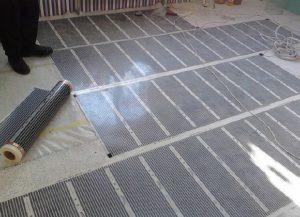
- connection and testing of the system;
- pouring a very thin concrete screed or applying an adhesive;
- laying out the carpet.
This completes the installation of the undercarpet heating system. Now you have a warm and soft floor.
Underfloor heating under carpet on a wooden floor
If you have a wooden subfloor and cannot tolerate increased loads on it, installing underfloor heating under carpeting in a dry environment is possible. Both hydronic and electric systems are permitted.
Pipes or cables are installed on the wooden floor in grooves prepared from slats. The opening size should be equal to the thickness of the heating elements. Prefabricated modules can be installed on the wooden floor, into which the heater will be installed.
Another option is to cut grooves in expanded polystyrene foam, which will serve as both insulation and prevent heat loss through the subfloor. This structure is then covered with plywood or chipboard sheets, onto which carpet will be laid.
Infrared heated floors can be laid directly on a wooden base, then covered with plywood and carpet.
For your information! To avoid unexpected heat losses or to minimize them, it is recommended to lay a foil film between the heating elements and the subfloor, which will reflect infrared rays upward.
Carpet can be used in conjunction with underfloor heating, provided the proper material requirements are met. The carpet structure should have a porous, natural base. This will reduce the heat transfer.
However, regular carpet cleaning will be necessary to prevent dust mites from infesting the carpet. However, this drawback is offset by the floor's comfort year-round.
Video tutorials


It's now much easier for me to imagine all the advantages and differences between all the different types of underfloor heating. We're still deciding which option is best for the first floor. We want to do the same throughout the entire apartment. I think it would be better to install electric underfloor heating under the kitchen tiles. And we'll probably install infrared underfloor heating under the carpet. The main thing is to find a good team.
In my opinion, underfloor heating should be individual in an apartment or a private home. Here's an example I had: in one private home, there was electric underfloor heating, but there was no conventional stove and only one small convector in each room. And everything was heated very well, in every room, even in -40°C (-40°F). But my best option, if we're talking about an apartment, is strip underfloor heating. However, there was a case where a builder suggested installing hydronic underfloor heating in a client's apartment!!! I think this is complete nonsense to install such a floor in an apartment, but I think he was just trying to rip off the potential client.
But for a private home, yes, it is suitable if it is installed correctly, according to the load that the floor can withstand, but at the same time, the floor covering must be durable.
If you're short on cash, it's best to forget about heated floors altogether. And for an apartment or house, you definitely need to install infrared heated floors. Film-based ones wear out quickly, and hydronic ones are simply impossible to make high-quality for an apartment. Maintenance is difficult, so infrared is the best option.
The explanation is detailed and clear; now I'll be trying to install underfloor heating myself. There are a lot of good articles on this site.