Ceramic tiles are a popular flooring choice, practical and beautiful. They are most often used in bathrooms and kitchens.
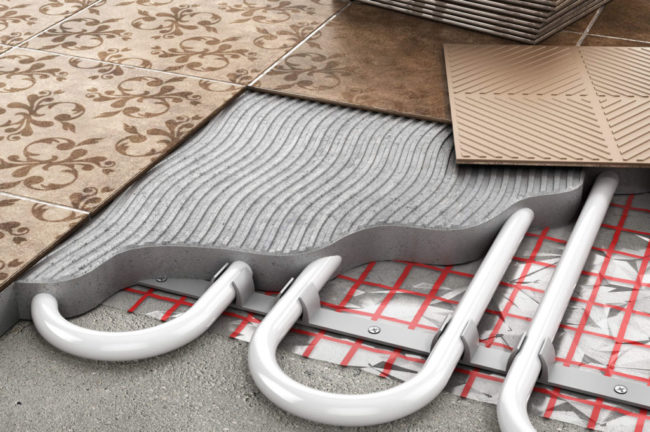
However, tile is a cold material, especially in winter. Therefore, if you want to use this type of flooring, the best option for installing under the tile is hydronic underfloor heating—we suggest learning how to install it yourself.
- Pros and cons of tiled flooring for underfloor heating
- Preparatory activities
- Tools and materials
- Calculation of required material
- Project preparation
- Installation of a water-based floor under tiles
- DIY methods for laying tiled floors
- With coupler
- With lags
- The spreading method
- Laying the tiled water floor "pie" in the screed and connecting the system
- Waterproofing
- Damper tape
- Thermal insulation and reflector
- Reinforcement
- Circuit installation
- Installation of the compressor cabinet and connection of the system
- Pressure testing
- Pouring concrete screed
- Selecting tiles and adhesives
- Room layout
- Laying tiles
- Seam treatment
- Video materials
Pros and cons of tiled flooring for underfloor heating
The combination of ceramic tiles and heated water floors has a number of advantages:
- heated floors make the tiled floor comfortable to walk on with bare feet;
- water on the surface dries quickly, which is especially important for the kitchen, pool or bathroom - Step-by-step instructions for installing a hydrofloor in a bathroom;
- mold and microorganisms harmful to human health do not form on tiled heated floors;
- installation of heating pipes under tiles does not require additional costs;
- tiled heated floor, can be installed with other types of heating;
- This combination creates conditions in the room (bath, pool) that meet sanitary standards.
It's worth noting the high thermal conductivity of tiles, meaning heat from heating elements will flow freely into the room. Therefore, they are considered the most suitable flooring for heated floors. Furthermore, tiles offer the following advantages: durability, resistance to temperature fluctuations, and strength.
The ideal option is to lay the ceramic tiles on a concrete screed that underlays the underfloor heating system. However, if a leak occurs, not only the concrete base but also the tiles will have to be removed.
Installing a heated water circuit under tile is not complicated, but it is labor-intensive, and it's important to strictly follow the instructions. Furthermore, installing a tiled water-based floor isn't possible in all rooms. This type of system is recommended for private homes. However, installing a heating system in apartments requires permission to connect it to the main heating system.
Another disadvantage of such devices is the impressive thickness of the "pie", so if you have low ceilings, this option is not suitable.
Preparatory activities
Before you begin installing a heated water floor under the tiles, you need to prepare the materials, tools, and a design for the future structure.
Watch the video
Tools and materials
To install the heating structure, you need to prepare the following tools: a screwdriver, a tape measure, an open-end wrench, a hammer drill, and a straight edge for leveling the screed.
In addition, you should purchase the following materials:
- pipes and elements for their fixation;
- pump and valves;
- reinforcing mesh;
- hydro and thermal insulation material;
- construction cattle;
- fasteners.
Pipes for hydronic underfloor heating systems are made from various materials and vary in price, technical specifications, and operating conditions. Common types of pipes include:
- Polypropylene - this material does not bend well and expands when heated, so it is recommended to install the product with the addition of reinforced fiber.
- Polyethylene is slightly more expensive than polypropylene, but it bends better, is stronger, can withstand higher temperatures, and does not expand when heated. The main drawback is that it tends to straighten out, requiring secure fixation.
- Metal-plastic is a durable contour that has long been used in the installation of heated floors.
- Copper ones are a great option; they're flexible and durable. Their main drawback is that they're more expensive than other options.
- Steel is a high-quality and durable product. However, over the years, it can corrode.
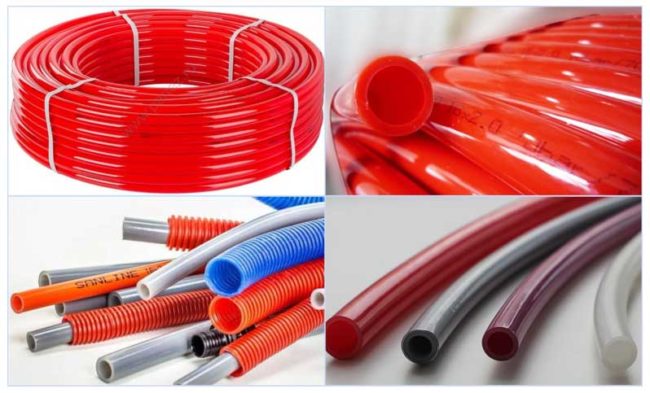
Each type of pipe has its own advantages and disadvantages. Therefore, when choosing, consider not only the characteristics of the product and the room in which it will be installed, but also your requirements and budget.
Calculation of required material
To calculate the pipeline length, consider the characteristics of the pipe and the specifics of the heating system. To make the calculations easier, you can use an online calculator.
The program produces average data, so a correction factor is applied for adjustments, which is influenced by a number of parameters. You will need to enter the pipe size (diameter), installation pitch, and information about the material of the circuit, finish coating, and screed.
To calculate the size of the pipeline, you can use the following formula:
L=S/n*1.1+k,
in which:
- L — length of the heating circuit;
- S — area of the room;
- n — laying step;
- 1.1 — average safety factor for bending;
- k is the distance of the collector from the floor.
There's a simpler formula: multiply each of the two adjacent sides of the room by the installation pitch, and add the results together. This is the circuit length, but you should add the distance to the manifold.
Project preparation
To create a plan, you can use a sheet of paper from a regular grid notebook. It's important to strictly adhere to the scale of the room where you plan to install the tiles.
The drawing should begin with the general outline of the room, marking the areas where doors, windows, and the exterior wall are located. For large rooms, expansion joints must be installed, which are also reflected in the plan. Underfloor heating pipes should not be placed on these joints. However, if the outline intersects them, it is protected with corrugated pipe.
Next, the areas where furniture will be installed, which will lie flush with the floor, are marked on the diagram. Heating elements should not be installed here. The location for the manifold cabinet is determined. After this, the piping layout is shown on the plan.
There are two main patterns used for installation:
- "snake" - the pipeline is laid along the wall at a certain pitch, that is, in one half of the room the pipes will be hotter than in the other, this method is recommended for small rooms;
- "Snail" - pipes with hot coolant are placed parallel to those through which cooled water circulates, so the surface heating is more uniform.
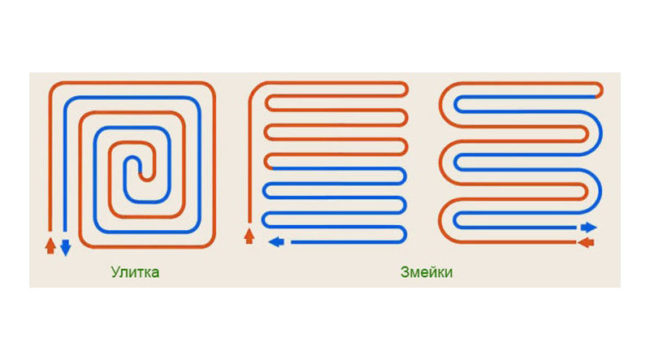
When drawing up a diagram, it is necessary to adhere to a number of rules:
- the length of one circuit is no more than 120 meters;
- all highways should be approximately the same - the difference is no more than 15 meters;
- the standard pitch is 150 mm, in severe climates it can be slightly reduced;
- the heating element must be laid with an indentation of 150–300 mm from the walls;
- the outline must be solid.
If you are not sure that you can carry out the design and material calculations correctly, it is better to use the services of professionals.
Installation of a water-based floor under tiles
A hydronic underfloor heating system under tiles consists of several layers. The "pie" looks like this:
- The waterproofing layer is selected based on the installation method. If it's on the ground, use polyethylene or roofing felt. If it's on a screed, use a special material with a membrane layer.
- Thermal insulation - dense polystyrene foam is recommended.
- The reflector is a foil layer; metal plates with channels for the contour can be used instead.
Please note: If you are installing insulation with a foil surface, this layer is not required.
- Pipes are the main part of the structure. The heated coolant moves through them.
- The basis is technology, for laying tiles (see step-by-step instructions on how to lay tiles) A solid surface is required. The best option is a concrete screed. If the installation is dry, wood, plywood, or drywall can be used as a subfloor under the tiles.
- The finishing coating is tiles.
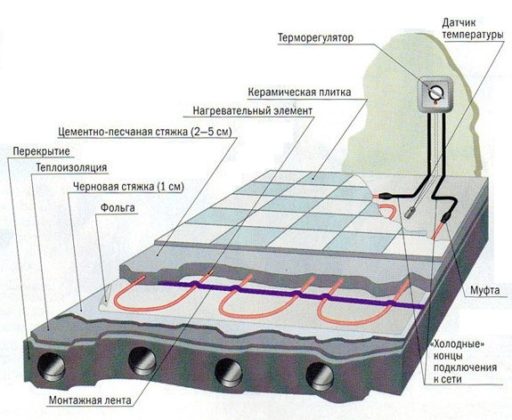
In addition, the device is equipped with a boiler for heating water, a distribution unit and a pump.
The choice of material for each layer of underfloor heating should be approached seriously, as it affects the thickness of the “pie”.
DIY methods for laying tiled floors
There are several technologies for installing underfloor heating, and before choosing one, it is necessary to consider the specific features of the room and ceilings, and familiarize yourself with all the methods in more detail.
With coupler
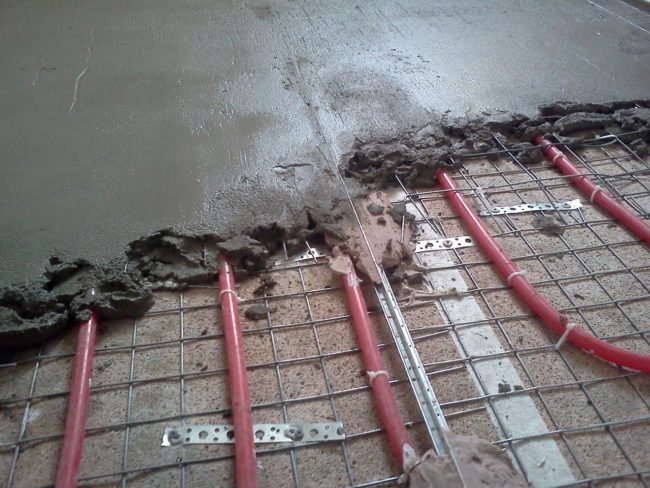
This method is the most popular. It involves pouring a cement-concrete mortar onto the existing warm system. The concrete surface must be level and free of voids, otherwise it could cause deformation of the structure. Ceramic tiles are then laid on the dried mortar.
With lags
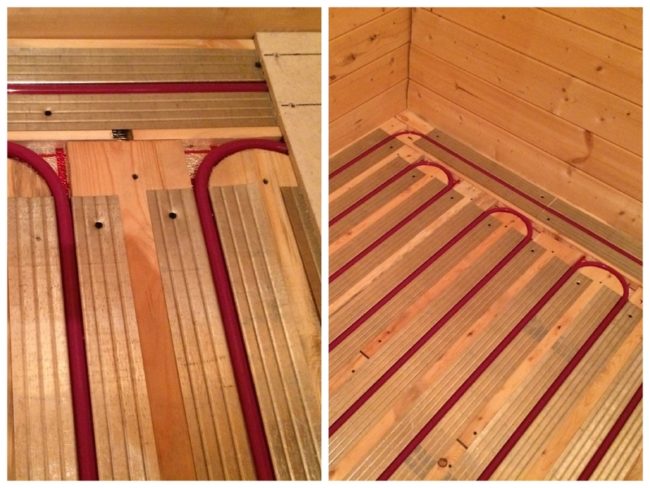
This method is more commonly used in wooden houses, where the floors cannot support the weight of a concrete screed. Wooden joists are installed, with insulation—polystyrene foam boards or mineral wool—laid between them. Installation is performed using two methods: chipboard modules, in which grooves are cut for the contour, and slatted installation, where pipes are installed in plates placed between the slats.
After the contour is installed, a gypsum fiber flooring is laid on top, and tiles are attached to it.
The spreading method
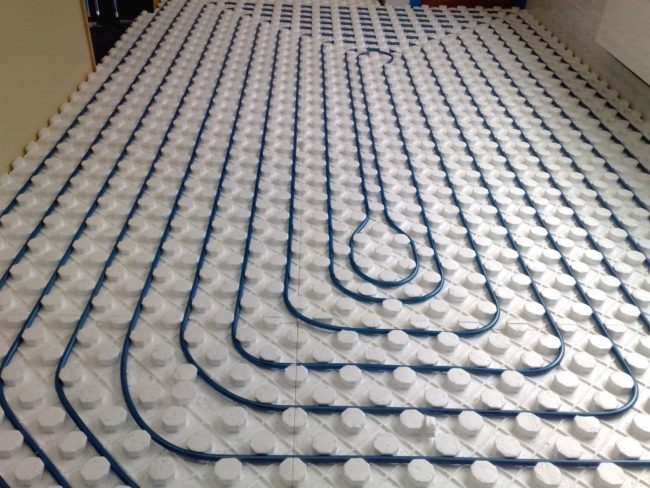
Expanded polystyrene boards with studs are used for laying the pipes. The advantage of this method is its easy installation. It is recommended for rooms with low ceilings or when installation with screed is not possible due to the structure's weight. A moisture-resistant material, gypsum fiber, is used as a substrate under the ceramic tiles.
Please note! One square meter of concrete screed with a contour weighs 200-300 kg. Stone buildings with concrete floors can withstand this load, but wooden ones cannot.
In summary, hydronic underfloor heating with screed is the most suitable option under tiles, if the technical specifications of the room allow it. This is because the circuit is easier to conceal in the screed than in a thin layer of tile adhesive. Furthermore, installing ceramic tiles on this surface is easy, as the resulting surface is smooth. However, achieving a perfectly smooth surface is difficult with wooden structures.
Laying the tiled water floor "pie" in the screed and connecting the system
There's no fundamental difference between installing underfloor heating systems under tile and installing this heating system under other flooring. The circuit is installed in the traditional manner with a predetermined spacing.
When laying a tiled water floor, the main thing is to allow the screed and adhesive time to mature, and not to lay too much. If the distance between the circuits is large, the floor heating will be uneven. — see how to calculate the ideal inter-pipe distance.
Subfloor
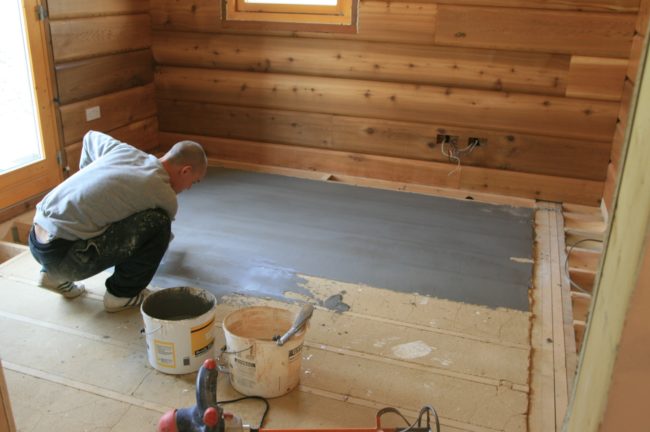
The warm water system must be installed on a level surface; any unevenness in the surface may cause the pipes to deflect. Therefore, any unevenness or potholes in the concrete surface must be sealed with a special mixture.
If the coating is old and cannot be reconstructed, it is better to pour a thin layer of rough screed.
Waterproofing
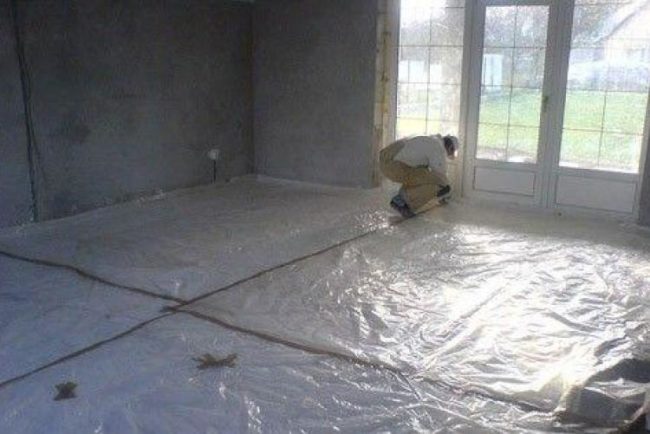
A waterproofing material is laid on this surface. It is overlapped, and the joints are sealed with tape. For cost-effectiveness, a standard polyethylene film can be used.
Damper tape
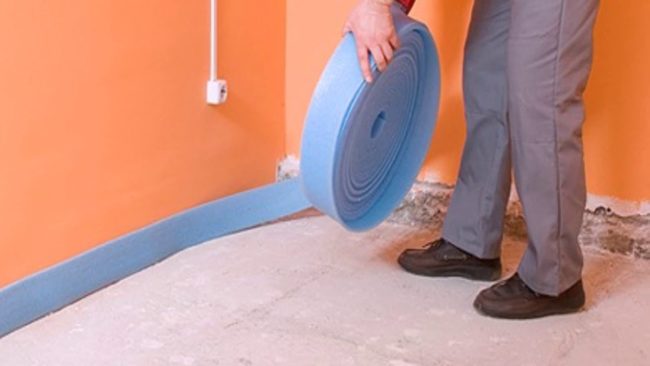
A damper tape is applied around the perimeter of the room. This is necessary to compensate for thermal expansion of the concrete. The tape should fit tightly against the wall and can be secured with screws.
Thermal insulation and reflector
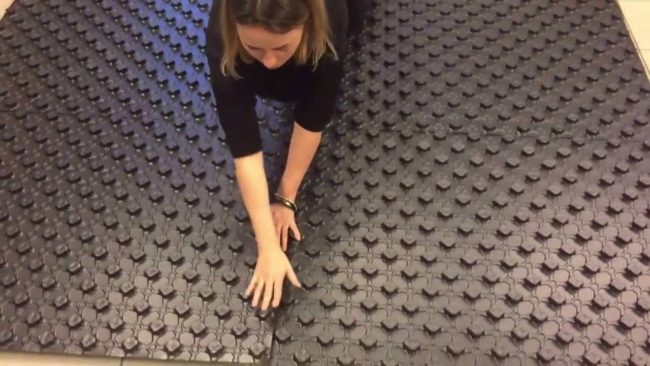
The next step is laying the insulation. Foam sheets or polystyrene foam mats, either plain or with studs, are most commonly used for this purpose. The standard insulation layer is 30 mm thick, but when installing hydronic underfloor heating on the ground floor, the instructions recommend a 100 mm insulation thickness. Insulation helps retain heat, which reduces operating costs.
Please note! If the thermal insulation product does not have a reflective foil surface, additional reflective material should be laid out. It is best if the foil has markings for the location of the heating elements.
Reinforcement
The reinforcing mesh is placed on top of the thermal insulation; the underfloor heating elements will be attached to it. It is recommended to use a product with a rod thickness of 4–5 mm and a mesh size of 10 x 10 or 15 x 15 cm.
If polystyrene foam mats with bosses are used as thermal insulation, then there is no need for a mesh.
In this case, to give the structure strength, reinforcement is placed on top of the laid pipes.
Circuit installation
Installation should begin by unwinding a section of the circuit from the coil. This is best done using specialized equipment rather than by hand. Avoid unwinding pipes that are too long, as they may become kinked.
The loop is laid according to the planned layout. It should start at the manifold cabinet, and the other end should also return to the manifold. The loop must be seamless, without joints or connections, otherwise there is a risk of leaks.
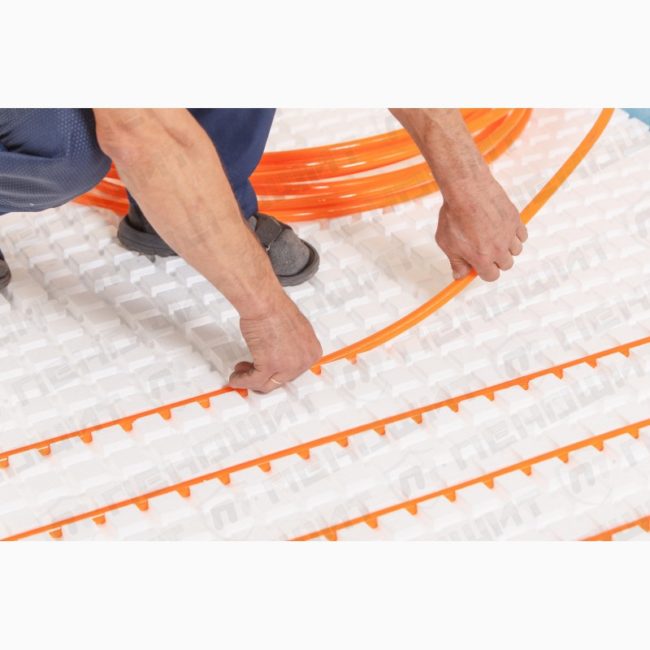
If the heating element is installed on a reinforcing mesh, it can be secured with plastic clamps. When installing pipes on mats with protrusions, no additional fastening is required. This option is simpler and more convenient, as the circuit will fit into the grooves of the slabs.
Please note! Pipes expand when exposed to hot coolant, so do not attach them tightly to the rods, as this may cause them to become deformed.
Installation of the compressor cabinet and connection of the system
A water-heated floor is a complex device whose operation requires control. A distribution unit is designed for this purpose.
Please note! The boiler may supply coolant at a temperature higher than required for underfloor heating (30 degrees Celsius). In the mixing unit, the cooled water will be diluted to the required temperature.
The location for the manifold is chosen so that the distance from it to all circuits is equal. A 12-cm-deep opening is made in the planned section of the wall. The compressor box, which houses the distribution unit, is installed in this opening. Pipes from the boiler or heating system are connected to the manifold. A return line is installed at the other end to collect the used coolant.
Important to know! It is recommended to purchase a manifold with a water flow regulator; it facilitates uniform distribution of the coolant throughout all circuits.
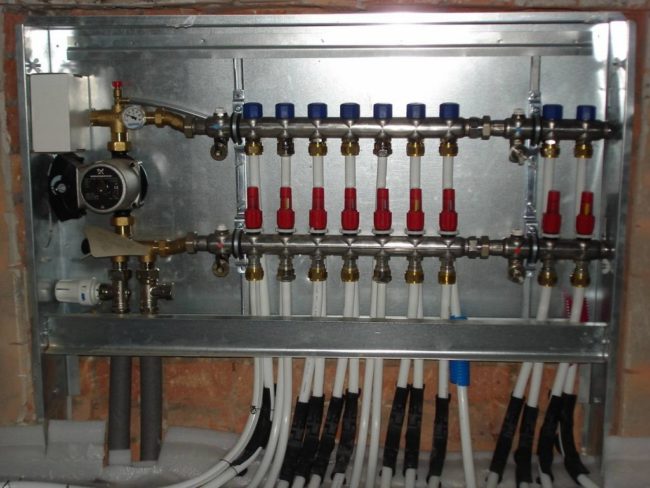
A pump is mounted to the manifold assembly. To prevent the pump from running continuously, a thermostat with a timer is installed to maintain the desired temperature. Boilers often come with a built-in pump, which is sufficient to heat an area of 150 m². Larger areas require an additional pump.
All dirty work associated with installing the manifold cabinet should be completed before laying the hydronic underfloor heating system to avoid having to clean the surface of debris again.
Next, the underfloor heating pipes are connected to the distribution unit. One end is connected to the inlet valve, and the other to the outlet valve. The circuit is connected to the manifold using compression fittings.
Pressure testing
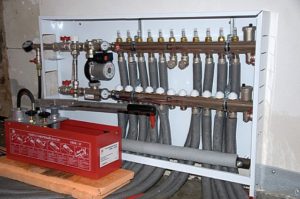
Once the pipes are laid and connected to the manifold, it's necessary to pressure test the system to ensure it's working properly. This is because any problems or leaks that arise after the screed has been poured will be difficult to fix.
To do this, fill the system with water and set the pressure to 1.5 times the operating pressure for 15 minutes. Then, set the operating pressure to 5-6 bar for 24 hours. If no leaks or expansions are detected in the main line after this time, the screed can be poured.
Pouring concrete screed
You can use ready-made mixtures for the pouring solution, or you can prepare your own solution from cement and sand, with the addition of plasticizers.
The room is poured all at once; it cannot be done in sections. The concrete layer height is adjusted using markers installed in advance. Begin in strips from the far corner of the room and finish at the door. Each strip must be leveled immediately using a straightedge.
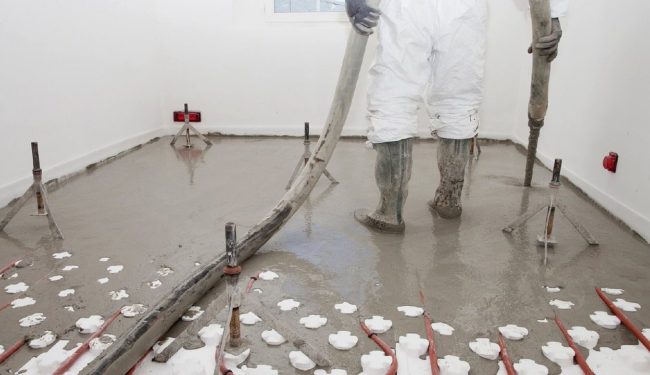
The recommended thickness of the screed for a water-heated floor is 5–6 cm; the mortar layer above the pipeline should be 2–3 cm.
Important! The screed is poured when the system is full and there is pressure in the pipes.
Once the screed has set slightly, it's trowelled. This process is necessary to achieve a smooth surface. Afterward, the floor is left until the concrete has fully cured, which takes about 25 days.
Selecting tiles and adhesives
When choosing tiles, in addition to your taste preferences and interior features, you need to consider the following:
- Too thick a product will affect thermal resistance;
- Marble or porcelain tiles have low thermal conductivity, so if you choose these types, you should increase the diameter of the pipes to increase heat transfer.
The simplest type is considered to be PVC tiles, equipped with an adhesive layer on the bottom.
For water-based floor structures, it's recommended to choose a product with a rough surface. Pay particular attention to the material's abrasion resistance. A higher abrasion resistance is preferable.
Important! When purchasing, be sure to pay attention to the lot number. All tiles must be from the same batch. The color shade may vary slightly between different batches, even if they are the same product.
In addition to choosing the right tiles, it's important to choose the right adhesive. Since expansion joints are required when laying tiles on a warm surface, it's recommended to use two adhesives. One side of the tile should be sealed with a regular tile adhesive, and the other with an elastic sealant.
Please note! The adhesive for water-heated floors must be moisture-resistant and non-toxic.
Room layout
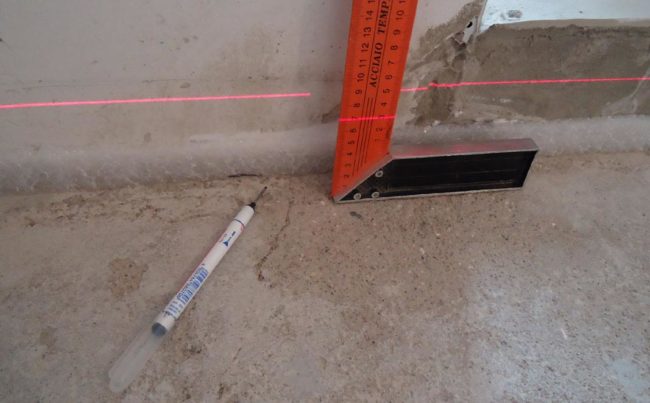
To make tiling easier, mark out the room. The easiest way to do this is with a laser level. However, you can also use a tried-and-true method: a string dipped in coloring powder.
The process looks like this:
- in the center of the room a line is drawn parallel to the longest wall:
- the second line is located perpendicular to the first, also in the center;
- A wooden block is installed in the doorway; it will serve as a limiter.
Laying tiles
To lay the tiles you will need a notched trowel, plastic spacers, primer and grout.
Lay tiles on a flat, clean surface. Start in the center of the room and work outward. Use a level to check the position of each tile.
Using a notched trowel, apply adhesive to the larger section of the tile and sealant to the other section. Spread the adhesive evenly over the surface of the tile. Apply two coats of sealant. Then, lay the tile on the subfloor and press firmly into place. Add a small amount of sealant to the gap between the floor and the tile, and remove any excess with a rag. Repeat this process until the entire room is covered.
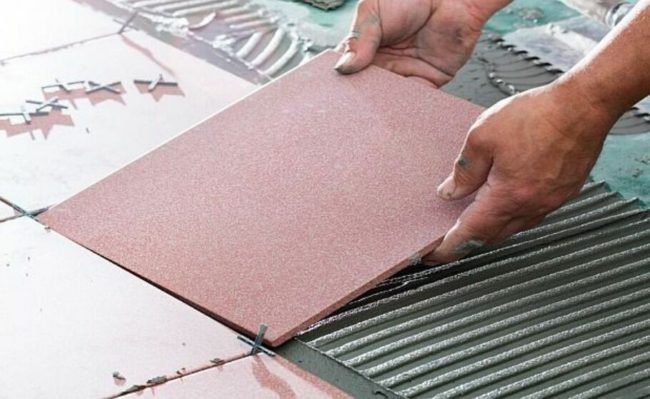
Please note! Another method may be used, where the adhesive is applied to a concrete base rather than to the tiles.
After laying each row, use a level to check the evenness of the tiles. Cross-shaped spacers are installed between the tiles to ensure consistent joints.
Once the entire room is covered, let the adhesive dry. This will take at least 12 hours.
Seam treatment
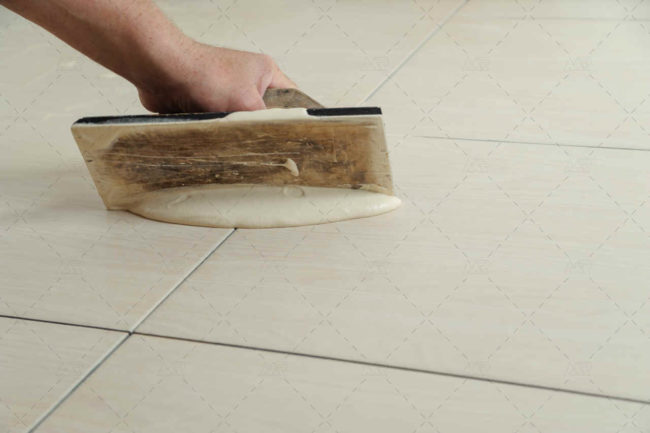
Once the adhesive has dried, carefully scrape it out of the seams with a putty knife, and remove the spacers. Now you can begin cleaning the seams.
Using a rubber spatula, apply a small amount of the mixture to the seams using crisscross motions. Immediately remove any excess from the tiles with a cloth.
Allow the mixture to harden slightly and check the quality of the grouting. Add more grout to any areas where the grout is lacking. Photo - Grouting
Please note: Grout protects joints from mold and dirt accumulation.
Underfloor heating installed under tiles should not be turned on until 20 to 25 days after the tiles are installed. This time is required for the screed to fully harden and the tile adhesive to set.
Underfloor heating combined with tile is an ideal option, quickly recouping the investment. Furthermore, this design will ensure comfort in your home for years to come.


I completely agree with the author that tiled heated floors can be combined with other types of heating, which is what I actually did, but the thickness of such a floor is really large.