Heated floors are becoming a permanent fixture in our lives. They are no longer a luxury item, but rather an affordable and convenient heating system.
However, when choosing this type of heating, many people have a question: is underfloor heating harmful to health or not?
- Advantages and disadvantages of heated floors
- Types of heated floors and their health risks
- What are the dangers of water-heated floors?
- Are electric heated floors harmful to health?
- Are warm infrared floors harmful or not?
- Underfloor heating: real harm or exaggeration?
- Fire safety
- Electrical safety
- Allergies and heated floors: harm for allergy sufferers due to dust raising
- Dry air
- Blood flow to the legs
- Harmful to men's health
- Impact on sleep (uncomfortable sleeping on the bed)
- Effect of finishing coating
- Does it cause harm to plumbing or not?
- Impact on household appliances
- Installing underfloor heating under furniture
- Damage to the car
- Potential problems with underfloor heating
- Video: The benefits and harms of heated floors
Advantages and disadvantages of heated floors

Before planning the installation of underfloor heating in your home and determining the health risks, it's important to familiarize yourself with all the pros and cons of these devices.
Let's take a look at the main benefits of heated floors:
- environmentally friendly - unlike electric heaters;
- economical - this is practically the most cost-effective type of heating;
- They heat the room evenly and quickly - they maintain a comfortable temperature from the moment they are turned on (but the convector must first heat up to a certain temperature, which can result in the air becoming too dry);
- they are built into the interior - they are hidden from view;
- durable and strong - if high-quality material is used and installation is carried out correctly;
- universal - such systems are suitable for residential, office and industrial premises.
This type of heating also has its drawbacks. Let's take a look at them:
- emissions of harmful substances are possible when the finishing coating is heated - but this is in cases of incorrectly selected type of finishing;
- electromagnetic and infrared radiation - refers to electric floors;
- Fire hazard - also applies to electric floors;
- risk of flooding neighbors - when using a water circuit;
- a labor-intensive and lengthy installation process - when constructing structures with screeds;
- lack of air exchange - installation of a ventilation system is required.
Please note: Incorrectly selecting the heat level may worsen the condition of pregnant women.
In addition, temperatures above 30 degrees are not allowed in a child’s room or bedroom.
Types of heated floors and their health risks
Underfloor heating systems come in two types: hydronic and electric. Electric systems, in turn, are further divided into cable and infrared.
Video
Let's take a closer look at the impact of each design on human health.
What are the dangers of water-heated floors?
Hydronic underfloor heating is a system with pipes that carry heated coolant. The main drawback of such systems is the potential for excessive heating of the flooring, reaching 30-40°C. In such a case, comfort is out of the question, as such floors are very difficult to operate.
Moreover, according to doctors, excessive heating can trigger attacks of conditions such as asthma and radiculitis. It can also impair blood circulation. However, these health problems can also arise from overheating a room with a regular radiator.

More often, such overheating is associated with installation errors, which leads to thermal inertia and reduces the lifespan of the floors. Furthermore, improperly installed flooring leads to formation of condensation.
Please note! It is believed that the warm air circulation caused by underfloor heating is detrimental to human health. However, this is not true!
Disruptions in the functioning of the body are caused by an incorrectly established temperature regime.
For people with asthma or respiratory problems, the harm from this device is associated with dry air, but this applies to all existing heating systems.
If installation is carried out according to the instructions and without errors, and the operation of the heated hydrofloors is carried out without violations, then for a person who does not have chronic diseases, they do not pose a danger, and their use does not have a negative impact on health.
Are electric heated floors harmful to health?
Electric underfloor heating uses a cable as the heating element. The system operates on electric current, so like all conductors, it emits electromagnetic waves.
In this regard, the Russian Sanitary and Epidemiological Service conducted a study on the effects of electromagnetic fields on humans and the harm they cause to health. The study concluded that the permissible level of constant electromagnetic flux, which does not pose a health risk, is between 0.2 and 0.3 μT.
The average radiation level of electric underfloor heating systems with a twin-core cable is 0.2 μT, which meets sanitary standards. A single-core cable emits electromagnetic waves equal to 2 μT.
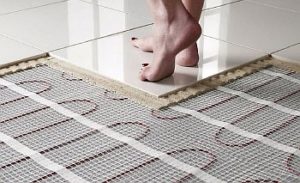
Please note! The average density of the earth's magnetic flux is 50 μT; this level is a natural background and does not negatively affect the human body.
To ensure that the cable floor does not cause any harm, or at least minimal harm, it is important to choose the right model:
- it must have the ISO 1400 environmental safety standard;
- It is better to purchase a floor with a two-core shielded cable; it has a metal braid that protects against radiation.
If you are still concerned that electromagnetic waves will harm your health, do not place them in recreation areas or places where you spend a lot of time.
Are warm infrared floors harmful or not?
Infrared floors are electric and consist of a film with embedded carbon plates. When operating, these devices emit infrared radiation, which is also regulated by SanPiN 2.2.4.548-96.
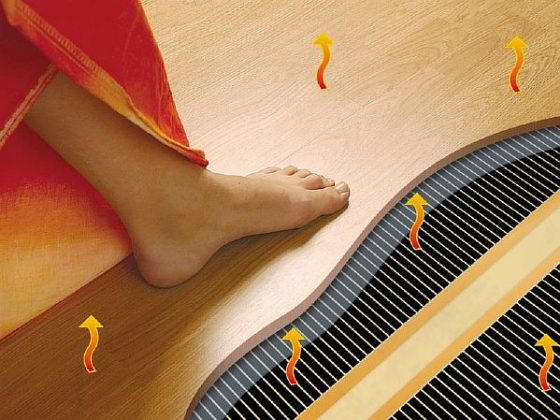
The myth about the negative impact of infrared waves from underfloor heating on human health is greatly exaggerated. While the powerful effects of infrared rays on the body are certainly harmful, the level of harm in the film is minimal, no greater than in other household appliances.
The spectrum of infrared waves varies and is divided into three ranges according to the degree of penetration into the skin layers:
- with a deep one - up to 4 cm;
- only under the top layers - 0.5 cm;
- with maximum penetration of up to 0.2 mm.
Infrared film emits all three wavelengths. As the temperature increases, the film emits short waves, and as it cools, it emits long waves. If we consider the wavelengths from a safety perspective, then, based on a normal human body temperature (36.6), we can say that the peak radiation wavelength is 9.6 microns.
Thermal energy equivalent to this value has no negative impact on the body and is considered relatively safe. This wavelength range does not penetrate the skin.
Important! When purchasing infrared heated floors, consider the wavelength ranges specified in the specifications. Experts recommend products with wavelengths ranging from 3 to 10 microns.
Underfloor heating: real harm or exaggeration?
There's a belief that heated floors negatively impact the well-being of humans and animals, and even damage household appliances. Let's examine each of these issues individually and explore the benefits and harms of heated floors.
Video
Fire safety
Electric underfloor heating systems pose a fire hazard, while water-based systems are superior in this regard. However, it's worth noting that electric underfloor heating is only dangerous if installed improperly.
For example, if the cable is not laid deep enough relative to the floor covering, there is a risk of damage and, as a result, a short circuit.
Electrical safety
If we consider the possibility of electric shock from underfloor heating, such a risk is unlikely. After all, if the system is certified, it has high-quality insulation that reliably protects the cable from water, so the risk of electric shock is reduced to zero.
In this situation, we again pay attention to the quality of the components, installation, and cable depth. Your safety will directly depend on these aspects.
Allergies and heated floors: harm for allergy sufferers due to dust raising
Underfloor heating operates by radiation, not convection. The device does not mix cold and hot air flows, so it does not contribute to the agitation of dust.
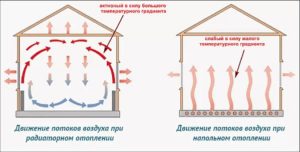
The floor simply radiates heat, transferring it to the finishing coating, and if you keep it clean, there will be no problems at all.
Dry air
There's a concern that heated floors dry out the air. However, with proper installation and a coolant temperature of no more than 45 degrees Celsius, the surface of the flooring only reaches 28 degrees Celsius. At these temperatures, the air won't become overly dry.
Furthermore, this system doesn't come into contact with the air. Yes, moisture evaporates during heating, but the circulation process is significantly slower than with convection radiators. If desired, a humidifier can be installed, which will minimize this problem.
Blood flow to the legs
The myth about increased blood flow to the legs when heated arose from the common belief that the warmer the legs, the more blood flows to them. This is true to some extent, but only when the temperature reaches above 45 degrees Celsius.
In underfloor heating circuits, the coolant reaches temperatures of up to 45 degrees, but at the same time, it warms the floor to a maximum of 30 degrees—this is considered a very comfortable heating level.
However, it's worth noting that there is a contraindication: people with vascular diseases (varicose veins, swelling of the lower extremities) should not keep their feet warm. A solution is to install a thermostat to regulate the temperature.

It can be said that housewives suffer the most harm from this type of heating.
They stand on a heated floor near a hot stove, and there is a risk of developing problems in the gynecological area and with veins (varicose veins).
To minimize this possibility, it is recommended to cover the heated floor with parquet rather than laying a covering made of artificial material, and to equip the system with a heating regulator.
Harmful to men's health
It's common knowledge that being too cold or too hot is detrimental to men's health. There's a belief that heated floors impair potency and lead to infertility in men.
However, this is a myth, as the floor heats up to 28 degrees, while for proper sperm development, the temperature should not exceed 35. Furthermore, the scrotum acts as a thermostat and prevents overheating.
Impact on sleep (uncomfortable sleeping on the bed)
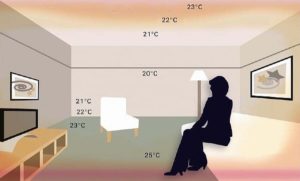
Even with heated floors, some people find sleeping on their bed uncomfortable. This is because the temperature in the bed area is typically around 23 degrees (which is unhealthy), while 18 degrees is considered comfortable for sleep.

To solve this problem you can:
- increase the laying pitch of heating elements to 20 mm for water circuits;
- Install a room thermostat to regulate the temperature and connect it to the manifold.
Effect of finishing coating
The finishing coating, regardless of its type (tiles, linoleum, parquet), is harmful to human health, releasing vapors and gases - only when overheated, and this requires very high temperatures.
Underfloor heating operates within a temperature range of 0 to 45 degrees Celsius. This temperature prevents the material from overheating, preventing the release of harmful emissions.
When choosing a floor covering, it is necessary to pay attention to the manufacturer's instructions regarding the permissibility of installing this product with heating structures.
Does it cause harm to plumbing or not?
Plumbing fixtures such as bathtubs, sinks, and sanitary ware are not affected by elevated temperatures, so they can be installed safely on heated floors.
The main thing is that these products do not exert pressure on the surface and thereby do not damage the heating elements.
Impact on household appliances
The idea that heated floors damage household appliances is not entirely justified. Main appliances, such as televisions and kitchen appliances, are not located on the floor and have no contact with the heating system. Refrigerators and washing machines, which sit on the floor, are an exception.
In this case, the heating element should be positioned so that it does not pass under the appliance body. This also saves on materials during construction. Furthermore, if there is underfloor heating underneath the appliance, the contacts may oxidize, and condensation and moisture may accumulate underneath.
Installing underfloor heating under furniture
It's generally believed that installing underfloor heating under heavy furniture is unnecessary. Indeed, it's unnecessary there, and you can save money by doing so. However, if you decide to rearrange your apartment, the furniture will end up on a heated surface, leaving you walking on a cold one.
The fear that heat damages furniture is a myth, as underfloor heating reaches a surface temperature of 28 degrees Celsius, which can't negatively affect it. This means the furniture won't dry out, and it won't emit harmful substances when exposed to heat.
Damage to the car
Installing heated floors in a garage only makes sense if the structure is permanent. Since this space isn't intended for human habitation, a temperature of 15-17 degrees Celsius is sufficient.
The device will not harm the car; on the contrary, being in a dry environment will protect the car from rust and corrosion.
Potential problems with underfloor heating
In general, problems with underfloor heating can only arise from the wrong type of system and installation errors. When choosing a heating system, it's important to strictly adhere to the technical regulations and consider the room's dimensions.
It is worth noting the following mistakes that are often made when installing heated floors:
- When installing a water-based underfloor heating system, the manifold is placed below the base level, which causes the system to periodically fill with air. This can lead to clogged pipes and ultimately disrupt the coolant's circulation. To prevent this, the manifold should be positioned at a high point and equipped with an automatic air collection system.
- When installing cable floors, the outer winding of the heating elements is often damaged. Often, a conductor breaks, or the current supplied is inappropriate, leading to system burnout. Installing a voltage stabilizer can help prevent this.
- When laying an infrared floor, the film is bent, which causes contact to be lost. Therefore, handle the film carefully, and when pouring the screed, choose a mixture with fine particles.
In conclusion, we can conclude that, when properly installed and used, heated floors pose no harm to human health. After all, heated floors operate by radiation. The sun operates on the same principle: it heats the Earth, which in turn radiates heat back to us.