A drinking water tap in every home isn't a luxury, but a significant advancement. However, this pleasant convenience can be lost in an instant if a water hammer occurs in the pipeline. Water hammer can not only result in a lack of water but also lead to flooding of the apartment.
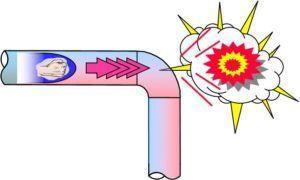
How this dangerous phenomenon occurs and how to avoid it will be discussed in detail in this article.
The nature of water hammer in pipelines
Water hammer is a shock wave that propagates along the surface of a water pipe and through its fittings. When pressure increases, the shock wave is positive; when pressure drops, it is negative. It occurs when an empty pipe is filled or a tap is suddenly closed. The destructive effect of this phenomenon is primarily due to the incompressibility of liquid.
If water could be compressed several times, like gas, for example, then the pipes would not burst from a sharp increase in pressureExcessive pressure occurs when the flow of liquid suddenly stops, but water hammer can also be caused by other phenomena in the water supply system.
Reasons
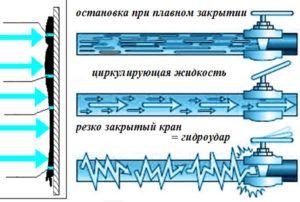 Water hammer most often occurs when a shut-off valve is suddenly closed. When water flows through pipes and comes out of a faucet, the pressure in the plumbing system remains constant. However, when a valve is suddenly shut off, this pressure can increase several times, causing the pipe walls to burst and fail.
Water hammer can also be caused by:
- Abrupt switching on or off of a powerful pump.
- Air locks present in the water supply or heating circuit.
Pump switching on and off can be caused by unstable power supply to a facility housing high-power water pumping stations. Air locks are also a significant contributor to this dangerous phenomenon, so before operating closed liquid systems, ensure they are completely free of air.
Consequences
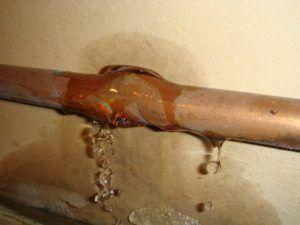 When repeatedly exposed to high pressure, which occurs as a result of water hammer, even the most reliable systems can lose their seal. A pipeline rupture can also occur from a single but strong hydraulic shock.
As a result of this impact, the water supply to the buildings connected to the water pipe is completely cut off. Unfortunately, the consequences of this phenomenon are not limited to a lack of water in the tap.
If a pipe bursts in an apartment building, the property of the apartment owners, as well as the neighbors on the floor below, will be damaged after the pipe bursts and liquid enters the living space.
If a main water pipe that supplies water to an entire city district ruptures, the accident can already be considered an emergency.
As a result of such an incident, residents of dozens of apartment buildings will be left not only without drinking water but also without sewage, as all toilet cisterns are fed by the cold water supply. Showering, even with an undamaged hot water supply, will also be impossible.
If a hot water pipe is damaged as a result of a water hammer, the incident, in addition to causing property damage, can result in serious burns. A leak in the heating system, where the coolant is always under significant pressure and the temperature of the liquid exceeds 70 degrees Celsius, can be particularly dangerous.
The consequences of water hammer can lead to significant damage, so it is important to learn how to prevent sudden increases in pressure in pipelines.
Methods of protection
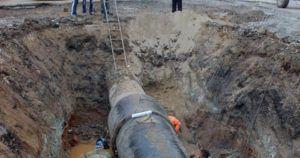 Adherence to plumbing and heating system installation guidelines can minimize the risk of water hammer, but properly designed systems alone cannot completely eliminate it. Avoiding this unpleasant situation requires a comprehensive approach and adherence to safety regulations and technical instructions.
The likelihood of water hammer can be significantly reduced by following the following rules when installing and operating water pipes.
- When starting up the water supply or heating system, the shut-off elements of the fittings must open very slowlyShutting off the water supply must also be done very smoothly. Smooth closing and opening of shutoff valves is essential not only in industrial facilities but also when turning on the water supply and heating systems in a private home. Excessive pressure during a water hammer can easily damage home utilities, so it's important to follow safety precautions when water is supplied to a private home under significant pressure.
- By installing automatic devices for smooth opening and closing of shutoff valves in a plumbing or heating system, human error in the event of a water hammer can be completely eliminated. Of course, when using electronics, plumbing systems become dependent on electricity, but to completely eliminate the possibility of failure due to automatic devices, it is necessary to equip such mechanisms with a backup power source. This backup is absolutely essential, both in a large enterprise and for the normal operation of utilities in a private home. It is also recommended to equip pumping stations with automatic control. This also helps prevent water hammer from a sudden pressure drop caused by the activation or deactivation of powerful pumping equipment.
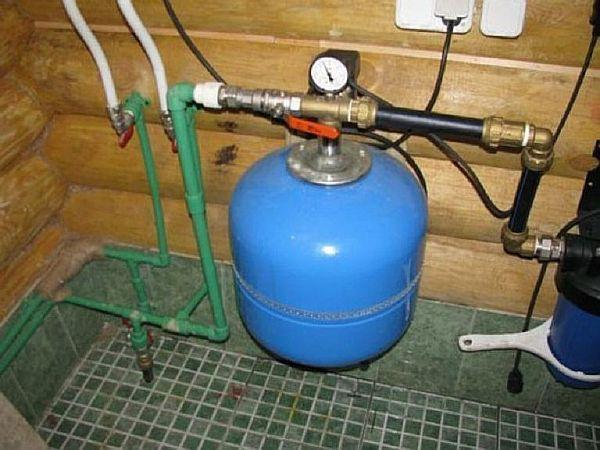
- Application of hydraulic accumulators and damper devices, also helps minimize the effects of sudden pressure increases in the water supply network. Such devices typically consist of a metal housing with a membrane located inside. When a water hammer occurs, the membrane moves, allowing the excess liquid to be absorbed. When there is a risk of a pipeline rupture
will pass and the pressure will decrease, the membrane will return to its original position due to the air located on the reverse side. - To reduce the pressure in water supply networks, it can be used safety valve, which opens when the liquid reaches a certain level. Such devices can also protect the pipeline from damage, but this type of protection requires an additional branch line from the valve to the sewer system.
- To protect a private home or apartment from water hammer, you can use a very simple method that compensates for excess pressure by expanding the pipe walls. Heating or water supply systems don't necessarily need to be installed using such materials, but a section of pipe made with heat-resistant rubber can fully absorb water hammer in a small system.

- Thermostat bypass, is an effective measure to combat low-level water hammer, so this "improvement" to autonomous heating can only be implemented in private heating systems. Typically, a 0.5 mm diameter hole in the main valve is sufficient to allow excess fluid to flow freely into the cold water circuit when high pressure occurs.
- Thermostat with protection installed in the heating system, also helps prevent dangerous phenomena such as water hammer. This device operates by incorporating a small additional mechanism within the main thermostat valve that opens regardless of the fluid temperature. This internal valve will begin to allow fluid to pass when the coolant pressure approaches the maximum permissible value, thereby preventing pipes from rupturing.
How to protect your home's utilities from water hammer
A leak in a water pipe in an apartment can have very serious consequences, especially if the leak causes damage to neighbors whose apartment is located on the floor below where the accident occurred.
The section of the water supply system located in the apartment may contain old metal pipes, which rust over time and can be destroyed during operation, not to mention the deadly force of water hammer.
IMPORTANT! To minimize the risk of leaks, it is recommended to install gate valves, which, due to their design, cannot immediately shut off the water. Ball lever valves, which are so convenient not only in the kitchen but also in the shower, can cause a serious accident.
Although hydraulic accumulators are most often used in private homes, where water is supplied by a pump located in a deep well, such products can also help protect the water supply system located in an apartment from water hammer.
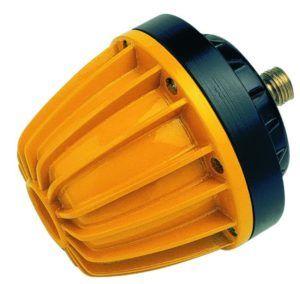 Furthermore, the liquid accumulated in such devices can be used in the event of a temporary water supply outage. Water hammer can also be protected from water hammer by using special dampers installed in the cold or hot water supply pipe.
Unauthorized installation of any equipment in a central heating system is strictly prohibited. To protect your home from water hammer, allow a management company specialist to perform a test run of the heating system.
If all air pockets are removed from radiators and pipes in a timely manner, there will be no need to worry about water hammer, as all necessary measures to prevent such a phenomenon will be taken in the boiler room and along the coolant supply route to the apartment.
To reduce the risk of hot water supply system leaks, it is also recommended to replace taps with screw-type designs and install pipelines using modern materials that can handle excess pressure in the pipeline as effectively as possible.
A few words about the theory of water hammer
Hydraulic hammer can only occur because the fluid is unable to compress sufficiently to compensate for the sudden pressure surge. When pressure increases in one location, its force spreads throughout the entire pipeline, and finding a weak point, it leads to deformation or failure of the material.
This effect, occurring in high-pressure pipelines, was first discovered by the Russian scientist N. Ye. Zhukovsky in the late 19th century. Zhukovsky also developed a formula for calculating the minimum time required to close a valve to avoid a dangerous increase in pressure in a closed water supply system.
- Dp=p(u0-u1)
Where:
- Dp — pressure increase in N/m2;
- p is the density of the liquid, kg/m3.
- u0 and u1 are the average value of the liquid velocity in the pipeline before and after closing the valve.
The scientist proved that the speed of shock wave propagation depends primarily on the diameter and material of the pipe. This value also depends on the compressibility of the liquid.
Calculations should only be performed after experimentally determining the water's density, which can vary significantly depending on the amount of dissolved salts. The propagation velocity of a water hammer is always calculated using the following formula:
- c=2L/T.
Where:
- c is the shock wave velocity;
- L — pipeline length;
- T — time.
By substituting the values into this formula, you can accurately determine the propagation velocity of water hammer. Water hammer is a wave that oscillates at a specific frequency.
Calculating the number of oscillations per unit of time is also easy, if necessary. Simply use the following formula:
- M = 2L/a
Where:
- M is the duration of the oscillation cycle;
- L — pipeline length;
- a is the wave speed (m/s).
To simplify the calculations, the shock wave velocity values for water hammer for pipes made of the following materials are given below:
- Steel - 900 - 1300 m/s;
- Cast iron - 1000 - 1200 m/s;
- Plastic - 300 - 500 m/s.
By substituting these values into the formula, one can accurately calculate the frequency of water hammer oscillations on a section of a water pipeline of a certain length.
This is the theory of water hammer in its most rudimentary mathematical description. When designing modern engineering systems, powerful computers are used to perform such calculations, so there is no need to resort to manual calculations of water hammer velocity and force.
Conclusion
Water hammer in water pipes can cause serious accidents in the housing and utilities sector. Such incidents are especially serious in winter. A ruptured heating pipe can lead to hypothermia and illness, especially when young children and the elderly are left without heat.