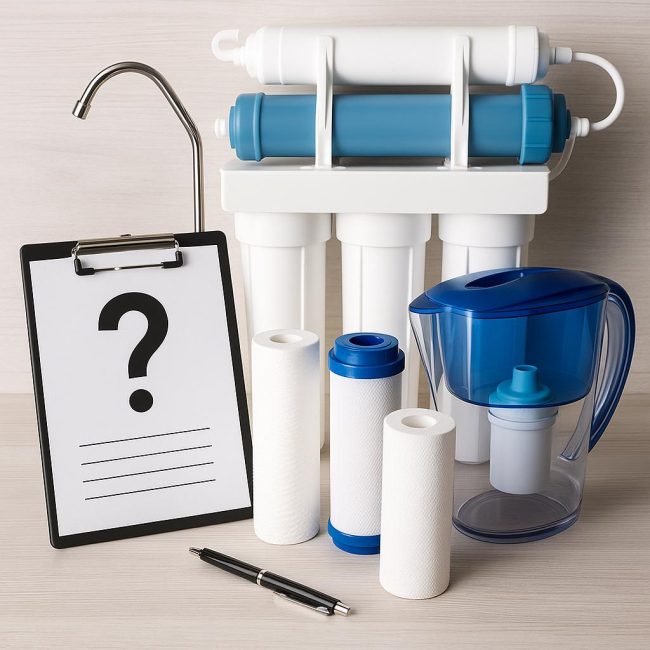
When you first face the challenge of improving the water quality in your home or apartment, it's easy to feel overwhelmed: there are dozens of solutions on the market, from simple pitchers to complex multi-stage systems. It might seem like "just buying a filter" is enough, but in reality, every family has its own unique circumstances and water. That's why it's important to understand how to choose a water filter that best suits your needs, rather than relying on popular models or advice from friends.
- What source does the water come from?
- Central water supply (city apartment)
- A private house with a well
- Well
- What is the actual composition of the water? Analysis is a mandatory step.
- What problems do you want to solve?
- Main tasks and solutions:
- What housing and connection parameters should be taken into account?
- For an apartment:
- For a private house:
- How much time and budget are you willing to devote to maintenance?
- Common Mistakes When Choosing a Filter (and How to Avoid Them)
- Summary: How to organize your selection correctly
What source does the water come from?
The type of water source is the starting point for selection. Water varies in composition and levels of contamination, so there is no one-size-fits-all solution.
Main options:
Central water supply (city apartment)
The advantages are basic treatment at the water supply and control by sanitary services.
Disadvantages: chlorination, rust from old pipes, unpleasant odor, turbidity, possible impurities of heavy metals and micropollutants.
For apartments, systems are more suitable under the sink: carbon filters, reverse osmosis membranes, combined modules.
A private house with a well
The main feature is - unstable and individual compositionThe following are often found in water:
- iron (metallic taste, reddish coating),
- manganese,
- hydrogen sulfide (rotten egg smell),
- rigidity,
- mechanical impurities (sand, silt).
Wells require multi-stage systems, where iron removal, softening, sorption, and disinfection are combined.
Well
Well water may be softer, but it is vulnerable to bacteria, nitrates, organic matter, and contamination from surface runoff. Mechanical filters, disinfection, and sorption are often required.
What is the actual composition of the water? Analysis is a mandatory step.
If you choose a solution without analysis, you risk buying either a system that is too weak (which will not change anything) or one that is overly expensive and complex (which is not needed in your specific situation).
What does water analysis reveal?
- Clear understanding of the composition and level of contaminants
- Possibility to select filters precisely
- Calculation of service life and frequency of maintenance
- Savings: filters don't "fight" what's not in the water
The analysis can be done in a laboratory or at a specialized company. For wells, this is Necessarily: two neighboring wells in one village can produce completely different water.
What problems do you want to solve?
Clearly define what is most important to you, because you cannot get “ideal water” for all purposes with one device.
Main tasks and solutions:
| Task | What you will need |
|---|---|
| Improve the taste and smell of drinking water | Compact under-sink systems, sorption modules, reverse osmosis |
| Get rid of iron and hydrogen sulfide smell (well) | Iron removal: aeration, catalytic filters, loadings |
| Reduce hardness (scale) | Softeners (ion exchange), sometimes complex purification systems |
| Protect plumbing and appliances | Coarse filters, softeners, main cartridges |
| Make water microbiologically safe | UV disinfection, membranes, complex systems |
It is important to understand: "One jug for everything" doesn't solve the problemIt only improves taste and smell, but does not remove serious impurities, does not protect equipment and health.
What housing and connection parameters should be taken into account?
Even a perfectly selected system can be inconvenient or ineffective if technical nuances are not taken into account.
For an apartment:
- Is there any free space under the sink?
- What is the family's water consumption volume?
- Are you ready to allocate space for a reverse osmosis membrane tank?
- Is it possible to connect to the sewerage system (for systems with drainage)
If the family drinks a lot of water, it is better to choose productive system or a model with a larger storage tank.
For a private house:
- Availability and type of pumping equipment
- System pressure (some filters require stable pressure)
- Ease of maintenance (where to place cylinders, softener brine tank)
- Water consumption (important for calculating performance)
For home use, filtration is usually installed. at the input, to protect the entire system, not just drinking water.
How much time and budget are you willing to devote to maintenance?
Choosing a filter is not only a purchase, but also regular maintenance.
What to look out for:
- Cost and frequency of cartridge replacement
- Salt consumption for softeners
- Electricity consumption (if the system is automated)
- Possibility of self-service or specialist-assisted service
- Availability of consumables
Simple guide:
- Budget solutions require more frequent cartridge replacement
- More expensive automated systems last longer and require minimal intervention.
Don't rush to buy the cheapest option—the savings are usually temporary. But overpaying for "excessive" functionality without a real need is also unwise.
Common Mistakes When Choosing a Filter (and How to Avoid Them)
❌ Purchasing based on recommendations from neighbors or forums
✅ Consider only the data from your water analysis.
❌ Choosing the cheapest solution
✅ Assess total cost of ownership and compliance with objectives.
❌ Installation of one stage instead of a complex system
✅ Filtration must be multi-stage if there are several contaminants.
❌ Focusing only on the taste of water
✅ The external taste may be normal, but the composition is unsafe.
Summary: How to organize your selection correctly
To avoid mistakes, follow this simple sequence:
- Identify the water source and the problems you want to solve.
- Have your water tested.
- Determine your priorities: drinking water, health, equipment protection, or all three.
- Select a system that suits the conditions of your house or apartment.
- Compare options by service, not just by purchase price.
A properly selected system ensures safety, comfort, savings, and a long service life for your home's utilities. Most importantly, it eliminates the need to constantly buy bottled water and solve problems by guesswork.